
The Mirrored Self: Reflections of the Experiencer and Experienced
Experience, by its very nature, is inherently subjective. It is the culmination of one’s perceptions, interpretations, emotions, and cognitive processes. Every individual, with their unique personal history, values, beliefs, and physiological makeup, encounters the world in a way that is uniquely their own. For instance, two people might stand before a work of art—one sees profound beauty and feels deep emotion, while the other simply sees colors on canvas. Both are valid experiences, but they differ drastically based on the individual’s subjective lens.
Yet, the objective reality of the world persists. The artwork, the physical colors, and brushstrokes remain constant. It’s this duality of the objective and subjective that creates the richness of human experience. We all share the same objective world, but our subjective interpretations of it vary widely, leading to an immense diversity of human thought, emotion, and expression.
Despite the deeply personal nature of experience, there exists within us a contrary desire to communicate and validate our experiences with others. This need can be attributed to our inherently social nature. As social beings, we have an innate drive to connect, to be understood, and to find commonality with others.
However, the act of communication is fraught with challenges. Language, while powerful, often falls short of capturing the full depth and nuance of our experiences. Words are mere approximations, often failing to convey the entirety of what we feel or perceive. When faced with the ineffability of certain experiences, humans may resort to crafting stories, metaphors, or beliefs to encapsulate and convey the essence of their experiences to others. While these may not represent the experience in its entirety, they offer a bridge, a means to connect with others and share a glimpse of our internal world.
Consider an example of observing a tree. The act of seeing is immediate and direct, but the moment we try to articulate the experience, we find ourselves grappling with memory, association, and linguistic constraints. If the tree is of a kind we’ve never seen before, we still try to relate it to what we know, drawing parallels and making distinctions. This process, while it can enrich our understanding, can also distance us from the immediacy of the experience itself.
This leads us to the profound realization that perhaps the “experiencer” is indeed the “experienced.” Every thought, sensation, or emotion we have is not just a passive observation but an active engagement with our internal and external realities. The very act of experiencing reshapes our understanding, influencing future experiences in a continuously evolving cycle. One could argue that the realm of art, music, poetry, and other forms of non-verbal expression arises from this very challenge. When words fail, a painting, a melody, or a dance can capture and convey those intangible feelings and thoughts. They provide a medium that transcends linguistic barriers, offering glimpses into those profound depths of human experience. It’s no surprise that many people, when moved by a piece of art or music, often exclaim, “That’s exactly how I feel!” even if they couldn’t previously articulate that feeling.
Every individual, in their quest to understand and make sense of their experiences, inevitably draws from the collective knowledge and wisdom of humanity. Philosophies, religious teachings, scientific discoveries, and cultural narratives all play a role in shaping how one interprets and understands their experiences. They provide frameworks and lenses through which experiences are viewed, digested, and integrated.
This interplay between the individual and the collective further emphasizes the inherent tension between subjectivity and objectivity. While personal experiences are deeply subjective, the frameworks we use to understand them often have objective, shared components. A sunset viewed by an individual might evoke a personal memory or emotion, but the scientific understanding of why sunsets appear as they do, or the cultural or poetic interpretations of sunsets, come from collective human knowledge. Moreover, as individuals continue to share and communicate their experiences, they contribute to the collective understanding, which in turn shapes future individual and collective experiences. It’s a dynamic, reciprocal relationship, highlighting the interconnectedness of humanity.
The inherent elusiveness of pure experience, the ever-present gap between what is felt and what can be communicated, reminds us of the limitations of our human condition. Yet, it also highlights the beauty and depth of our existence. In our attempts to bridge this gap, we engage in some of the most profound human endeavors: art, literature, philosophy, and spirituality. Through these mediums, we continuously strive to touch the intangible, to grasp the ungraspable, and to share the very essence of what it means to be human.
Experience, in its fullest form, requires presence. To truly experience is to be fully in the moment, unburdened by the past and undistracted by the future. It’s here, in the pure and unfiltered present, that the experiencer and the experienced merge. This idea echoes in various spiritual traditions which posit that in moments of true presence, the duality of observer and observed collapses. Such moments, where one feels at one with the world, are often described as transcendent or mystical. They hint at a deeper interconnectedness, a web of existence that binds all things.
Yet, despite these profound moments, the human condition is also characterized by a fundamental sense of separateness. It’s this very separateness that gives rise to the desire to communicate, to reach out, to bridge the gap between self and other. We yearn to share, to be understood, and to understand. This yearning, however, is fraught with challenges. As earlier mentioned, the depth and richness of personal experience often evade linguistic encapsulation. But it’s not just about the inadequacy of language; it’s also about the limitations of perception.
Going into depths, In day-to-day life, we’re accustomed to distinguishing ourselves from our environment. We say “I am looking at the tree,” naturally separating the ‘I’ (experiencer) from the ‘tree’ (experienced). However, if we deconstruct this process, things become more intriguing. When you observe a tree, light reflected from its leaves and bark enters your eyes, gets processed by your brain, and forms an image. Here, the ‘tree’ you perceive isn’t the physical entity outside; it’s a manifestation within your consciousness. The tree, as you know it, exists within you, blurring the lines between the observer and the observed. Now, extend this idea to all experiences. Sounds you hear, emotions you feel, even thoughts that arise — all these are not ‘external’ or ‘separate’ events, but transformations within your field of consciousness. You never truly experience the world directly; you experience your consciousness’s interpretation of the world. This realization is profound: it suggests that what we consider ‘external’ is intricately woven into our ‘internal’ realms of experience. The division between us and the universe isn’t as sharp as it might seem.
Many spiritual traditions suggest that this feeling of separateness is a kind of illusion, often termed ‘maya’ in Hinduism. Beneath this illusion, it is proposed that there’s a deeper, unified reality where all distinctions merge. The Zen Buddhist concept of ‘interbeing’ beautifully encapsulates this: nothing exists independently; everything inter-is with everything else. So, in this interconnected dance of existence, to say “I am experiencing the tree” might be more aptly expressed as “The universe, in the form of ‘me’, is experiencing the universe in the form of ‘tree’.”
Exploring this further, we confront the nature of the ‘self’. If the experiencer and the experienced are one, what does this mean for our sense of identity? Who is the ‘I’ that experiences? These questions lie at the heart of self-inquiry in traditions like Advaita Vedanta, where meditative introspection is used to peel back layers of identity, seeking the true Self or ‘Atman’ beneath.

When one begins to deeply contemplate these ideas, the boundaries of self start to dissolve. This can lead to transformative experiences, often described as feelings of oneness or unity with all of existence. Such experiences are marked by a dissolution of the ego, a fading of the habitual sense of separateness. Individuals who have undergone such experiences often describe them as the most profound and meaningful of their lives, reshaping their understanding of themselves and the universe. However, embodying this perspective consistently in daily life is challenging. We’re evolutionarily wired to perceive separateness, as it’s useful for survival. But periodic glimpses into the interconnectedness of all things can offer solace, meaning, and a sense of belonging in a vast universe. They remind us that even amidst the diversity and multiplicity of existence, at the deepest levels, perhaps the experiencer truly is the experienced.
If we consider consciousness to be all-encompassing, then everything we experience is a manifestation within this field of awareness. This perspective aligns with the concept of non-duality, where there’s no division between the self and the rest of existence. In this view, consciousness isn’t something we have; it’s what we are. Our individual sense of self, our thoughts, emotions, and the world we perceive are all arising within and made of this same foundational consciousness.
When we say “I am experiencing this,” who is this ‘I’? Psychologically, it refers to the ego—a mental construct that represents our individual identity. The ego is essential for our survival and functioning, but it also gives us a sense of separateness. From birth, we’re conditioned by society, family, and culture, creating layers of beliefs, desires, and fears that shape this ego. We start identifying with our thoughts, our bodies, our roles, and possessions, forgetting our intrinsic connection with the wider universe. The ego, being a construct, is fragile. It seeks validation and fears annihilation. This is why even after a profound experience, there’s an urge to share or validate it. The ego wants assurance that its interpretation of the experience is ‘real’ or ‘valid’. In moments of deep meditation or spiritual insight, the boundaries of the ego can dissolve, giving a person a glimpse of a reality beyond the constructed self—a state where the experiencer and the experienced merge.
Our understanding of reality is based on our sensory perceptions and cognitive interpretations. But our senses have limits. There’s a vast spectrum of light we can’t see, sounds we can’t hear, and dimensions of reality we might be oblivious to. Quantum mechanics, for instance, has shown that at fundamental levels, particles don’t have definite states until observed, challenging our classical views of reality. Could it be that reality, as we perceive it, is just a sliver of what’s truly out there? And if our very observation shapes reality (as quantum mechanics suggests), then the distinction between the observer and the observed becomes even more blurred. The act of experiencing might be intrinsically linked to the shaping of reality itself. Finally, the experience, consciousness, and reality challenges our conventional beliefs and invites us question, to meditate, introspect and to realize that our fundamental nature might be far more interconnected and expansive than our day-to-day experiences suggest. The dance between the experiencer and the experienced isn’t just a philosophical or spiritual inquiry; it’s a journey into the very heart of existence!!
10 Things I Wish I knew when I was in 20s
Share a lesson you wish you had learned earlier in life.
Choice “Paralysis“
A choice implies that there is an alternative, and with every alternative comes the weight of consequences, perceived or real.
You speak of a ‘neutral’ stand, but let’s investigate what that really means. In reality, the idea of a neutral stance is a contradiction in terms. The very act of choosing neutrality is in itself a choice, made in opposition to other possible choices. So, the notion of being ‘neutral’ is inherently paradoxical because it cannot exist without the conditions that make it a choice to begin with.
For example, When you agree to a certain dosage of medication, you exercise control by making an informed decision. However, you also surrender control to the effects of that dosage, which may not be entirely predictable. This brings emotional complexity into play: the comfort of taking action (choosing the dosage) juxtaposed against the uncertainty of outcome. When we agree to disagree, we are on the contrary acknowledging that a middle ground is unreachable, yet we’re finding a sort of middle ground in that very acknowledgment. The challenge lies in our psychological need for validation and agreement, which often feels at odds with the more rational understanding that it’s perfectly okay for different viewpoints to coexist. We often fail to agree to disagree because our conditionings, our egos, don’t allow us to let go without a ‘win’ or a ‘loss.’
Every choice, by definition, is a rejection of its alternative. Therefore, choices are always relative, biased, and limited by the options that exist. In that sense, a choice cannot be independent because it is defined by the conditions that make it a choice. The idea of a ‘choice’ presupposes the existence of an alternative, of a comparison. In a context where there is only one thing that exists independently, the notion of ‘choice’ would be meaningless because there would be nothing to choose from. Therefore, it wouldn’t be a choice; it would simply be a state of being. The paradox exists because we try to define and understand choice within the limited framework of language and duality. However, once you recognize that the very nature of choice is paradoxical and conditional, and you embrace that paradox rather than trying to resolve it, you arrive at a sort of meta-clarity. This does not mean you’ve resolved the paradox; it simply means you’ve stepped outside of it. You’ve transcended the limitations that come with the dualistic thinking of ‘this or that,’ ‘yes or no,’ ‘neutral or biased.’
Choices are never made in emotional vacuums. They are laden with expectations, fears, and desires that stem from our past experiences, conditionings, and inherent personality traits. Even the seemingly most “logical” choice is often deeply influenced by emotions we may not even be fully aware of. The emotional charge of expectations is often the heaviest. When we make a choice, it is often governed by what we expect the outcome will bring us—pleasure, validation, success, or the avoidance of pain and conflict. The emotion here is one of anticipation, coupled with anxiety about whether our expectations will be met.
Then there’s desire, an emotion that often masquerades as need. The choices we make based on desire are emotionally charged with hopes for fulfillment, achievement, or recognition. But desire is a double-edged sword: while it motivates us, it also sets us up for disappointment if things don’t go as planned.
Even when we think we are making a “neutral” choice, what we are often trying to do is distance ourselves emotionally from the implications of the decision. We might say it’s “purely logical,” but the underlying emotion is often one of self-preservation—we wish to remain unscathed by the emotional weight that comes with making a more obviously partial choice.

One reason choices are emotionally charged is that they give us the illusion of control. Making a decision allows us to feel like we have some say over our fate. However, this control is always somewhat illusory. Life’s unpredictability ensures that our choices, no matter how well-considered, often have unexpected outcomes. The realization that our control is limited can bring up a host of emotions like helplessness or existential dread. Every choice we make, big or small, adds a brick to the edifice of our self-identity. We look for validation through our choices; when they lead to desired outcomes, it reinforces our sense of self-worth. When they don’t, it challenges our self-image and can lead to emotions like self-doubt, shame, or regret.
Our choices also affect how we are viewed by others, adding another layer of emotional complexity. Sometimes we make choices that conform to societal norms or expectations to avoid judgment or gain approval. The emotions at play here are often related to a fear of rejection or a need for social cohesion. At other times, we may make choices that go against the grain, driven by a desire for individuality or authenticity. This can lead to a complicated cocktail of pride, liberation, but also potential loneliness.
When it comes to seemingly paradoxical choices—like choosing wisdom over a loved one or maintaining a “neutral” stance—the emotional texture becomes even more intricate. For instance, choosing wisdom over a loved one might be a defense mechanism to protect oneself from future emotional pain, yet it can also lead to immediate emotional pain due to the distancing from the loved one. Here, both foresight and dread, love and rationality, are locked in an emotional tussle.
In cases where we choose to be “neutral,” what we are really doing is choosing not to engage emotionally in a way that makes us vulnerable. We might convince ourselves that we’re staying above the fray, but deep down, the need to protect ourselves emotionally is dictating that ‘neutral’ choice. The emotion behind neutrality is often a fear of emotional engagement, wrapped up in a protective layer of rationality. Ultimately, emotional maturity plays a large role in how we navigate the sea of choices and their associated feelings. Being aware of our emotional drivers allows us to make more ‘informed’ choices, even if that information is coming from within ourselves. This kind of self-awareness can temper the more reactive emotions like fear and desire and allow room for more nuanced feelings like contentment, acceptance, and genuine love to inform our decisions.
Choice is often seen as liberating, an act of free will that puts us in the driver’s seat of our destiny. However, with every choice we make, we also close off other possibilities, limiting ourselves in certain ways. The emotional paradox here is the simultaneous existence of freedom and constraint within the same action. We may feel exuberant for choosing a particular path, but there can be a latent sadness or anxiety about the paths left unexplored.
While choices often feel monumental in the moment, their impact can wane over time, sometimes even reversing in significance. What seemed like a terrible choice in the past may later appear wise, or vice versa. This fluidity can generate complex emotions, such as regret for past choices or anxiety about the unpredictability of future choices and their unforeseeable emotional implications.
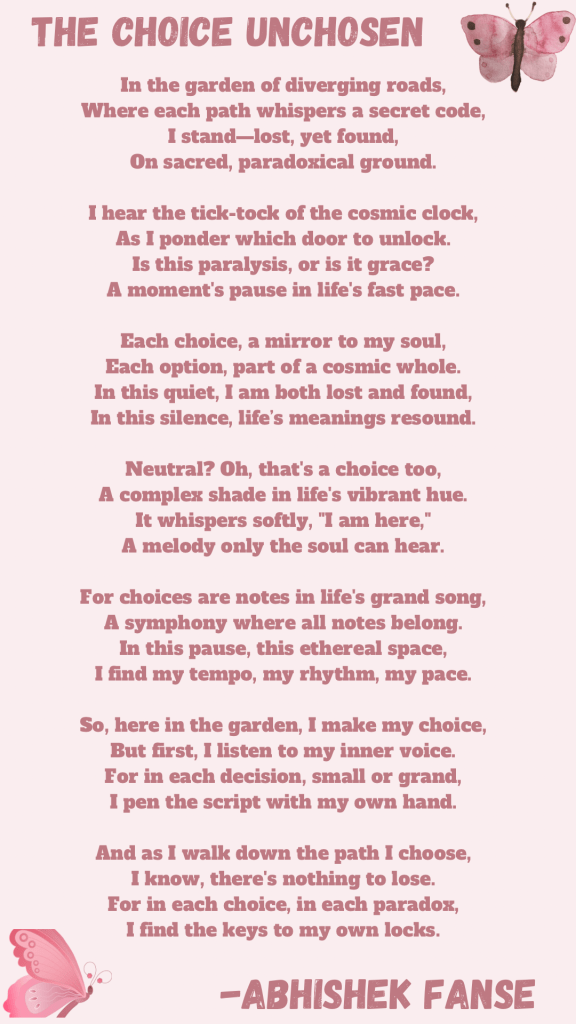
Ultimately, where every action presents us with a choice and counter choices, we sometimes find ourselves paralyzed, suspended in a moment of indecision. Yet, this paralysis isn’t a dead end; it’s a pause, a sacred space that invites us to reflect, to feel, and to become keenly aware of our humanity.
What if we reframe this so-called “choice paralysis” not as a dilemma but as a moment of pause in the great narrative of our lives? It becomes not a prison, but a platform; not a quagmire, but a quest. In this paused state, we are philosophers, artists, and explorers of the inner cosmos. We grapple not just with options but with identities, not merely with pros and cons but with hopes and fears, love and loss.
In this pause, we are not frozen; we are fervently alive. We are composing in our minds the symphony of our future, writing the next act of our life’s drama, sculpting the clay of our becoming.
And when the pause lifts—as it always does—we make a choice, yes, but we also do something more profound: we embrace our capacity to choose, even when the choices are hard, even when the path is foggy. For it’s in the wrestling with choices that we come to know who we truly are.
So, the next time you find yourself in the clutches of choice paralysis, remember: you are standing at the confluence of many rivers, each leading to a different ocean but all part of the same Earth. And it’s okay to stand there for a while, to feel the currents, to listen to their distinct murmurs, before stepping into the stream that will carry you to your next adventure.
And so, we are forever navigating, forever choosing. Not in search of resolution, but in pursuit of growth. In the end, it’s not about making the perfect choice, but about making our choices perfect us.
The Clarity in Uncertainty – Dance between Fog and Focus
The tension between clarity and unclarity seems to be rooted in the human condition itself. Our minds are built to seek patterns, to make sense of the world, and to resolve ambiguity. When things are unclear, we often experience discomfort because it conflicts with our innate desire for resolution and understanding. Unclarity poses a challenge, and humans are generally wired to confront and solve challenges; it’s a basic survival instinct.
However, once we achieve clarity, the “puzzle” is solved, the “problem” is resolved, and the thing that engaged our curiosity and problem-solving abilities no longer does so in the same way. The mind then moves on to the next challenge. It’s a kind of restlessness that keeps us evolving, learning, and growing, but it can also be a source of dissatisfaction or even suffering.
The reason why unclarity is challenging could be because it disrupts our sense of control. Clarity gives us the illusion of control, of being able to predict and manipulate our environment effectively. However, life is full of complexities and dualities that resist simple explanations or solutions. That’s why even when we feel we’ve achieved some clarity, it often seems limited or provisional.

This issue also brushes up against existential and spiritual concerns that have fascinated philosophers and religious thinkers for centuries. The idea that life is fundamentally uncertain and that we must find a way to live with this uncertainty is a central theme in many worldviews. It raises questions about how to live a meaningful life within the constraints of our limited understanding and control. Our relationship with unclarity can also change over time and with experience. As we age, we might find that we become more comfortable with shades of gray, more accepting of the limitations of our knowledge and control. Some people find great peace in embracing the mysteries of life, in recognizing the limitations of human cognition and the vastness of what we don’t know.
But this is often a hard-won wisdom, coming after years, or even decades, of grappling with the discomfort and challenges that unclarity brings. Some of the greatest minds in history have discussed the virtue of embracing uncertainty. Scientists, for example, thrive on it; it’s the engine that drives scientific inquiry. For artists, ambiguity can be a rich source of inspiration, a space where new ideas and forms can emerge. In spiritual practices, the embracing of mystery is often considered a path to deeper understanding and enlightenment.
This doesn’t make the process of dealing with unclarity any less challenging, but it may offer a different perspective on why this is such a universal human experience. It might not be something to be solved or eradicated but a fundamental aspect of the human condition to be explored, understood, and even embraced.
In other words, both clarity and unclarity have their roles in our lives, offering different kinds of lessons and opportunities for growth. Clarity can offer us direction and a sense of purpose, but it can also make us complacent or narrow in our thinking. Unclarity, on the other hand, while often uncomfortable, pushes us to question, explore, and stretch our boundaries.
Think of it as a sort of dance. Sometimes, life leads with clarity, providing us with straightforward answers, well-defined goals, and unambiguous directions. At other times, it leads with unclarity, challenging us with questions, uncertainties, and complex dilemmas that don’t have easy answers. Both stances have their own unique beauty and can enrich our lives in different ways.

The key might be learning how to navigate between these two states, knowing when to seek clarity and when to embrace uncertainty, how to balance our need for concrete answers with a willingness to dwell in ambiguity. And most importantly, how to find a sense of peace and even joy in that ongoing dance between the known and the unknown. So while the discomfort and challenge of unclarity can be difficult to live with, they also serve as catalysts for growth, pushing us to evolve and adapt in ways we might not have otherwise. After all, if life were entirely predictable and clear-cut, would it hold the same richness and potential for growth? Perhaps not.
Human nature is inclined toward a preference for clarity because it gives us a sense of control. When things are clear, we know what to expect, how to behave, what choices to make, and that gives us comfort. Clarity aligns with our need for stability and security.
On the other hand, unclarity often provokes discomfort because it takes away our sense of control. When situations are unclear or when we’re facing ambiguity, it triggers our brain’s threat detection systems, making us feel unsettled or anxious.
However, there’s an ironic twist to this natural inclination for clarity: the thrill of the unknown. Humans are also explorers, innovators, and problem solvers. These traits are activated by unclarity. We are drawn to mysteries, puzzles, and challenges because they promise the reward of discovery and growth. So, while our first reaction to unclarity may be discomfort, that same discomfort can motivate us to explore, to understand, and to grow.
But why do we pay more attention to what is unclear even after achieving clarity? Because clarity often brings resolution, and with resolution comes the end of that particular cycle of exploration or growth. On the other hand, unclarity sustains a continual process of seeking and questioning. Even when we solve one puzzle, another often takes its place. This continuous seeking can be stressful, but it’s also how we grow and evolve as individuals.
This is the paradox: Clarity and unclarity are two sides of the same coin, each with its own set of challenges and rewards. Clarity provides comfort but can lead to complacency. Unclarity creates discomfort but also fuels growth. Both are necessary for a fulfilling, well-rounded life.
The challenge, then, isn’t to eliminate unclarity but to engage with it in a way that is constructive rather than paralyzing. This often involves a level of acceptance that some questions might not have straightforward answers, and some situations will involve navigating through grey areas. Yet, it is precisely these challenges that enable us to grow mentally, emotionally, and spiritually. So, living with unclarity is not about finding a final state of total clarity, but about developing the resilience and wisdom to navigate life’s inherent uncertainties in a meaningful way.
In the realm of philosophy, this dual need for both clarity and unclarity echoes the dialectic process—where contradictory ideas coexist, inform each other, and even enable progress. To engage constructively with unclarity, one can apply a similar approach—acknowledging both the comforting aspects of clarity and the growth-oriented elements of unclarity without seeking to completely eliminate either one.
The act of accepting unclarity as a natural part of life can also be seen as an exercise in humility. No matter how much we know, there will always be elements that are out of our control, questions that don’t have immediate answers, and complexities that don’t yield to simple explanations. Acknowledging these uncertainties can open us to deeper understanding, greater empathy, and even wisdom. It frees us from the paralyzing quest for perfect certainty and allows us to make meaningful decisions despite incomplete information.
In practice, this might mean being okay with not having all the answers before taking action, or recognizing that it’s alright to change our minds when faced with new information. It could involve embracing ‘not knowing’ as a state that propels inquiry rather than stifles it. It also encourages a dynamic state of learning, where the lines between teacher and student blur, and every experience becomes an opportunity to grow.
In many philosophical frameworks, absolute clarity or certainty is considered an illusion or an ideal that can never be fully attained. We might strive for clarity but should recognize that it will often be provisional and subject to change.
Perhaps we can think of clarity not as an endpoint, but as a spectrum. At one end is complete confusion or lack of understanding, and at the other is perfect clarity. Most of the time, we find ourselves somewhere in between. Clarity, in this sense, becomes not a destination but a process—a movement along that spectrum towards greater understanding.
When we say we “have clarity,” it might simply mean we’ve moved far enough along this spectrum to make a confident decision or to understand a situation to our own satisfaction. This doesn’t mean we’ve solved the puzzle entirely, just that we have enough pieces in place to see the image taking shape. But clarity is often elusive because life is inherently complex, unpredictable, and full of uncertainties. Our plans and perspectives are always subject to change due to new information, experiences, and insights. Thus, even when we achieve a state of clarity, it’s often temporary and subject to change.
The search for clarity often seems like an endless endeavor precisely because life is complex and ever-changing. When we seek clarity, what we’re often looking for is a framework or paradigm that allows us to make sense of our experiences and observations. But each framework has its limitations; no single lens can capture the full depth and complexity of reality.
The existentialist philosophers, for example, posited that life is inherently ambiguous. There is rarely a single, clear-cut answer to complex questions. The more we learn, the more we recognize the limits of our knowledge. This is what Socrates meant when he said, “I know that I know nothing.” His wisdom lay in recognizing his own ignorance.
Similarly, Eastern philosophies like Buddhism speak of “beginner’s mind,” the idea of approaching life with openness, eagerness, and a lack of preconceptions, much like a beginner or a child. This is not the same as saying one should be ignorant, but rather that one should be open to multiple perspectives and willing to revise one’s understanding as more information becomes available.
In modern psychology, this ongoing quest for clarity amidst uncertainty can sometimes be framed as “tolerance for ambiguity,” a psychological trait that defines one’s ability to function well in situations that are uncertain, unclear, or chaotic. People with high tolerance for ambiguity are generally more flexible and find it easier to adapt to new situations, while those with low tolerance may find ambiguity to be stressful and may seek to resolve it as quickly as possible, even if it means settling for a simplistic answer.
So why do we seek clarity? From an evolutionary standpoint, being able to quickly assess and understand our environment could have survival benefits. However, the modern world is much more complex than the environments in which our ancestors lived, and the “clarity” we seek may not always be achievable or may require us to accept some level of uncertainty or paradox.
The pursuit of clarity, then, is both a psychological and philosophical endeavor. It involves developing the cognitive and emotional skills needed to navigate uncertainty and the wisdom to recognize that our understanding of any given situation is likely to be partial and contingent on various factors.
If we can get comfortable with the idea that absolute clarity is an ideal rather than a constant state, we can free ourselves to seek understanding in a more nuanced and open-minded way. We learn to appreciate the journey of intellectual and emotional growth, even if it never leads to a single, unambiguous destination.
The Fluidity of Stillness: Understanding Stagnation Amidst Movement
“Movement in Stagnation” captures the tension between seemingly opposite states—feeling spiritually stuck or stagnant while simultaneously experiencing inner changes or shifts. This suggests that even within periods of seeming inertia, movement is happening, whether you recognize it or not.
The experience of feeling both movement and stagnation simultaneously—or alternately—can be influenced by various factors, including your emotional state, external circumstances, and perspective. On a day-to-day basis, there are changes, interactions, and new experiences, which might seem like movement. However, these might not register on the long-term scale, where overarching goals and life trajectories are considered.
ertain philosophies and spiritual perspectives propose that time is not linear but cyclical. Thus, the repetition or perceived stagnation may actually be a part of natural cycles. However, Emotions are incredibly transient; they can change from moment to moment. This emotional flux might be what you’re identifying as “movement” within the stagnation. Emotional highs feel even higher when coming out of a low and vice versa. This contrast might contribute to the sensation of significant movement even when your situation hasn’t drastically changed.
Humans are wired to identify patterns. When you start noticing recurring themes or experiences, your brain flags these as patterns, which can feel like you’re stuck in a loop. Once you recognize a pattern or feel stuck, you’re more likely to notice information that confirms this belief, thereby reinforcing the feeling of being stuck.
Some spiritual teachings suggest that life inherently consists of repetitive cycles—birth, growth, decay, death, and rebirth—and that recognizing this can free you from the illusion of stagnation. Certain philosophies like Buddhism focus on the present moment as the only “real” moment, suggesting that both the past (stagnation) and the future (movement) are constructs of the mind.
When you look at your life on a daily basis, you can see a lot of activities, interactions, and events that unfold. The sun rises and sets, you go to work, eat, sleep, talk to people, perhaps engage in some hobbies. This flurry of activity can give you the impression that things are constantly moving and changing. However, if you were to zoom out and look at a larger slice of your life, say a year or a decade, the feeling is often quite different. Major life circumstances—your job, where you live, your relationship status—may not change as frequently. Even if they do, the underlying patterns of behavior, the kinds of relationships you engage in, and your day-to-day experiences might not undergo a significant transformation. This is where the feeling of “stagnation” often comes in. Despite the constant activity and interactions, there may be an underlying sense that nothing much has really changed—or is going to change.
Emotions, by their very nature, are transient and fluid. Even within a single day, you might experience a range of emotions—joy, frustration, excitement, boredom, love, irritation—and these emotions have a way of coloring your perception. When you’re joyful, the world seems vibrant, full of possibilities; you feel like you’re “moving.” When you’re frustrated or bored, the world can seem dull, repetitive; hence the feeling of “stagnation.”
The mind has certain tendencies that influence this dual experience of movement and stillness. One of these is the brain’s knack for pattern recognition. We make sense of the world by recognizing patterns; it’s how we learn and navigate complex realities. However, this strength can turn into a trap when the patterns you recognize lead to a sense of helplessness or stagnation. For instance, if you’ve had several failed relationships, you may start to believe that all relationships are doomed to fail, leading to a feeling of being “stuck.”
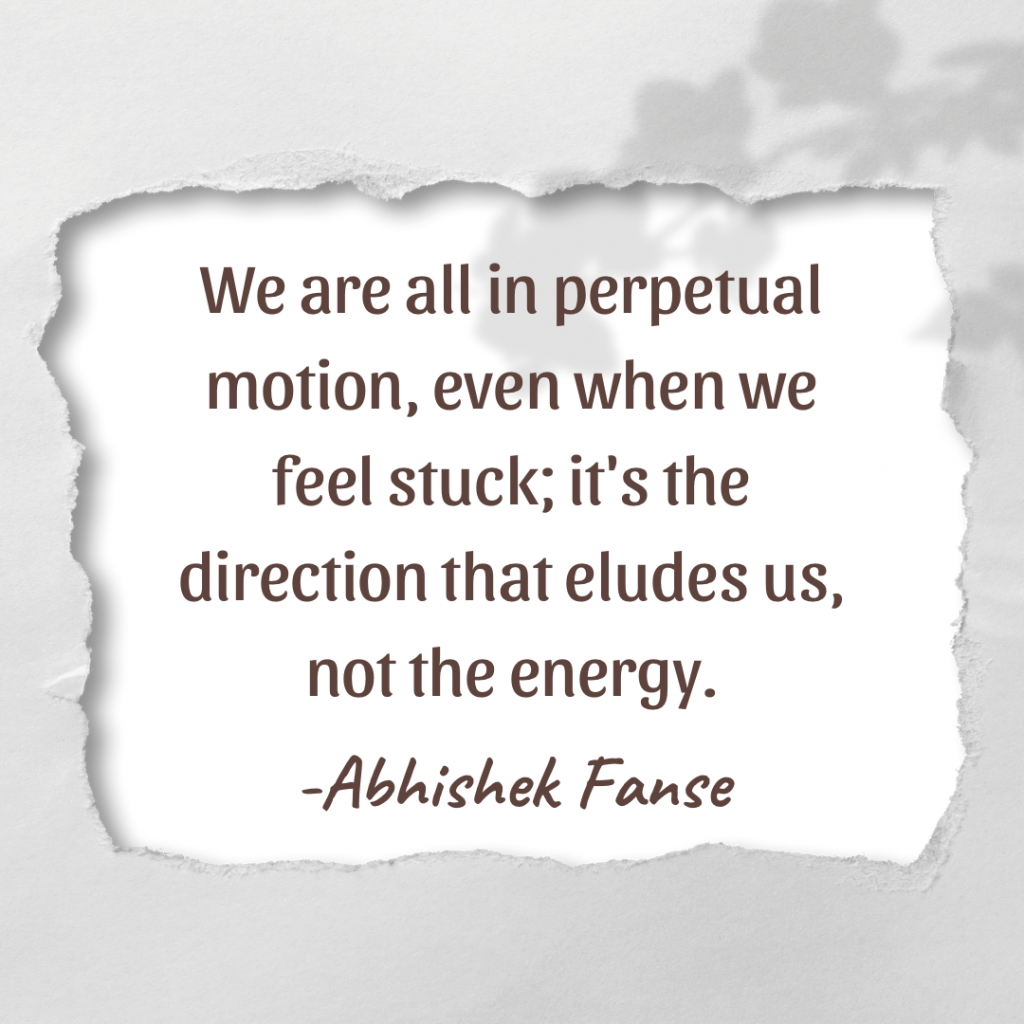
Finally from a more spiritual or existential standpoint, the very idea of movement and stagnation can be questioned. Certain spiritual teachings suggest that the material world is an illusion, and that true “movement” is a journey inward, toward understanding one’s own nature and the nature of reality. In this context, both the feeling of “moving” and “being stuck” can be seen as distractions from the true journey, which is neither about moving nor staying but about understanding and being.
 Abhishek Fanse