Illuminating the “Unseen” & “Unspoken”
Thought, in its essence, is an intellectual construct, a tool for navigating the practical aspects of life. It’s essential for planning, learning, and organizing. However, its fundamental limitation lies in its basis in the past – thoughts are a response to accumulated memories, knowledge, and experiences. This retrospective nature means thought is inherently unable to apprehend the present moment in its totality. It’s always a step removed from the direct experience, interpreting rather than experiencing. Thought can be understood as a mental process wherein ideas, images, and cognitive symbols are conjured and manipulated. It is a fundamental aspect of human consciousness leading to the formation of ideas, judgments, memories, and plans.
Biologically, thoughts arise from the neural activity in the brain. Psychologically, they are influenced by our experiences, emotions, culture, and subconscious mind. Philosophically, some argue that thoughts are more than mere brain activity; they might represent an interaction with a broader consciousness or a deeper, more intrinsic aspect of the self. The exploration of the psyche in it’s entirety beyond thoughts involves looking into the depths of consciousness, beyond the surface-level chatter of the mind. It’s an exploration of what remains when thoughts are quieted – the essence of being, the fundamental nature of consciousness.
Thought is inherently limited. It is born from our accumulated knowledge, memories, experiences, and conditioning. Each thought is a fragment, a part of the whole, filtered through our personal lens. The limitation of thought lies in its inability to capture the totality of what is, as it’s always colored by past conditioning and subjective interpretations.
Let’s understand if there’s any thinking without thought ? Exploring this notion of thinking without thought ventures into a paradoxical realm. Traditionally, thinking is seen as the process of using thoughts. However, there are some different perspectives revolving around the same. They speak of a state of ‘pure observation’ or ‘direct perception,’ where one is aware and attentive but not caught in the web of conceptual thinking. This is not thinking in the traditional sense but a state of heightened awareness where one perceives things as they are, unfiltered by thoughts. The inadequacy of language in capturing this entirety of an experience is a well-acknowledged philosophical challenge. Words are symbols, abstractions that represent reality but are not reality themselves. They can point towards the truth but cannot fully encapsulate it. This disconnect between the symbol and the actuality is why descriptions often fall short of conveying the full essence of an experience. Perceiving something without the interference of subjective knowledge or past experiences is a central aim in our exploration. It is akin to seeing with a ‘beginner’s mind’ in Zen Buddhism or practicing ‘choiceless awareness’. In such states, perception is not clouded by previous conditioning; one sees the ‘what is’ without the overlay of the ‘what has been’ or ‘what could be.’ Direct perception/reception or choiceless awareness is a key concept in understanding a state beyond the limitations of thought. This is a state of consciousness where one observes without the duality of the observer and the observed. In this state, the mind does not interpret, compare, or evaluate, but simply perceives what is. This kind of perception is devoid of the biases, filters, and conditioning that usually cloud our understanding.

Consciousness, in its purest form, is often described as a vast, boundless field of awareness that transcends the limitations of thought. In various spiritual traditions, this consciousness is seen as the fundamental essence of our being, uncolored by personal identity, cultural conditioning, or linguistic constructs. It’s an experiential state where the sense of separation between the self and the external world diminishes, leading to a profound sense of unity or oneness. Non-dual awareness refers to a state of consciousness where the artificial distinctions between subject and object, observer and observed, dissolve. In this state, one experiences reality as an undivided whole, where the dichotomies and dualities created by thought no longer hold sway. This non-dual awareness is often described as a direct experience of the true nature of reality, unmediated by the conceptual mind and ego. The ego is often seen as a construct of the mind, a collection of self-identifications, memories, and personality traits that create the illusion of a separate, distinct self. Transcending thought involves recognizing the ego as an illusion, a limited perspective that confines our understanding of ourselves and the universe.
Exploring this further, let’s delve deeper into the aspects where we try to understand if there can be observation without conditioning/ego/judgements/thoughts.
Interpreting an observation that is not shaped or driven by thought presents a unique challenge. By its very nature, this type of observation defies conventional interpretation, as interpretation itself is a function of thought. Therefore, experiences rooted in direct perception/reception or choiceless awareness are often described as ineffable or transcendental. They are understood not through the analytical mind but through a profound sense of knowing or/of being. Thought is inherently a movement of memory, knowledge, and experience. It is a dynamic process, always referencing the past, comparing, and categorizing based on previous data stored in the brain which is actually static. Due to its reliance on past information, thought is inherently limited in apprehending the new, the unknown, or the present moment in its fullness. It is always a step behind, processing and interpreting, rather than directly experiencing. It’s a process that, by its very nature, is retrospective, constantly referring to the past to make sense of the present. This reference to the past is both the strength and limitation of thought. It allows us to learn, plan, and reason, but simultaneously confines us within the boundaries of our previous experiences and conditioning. Every thought, therefore, is a reflection of this accumulated knowledge, a product of our individual histories and the collective history of our species. As we deepen our exploration, we begin to see the interplay between thought and awareness more clearly. We start to understand that thoughts, in themselves, are not the problem. The challenge lies in our identification with them, in our habitual pattern of mistaking the content of our thoughts for the totality of our being. This identification is what keeps us entangled in the web of ego and illusion, preventing us from experiencing the fullness of our true nature. The challenge and the beauty of experiencing the present moment beyond the framework of thought lies in stepping out of the known – the accumulated knowledge, memory, and experience – and entering the realm of direct, immediate experience.
When we delve into the concept of observation beyond thought, we venture into a realm that is often uncharted by our regular conscious experience. This form of observation is not an act of the thinking mind but a state of pure awareness. It is a form of perception that is immediate and direct, unmediated by the processes of cognition, analysis, or linguistic formulation. In this state, the mind is silent yet acutely aware, observing without the interference of preconceived notions, judgments, or interpretations. This is a form of observation where the observer is fully present, yet there is no active process of ‘observing’ in the conventional sense. Interpreting this thought-free observation poses a significant challenge because interpretation itself is a function of thought. To understand or articulate these experiences, we invariably revert to the tools of thought – language, symbols, and concepts. However, these tools are inadequate to fully capture the essence of such experiences. They are like trying to describe the taste of water using only colors; the medium is fundamentally incapable of conveying the actual experience. Hence, experiences rooted in direct perception or choiceless awareness are often described as ineffable or transcendent. They are understood not intellectually but experientially, as a profound sense of knowing or being that transcends the conventional modes of understanding. The movement of thought, being a continuum of memory and knowledge, inherently limits our perception of the present moment. It’s always a step behind, interpreting and processing rather than directly experiencing. This lag, this reliance on the past, is what prevents thought from apprehending the new, the unknown, or the present moment in its full immediacy. To step beyond this limitation requires a different quality of attention – an attention that is not bound by the linear, sequential process of thinking but is open, expansive, and fully present. This disengagement from the thought process allows for moments of clarity and direct perception, where one can experience reality as it is, not as it is interpreted or remembered. In this context, the role of the observer becomes crucial. In deep observation, the distinction between the observer and the observed begins to blur. This blurring is a realization that the separation between the self and the world is largely a construct of thought. When this artificial barrier falls away, what remains is a state of being where the observer is not separate from the observed but is an integral part of a unified field of awareness. This realization can lead to a profound shift in consciousness, a shift from the duality of subject and object to a state of non-dual awareness. To truly understand and integrate this understanding into our lives we must confront the structures of thought that define our perception of reality.
The present moment, ever fleeting and elusive, exists beyond the grasp of our thoughts. Our attempts to understand the present through thought inevitably involve a retrospective analysis, a looking back to what we already know, to what we have already experienced. This backward glance prevents us from experiencing the present moment in its true essence. It’s like trying to capture the beauty of a sunset by looking only at its reflection in a mirror; the experience is always one step removed from reality. When we speak of observation beyond thought, we are referring to a state of pure awareness, an unfiltered engagement with the present moment. This is a form of observation that transcends the cognitive processes of the mind. It is not about thinking more clearly or more deeply; it is about not thinking at all. In this state, the mind is still, yet acutely aware. There are no judgments, no comparisons, no interpretations. There is only the experience of the present moment in its unadulterated form. This state of observation is not easily attainable, nor is it a permanent state of being. It is a fleeting glimpse into a reality that exists beyond the confines of our conditioned mind. It requires a quieting of the mental chatter, a suspension of the habitual thought processes that dominate our waking life. This quieting is not an act of suppression but an act of surrender, a letting go of the need to analyze, categorize, and understand. In this space of thought-free observation, we encounter the world in a way that is fundamentally different from our usual mode of experience. It is a mode of experience that is direct and immediate, unmediated by the filters of our past experiences and conditioning. In this space, we find a connection to the world that is more intimate and more profound than anything thought can provide. It is a connection that speaks to the interconnectedness of all things, to the fundamental unity of existence.

The challenge, however, lies in integrating this understanding into our daily lives. How do we maintain this connection to the present moment in a world that is constantly pulling us back into the realm of thought? The answer lies not in rejecting thought but in understanding its place and its limitations. It involves cultivating a balance between using thought as a tool for practical living and allowing ourselves to experience moments of thought-free awareness. This balance is not easily achieved. It requires practice, patience, and a willingness to explore the depths of our own consciousness. It involves cultivating mindfulness in our daily activities, being fully present in each moment, whether we are eating, walking, talking, or simply sitting. It involves meditation, not just as a formal practice but as a way of being, a constant attunement to the present moment. As we deepen our practice, we begin to notice subtle shifts in our perception. We start to see the world with a freshness and clarity that was previously obscured by the veil of our thoughts. We begin to experience moments of profound peace and connectedness, moments where the boundaries between self and other dissolve, and we are left with a sense of being part of a larger whole. We may find that our moments of thought-free awareness become more frequent and more profound. We may begin to experience flashes of insight and understanding that arise not from the thinking mind but from a deeper, more intuitive level of consciousness. These moments have the potential to be deeply transformative, offering a glimpse into a way of being that is free from the constraints of conditioned thought. This sense of interconnectedness is not merely a philosophical abstraction but a lived experience. It manifests in a deep sense of empathy and compassion, a genuine understanding of the interconnected nature of all life. In this understanding, the well-being of others becomes inseparable from our own. The artificial distinctions that thought creates between ‘us’ and ‘them’ lose their significance, and we begin to act from a place of intrinsic connection and unity.
The journey towards this understanding and experience is both personal and universal. It is personal in the sense that it requires a deep exploration of one’s own mind and consciousness. It involves a process of unlearning, of letting go of the preconceived notions and beliefs that cloud our perception of reality. At the same time, it is a universal journey, one that has been embarked upon by seekers across different cultures and throughout history. It is a journey towards a truth that transcends the particularities of individual perspectives and cultural conditioning. Moreover, this journey brings us into a closer relationship with the mystery of existence. It opens us to the wonder and awe of life, allowing us to experience the world with a freshness and immediacy that is often lost in adulthood. In this space, we find beauty in the mundane, joy in the simple act of being, and a sense of peace that transcends the ups and downs of daily life. Yet, this journey is not about permanently residing in a state beyond thought. Such an expectation would be unrealistic and contrary to the very nature of human existence. Rather, it is about cultivating the ability to move fluidly between different states of consciousness. It is about learning to use thought when it is useful and necessary, while also being able to step beyond it to experience a more direct and unmediated connection with life.
As we continue to explore this deeper dimension of ourselves, we encounter a paradox. On one hand, there is a sense of individuality, the unique perspective and experiences that each of us brings to the world. On the other hand, there is a sense of universality, a recognition that at the core, we are all expressions of the same fundamental consciousness. This duality of individuality and universality is one of the great mysteries of human existence, a mystery that challenges the linear and rational mind but is intimately known to the heart. In this space beyond thought, we also begin to experience time differently. The usual linear progression of past, present, and future gives way to a more fluid and expansive experience of time. Moments of deep presence and awareness can feel timeless, as if we are touching an eternal now that underlies the changing scenes of life. This experience of timelessness is not an escape from the world but a deeper engagement with it, a recognition that each moment is a doorway to the infinite. This deeper exploration also challenges our conventional understanding of not only time but space as well. In the realm of pure awareness, the linear progression of time gives way to a more fluid and expansive experience. We begin to see time not as a series of discrete moments but as a continuous flow, a flow of creation and dissolution in which we are intimately involved. Similarly, our experience of space transforms from a fixed, three-dimensional framework to a more dynamic and interconnected field. We start to perceive space not as something that separates but as something that unites, a medium through which the dance of existence unfolds.
In this deeper realm, we encounter the concept of the Absolute, a term used in various philosophical and spiritual traditions to denote the ultimate, indivisible reality. The Absolute is often described as the source and substance of all that exists, transcending all categories of thought, including being and non-being. This is not an entity or a being in the traditional sense, but the very ground of being itself. In the presence of the Absolute, the distinctions that dominate our usual experience of reality – between subject and object, self and other, observer and observed – dissolve into a state of non-dual awareness. In this state, the individual consciousness recognizes its unity with the Absolute, realizing that the separation it perceives in the ordinary state of consciousness is an illusion. The dualities that govern our ordinary perception – light and dark, good and evil, pleasure and pain – are seen as expressions of a deeper unity. This perception brings with it a sense of profound peace and equanimity, as one realizes that the essential nature of reality is unchanging and eternal, despite the ever-changing play of phenomena.
Mystique of Manifestation: Sculpting Reality
To understand manifestation, we must journey back to ancient philosophies and spiritual teachings. In Eastern philosophies, particularly within Hinduism and Buddhism, the concept of ‘Sankalpa’ or intention is paramount. It suggests that focused intention with a clear vision and a pure heart, has the power to shape one’s reality. This aligns closely with the Buddhist teaching of ‘Pratītyasamutpāda’ or dependent origination, which posits that all phenomena arise in interdependence and not in isolation. In Western thought, traces of manifestation can be found in the works of philosophers like Aristotle, who emphasized the power of potentiality and actuality – the transformation of what ‘could be’ into what ‘is’. This idea was further nuanced in the Hermetic traditions, particularly in the principle of ‘As above, so below’, suggesting a mirror-like relationship between the macrocosm (the universe) and the microcosm (the individual). In psychology, manifestation finds resonance with the theory of self-fulfilling prophecy and the placebo effect. The former, proposed by sociologist Robert K. Merton, argues that believing in a certain outcome can indeed cause it to occur, primarily through the lens of expectation influencing behavior. The placebo effect, a well-documented phenomenon in medical science, further illustrates how belief can result in tangible changes in the physical body.

Is manifestation empirical or imaginary? The answer is nuanced. While certain aspects, like the placebo effect, have empirical evidence, other elements tread into the subjective and personal realms of belief and faith, which evade empirical scrutiny.
When individuals set an intention, their subconscious mind begins aligning thoughts and actions towards the desired outcome. This alignment can often result in heightened awareness of opportunities and a greater propensity to take actions that lead towards the goal. Manifestation often emphasizes the importance of ‘feeling’ the reality of the desired outcome. This emotional resonance might act as a catalyst for more profound engagement with one’s goals, thereby increasing the likelihood of their realization. Manifestation is not a magic wand. The constraints of physical reality, combined with personal limitations (skills, resources, timing), play a significant role. Moreover, a misunderstanding of manifestation as merely ‘wishing’ without corresponding action leads to its ineffectiveness. The universe is not entirely predictable. Random events and external factors beyond one’s control can influence outcomes, irrespective of one’s intentions or actions.
Manifestation often works more effectively at the level of basic needs because these needs are more deeply connected to our survival instincts and thus, may be more intensely focused upon. Desires, especially those that are more whimsical or less aligned with our core values and needs, might not hold the same power in our psyche, leading to lesser focus and energy directed towards them.
Psychologically, when we set an intention to manifest something, it often creates a state of cognitive dissonance – a psychological tension between our current reality and our desired state. Leon Festinger’s theory suggests that we are intrinsically motivated to reduce this dissonance. This motivation can lead to a change in attitude or behavior, aligning more closely with the desired outcome. When we are focused on manifesting a particular outcome, we tend to notice and give importance to events and information that support our beliefs or desires. This selective attention can sometimes make the process of manifestation seem more effective than it might objectively be. A common misconception is that manifestation is solely about attracting what you desire through thought. This overlooks the necessity of action and the multifaceted nature of human experiences where external factors and chance also play significant roles. While the idea of manifesting one’s destiny is empowering, it can oversimplify the complexities of life’s challenges. Issues like systemic inequality, health problems, and other factors often cannot be resolved merely through positive thinking or intention setting.
The subconscious mind is a powerful aspect of our psyche, operating below the level of conscious awareness. It plays a critical role in manifestation. Our deep-seated beliefs, often formed in childhood and shaped by our experiences, reside here. These beliefs can either propel us towards our goals or hold us back. The process of manifestation often involves reprogramming the subconscious to align with our conscious desires. Visualization, a key technique in manifestation practices, leverages the brain’s neuroplasticity. By repeatedly visualizing a desired outcome, we can potentially rewire our brain to be more attuned to opportunities and actions that can make the visualization a reality. This practice can create mental and emotional readiness, aligning our internal state with our external actions. The power of manifestation comes with responsibility. It raises questions about ethics and intentions. For instance, manifesting at the expense of others or for purely selfish gains goes against many spiritual teachings’ emphasis on compassion and interconnectedness.
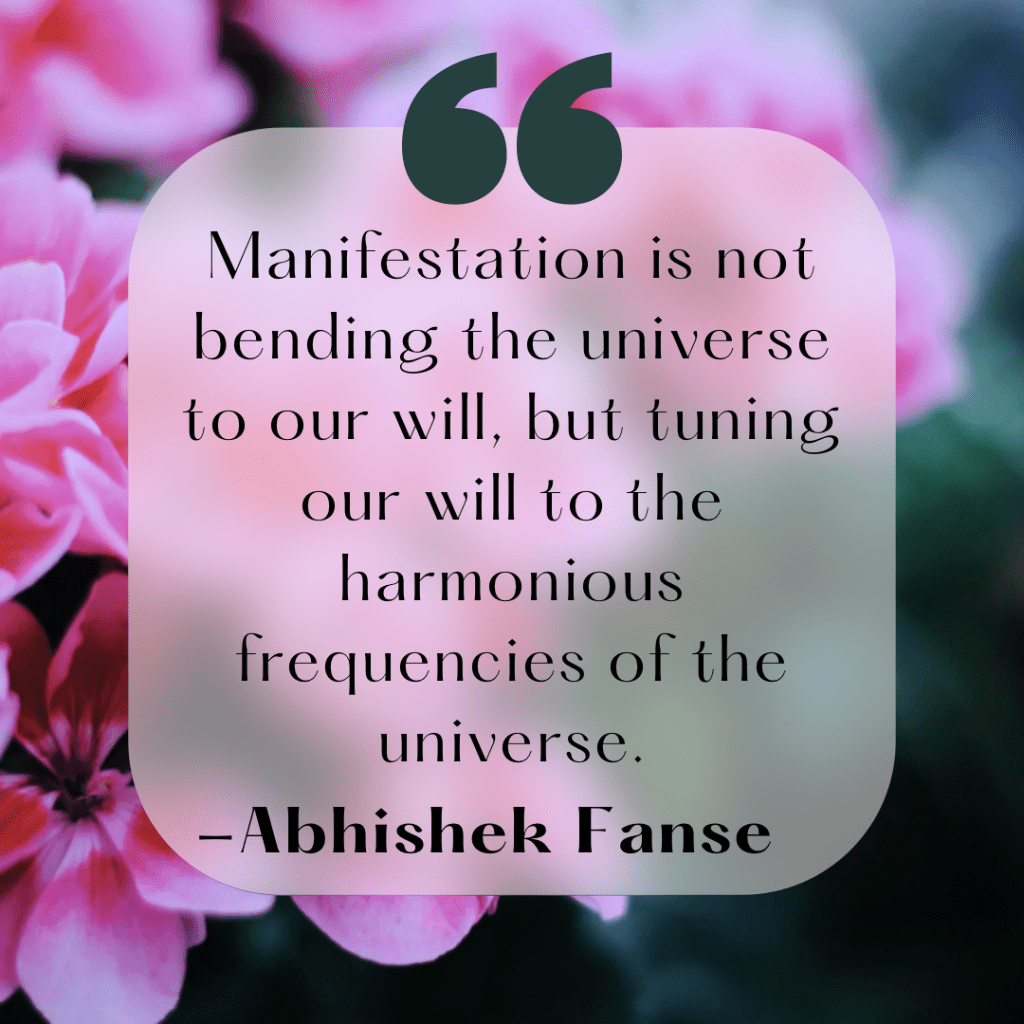
Carl Jung’s concept of the Shadow Self is pivotal in understanding manifestation. The Shadow encompasses the parts of ourselves we reject or ignore. When these aspects are unacknowledged, they can sabotage our manifesting efforts. For instance, if someone desires success but subconsciously harbors a fear of failure or unworthiness, these shadow elements can hinder manifestation. The nature of desire itself is complex. Desires are not always straightforward or conscious. They can be influenced by societal expectations, past traumas, or unmet childhood needs. Understanding and untangling these desires is crucial in manifestation, as conflicting or unconscious desires can lead to mixed results or unfulfilled outcomes.
Many spiritual traditions, such as Buddhism, advocate for non-attachment to outcomes. This presents a paradox in manifestation: How does one intensely desire and visualize an outcome while simultaneously practicing detachment from it? Balancing intense desire with a state of inner peace and acceptance is a nuanced aspect of manifestation. At the heart of this complexity is the human psyche itself, an intricate and layered entity. The conscious mind, where intentions and desires are actively formed, is just the tip of the iceberg. Beneath this lies the vast expanse of the subconscious, a realm filled with deeply ingrained beliefs, past experiences, and emotional patterns. Often, these subconscious elements are not in complete harmony with our conscious desires. This discord can subtly undermine our efforts at manifestation, creating an internal resistance that might not be immediately apparent. This inner landscape is often a repository of contradictory desires, fears, and conditioning from past experiences. For instance, a person might consciously desire success but subconsciously fear it due to past experiences of failure or a deep-seated belief that they are unworthy of success. These subconscious elements create a complex inner dialogue, often leading to a manifestation process that is less straightforward and more convoluted than initially assumed.
A central paradox in the art of manifestation is the balance between control and surrender. On one hand, manifestation requires a clear vision and proactive effort towards achieving our goals. On the other hand, there is a need for surrender – an acceptance of the unknown and an acknowledgment that not everything is within our control.
This balance is not a static state but a dynamic equilibrium, constantly shifting as we navigate through life. It involves recognizing our co-creative role in the universe while also understanding that the universe has its own wisdom and timing. In many spiritual traditions, this surrender is not seen as a weakness but as a strength – a deep trust in the larger cosmic order.

Manifestation is also intimately tied to the concepts of timing and synchronicity. The universe operates on its own rhythms and cycles, which do not always align with our personal timelines. Sometimes, what we wish for does not manifest not because the intention is flawed, but because the timing is not right. Synchronicity, a term coined by Carl Jung, refers to meaningful coincidences that seem to defy conventional explanations. In the context of manifestation, synchronicity can be seen as the universe’s way of aligning our intentions with the right opportunities and connections. These synchronicities are often markers that we are in harmony with the larger flow of life, guiding us towards our goals in ways that our rational minds may not immediately comprehend.
If we’re not tired of reading, let’s delve deeper into it to understand the finer nuances of “Manifesting in the Now”!
When we manifest in the now, our focus is not on a future goal but on the quality and richness of our present experience. This form of manifestation is about aligning with the current moment, fully engaging with it, and allowing it to unfold naturally. It’s a state of being deeply rooted in the present, where every action and thought is an expression of our intention to be fully alive and aware in the here and now. In this state, the power of manifestation is not directed toward changing or obtaining something in the future, but in transforming the present moment. It’s about bringing a quality of awareness, gratitude, and intentionality to whatever we are experiencing. This approach often involves a heightened sense of awareness and mindfulness, where each action and thought is infused with a conscious presence.
Manifesting in the now aligns closely with the concept of non-attachment found in various spiritual traditions. Non-attachment doesn’t mean not caring about outcomes; rather, it’s about not being controlled by the desire for specific outcomes. This approach allows for a more fluid interaction with life, where one is open to the myriad possibilities that each moment presents, free from the constraints of rigid expectations. The ‘now’ is often viewed as the only true reality. Past and future are seen as constructs of the mind, illusions that distract from the full experience of life. In this context, manifesting in the now becomes a practice of deep spiritual significance. It’s about aligning with the eternal present, where all of life’s potentialities exist in a state of pure possibility.
Here Time is realised as an illusion, a linear construct that confines the boundless nature of consciousness. By focusing on manifesting in the now, one steps out of the confines of chronological time and into a more fluid, timeless state of being. This state is often described as experiencing the eternal ‘now’, where every moment holds infinite potential and is complete in itself. The concept of desire is paradoxical. While desires are seen as natural, there’s an emphasis on non-attachment to them. Manifesting in the now, therefore, involves a balance between honoring one’s desires and simultaneously releasing attachment to their outcomes. It’s about fully engaging with life as it is, without being ensnared by the relentless pursuit of specific goals.
Intention is more than just a goal or a desire. It’s a powerful force that shapes the energy and direction of our lives. By focusing on the present, intentions are set not for future outcomes but for the quality and experience of the present moment. Manifesting in the now is seen as a tool for the transformation of consciousness. It shifts the focus from external achievements to internal growth and understanding, fostering a deeper connection with the self and the universe. This practice aligns with the belief that the universe operates in a state of perfect harmony and balance. By focusing on the now, one aligns with this cosmic rhythm, experiencing life as a seamless flow rather than a series of disjointed events.
Let’s touch little bit on the illusion of separation as well – the false belief that we are distinct and isolated from the rest of existence. This illusion is perpetuated by our adherence to linear time. In the practice of manifesting in the now, this illusion begins to fade. The present moment is understood not as a fleeting point between past and future, but as the eternal ‘now’ – a timeless space where all of existence converges.
Consciousness is not static but fluid and ever-changing. It’s like a river flowing through the landscape of reality, constantly reshaped by its interactions with the external world and internal states. Manifesting in the now becomes an act of navigating this fluidity, understanding the transient nature of thoughts and emotions, and aligning with the deeper currents of consciousness.
The deepest aspect of manifesting in the now is self-realization – the understanding of one’s true nature beyond the ego and individual identity. In this state, manifestation is not about bringing desires into reality but realizing that one’s essential nature is already whole and complete. In this space, manifestation is experienced as an alignment with the cosmic dance of creation, where the distinction between the manifestor and the manifested blurs with the ultimate realisation “Manifestor is manifested”.
Diwali – The Luminous Legacy
Diwali, also known as Deepavali, is a major Hindu festival celebrated with great enthusiasm across India and by Indian communities worldwide. Its roots trace back to ancient times and are steeped in various legends and religious traditions, reflecting the richness of Indian culture. The festival spans five days, each with its unique significance and associated rituals. The origins of Diwali are found in ancient Indian texts like the Ramayana. It marks the return of Lord Rama, his wife Sita, and brother Lakshmana to Ayodhya after 14 years in exile and a victory over the demon king Ravana. The people of Ayodhya lit rows of clay lamps (deepas) to welcome them, symbolizing the victory of good over evil, light over darkness. Diwali is also associated with the goddess of wealth, Lakshmi. It’s believed that she visits homes on Diwali night, and so people light lamps to welcome her and seek her blessings for prosperity and well-being.
The term “Diwali” is derived from the Sanskrit word “Deepavali,” which is a conjunction of two words: “Deepa” meaning lamp or light, and “Avali” meaning a row or series. Therefore, “Deepavali” translates to “a row of lamps.” Over time, the word evolved phonetically into “Diwali” in various Indian languages. The name itself is a direct reference to one of the most iconic aspects of the festival: the lighting of oil lamps (diyas) that are arranged in rows around homes, temples, and other buildings. This practice symbolizes the victory of light over darkness and knowledge over ignorance. The lighting of lamps is an integral part of the Diwali celebration and directly ties to the festival’s name, emphasizing its significance as a festival of lights.
In the traditional five-day celebration of Diwali, the days preceding the main Diwali night, namely Ekadashi and Dvadashi (often referred to as Baras), are also significant, though they are less emphasized compared to the other days like Dhanteras, Narak Chaturdashi (Choti Diwali), and Bhai Dooj.
The continuous, linear celebration of Diwali over five days, despite its roots in events that did not occur in a linear or chronological fashion, is a reflection of how cultural, religious, and historical narratives are woven together to form meaningful traditions. This structure of celebration is less about historical accuracy and more about the symbolic representation of themes and values important to the culture. The ordering of the Diwali days creates a thematic continuity that resonates with the overarching themes of light over darkness, knowledge over ignorance, and good over evil. Each day adds a layer to this narrative, building up to the grand celebration of Diwali and then gradually winding down, reflecting a journey from preparation (Dhanteras) to culmination (Diwali) and then reflection (Bhai Dooj).
Ekadashi (Two Days Before Dhanteras):
Ekadashi is the eleventh day of the lunar cycle and is considered sacred in Hinduism. While not directly a part of the Diwali festivities, it holds spiritual significance and is observed by many through fasting and prayers. Devotees often observe a fast (Ekadashi Vrat) dedicated to Lord Vishnu on this day. The fast and associated rituals are believed to bring spiritual benefits and purification.
Dvadashi or Baras (The Day Before Dhanteras):
Dvadashi, the twelfth day, also has its own importance in the lunar calendar. In some regions, this day is observed as Govatsa Dwadashi or Vasu Baras, marking the worship of cows, which are considered sacred in Hinduism. The day typically involves the worship of cows and calves, symbolizing the nurturing aspect of the divine. In agricultural communities, this day is particularly significant, as it honors cattle for their role in farming.
The Five Days of Diwali:
Day – 1 – Dhanteras: Dhanteras typically falls on the thirteenth lunar day of Krishna Paksha (the waning phase of the moon) in the Hindu calendar month of Kartik. In the Puranas, Dhanteras is associated with the Samudra Manthan (churning of the ocean) narrative, where Dhanvantari, the god of Ayurveda, emerged with the pot of amrita (nectar). Traditionally, this day involves the worship of Lord Dhanvantari for health and well-being. The purchase of new utensils or precious metals is a symbolic act, reflecting the emergence of wealth and blessings from the ocean. The day is considered auspicious for wealth and prosperity. Astrologically, it’s believed that purchases made on this day, especially of metal, bring good luck and prosperity due to the favorable positioning of certain planets.

The act of buying metal on Dhanteras goes beyond mere tradition. In Hindu philosophy, metal, especially gold and silver, is considered auspicious, signifying purity and spiritual wealth. The lighting of the first lamp of Diwali on Dhanteras is a ritual symbolizing the drive away from spiritual darkness and the ushering in of knowledge. The worship of Lord Dhanvantari, the god of Ayurveda, on Dhanteras links this day to health and healing. The preparation of traditional sweets and dishes on this day also reflects the convergence of health and prosperity in Hindu culture. According to folklore, a prince, destined to die by a snakebite, was saved when his wife created a barrier of gold and lamps that blinded the serpent. Buying metal on Dhanteras is believed to ward off death and bring prosperity. The lighting of lamps and rangolis (colorful designs) are meant to welcome Lakshmi, the goddess of wealth.

Additionally, in agrarian societies, Dhanteras marks the end of the harvesting season, and farmers celebrate their harvests, attributing their prosperity to divine forces.
Day – 2 – Narak Chaturdashi or Choti Diwali: This day falls on the fourteenth lunar day of Krishna Paksha. Astrologically, this day is considered significant for warding off evil and negativity, as it is believed that certain planetary positions on this day help in cleansing negative influences.

This day is linked to the story of Narakasura, a demon king who was defeated by Krishna. It symbolizes the victory of good over evil and light over darkness. The tradition of taking an oil bath is believed to cleanse the body and spirit, emulating Krishna’s cleansing after slaying the demon. The lighting of lamps and bursting of crackers signify the joyous celebration of the demon’s defeat, while the preparation for the main Diwali night reflects the anticipation of something grand and auspicious.

The ritual of the early morning oil bath is not just a physical cleansing act but is also symbolic of spiritual renewal and purification. The application of fragrant oils and the subsequent bath are considered equivalents of a purifying ritual dip in the holy rivers of India. The breaking of dawn after Narak Chaturdashi is symbolic of a new awakening, a metaphor for enlightenment and the dispelling of ignorance, as represented in the story of Krishna and Narakasura.
Day – 3 – Diwali: Diwali is celebrated on the new moon day (Amavasya) of Kartik, which is considered the darkest night of the Hindu lunisolar calendar. The new moon is traditionally associated with honoring ancestors and inviting prosperity. The absence of moonlight is believed to enhance the spiritual and astrological significance of the lamp lighting.

The most significant day of the festival, it celebrates the return of Rama, Sita, and Lakshmana to Ayodhya, as narrated in the Ramayana. The lighting of lamps symbolizes the light Rama brought back to Ayodhya, overcoming the darkness of Ravana’s rule.

The evening Lakshmi Puja is the core ritual of Diwali. This ritual, performed to invite prosperity and well-being, is not just a plea for material wealth but also a prayer for spiritual richness. The traditional Diwali sweets and delicacies represent the sweetness of life and gratitude for the bounties of nature. Across different regions in India, Diwali is celebrated in various forms, from worshipping Goddess Kali in Bengal to celebrating the victory of Lord Vishnu in his Vamana avatar in Kerala. This diversity reflects the festival’s adaptability and relevance across different cultural and geographic landscapes.
Day – 4 – Govardhan Puja or Annakut: This day falls on the first lunar day of Shukla Paksha (the waxing phase of the moon) in Kartik. The beginning of the waxing phase is traditionally seen as a time of growth and renewal, reflecting the themes of abundance and gratitude expressed in the Govardhan Puja.

This day commemorates Krishna’s miraculous feat of lifting the Govardhan Hill to protect the villagers from Indra’s wrath. The act of preparing a mountain of food (Annakut) symbolizes the hill itself and is an offering of gratitude. This day also aligns with the end of the harvest season in many parts of India, and the food offered represents the bounty of the land. The preparation of Annakut is a homage to the agricultural bounty. This ritual underscores the dependence of human life on nature’s cycles, reinforcing the need for harmonious coexistence with the environment. The story of Krishna lifting the Govardhan Hill serves as a reminder of the power of faith and the need for humility in the face of nature’s and the divine’s immeasurable strength. The circumambulation of Govardhan (Govardhan Parikrama) is also a traditional ritual in some regions.
Day – 5 – Bhai Dooj: Bhai Dooj is observed on the second lunar day of Shukla Paksha. The day is considered auspicious for strengthening bonds between siblings, with certain planetary positions believed to enhance the emotional and spiritual connections.

Bhai Dooj celebrates the bond between brothers and sisters, akin to Raksha Bandhan. According to one legend, Yama visited his sister Yami on this day. She applied the ceremonial tilak on his forehead for his welfare. This ritual symbolizes the sister’s prayers for her brother’s long life and well-being. Bhai Dooj is not just a celebration of the bond between brothers and sisters but also a reinforcement of the social fabric. It emphasizes the importance of family in the Hindu way of life and the duties and responsibilities that come with these relationships. The story associated with Bhai Dooj also resonates with the theme of life and death, and the protective power of familial love, as seen in the tale of Yama and Yami.
The ceremony of the sister applying a tilak (vermilion mark) on her brother’s forehead is a ritual of protection and blessing. The exchange of gifts and special meals reinforces familial bonds.
Depths of Hurt: An Intriguing Emotion
At its core, hurt is an emotional response to a perceived loss or violation. This loss can be tangible, such as the loss of a loved one, or intangible, like the loss of respect or love. The perception of this loss is crucial; it’s not the objective situation that determines hurt, but how one interprets and internalizes it. The origins of hurt can be traced back to our earliest human experiences. As infants, we are utterly dependent on others for our survival, leading to a deep-rooted need for attachment and acceptance. This need, while essential for survival, also becomes the breeding ground for hurt. When our expectations of support, love, or acknowledgment are unmet, we experience hurt.
Hurt often manifests differently in personal and professional contexts, yet the underlying mechanics are surprisingly similar. In personal relationships, hurt is often more directly linked to emotional bonds and expectations of love, loyalty, and understanding. In professional settings, while the emotional stakes may seem lower, the hurt can still be profound. It often stems from unmet expectations regarding respect, recognition, or the outcome of our efforts. The statement “don’t take it personally” in professional environments is an acknowledgment of this complexity. It attempts to draw a boundary between the personal self and the professional role. Yet, this separation is often not as clear-cut as it seems. Our professional lives are an extension of our personal selves; the values, aspirations, and efforts we put into our work are deeply personal. Thus, when we face criticism, rejection, or failure at work, it can still impact our personal self-esteem and sense of worth.

The hurt one experiences is often a reflection of internal expectations and self-perception. When others do not meet our expectations, or when we fail to meet our own, we experience a sense of loss. This loss is not just about the external situation but also about our internal narrative. We construct stories about who we are and how the world should respond to us. When reality diverges from these stories, we feel hurt. Understanding hurt requires dissecting the dichotomy between external causes and internal reactions. Is hurt caused by others, or is it self-inflicted? The answer is nuanced. Others can act as triggers, but the actual experience of hurt is an internal process. It is our interpretation of events, filtered through our personal beliefs and past experiences, that generates hurt. human experience. We are beings of desire and expectation, living in a world that is constantly changing and often unpredictable. This disconnect between our desires and reality is a fertile ground for hurt. However, this inevitability doesn’t imply helplessness. It requires a shift from external validation to internal self-acceptance, and from rigid expectations to flexible aspirations. This journey towards resilience is not about becoming indifferent or uncaring, but about cultivating a grounded sense of self that can navigate the ups and downs of life with equanimity.
Developmental psychology, for instance, sheds light on how early experiences shape our vulnerability to hurt. Childhood, where the foundation of our self-esteem and worldviews are formed, significantly influences how we perceive and react to potential hurts in later life. Attachment suggests that our early bonding experiences with caregivers form templates for future relationships. Secure attachments lead to resilience, while insecure attachments can heighten our sensitivity to rejection and loss, predisposing us to deeper hurt.
Hurt also stems from conflicts of human existence – our search for meaning in an indifferent universe, the realization of our freedoms and limitations, and the ultimate confrontation with our mortality. Our self-perception plays a critical role in this process. If we perceive ourselves as capable and deserving, failing to meet expectations can lead to self-criticism and hurt. Conversely, if we see ourselves as unworthy, we may internalize external negative outcomes as confirmations of this belief, perpetuating cycles of hurt and low self-esteem.
Let us take a simple example where you feel hurt due to a longing for more time and attention from a loved one, even though you recognize they are doing their best. At the heart of your experience lies a paradox: you have an expectation (desiring more time and attention) and simultaneously an understanding (knowing your loved one is doing their best). This dichotomy is not just a matter of conflicting thoughts, but a reflection of the complex nature of human needs and empathy. On one hand, your need for time and attention is genuine – a fundamental aspect of human relationships where such connections and affirmations are essential for emotional bonding and fulfillment. On the other hand, your empathetic understanding of your loved one’s circumstances shows a depth of maturity and compassion. Feeling hurt in this context may arise from an unmet need, which is central to your emotional wellbeing. It’s important to recognize that such needs are not just whimsical desires; they are integral to our sense of connection and belonging. When these needs are not fully met, even in the presence of understanding and rationalization, it creates an emotional void, often experienced as hurt. The consequences of this paradox can be profound. When the fear of burdening outweighs the need for communication, individuals might choose to suppress or hide their feelings. This suppression, while it might seem to maintain harmony in the short term, can lead to several negative outcomes like emotional distance, resentment or misunderstanding. However, this need for emotional expression often collides with an equally powerful force – the fear of overburdening others. This fear stems from a place of empathy and concern, where we become acutely aware of the other person’s potential struggles and challenges. It also arises from our own vulnerabilities; the fear of being seen as needy, weak, or burdensome. Moreover, there’s an underlying concern about the dynamics of the relationship itself – the worry that being too open about our troubles or desires might alter the equilibrium of the relationship, potentially leading to conflict, distance, or discomfort.
At the heart of this paradox is our self-concept, the multifaceted perception we hold of ourselves. This self-concept is not static; it is shaped by our experiences, beliefs, and the feedback we receive from our environment. When we consider communicating our innermost thoughts and feelings, we are also negotiating with our self-concept. Are we someone who burdens others? Are we worthy of being heard and understood? These questions reflect deeper insecurities and beliefs about our worthiness and role in our relationships. The fear of being a burden often stems from a vulnerable place in our self-concept, where we doubt our value in the eyes of others. The complexity of this paradox also lies in the dynamic nature of human relationships. Each relationship we form is a unique intersection of personalities, histories, and expectations. In some relationships, there may be an established pattern of one person being the caregiver and the other the receiver. Attempting to reverse or alter these roles by expressing one’s own vulnerabilities can feel disruptive and fraught with uncertainty. There’s also the aspect of reciprocity – the balance of give and take. In healthy relationships, this balance is fluid and flexible, but the fear of disturbing this balance can make the act of communication seem daunting.
Psychologically, this paradox is intersecting with our deepest fears and vulnerabilities. It often triggers core issues related to self-worth, rejection, and abandonment. When we contemplate sharing our burdens, we are not just sharing a specific problem or feeling; we are also, on a deeper level, testing our acceptability and worthiness in the eyes of others. The fear that our vulnerabilities might make us less worthy of love or respect can be a powerful deterrent to open communication…
 Abhishek Fanse