Paradox of Effort and Effortlessness
In the vast expanse of the universe, there is an inherent rhythm, a flow that moves with an effortless ease. The planets orbit around the sun, the tides ebb and flow, the seasons change, all in an effortless dance of existence. This is the law of nature, the law of the universe – a state of effortless being. Yet, as human beings, we often find ourselves in a state of constant effort, pushing against the currents of life, striving to achieve, to become, to attain. This dichotomy raises a profound question – why is there effort involved in all we do when effortless is the law of nature and the universe?

To understand this paradox, we must delve into the nature of the human mind and the construct of the ‘self’. The ‘self’, or the ‘I’, is a construct of the mind, a collection of thoughts, beliefs, and experiences that we identify with. It is this ‘self’ that strives, that makes effort, that pushes against the flow of life. The ‘self’ seeks to preserve and enhance itself, to achieve and attain, to become more than what it is. This striving, this effort, is born out of a sense of incompleteness, a feeling of lack, a desire for more.
However, this constant effort, this push, is indeed in conflict with the law of the universe. It creates a sense of struggle, a feeling of being out of sync with the natural flow of life. It is like trying to swim against the current – it requires effort, struggle, and ultimately leads to exhaustion.
So, how can we align ourselves with the law of the universe, with the effortless flow of life? The key lies in understanding the nature of the ‘self’ and the illusion of effort.
The ‘self’ is not a fixed or permanent entity. It is a transient construct, a collection of thoughts, beliefs, and experiences that are constantly changing and evolving. The effort we make, the push we exert, is an attempt to hold onto this transient ‘self’, to make it permanent, to give it substance. But this is an illusion. The ‘self’ is like a river, constantly flowing, constantly changing. Trying to hold onto it is like trying to hold onto water – it slips through our fingers, leaving us empty-handed.
When we realize this, when we see the transient nature of the ‘self’, the illusion of effort begins to dissolve. We see that there is nothing to hold onto, nothing to strive for, nothing to become. We see that we are already part of the effortless flow of life, that we are already in sync with the law of the universe. We see that effort is not necessary, that it is a product of our misunderstanding, our misperception.
This realization brings a profound shift in our approach to life. Instead of striving, we start being. Instead of pushing, we start flowing. Instead of making effort, we start living effortlessly. We align ourselves with the law of the universe, with the effortless flow of life. We become like the planets orbiting around the sun, the tides ebbing and flowing, the seasons changing – moving with an effortless ease, in harmony with the universe.
The paradox of effort and effortlessness is a reflection of our misunderstanding of the ‘self’ and the law of the universe. When we understand the transient nature of the ‘self’ and the effortless flow of the universe, we can let go of effort and align ourselves with the natural rhythms of life. This is not a state of passivity or inaction, but a state of active surrender, of conscious participation in the dance of existence. It is a state of being inflow, of moving with the currents of life, of living in harmony with the universe.
Effort arises from the illusion of separateness, from the belief in a separate ‘self’ that needs to strive, to achieve, to become. It is a product of the mind, a manifestation of the ego. The ego seeks to preserve and enhance itself, to assert its existence, to prove its worth. It believes that it needs to make effort, to push, to strive, in order to survive and succeed.
But this is a misunderstanding. The ‘self’, the ego, is not a separate entity, but a part of the whole, a wave in the ocean of existence. It does not need to strive or struggle, for it is already part of the effortless flow of life. It is already in harmony with the law of the universe.
When we realize this, when we see the illusion of the separate ‘self’ and the futility of effort, we can let go. We can surrender to the flow of life, to the effortless ease of existence. We can stop pushing, stop striving, stop struggling. We can simply be, simply flow, simply exist.
This does not mean that we become passive or inactive. On the contrary, we become more active, more engaged, more alive. But our action is not born out of effort or struggle, but out of alignment with the flow of life. It is not a push, but a flow. It is not a fight, but a dance.
We move with the currents of life, not against them. We dance with the rhythms of existence, not against them. We flow with the river of life, not against it. We become one with the universe, in harmony with its laws, in sync with its rhythms.
This is the state of effortless living, of being in flow, of being in harmony with the universe. It is a state of grace, of peace, of joy. It is our natural state, our true nature, our birthright.

So, let us let go of effort, let go of struggle, let go of the illusion of the separate ‘self’. Let us align ourselves with the flow of life, with the law of the universe. Let us live effortlessly, flowingly, joyously. Let us dance with the rhythms of existence, with the music of the universe. Let us be in harmony with all that is, with all that we are.
In the end, it is not about putting away fear or effort, but about understanding their nature and their roots. It is about seeing the illusion of the separate ‘self’ and the futility of effort. It is about aligning ourselves with the flow of life, with the law of the universe. It is about living effortlessly, flowingly, joyously. It is about being in harmony with all that is, with all that we are. It is about being, simply being, in the here and now, in the eternal present, in the heart of existence.
Paradox of Effort and Effortlessness
In the vast expanse of the universe, there is an inherent rhythm, a flow that moves with an effortless ease. The planets orbit around the sun, the tides ebb and flow, the seasons change, all in an effortless dance of existence. This is the law of nature, the law of the universe – a state of effortless being. Yet, as human beings, we often find ourselves in a state of constant effort, pushing against the currents of life, striving to achieve, to become, to attain. This dichotomy raises a profound question – why is there effort involved in all we do when effortless is the law of nature and the universe?
To understand this paradox, we must delve into the nature of the human mind and the construct of the ‘self’. The ‘self’, or the ‘I’, is a construct of the mind, a collection of thoughts, beliefs, and experiences that we identify with. It is this ‘self’ that strives, that makes effort, that pushes against the flow of life. The ‘self’ seeks to preserve and enhance itself, to achieve and attain, to become more than what it is. This striving, this effort, is born out of a sense of incompleteness, a feeling of lack, a desire for more.
However, this constant effort, this push, is indeed in conflict with the law of the universe. It creates a sense of struggle, a feeling of being out of sync with the natural flow of life. It is like trying to swim against the current – it requires effort, struggle, and ultimately leads to exhaustion.
So, how can we align ourselves with the law of the universe, with the effortless flow of life? The key lies in understanding the nature of the ‘self’ and the illusion of effort.
The ‘self’ is not a fixed or permanent entity. It is a transient construct, a collection of thoughts, beliefs, and experiences that are constantly changing and evolving. The effort we make, the push we exert, is an attempt to hold onto this transient ‘self’, to make it permanent, to give it substance. But this is an illusion. The ‘self’ is like a river, constantly flowing, constantly changing. Trying to hold onto it is like trying to hold onto water – it slips through our fingers, leaving us empty-handed.
When we realize this, when we see the transient nature of the ‘self’, the illusion of effort begins to dissolve. We see that there is nothing to hold onto, nothing to strive for, nothing to become. We see that we are already part of the effortless flow of life, that we are already in sync with the law of the universe. We see that effort is not necessary, that it is a product of our misunderstanding, our misperception.
This realization brings a profound shift in our approach to life. Instead of striving, we start being. Instead of pushing, we start flowing. Instead of making effort, we start living effortlessly. We align ourselves with the law of the universe, with the effortless flow of life. We become like the planets orbiting around the sun, the tides ebbing and flowing, the seasons changing – moving with an effortless ease, in harmony with the universe.
The paradox of effort and effortlessness is a reflection of our misunderstanding of the ‘self’ and the law of the universe. When we understand the transient nature of the ‘self’ and the effortless flow of the universe, we can let go of effort and align ourselves with the natural rhythms of life. This is not a state of passivity or inaction, but a state of active surrender, of conscious participation in the dance of existence. It is a state of being inflow, of moving with the currents of life, of living in harmony with the universe.
Effort arises from the illusion of separateness, from the belief in a separate ‘self’ that needs to strive, to achieve, to become. It is a product of the mind, a manifestation of the ego. The ego seeks to preserve and enhance itself, to assert its existence, to prove its worth. It believes that it needs to make effort, to push, to strive, in order to survive and succeed.
But this is a misunderstanding. The ‘self’, the ego, is not a separate entity, but a part of the whole, a wave in the ocean of existence. It does not need to strive or struggle, for it is already part of the effortless flow of life. It is already in harmony with the law of the universe.
When we realize this, when we see the illusion of the separate ‘self’ and the futility of effort, we can let go. We can surrender to the flow of life, to the effortless ease of existence. We can stop pushing, stop striving, stop struggling. We can simply be, simply flow, simply exist.
This does not mean that we become passive or inactive. On the contrary, we become more active, more engaged, more alive. But our action is not born out of effort or struggle, but out of alignment with the flow of life. It is not a push, but a flow. It is not a fight, but a dance.
We move with the currents of life, not against them. We dance with the rhythms of existence, not against them. We flow with the river of life, not against it. We become one with the universe, in harmony with its laws, in sync with its rhythms.
This is the state of effortless living, of being in flow, of being in harmony with the universe. It is a state of grace, of peace, of joy. It is our natural state, our true nature, our birthright.
So, let us let go of effort, let go of struggle, let go of the illusion of the separate ‘self’. Let us align ourselves with the flow of life, with the law of the universe. Let us live effortlessly, flowingly, joyously. Let us dance with the rhythms of existence, with the music of the universe. Let us be in harmony with all that is, with all that we are.
In the end, it is not about putting away fear or effort, but about understanding their nature and their roots. It is about seeing the illusion of the separate ‘self’ and the futility of effort. It is about aligning ourselves with the flow of life, with the law of the universe. It is about living effortlessly, flowingly, joyously. It is about being in harmony with all that is, with all that we are. It is about being, simply being, in the here and now, in the eternal present, in the heart of existence.
What is fear ? Source of fear and how to deal with it ?
What fears have you overcome and how?
Fear, in its most basic form, is a response to perceived danger. It is a survival mechanism, a primal instinct that alerts us to threats and prepares us to either fight or flee. However, fear is not merely a physiological response. It is deeply intertwined with our thoughts, beliefs, and perceptions. It is not the external threat that causes fear, but our interpretation of it.
The root of fear lies in the mind. It is the product of thought, a projection of the future based on past experiences. We fear the unknown because we cannot predict or control it. We fear loss because we are attached to what we have. We fear pain because we have experienced it in the past and wish to avoid it in the future.
Fear is also a product of the self, the ‘I’, the ‘me’. The self is a construct of the mind, a collection of memories, experiences, and beliefs that we identify with. The self is inherently fragile, constantly changing, and ultimately, transient. Yet, we cling to it, seeking to preserve and protect it. It is this attachment to the self that gives rise to fear. We fear anything that threatens the self – loss, change, rejection, failure, death.
So, how can we address fear? The first step is to understand it. To observe it without judgment, without resistance. To see it for what it is – a product of thought, a projection of the mind. When we observe fear in this way, we begin to see its transient nature. We see that it comes and goes, that it changes and evolves. We see that it is not a fixed or permanent part of our being, but a passing emotion.
Observation also brings awareness. When we are aware of our fear, we can begin to understand its triggers. We can see how certain thoughts, beliefs, or situations give rise to fear. This understanding allows us to address these triggers, to question the beliefs that underlie our fear, to change the thought patterns that perpetuate it.
However, addressing fear is not about eliminating it. Fear is a part of the human experience, a natural response to the uncertainties of life. The aim is not to eradicate fear, but to learn to live with it, to accept it, to move through it.
This is where mindfulness comes in. Mindfulness is the practice of being fully present in the moment, of observing our thoughts, emotions, and sensations without judgment. When we practice mindfulness, we learn to sit with our fear, to observe it without reacting to it. We learn to see it as a passing emotion, not a defining characteristic of our being.
In the light of mindfulness, fear loses its power. It is no longer a terrifying force that controls us, but a transient emotion that we can observe and understand. We see that fear is not an inherent part of us, but a product of our thoughts and perceptions. And with this realization, we find freedom. Freedom from the grip of fear, freedom to live fully and authentically, freedom to embrace the uncertainties of life with courage and grace.
Fear is not an entity that exists independently of us. It is a creation of the mind, born out of our thoughts, beliefs, and perceptions. It arises when we project our past experiences into the future, when we anticipate danger or loss, when we feel threatened or insecure. It is tied to our sense of self, to our attachment to our identities, possessions, relationships, and achievements.
Understanding this is the first step towards addressing fear. When we see fear for what it is – a product of the mind, a transient emotion – we can begin to detach ourselves from it. We can observe it without judgment, without resistance, without fear of the fear itself. We can allow it to be, to come and go, to rise and fall, without trying to control or suppress it.
This is not to say that we should ignore our fears or pretend they don’t exist. On the contrary, we should acknowledge them, explore them, understand them. We should delve into their roots, uncover their triggers, dissect their mechanisms. We should see how they are tied to our thoughts, beliefs, and perceptions, how they are linked to our sense of self.
But we should also see beyond them. We should see the impermanence of fear, its lack of substance, its ultimate unreality. We should see that just as fear arises, it also subsides. Just as it comes, it also goes. Just as it is born, it also dies. We should see that fear, like all emotions, is not a fixed or permanent part of us, but a passing phenomenon, a fleeting experience.
This understanding can free us from the grip of fear. It can allow us to face our fears with courage and equanimity, to navigate through them with grace and wisdom, to emerge from them stronger and more resilient. It can help us to live not in fear, but in spite of it. Not driven by fear, but driven by love, by passion, by purpose, by the sheer joy of being alive.
In the end, the question is not whether we can completely put away fear. The question is whether we can live fully, authentically, courageously, in spite of fear. The question is whether we can embrace the uncertainties of life, the unpredictability of the future, the inevitability of change, without being paralyzed by fear. The question is whether we can face fear, understand fear, transcend fear, and in doing so, find freedom, find peace, find joy.
So, let us not strive to be fearless, but to be courageous. Let us not seek to eliminate fear, but to understand it. Let us not aim to control fear, but to transcend it. Let us not wish for a life without fear, but for a life that is so much more than fear. A life of freedom, of peace, of joy. A life that is not dictated by fear, but inspired by love. A life that is not limited by fear, but expanded by courage. A life that is not overshadowed by fear, but illuminated by wisdom. A life that is not defined by fear, but defined by who we truly are!!!
Patanjali Yoga Sutra: Yama Niyama Asana Pranayama Pratyahara Dharana Dhyana Samadhayo Ashtavangani
Describe one simple thing you do that brings joy to your life.
Sutra 8: “Yama Niyama Asana Pranayama Pratyahara Dharana Dhyana Samadhayo Ashtavangani” – The Eight Limbs of Yoga are Yama, Niyama, Asana, Pranayama, Pratyahara, Dharana, Dhyana, and Samadhi.
Sutra 8 encapsulates the essence of Ashtanga Yoga, which consists of eight limbs or steps that collectively guide us on the path of self-discovery, spiritual growth, and union with the divine.
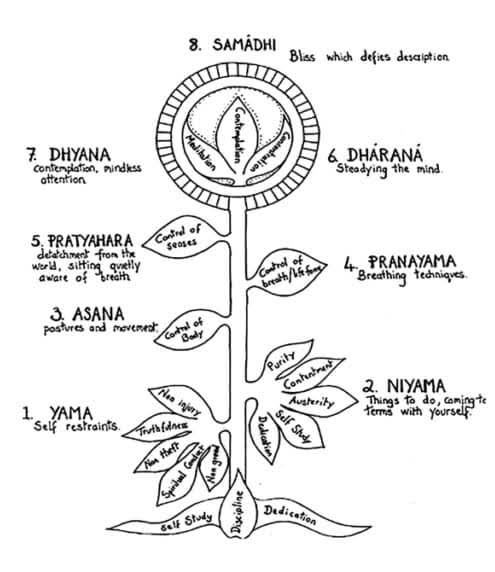
Ashtanga Yoga, as outlined in Sutra 8, serves as a roadmap for the seeker’s journey towards self-realization. The Eight Limbs of Yoga provide a systematic and holistic approach to harmonizing the body, mind, and spirit. Each limb represents a crucial aspect of the yogic path, and together, they form a complete framework for personal transformation.
The Eight Limbs of Yoga:
- Yama (Ethical Principles): Yama refers to the moral and ethical principles that guide our behavior towards ourselves and others. It encompasses concepts such as non-violence (ahimsa), truthfulness (satya), non-stealing (asteya), moderation (brahmacharya), and non-possessiveness (aparigraha). By cultivating these principles, we establish a foundation of integrity and harmonious living.
- Niyama (Personal Observances): Niyama focuses on self-discipline and personal observances. It includes practices such as cleanliness (saucha), contentment (santosha), self-discipline (tapas), self-study (svadhyaya), and surrender to a higher power (ishvara pranidhana). Niyama supports the cultivation of inner strength, self-reflection, and spiritual growth.
- Asana (Physical Postures): Asana refers to the physical postures practiced in yoga. It involves adopting and holding various poses that enhance strength, flexibility, and balance in the body. Asanas prepare the physical body for deeper practices and serve as a means to develop mindfulness, focus, and presence.
- Pranayama (Breath Control): Pranayama involves breath control techniques that harness the life force energy (prana) within us. By regulating the breath through practices such as alternate nostril breathing (nadi shodhana) and breath retention (kumbhaka), we balance and energize the body-mind complex, calming the mind and expanding our vital energy.
- Pratyahara (Withdrawal of the Senses): Pratyahara is the practice of withdrawing the senses from external distractions and turning inward. By detaching from sensory stimuli, we cultivate a state of inner focus, allowing us to navigate our internal landscape with clarity and introspection.
- Dharana (Concentration): Dharana involves developing focused concentration on a single point of focus, such as the breath, a mantra, or an image. It cultivates the ability to hold the mind steady, free from distractions, and prepares the ground for deeper states of meditation.
- Dhyana (Meditation): Dhyana is the state of meditation, characterized by uninterrupted flow of awareness and deep absorption. In Dhyana, the meditator merges with the object of meditation, experiencing a profound sense of oneness and inner stillness. It is a state of expanded consciousness, where the boundaries between the self and the object dissolve.
- Samadhi (Union with the Divine): Samadhi is the ultimate goal of yoga, representing the state of complete union with the divine. It is a state of pure awareness and transcendence, where the meditator experiences the merging of the individual self with the universal consciousness. In Samadhi, the seeker attains a profound realization of their true nature and experiences profound peace, bliss, and liberation.
Ashtanga Yoga, with its Eight Limbs, offers a holistic approach to self-realization and transformation. Each limb builds upon the other, creating a comprehensive system for harmonizing the body, mind, and spirit. By engaging in the practices of Yama and Niyama, we cultivate ethical living and inner discipline, creating a strong foundation for the physical practices of Asana and Pranayama. Pratyahara prepares us for deeper states of concentration (Dharana) and meditation (Dhyana), leading us ultimately to the state of Samadhi, where we experience the unity of all existence.
Benefits:
- Physical Well-being: Ashtanga Yoga enhances physical strength, flexibility, and balance. Regular practice of the asanas improves posture, tones the muscles, and promotes overall health and vitality.
- Emotional Balance: Ashtanga Yoga cultivates emotional stability and resilience. The practices of Pranayama, Dharana, and Dhyana help calm the mind, reduce stress, and foster emotional well-being.
- Mental Clarity: Ashtanga Yoga enhances mental clarity and focus. The practices of Dharana and Dhyana improve concentration, expand awareness, and promote clarity of thought.
- Self-awareness and Self-discovery: Ashtanga Yoga facilitates self-exploration and self-discovery. Through the observance of Yama and Niyama, self-reflection, and meditation, we gain deeper insights into our true nature and develop a greater sense of self-awareness.
- Spiritual Growth: Ashtanga Yoga provides a path for spiritual growth and self-realization. The practices of meditation and Samadhi offer a direct experience of the divine and facilitate the realization of our interconnectedness with all beings.
Intelligence and its Quality
Intelligence, as commonly understood, is often associated with the capacity for learning, understanding, and applying knowledge. It is seen as a cognitive faculty that allows us to solve problems, make decisions, and navigate the complexities of life. However, this conventional understanding of intelligence, while not entirely incorrect, is limited in its scope and depth.
In the realm of true intelligence, knowledge is merely a tool, not the essence. True intelligence transcends the boundaries of knowledge and ventures into the domain of understanding and perception. It is not confined to the intellectual understanding of facts and concepts but extends to the intuitive understanding of life and existence.
Intelligence is not a static entity but a dynamic process. It is not a possession that one can acquire and hold onto, but a state of being that one embodies. It is characterized by a constant flow of understanding, a ceaseless movement of learning and unlearning.
True intelligence is free from ignorance and illusion. It is not clouded by preconceived notions, biases, or prejudices. It sees things as they are, not as they appear to be or as one wishes them to be. It perceives the truth directly, without the interference of thought or the distortion of perception.
Intelligence involves immediate action. It does not procrastinate or delay. When it perceives danger, it moves away from it instantly. It does not wait for thought to process the situation and decide on a course of action. Its response is instantaneous and appropriate.
Dependence on others for affection, love, comfort, or enlightenment is psychologically dangerous and denies intelligence. True intelligence is self-reliant. It does not depend on others for its well-being or fulfillment. It finds its own path and walks it with courage and conviction.
Conforming to patterns laid down by gurus or others also denies intelligence. Intelligence is not about conforming to patterns or following prescribed paths. It is about seeing beyond conformity and following one’s own idiosyncrasies. It is about being true to oneself, regardless of societal norms or expectations.
The mind must be intelligent and enquiring to solve conflicts and miseries. An intelligent mind does not avoid or escape conflicts and miseries but faces them with courage and understanding. It does not seek temporary solutions or quick fixes but delves deep into the root of the problem and resolves it from there.
Intelligence is not violent. It does not impose, dominate, or harm. It is gentle, compassionate, and respectful. It understands that violence, whether physical or psychological, is born out of ignorance and fear, and it strives to transcend these limitations.
Love is inseparable from intelligence. Love, in its truest sense, is not a mere emotion but a state of being that encompasses understanding, empathy, and a sense of responsibility towards oneself and others. It is the total answer and is the responsibility not only to oneself but to the whole of life.
Intelligence is not merely a cognitive faculty but a holistic understanding of life and existence. It is not about acquiring knowledge but about perceiving truth. It is not about conforming to patterns but about being true to oneself. It is not about avoiding conflicts but about resolving them with understanding. It is not about depending on others but about being self-reliant. And most importantly, it is not separate from love but is inseparable from it.Intelligence is a quality that is deeply intertwined with the very fabric of our existence. It is not an isolated attribute, but a comprehensive understanding that permeates every aspect of our lives. It is the lens through which we perceive the world, and the tool with which we navigate through the complexities of life.
The quality of intelligence is not determined by the amount of knowledge one possesses, but by the depth of one’s understanding and the clarity of one’s perception. It is not about knowing many things, but about understanding the essence of things. It is not about accumulating information, but about discerning the truth amidst the noise of information.
Intelligence is not a static entity, but a dynamic process. It is not a possession that one can acquire and hold onto, but a state of being that one embodies. It is characterized by a constant flow of understanding, a ceaseless movement of learning and unlearning. It is not confined to the past or the future, but is rooted in the present. It is not bound by time, but is timeless.
Intelligence is not a solitary endeavor, but a collective journey. It is not about isolating oneself from the world, but about engaging with the world with understanding and compassion. It is not about asserting one’s individuality, but about realizing one’s interconnectedness with all of life.
Intelligence is not about conforming to societal norms or expectations, but about questioning, exploring, and discovering. It is not about following the crowd, but about forging one’s own path. It is not about fitting in, but about standing out. It is not about being accepted, but about being authentic.
Intelligence is not about avoiding challenges or seeking comfort, but about facing challenges with courage and resilience. It is not about seeking security, but about embracing uncertainty. It is not about avoiding risk, but about taking calculated risks. It is not about seeking approval, but about pursuing truth.
Intelligence is not about competing with others, but about collaborating with others. It is not about defeating others, but about uplifting others. It is not about dominating others, but about empowering others. It is not about comparing oneself with others, but about realizing one’s unique potential.
Intelligence is not about accumulating power, but about exercising wisdom. It is not about controlling others, but about inspiring others. It is not about imposing one’s will, but about respecting the freedom of others. It is not about exploiting others, but about serving others.
Intelligence is not about pursuing personal gain, but about contributing to the common good. It is not about seeking personal glory, but about promoting collective wellbeing. It is not about serving oneself, but about serving humanity.
intelligence is not a mere attribute, but a way of life. It is not a means to an end, but an end in itself. It is not a tool for achieving success, but a measure of success. It is not a privilege of the few, but a potential of the many. It is not a gift of nature, but a product of nurture. It is not a matter of chance, but a matter of choice. It is not a question of capacity, but a question of commitment. It is not a matter of birth, but a matter of growth. It is not a matter of inheritance, but a matter of cultivation. It is not a matter of destiny, but a matter of determination. It is not a matter of luck, but a matter of labor. It is not a matter of fate, but a matter of faith. It is not a matter of probability, but a matter of possibility. It is not a matter of speculation, but a matter of exploration. It is not a matter of prediction, but a matter of preparation. It is not a matter of presumption, but a matterof perception. It is not a matter of assumption, but a matter of awareness.
intelligence is about understanding the interconnectedness of all things, about seeing the unity in diversity, about recognizing the harmony in chaos, about finding the order in disorder, about discovering the pattern in randomness, about sensing the rhythm in noise, about discerning the signal in the noise, about perceiving the beauty in the mundane, about appreciating the extraordinary in the ordinary, about realizing the profound in the simple, about acknowledging the sacred in the secular, about seeing the divine in the human, about recognizing the eternal in the temporal, about discerning the infinite in the finite, about perceiving the universal in the particular, about appreciating the whole in the part, about realizing the one in the many, about acknowledging the unity in the plurality, about seeing the truth in the illusion, about recognizing the reality in the appearance, about discerning the essence in the form, about perceiving the substance in the shadow, about appreciating the depth in the surface, about realizing the inner in the outer, about acknowledging the spirit in the matter, about seeing the invisible in the visible, about recognizing the silent in the audible, about discerning the intangible in the tangible, about perceivingthe timeless in the transient, about appreciating the constant in the changing, about realizing the permanent in the fleeting, about acknowledging the unchanging in the changing, about seeing the immutable in the mutable, about recognizing the eternal in the ephemeral, about discerning the absolute in the relative, about perceiving the ultimate in the immediate, about appreciating the transcendent in the immanent, about realizing the divine in the human, about acknowledging the sacred in the profane, about seeing the spiritual in the material, about recognizing the infinite in the finite, about discerning the universal in the particular, about perceiving the cosmic in the personal, about appreciating the macrocosmic in the microcosmic, about realizing the all in the one, about acknowledging the totality in the individual, about seeing the whole in the part, about recognizing the unity in the diversity, about discerning the harmony in the discord, about perceiving the order in the chaos, about appreciating the pattern in the randomness, about realizing the rhythm in the noise, about acknowledging the signal in the noise, about seeing the meaningful in the meaningless, about recognizing the purposeful in the purposeless, about discerning the intentional in the accidental, about perceiving the planned in the spontaneous, about appreciating the designed in the random, about realizing the organized in the disorganized, about acknowledging the structured in the unstructured, about seeing the systematic in the unsystematic, about recognizing the logical in the illogical, about discerning the rational in the irrational, about perceiving the reasonable in the unreasonable, about appreciating the sensible in the nonsensical, about realizing the meaningful in the meaningless, about acknowledging the significant in the insignificant, about seeing the valuable in the worthless, about recognizing the precious in the worthless, about discerning the priceless in the worthless, about perceiving the noble in the ignoble, about appreciating the honorable in the dishonorable, about realizing the dignified in the undignified, about acknowledging the respectable in the disreputable, about seeing the reputable in the disreputable, about recognizing the commendable in the reprehensible, about discerning the praiseworthy in the blameworthy, about perceiving the admirable in the despicable, about appreciating the lovable in the hateful, about realizing the desirable in the undesirable, about acknowledging the attractive in the repulsive, about seeing the beautiful in the ugly, about recognizing the good in the bad, about discerning the positive in the negative, about perceiving the beneficial in the harmful, about appreciating the advantageous in the disadvantageous, about realizing the constructive in the destructive, about acknowledging the creative in the destructive, about seeing the productive in the unproductive, about recognizing the fruitful in the fruitless, about discerning the useful in the useless, about perceiving the helpful in the unhelpful, about appreciating the supportive in the unsupportive, about realizing the cooperative in the uncooperative, about acknowledging the collaborative in the uncollaborative, about seeing the harmonious in the discordant, about recognizing the peaceful in the violent, about discerning the loving in the hateful, about perceiving the compassionate in the cruel, about appreciating the kind in the unkind, about realizing the gentle in the harsh, about acknowledging the soft in the hard, about seeing the tender in the tough, about recognizing the sweet in the bitter, about discerning the pleasant in the unpleasant, about perceiving the enjoyable in the unenjoyable, about appreciating the delightful in the dreadful, about realizing the joyful in the sorrowful, about acknowledging the happy in the unhappy, about seeing the blissful in the miserable, about recognizing the ecstatic in the agonizing, about discerning the heavenly in the hellish,about perceiving the divine in the demonic, about appreciating the godly in the ungodly, about realizing the sacred in the profane, about acknowledging the holy in the unholy, about seeing the spiritual in the material, about recognizing the ethereal in the earthly, about discerning the celestial in the terrestrial, about perceiving the sublime in the mundane, about appreciating the extraordinary in the ordinary, about realizing the miraculous in the commonplace, about acknowledging the wondrous in the commonplace, about seeing the magical in the commonplace, about recognizing the enchanting in the commonplace, about discerning the fascinating in the commonplace, about perceiving the captivating in the commonplace, about appreciating the mesmerizing in the commonplace, about realizing the hypnotizing in the commonplace, about acknowledging the alluring in the commonplace, about seeing the enticing in the commonplace, about recognizing the seductive in the commonplace, about discerning the irresistible in the commonplace, about perceiving the compelling in the commonplace, about appreciating the intriguing in the commonplace, about realizing the interesting in the commonplace, about acknowledging the engaging in the commonplace, about seeing the absorbing in the commonplace, about recognizing the involving in the commonplace, about discerning the immersing in the commonplace, about perceiving the engrossing in the commonplace, about appreciating the enthralling in the commonplace, about realizing the thrilling in the commonplace, about acknowledging the exciting in the commonplace, about seeing the stimulating in the commonplace, about recognizing the invigorating in the commonplace, about discerning the energizing in the commonplace, about perceiving the revitalizing in the commonplace, about appreciating the refreshing in the commonplace, about realizing the rejuvenating in the commonplace, about acknowledging the renewing in the commonplace, about seeing the restoring in the commonplace, about recognizing the healing in the commonplace, about discerning the curing in the commonplace, about perceiving the remedying in the commonplace, about appreciating the rectifying in the commonplace, about realizing the correcting in the commonplace, about acknowledging the righting in the commonplace, about seeing the amending in the commonplace, about recognizing the improving in the commonplace, about discerning the enhancing in the commonplace, about perceiving the enriching in the commonplace, about appreciating the augmenting in the commonplace, about realizing the increasing in the commonplace, about acknowledging the expanding in the commonplace, about seeing the extending in the commonplace, about recognizing the broadening in the commonplace, about discerning the widening in the commonplace, about perceiving the deepening in the commonplace, about appreciating the intensifying in the commonplace, about realizing the magnifying in the commonplace, about acknowledging the amplifying in the commonplace, about seeing the heightening in the commonplace, about recognizing the elevating in the commonplace, about discerning the uplifting in the commonplace, about perceiving the raising in the commonplace, about appreciating the advancing in the commonplace, about realizing the progressing in the commonplace, about acknowledging the developing in the commonplace, about seeing the evolving in the commonplace, about recognizing the growing in the commonplace, about discerning the maturing in the commonplace, about perceiving the ripening in the commonplace, about appreciating the blossoming in the commonplace, about realizing the flowering in the commonplace, about acknowledging the blooming in the commonplace, about seeing the flourishing in the commonplace, about recognizing the thriving in the commonplace, about discerning the prospering in the commonplace, about perceiving the succeeding in the commonplace, about appreciating the winning in the commonplace, about realizing the triumphing in the commonplace, about acknowledging the conquering in the commonplace, about seeing the mastering in the commonplace, about recognizing the dominating in the commonplace, about discerning the ruling in the commonplace, about perceiving the reigning in the commonplace, about appreciating the governing inthe commonplace, about realizing the leading in the commonplace, about acknowledging the directing in the commonplace, about seeing the guiding in the commonplace, about recognizing the steering in the commonplace, about discerning the piloting in the commonplace, about perceiving the navigating in the commonplace, about appreciating the driving in the commonplace, about realizing the propelling in the commonplace, about acknowledging the pushing in the commonplace, about seeing the moving in the commonplace, about recognizing the proceeding in the commonplace, about discerning the advancing in the commonplace, about perceiving the progressing in the commonplace, about appreciating the developing in the commonplace, about realizing the evolving in the commonplace, about acknowledging the transforming in the commonplace, about seeing the changing in the commonplace, about recognizing the altering in the commonplace, about discerning the modifying in the commonplace, about perceiving the adjusting in the commonplace, about appreciating the adapting in the commonplace, about realizing the conforming in the commonplace, about acknowledging the complying in the commonplace, about seeing the obeying in the commonplace, about recognizing the following in the commonplace, about discerning the heeding in the commonplace, about perceiving the listening in the commonplace, about appreciating the hearing in the commonplace, about realizing the understanding in the commonplace, about acknowledging the comprehending in the commonplace, about seeing the grasping in the commonplace, about recognizing the catching in the commonplace, about discerning the getting in the commonplace, about perceiving the acquiring in the commonplace, about appreciating the learning in the commonplace, about realizing the studying in the commonplace, about acknowledging the investigating in the commonplace, about seeing the researching in the commonplace, about recognizing the exploring in the commonplace, about discerning the discovering in the commonplace, about perceiving the finding in the commonplace, about appreciating the locating in the commonplace, about realizing the identifying in the commonplace, about acknowledging the recognizing in the commonplace, about seeing the distinguishing in the commonplace, about recognizing the discerning in the commonplace, about discerning the perceiving in the commonplace, about perceiving the noticing in the commonplace, about appreciating the observing in the commonplace, about realizing the watching in the commonplace, about acknowledging the looking in the commonplace, about seeing the seeing in the commonplace, about recognizing the viewing in the commonplace, about discerning the examining in the commonplace, about perceiving the inspecting in the commonplace, about appreciating the scrutinizing in the commonplace, about realizing the analyzing in the commonplace, about acknowledging the evaluating in the commonplace, about seeing the assessing in the commonplace, about recognizing the appraising in the commonplace, about discerning the estimating in the commonplace, about perceiving the calculating in the commonplace, about appreciating the measuring in the commonplace, about realizing the weighing in the commonplace, about acknowledging the considering in the commonplace, about seeing the pondering in the commonplace, about recognizing the contemplating in the commonplace, about discerning the meditating in the commonplace, about perceiving the reflecting in the commonplace, about appreciating the musing in the commonplace, about realizing the thinking in the commonplace, about acknowledging the reasoning in the commonplace, about seeing the rationalizing in the commonplace, about recognizing the intellectualizing in the commonplace, about discerning the conceptualizing in the commonplace, about perceiving the imagining in the commonplace, about appreciating the visualizing in the commonplace, about realizing the dreaming in the commonplace and the list will go on!!
**Commonplace refers to everyday experiences and situations!!
Patanjali Yoga Sutra: Tatra Pratyayaikatanata Dhyanam
This sutra is Sutra 7, which introduces the concept of Dharana, the practice of concentration and single-pointed focus. Dharana is a vital step in the path of yoga, leading us to harness the power of our mind and cultivate unwavering attention. Let us dive into the essence of Sutra 7 and discover how Dharana can enhance our practice and elevate our lives.
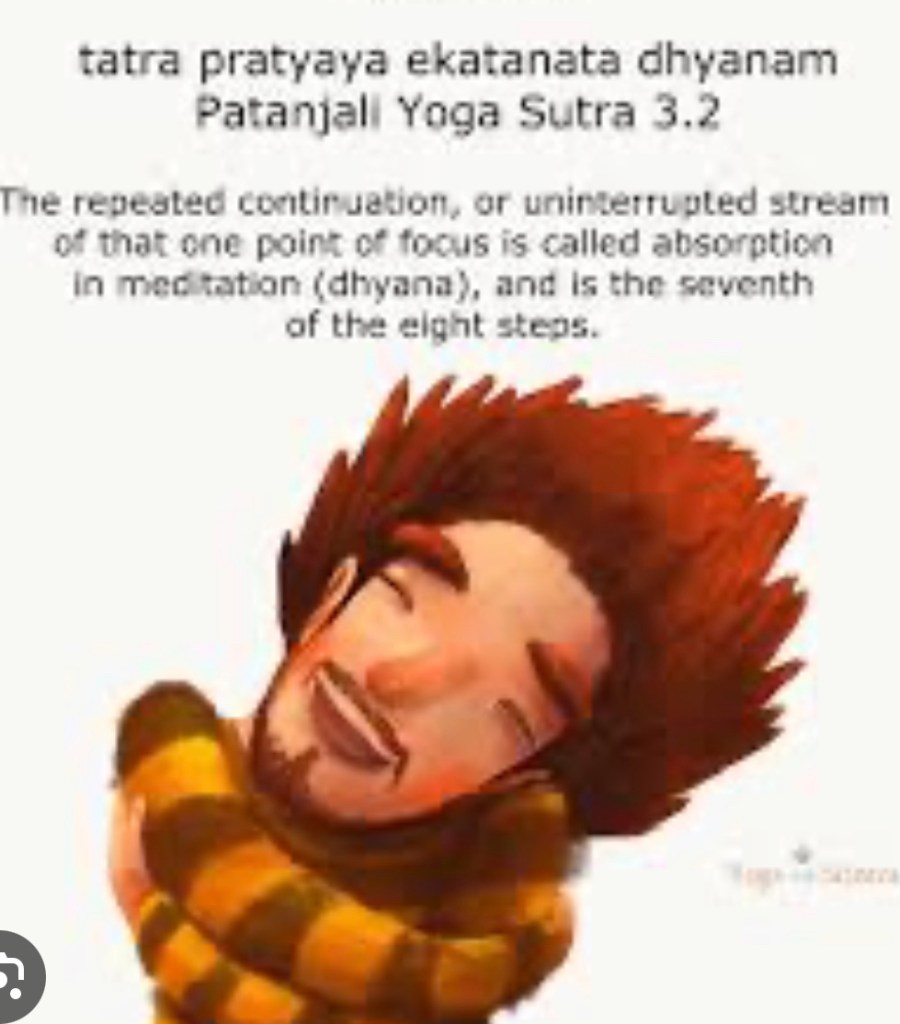
Sutra 7 encapsulates the essence of Dharana, emphasizing the continuous flow of attention towards a chosen object or point of focus. Dharana involves training the mind to sustain unwavering concentration, free from distractions and wavering thoughts.
Dharana is derived from the Sanskrit word “dhar,” which means “to hold” or “to concentrate.” It refers to the practice of directing and sustaining our attention on a specific object, such as the breath, a mantra, a visualization, or a chosen point of focus. Through Dharana, we cultivate the ability to hold our mind steady and prevent it from wandering aimlessly.
Practical Application of Dharana:
- Selecting a Point of Focus: Begin by selecting a point of focus for your concentration practice. This could be the sensation of the breath at the nostrils, a specific image or object, a mantra, or even a particular part of the body. Choose an object that resonates with you and facilitates concentration.
- Creating a Distraction-Free Environment: Find a quiet and calm space where you can practice Dharana without distractions. Create an environment that supports your practice, free from external disturbances.
- Steadying the Mind: As you begin your practice, gently bring your attention to the chosen object of focus. Allow your mind to settle and rest upon this focal point. When distractions arise, acknowledge them without judgment and gently guide your attention back to the chosen object.
- Cultivating Mental Discipline: Dharana requires discipline and persistence. Gradually increase the duration of your practice, starting with shorter periods and gradually extending them over time. This cultivates mental strength and trains the mind to sustain focus for more extended periods.
- The Power of Anchoring Techniques: Utilize anchoring techniques to enhance concentration. This can include visualizations, repetition of a mantra, or counting the breath. These techniques provide a focal point for the mind, allowing it to rest and remain anchored in the present moment.
Dharana holds immense significance on the yogic path. Through the cultivation of concentration, we develop a heightened state of awareness, mental clarity, and focus. Dharana enables us to penetrate the layers of the mind, transcend distractions, and tap into our innate potential.
Benefits:
Enhanced Mental Clarity: Dharana sharpens the mind and enhances mental clarity. As we practice sustained concentration, the mind becomes more focused, allowing us to cut through mental chatter and gain insight into the nature of our thoughts and emotions.
Heightened Sensory Awareness: Dharana enhances sensory awareness, enabling us to perceive the world with greater clarity and depth. By directing our attention to a chosen object, we become attuned to its subtleties and nuances, cultivating a profound connection with our environment.
Expanded Mindfulness: Dharana deepens our capacity for mindfulness, the art of being fully present in the moment. As we train our mind to stay focused on a single point, we develop a heightened sense of awareness and engage in the present experience with greater clarity and attentiveness.
Improved Mental Discipline: Dharana cultivates mental discipline, strengthening our ability to direct and sustain our attention. This discipline extends beyond the yoga mat, positively impacting other areas of our lives, such as work, relationships, and creative endeavors.
Harnessing the Power of the Mind: Dharana empowers us to harness the immense power of our mind. With focused attention, we gain control over our thoughts, emotions, and reactions, allowing us to respond to life’s challenges with clarity, equanimity, and wisdom.
With patience, persistence, and regular practice, we can develop a laser-like focus that permeates every aspect of our being. Through Dharana, we invite a state of unwavering concentration, opening the doors to self-discovery, transformation, and profound spiritual growth.
Patanjali Yoga Sutra: Tasya Bhumishu Viniyogah
This sutra delves into the depths of Sutra 6, which introduces the concept of Pratyahara, the withdrawal of the senses. Pratyahara serves as a crucial step in the path of yoga, allowing us to turn inward, transcend external distractions, and cultivate a deeper connection with our true selves.
This sutra is short but powerful, acting as a bridge between the external aspects of yoga (Yama, Niyama, Asana, Pranayama) and the internal dimensions of meditation (Dharana, Dhyana, Samadhi). It signifies the importance of Pratyahara, the practice of withdrawing the senses from external stimuli and redirecting our focus inward.
Understanding Pratyahara:
Pratyahara is derived from the Sanskrit words “prati,” meaning “against” or “away,” and “ahara,” meaning “food” or “nourishment.” In the context of yoga, it refers to the conscious withdrawal of the senses from the external world and the subsequent redirection of attention to the inner realm. It is the art of detaching from sensory distractions and turning inward to explore the subtler layers of our being.
Practical Application of Pratyahara:
- Sensory Awareness: Begin by cultivating mindful awareness of your senses. Observe how external stimuli, such as sights, sounds, smells, tastes, and touch, impact your state of mind and draw your attention outward. By developing heightened sensory awareness, you can consciously choose which stimuli to engage with and which to let pass without getting entangled in their influence.
- Breath as an Anchor: Utilize the breath as an anchor to redirect your focus inward. By centering your attention on the gentle rhythm of your breath, you create a bridge between the external and internal realms. The breath becomes a powerful tool to quieten the mind and cultivate a sense of inner stillness.
- Meditation and Mindfulness: Engage in regular meditation and mindfulness practices to deepen your ability to withdraw the senses. By observing thoughts, emotions, and sensations without judgment or attachment, you cultivate a spacious awareness that allows for greater insight and self-discovery.
- Creating a Sacred Space: Designate a dedicated space for your practice, free from external distractions. This can be a quiet corner in your home or a serene outdoor environment. By creating a sacred space, you set the stage for deeper introspection and facilitate the process of Pratyahara.
The Transformative Power of Pratyahara:
Pratyahara holds immense significance in the yogic journey. Through the practice of withdrawing the senses, we develop a heightened sense of self-awareness, inner strength, and mental clarity. We detach from the constant fluctuations of the external world and discover a deeper connection with our true nature. Pratyahara creates the foundation for deepening meditation, expanding consciousness, and experiencing the higher states of yoga, such as Dharana (concentration), Dhyana (meditation), and Samadhi (union with the divine).
Benefits:
Inner Stillness and Calm: Pratyahara allows us to cultivate a sense of inner stillness, free from the distractions of the external world. This cultivates a deep sense of calm and tranquility, providing respite from the busyness and chaos of daily life. We tap into a wellspring of peace that exists within us, regardless of the circumstances around us.
Heightened Self-Awareness: Through the practice of Pratyahara, we develop a profound awareness of our internal landscape. We become attuned to our thoughts, emotions, and sensations, allowing us to navigate our inner world with clarity and understanding. This self-awareness empowers us to make conscious choices and respond skillfully to life’s challenges.
Freedom from External Influences: Pratyahara liberates us from the grip of external stimuli. We break free from the conditioned patterns of seeking pleasure or avoiding discomfort that often dictate our actions. By withdrawing our senses, we reclaim our autonomy and no longer feel compelled to react blindly to the external world.
Cultivation of Inner Strength: Pratyahara strengthens our inner resilience and fortitude. As we learn to detach from external distractions, we develop a sense of inner stability and a deeper connection with our true essence. This inner strength allows us to navigate the ups and downs of life with grace and equanimity.
Deepening of Meditation: Pratyahara serves as a gateway to deeper states of meditation. By withdrawing our senses, we create a fertile ground for concentration, mindfulness, and the expansion of consciousness. We can explore the depths of our inner being, unravel the mysteries of the mind, and connect with the boundless wisdom that resides within us.
As we integrate the practice of Pratyahara into our lives, let us remember that it is not about rejecting or suppressing the external world, but rather cultivating a balanced relationship with our senses. By withdrawing from the external stimuli with mindful awareness, we create space for self-discovery, inner stillness, and a profound connection with our own being.
Understanding the Complexities of Communication beyond Expectations and Conflict
How do you know when it’s time to unplug? What do you do to make it happen?
Communication is a fundamental aspect of human interaction, connecting us with one another on various levels. However, despite our best intentions, we often find ourselves in situations where communication becomes difficult, leading to misunderstandings, conflicts, and unmet expectations.
One of the primary reasons communication becomes challenging is our tendency to hold expectations of how others should respond or behave. We create mental scripts of how conversations should unfold, and when reality doesn’t align with our expectations, frustration and conflict arise. communication often gets entangled in the web of our own needs and desires. We may approach conversations with the underlying motivation of seeking validation, acceptance, or care from others. This creates an imbalance and makes authentic communication difficult.

Some possible reasons of communication being difficult:
Assumptions and Misinterpretations: When we withhold our thoughts and emotions, assuming that the other person might get hurt, we leave room for assumptions and misinterpretations to arise. Our silence may be misinterpreted as disapproval or indifference, leading to misunderstandings and potential conflict.
Lack of Clarity and Openness: By not expressing ourselves openly, we deprive the other person of an opportunity to understand our perspective fully. Without clear communication, there is a higher likelihood of miscommunication or projection of our own assumptions onto the situation, which can fuel conflict.
Unresolved Emotions: Suppressing our thoughts and feelings in an attempt to prevent conflict can lead to the accumulation of unresolved emotions. Over time, these pent-up emotions may build up and eventually explode, causing an intense conflict that could have been avoided through open and honest communication.
Ineffective Communication Patterns: If we consistently choose silence to avoid conflict, it can become a pattern in our communication. This pattern may create a sense of distance and lack of connection between individuals, further exacerbating the potential for conflict when issues do arise.
Unmet Needs and Expectations: By choosing not to express ourselves, we may unintentionally create a gap between our own needs and the other person’s understanding of them. This mismatch can result in unmet expectations and unaddressed concerns, which can eventually lead to frustration and conflict.
Loss of Authenticity and Intimacy: When we withhold our thoughts and emotions, we sacrifice authenticity and genuine connection in our relationships. This can create a sense of disconnection and hinder the development of deep, meaningful bonds, potentially leading to conflicts arising from unexpressed needs and unspoken desires.
Conflicts can emerge even when we choose not to say anything out of concern for the other person’s feelings. Understanding the underlying dynamics and cultivating effective communication skills can help us navigate these situations with greater clarity, empathy, and harmony.
Patanjali Yoga sutra: Vrittayah Pancatayyah Klishtaklishtah
In the ancient teachings of Yoga, the fifth sutra of Patanjali’s Yoga Sutras holds profound wisdom and insight. It states: “Vrittayah Pancatayyah Klishtaklishtah,” which can be translated as “There are five types of mental modifications, which can be either painful or non-painful.”
This sutra offers us a deeper understanding of the nature of our mind and its various states of being. It recognizes that the mind is not a singular entity, but rather a dynamic interplay of different mental modifications, or vrittis, that shape our experience of reality.
According to Patanjali, these vrittis can be categorized into five types. They are:
- Valid Cognition (Pramana): This refers to mental modifications that arise from valid sources of knowledge, such as direct perception, inference, and reliable testimony. These vrittis are considered non-painful as they provide accurate and clear understanding of the world around us.
- Misconception (Viparyaya): This type of vritti arises when our perceptions and interpretations are distorted or incorrect. It leads to a distorted understanding of reality and can result in confusion and suffering. Viparyaya is a painful mental modification as it creates a sense of disconnection from truth.
- Verbal Delusion (Vikalpa): Vikalpa refers to the mental modifications that arise from imagination, conceptualization, and verbal constructs. These vrittis are based on linguistic constructs and can be either factual or fictional. While they can be helpful in certain contexts, they can also lead to confusion and suffering when we mistake them for ultimate reality.
- Sleep (Nidra): Nidra represents the mental modifications that arise during deep sleep or dreamless states. It is a state of unconsciousness where the mind is temporarily inactive. While Nidra is considered non-painful, it can become a source of suffering if we become attached to or dependent on sleep as a means of escape from the challenges of waking life.
- Memory (Smriti): Smriti refers to the mental modifications that arise from the recollection and retention of past experiences. Memories can evoke a wide range of emotions and can either be non-painful or painful depending on the content and our attachment to them. Attachment to pleasant memories can lead to craving and clinging, while attachment to painful memories can cause suffering.
Patanjali’s sutra reminds us that our mind is constantly in a state of flux, moving between these different types of mental modifications. It is through the cultivation of awareness and discernment that we can recognize the nature of our vrittis and their impact on our well-being.
By understanding the different types of mental modifications, we can begin to observe our own thought patterns and emotional reactions more objectively. We can discern which vrittis are helpful and supportive of our growth and which ones are causing suffering and limitation.
Through the practice of Yoga, we develop the ability to cultivate non-attachment to the fluctuations of the mind. We learn to witness the vrittis with detachment and without judgment, allowing them to arise and pass away without becoming entangled in their narratives.
By cultivating a state of inner stillness and clarity, we can transcend the influence of painful vrittis and cultivate more non-painful and beneficial mental states. We can access the inherent wisdom and insight that arises from a mind that is free from distortion and delusion.
Patanjali’s sutra invites us to explore the depths of our own consciousness and gain a deeper understanding of the workings of our mind. It is an invitation to cultivate a state of equanimity, where we can navigate the challenges of life with clarity, compassion, and wisdom.
This sutra reminds us that our mind is a multifaceted landscape, filled with a myriad of mental modifications. These modifications can either bring us joy and clarity or cause us pain and suffering. Through our daily experiences, we can observe the constant interplay of these vrittis and how they shape our perception of the world.
The first type of vritti, valid cognition or pramana, emphasizes the importance of acquiring knowledge from reliable sources. It encourages us to seek truth through direct perception, logical reasoning, and trustworthy testimony. By cultivating discernment and critical thinking, we can distinguish between what is real and what is illusory, leading to a more accurate understanding of ourselves and the world around us.
On the other hand, misconception or viparyaya represents the vrittis that arise from distorted perceptions. It is through the lens of misconception that we create false narratives and beliefs, often leading to confusion and misinterpretation. Recognizing and unraveling these misconceptions is crucial for developing clarity and aligning ourselves with the truth.
Vikalpa, or verbal delusion, highlights the power of language and conceptualization. Our mind has the incredible ability to construct imaginary scenarios, stories, and concepts. While this can be useful for communication and creativity, it can also lead us astray if we mistake these constructs for reality. Through self-inquiry and mindfulness, we can untangle ourselves from the web of verbal delusion and reconnect with the direct experience of the present moment.
The vritti of sleep, nidra, represents a state of unconsciousness where the mind temporarily rests. Although sleep is necessary for rejuvenation, it can become a source of escapism if we use it as a means to avoid facing our challenges and responsibilities. Developing a healthy relationship with sleep involves finding a balance between rest and engagement with life, so that we may fully participate in the world without becoming overwhelmed or disconnected.
Finally, memory or smriti encompasses the mental modifications that arise from past experiences. Memories have the power to shape our perception of the present moment and influence our emotions and actions. By cultivating awareness and non-attachment to memories, we can navigate the present with greater clarity, free from the limitations of past conditioning.
Patanjali Sutra: Tada drashtuh svarupe avasthanam – Then the seer abides in its own nature.
“Tada drashtuh svarupe avasthanam” translates to “Then the seer abides in its own nature,” signifying the profound state of self-realization that can be attained through the practice of Yoga.
The sutra points to a crucial aspect of the yogic journey – the recognition and realization of our essential nature beyond the fluctuations of the mind. It suggests that when the mind is stilled, and the fluctuations cease, the seer, our true Self, can abide in its own nature, free from the limitations and identifications imposed by the egoic mind.
The term “seer” refers to our true Self, the witnessing consciousness that is capable of observing and experiencing the activities of the mind. It is the unchanging, eternal essence that lies beyond the realm of thoughts, emotions, and sensory perceptions. In this sutra, Patanjali emphasizes that the ultimate purpose of Yoga is for the seer to abide in its true nature, transcending the illusions and limitations of the conditioned mind.
The phrase “abides in its own nature” points to a state of profound self-realization and self-acceptance. It signifies a deep sense of connection and alignment with our true essence, where we no longer identify with the fluctuations of the mind or seek validation from external sources. Instead, we find a sense of wholeness and completeness within ourselves, knowing that our true nature is untouched by the impermanent and ever-changing nature of the world.
The practice of Yoga becomes a means to quiet the mind, dissolve the egoic attachments, and awaken to the truth of our being. Through practices such as meditation, self-inquiry, and self-reflection, we gradually peel away the layers of conditioning and false identifications, allowing the seer to emerge and abide in its own nature.
When the mind is calm and the incessant chatter subsides, we gain access to a deeper level of consciousness – a state of pure awareness, free from the grip of thoughts and distractions. In this state, we experience the profound stillness, clarity, and expansiveness that lie at the core of our being. We recognize that our true nature is inherently peaceful, blissful, and limitless.
The realization of the seer abiding in its own nature brings forth a radical transformation in our perception of ourselves and the world. We begin to see through the illusions of separation and duality, recognizing the interconnectedness and oneness of all existence. We realize that our true Self is not separate from the universal consciousness but an integral part of it, intimately connected to the fabric of life.
This sutra serves as an invitation to embark on the path of self-discovery, to explore the depths of our being, and to awaken to the truth of who we really are. It reminds us that the practice of Yoga is not merely a physical exercise or a way to achieve temporary peace of mind, but a profound spiritual journey that leads to self-realization and liberation.
As we immerse ourselves in the practice of Yoga, let us remember the essence of this sutra – the potential for the seer to abide in its own nature. Let us cultivate the stillness, the self-inquiry, and the awareness necessary to transcend the limitations of the mind and awaken to the vastness and beauty of our true Self.
May this sutra inspire us to delve deeper into our own consciousness, to unravel the layers of conditioning, and to experience the profound peace, joy, and freedom that arise when the seer abides in its own nature. It is a journey of self-discovery that goes beyond the superficial layers of our identity and taps into the eternal essence that resides within.
As we delve into the practice of Yoga, we gradually develop the ability to witness the movements of the mind without getting entangled in them. We observe the thoughts, emotions, and sensations that arise, but we no longer identify with them as the core of our being. Instead, we recognize them as passing phenomena, like clouds drifting across the sky of our awareness.
Through the consistent practice of Yoga, we cultivate a state of inner stillness that allows the seer to shine forth. In this state, the mind becomes a tool, a vehicle for the expression of our true nature. We no longer perceive ourselves as separate entities struggling to navigate through life’s challenges, but as an integral part of the universal flow, connected to all beings and all of existence.
The realization that the seer abides in its own nature brings forth a profound sense of liberation. We are no longer bound by the limitations of the ego, the fears and desires that keep us trapped in patterns of suffering. Instead, we tap into an infinite wellspring of love, compassion, and wisdom that emerges from the depths of our being.
With this awareness, our actions become infused with a higher purpose. We engage in the world with a sense of clarity and intention, guided by the innate wisdom of our true Self. We no longer seek validation or fulfillment from external sources but draw upon the wellspring of inner abundance that flows from the recognition of our own inherent divinity.
In the realization of the seer abiding in its own nature, we discover a sense of wholeness and completeness that transcends the transient nature of the external world. We recognize that true happiness and fulfillment can never be found in the pursuit of external achievements or possessions. Instead, it arises from the deep connection to our true Self, where we find an unshakable peace and joy that is independent of external circumstances.
The practice of Yoga is an invitation to turn inward, to explore the vastness of our own consciousness, and to realize the truth of our being. It is a journey of self-discovery that unravels the layers of conditioning and reveals the eternal essence that resides within each and every one of us.
May we embrace the essence of Patanjali’s sutra and embark on the profound journey of self-realization. May we cultivate the stillness, awareness, and self-inquiry necessary for the seer to abide in its own nature. And may we experience the boundless peace, love, and freedom that arise when we recognize our true Self.
In the realization of the seer abiding in its own nature, we awaken to the beauty and wonder of life, realizing that we are not separate observers but active participants in the unfolding of the cosmic dance. Let us celebrate the journey of self-discovery, for it is through this journey that we come to know the true essence of our being and find our rightful place in the interconnected web of existence.
 Abhishek Fanse