The Monk and the Cherry Blossom: A Tale of Impermanence
Once upon a time in the heart of ancient Japan, there was a small Buddhist temple nestled in the verdant slopes of a quiet mountain. The temple was home to an old Zen master, and his young apprentice, Hiroshi. Their daily life was simple, revolving around meditation, mindfulness, and chores.
In the center of the temple garden stood a magnificent cherry tree, its blossoms blanketing the garden every spring in a sea of soft pink. Hiroshi, the apprentice, was particularly fond of this tree. Every spring, he would marvel at its beautiful blooms, losing himself in the breathtaking spectacle.
One spring, Hiroshi noticed something that filled his heart with dread. The cherry tree, once laden with countless flowers, was beginning to shed its blossoms earlier than usual. The young monk grew increasingly anxious as he watched the vibrant petals fall, leaving the once magnificent tree almost bare.
Distressed, Hiroshi approached the Zen master. “Master,” he said, “Our cherry tree is losing its blossoms. They’re falling before their time. We must do something!”
The old master, looking at Hiroshi with kind eyes, replied, “And what makes you think they’re falling before their time, Hiroshi?”
“The tree has always been full of blossoms at this time of year,” Hiroshi responded. “But look at it now. Its beauty is fading!”
With a gentle smile, the master led Hiroshi to the cherry tree. As they stood beneath its branches, a soft wind blew, carrying away a flurry of pink petals. Watching the petals dance in the wind, the master spoke, “Hiroshi, this is the nature of all things. It is the principle of Anicca, of impermanence.”
“Impermanence, Master?” Hiroshi asked, his eyes still fixed on the falling petals.
“Yes, Hiroshi,” the master continued. “Every single thing in this universe, every blossom, every tree, even we ourselves, are impermanent. Everything is subject to change and decay. It’s a natural process, one that we cannot resist. The beauty of the cherry blossoms lies not despite their impermanence, but because of it.”
The master paused, then added, “Embracing Anicca, understanding impermanence, brings with it a deep appreciation of each moment. It releases us from fear and attachment and helps us to live in harmony with the true nature of existence.”
Hiroshi took a moment to absorb his master’s words, watching as the last few petals drifted from the tree. Then, he looked around him, taking in the garden, the mountain, the sky – all in a constant state of change. A sense of peace settled in his heart.
From that day forward, Hiroshi saw the world with new eyes. Every falling petal, every gust of wind, every moment of silence was a reminder of the ever-changing nature of existence. Through understanding Anicca, he found a greater appreciation for each fleeting moment, seeing the inherent beauty in the impermanence of all things.
The cherry tree continued its cycle of blooming and shedding, its beauty undiminished. And the young monk, embracing the wisdom of impermanence, continued his journey on the path of Zen, his understanding deepening like the endless layers of a boundless ocean.
Dancing with Life: A Zen Perspective on Compulsiveness
We live in a world that thrives on habit and repetition. Our days are often filled with routines, activities, thoughts, and emotions that repeat themselves over and over again. This can lead to a state of compulsiveness, where we are constantly being driven by our habitual patterns and conditioned responses. The problem arises when we become enslaved by these patterns, forgetting that we are the ones who hold the reins of our lives.
From a Zen perspective, compulsiveness arises from a lack of awareness and understanding of our true nature. It is a product of the illusion that we are separate entities, disconnected from the flow of life. This illusion fosters desire, fear, and clinging, which in turn feed our compulsive behaviors.
In Zen teachings, the remedy to compulsiveness is not to suppress or fight against it, but rather to observe it, understand it, and transcend it through the power of mindfulness and insight. By becoming aware of our compulsive tendencies, we can start to see them for what they truly are: empty phenomena arising and passing away.
Through mindful observation, we can see that our compulsive thoughts, emotions, and behaviors are not truly ours. They are conditioned responses arising due to various causes and conditions. With this insight, we can start to let go of our identification with them.
The Zen practice of zazen or seated meditation is a powerful tool in this process. In zazen, we sit silently and observe the workings of our mind without judgment or interference. As we sit, we can start to see our compulsive patterns more clearly. We can see how they arise, how they persist, and how they cease.
But understanding and observing compulsiveness is not enough. We also need to cultivate a new way of being, one that is based on presence, openness, and flexibility. Instead of clinging to our habitual patterns, we can learn to dance with life, to move with the ebb and flow of experiences without losing our balance.
The purpose of Zen practice is not to become a passive observer of life, but to fully engage with it in a free and spontaneous way. It is about learning to respond to each moment with freshness and creativity, free from the constraints of habitual patterns.
So, let us take up the challenge of understanding and transcending our compulsiveness. Let us cultivate mindfulness and insight, and learn to dance freely with life. Only then can we taste the true freedom and joy that is our birthright.
The Effortless Beauty of Being: Lessons from the Lily and the Rose
Nature has long been a source of inspiration and wisdom for humanity. The lily and the rose, two of the most admired flowers in the world, provide a potent lesson in authenticity and effortless beauty. Their essence is found not in pretension, but in their innate ability to be what they are. This blog post delves into this beautiful metaphor and the profound lessons it holds for us as human beings.
The Lily and the Rose:
Lilies and roses, beloved by poets, artists, and nature enthusiasts alike, have a unique beauty and grace. This beauty doesn’t arise from attempting to be something else, but from the effortless expression of their true nature. A lily doesn’t strain to become a rose, nor does a rose yearn to resemble a lily. They bloom as themselves, unfettered by comparison or imitation.

Authenticity – The True Beauty:
Just like the lily and the rose, our true beauty as individuals lies in our authenticity, in being ourselves without pretense. In a world often governed by comparison and conformity, it can be tempting to shape ourselves according to societal standards and expectations. However, this external shaping often leads us away from our true nature.
The lily and the rose teach us that true beauty isn’t found in pretense or imitation, but in expressing our genuine selves. There’s an effortless beauty in being what we truly are, a beauty that shines forth when we are in alignment with our true nature.
Embracing Our Uniqueness:
Just as each lily and each rose is unique in its shape, size, and scent, so too are we as individuals. Our uniqueness isn’t a flaw to be corrected but a gift to be celebrated. When we embrace our distinctiveness, we allow our authentic selves to shine forth.
This doesn’t mean we should not strive for growth or self-improvement. Rather, it is about honoring and accepting our true selves as the foundation for genuine growth. It’s about understanding that true transformation doesn’t come from pretense or forced change, but from an authentic embrace of who we truly are.
The lily and the rose remind us of the effortless beauty of authenticity. They teach us that we don’t need to pretend or strive to be something we’re not. Our greatest beauty, like theirs, lies in the simple, unpretentious expression of our true nature.
In a world that often encourages us to compare ourselves to others and to conform to societal expectations, let’s remember the wisdom of the lily and the rose. Let us embrace our own unique beauty and let it shine forth, as effortlessly as a flower blooming in the sun. Our beauty, like that of the lily or the rose, is in being what we are, unapologetically and with grace.
The Wholeness of Being: When Nothing is Lacking, the World Belongs to You
At the heart of many spiritual traditions lies the profound understanding that, in essence, we lack nothing. This understanding is not about physical possession or material abundance, but rather a deeper, more essential sense of completeness within oneself. This blog post explores the profound realization that when we understand that nothing is lacking within us, we feel as though the whole world belongs to us.

The Illusion of Lack:
In our everyday lives, it is easy to feel a sense of lack or deficiency. We often believe we need something more – more money, more recognition, more love, a better job, or a different body – to be complete and happy. This perceived lack can lead to feelings of dissatisfaction, anxiety, and longing. However, this sense of insufficiency is often a product of our conditioned mind, not an inherent aspect of our true nature.
The Realization of Wholeness:
At a deeper level of our being, beyond the constructs of the mind, we are already whole and complete. This wholeness is not dependent on external factors or circumstances. It is an inherent aspect of our true nature. When we realize this fundamental wholeness, we understand that nothing is lacking. We are complete, just as we are, here and now.
This realization often arises from a deep inner journey that may involve meditation, contemplation, mindfulness, or other spiritual practices. It requires us to look beyond our surface-level wants and desires to the deeper reality of our inherent completeness.
The World Belongs to You:
When we realize that nothing is lacking, our perspective of the world around us transforms. We begin to experience life from a place of abundance rather than scarcity. This shift in perception is not about owning the world in a literal sense. Rather, it’s about experiencing a profound sense of unity and connection with all of existence.
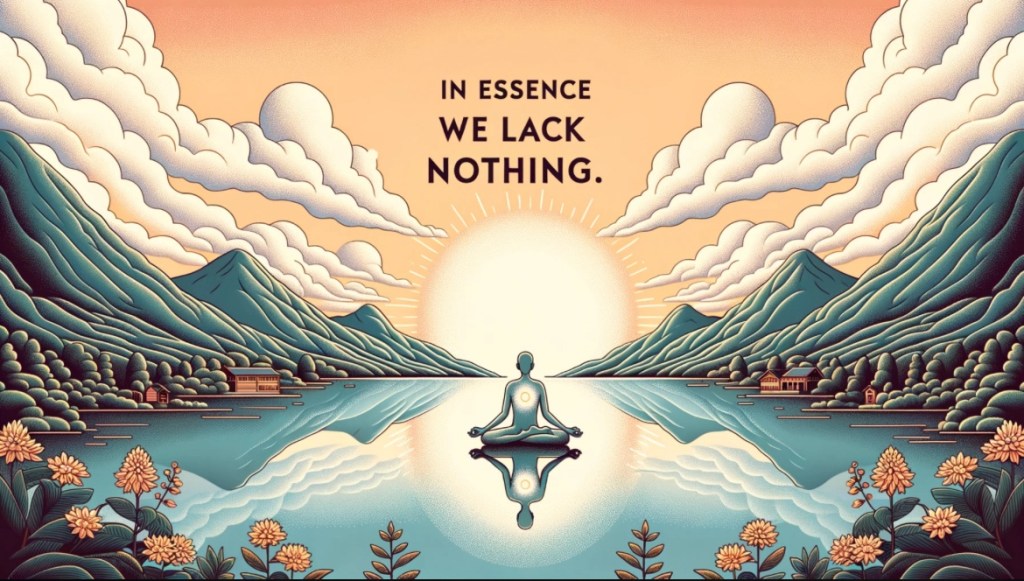
Feeling that the world belongs to us means experiencing a deep resonance with life itself. We can appreciate and love the world without needing to possess or control it. We can enjoy the beauty of a sunset, the scent of a flower, or the smile of a loved one without needing to cling to these experiences.
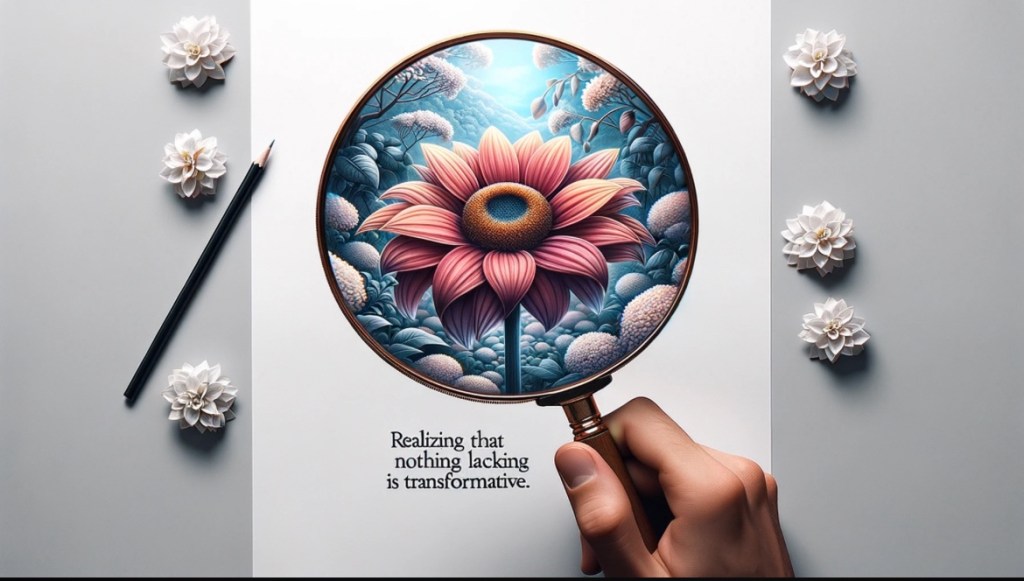
Realizing that nothing is lacking is a powerful and transformative understanding. It invites us to see beyond the surface-level perceptions of lack and deficiency that often cloud our experience of life. This realization helps us to connect with our inherent wholeness and to experience the world from a place of abundance and completeness. When we understand that we lack nothing, we can truly feel as though the world belongs to us, not in a sense of possession, but in a profound sense of unity and interconnectedness.
The Innate Perfection of ‘The Way’: An Exploration of Ineffable Experience
The spiritual path, often referred to as ‘The Way’, is an enduring theme across diverse religious and philosophical traditions. The concept is frequently associated with notions of divine will, cosmic order, or the natural flow of existence. This blog post is an exploration of ‘The Way’ as an innately perfect, ineffable, and subtly perceived experience.
The Innate Perfection of ‘The Way’:
To assert that ‘The Way’ is basically perfect is to acknowledge the innate perfection of existence itself. This is not to say that every event, action, or condition is flawless, but rather that the underlying essence, the natural flow of life, is intrinsically complete and does not need perfecting.
This perfection is not a static state of being, but rather a dynamic, ever-unfolding process. It’s not a destination to be reached but the journey itself, constantly unfolding in the here and now. It’s about realizing that every moment, every situation, every experience is just as it should be, even when it doesn’t conform to our ideas of what is desirable or perfect.
The Formless and Soundless Nature of ‘The Way’:
‘The Way’ is often described as having no form or sound, signifying that it is not an object that can be perceived through our conventional senses. It is a subtle presence, an underlying essence that permeates all of existence yet eludes direct sensory perception.
It is like the silence in music, which is as crucial as the notes themselves. It is like the emptiness of a pot, which makes it useful. We can’t directly see, hear, touch, taste, or smell ‘The Way’, yet its influence is evident in everything that exists.
The Subtle and Personal Perception of ‘The Way’:
The subtlety of ‘The Way’ makes it hard to perceive and even harder to communicate. It’s akin to drinking water and knowing how hot or cold it is but being unable to convey that sensation to others. This metaphor beautifully captures the deeply personal and subjective nature of spiritual experiences.
No two people experience ‘The Way’ in exactly the same manner. Each individual’s encounter with the ineffable is unique and deeply personal. Moreover, these experiences often defy our standard modes of communication, making them hard to articulate.
‘The Way’ represents the innately perfect, formless, and subtly perceived essence of existence. Recognizing and aligning ourselves with ‘The Way’ can bring about a profound shift in our perspective, allowing us to experience life with greater depth, richness, and authenticity. Though we may find it challenging to convey our experiences of ‘The Way’, it’s important to remember that these ineffable moments are not meant to be captured in words, but to be lived, felt, and experienced in the silent chambers of our hearts.
There was no one there to tell me that I couldn’t.
Share a story about someone who had a positive impact on your life.
In the bustling city of Mumbai lived a girl named Riya. She came from a modest background, with her father working as a security guard and her mother a housekeeper. From a young age, Riya had a fascination for books. She loved the adventures they held within their pages and the places they took her to, all from the safety of her humble home.
Riya’s family, though supportive, could not afford many luxuries. Books were considered one such luxury. Her parents would often remind her, “Books are expensive, Riya, we should be spending on necessities, not luxuries.” Yet, the fire of her passion for reading was undeterred.
One day, on her way back from school, she noticed an old man struggling with his load of books. With a heart full of kindness, Riya rushed to help him. The old man turned out to be the owner of a small, second-hand bookstore. To thank her, he offered Riya a book of her choice. That day, she returned home with a gleaming smile and a copy of ‘The Secret Garden’.
Following this, Riya began to visit the bookstore regularly, helping the old man with his daily chores. In return, she was allowed to read the books. She spent hours engrossed in the world of words, losing herself in the tales of courage, love, and adventure.
One day, the old man noticed Riya reading a book on programming. He was surprised and asked her why she was interested in such a complex subject. Riya replied, “I want to become a software engineer, but everyone tells me it’s a dream too big for a girl like me.” The old man just smiled and said, “Dear child, there’s no one here to tell you that you can’t.”
Emboldened by the old man’s words, Riya threw herself into learning programming languages from the books available in the bookstore. She began to create small applications, using the old, discarded computer in the bookstore.
Word soon spread about the talented young coder. A local NGO, aiming to promote education among underprivileged children, heard about Riya. They offered her a scholarship to pursue her studies in computer science. Riya’s dream was finally becoming a reality.
Riya’s story illustrates how powerful self-belief can be. Despite her humble background and the societal norms that attempted to limit her ambitions, she dared to dream big. She didn’t let her circumstances define her future. Instead, she used every opportunity to inch closer to her dream, reminding herself, “There was no one there to tell me that I couldn’t.”
The moral of this story echoes the spirit of- Believe in yourself, Utilise the resources available to you, and don’t let others’ perceptions limit your potential. You are the creator of your own destiny!!
The Art of Observation: Seeing the Fish by Observing the Water
There is a profound wisdom hidden within the seemingly simple act of observing a fish. It goes beyond merely seeing the creature with our physical eyes. To truly see a fish, we must observe the water. This philosophy is not only about the objective observation of nature, but it also encapsulates a deeper understanding of life and consciousness.
The Water as Context
When we observe a fish, we tend to focus on the fish itself – its colors, its movements, its form. We may admire its graceful dance, the shimmer of its scales, or the rhythm of its fins. However, we often overlook the water in which the fish swims. Yet, the water is integral to the fish’s existence. It provides the context in which the fish’s life unfolds. Without the water, there would be no fish.
Much like the fish, we too exist within a context – a vast expanse of life, consciousness, and reality. Our thoughts, emotions, and experiences are like fish, swimming within the ocean of our awareness. To truly understand ourselves and our experiences, we must observe not only the ‘fish’ but also the ‘water’ – the context in which our experiences arise and dissolve.
Observing the Water: The Practice of knowing
The practice of observing the water corresponds to the practice of knowing now or present moment awareness. It involves stepping back from our immediate experiences and observing them with detachment and openness.
When we practice this, we become aware of the space in which our thoughts and emotions arise. We observe the silent backdrop against which the drama of our lives unfolds. This is the ‘water’ – the field of consciousness within which our experiences come and go.
The Power of Observing the Water
When we shift our attention from the fish to the water, we gain a deeper understanding of the nature of reality. We begin to see that our thoughts and emotions, like the fish, are transient and dependent on the context. They arise and dissolve within the vast ocean of our awareness.
This shift in perspective allows us to relate to our experiences in a new way. Instead of getting caught up in the content of our thoughts and emotions, we can observe them with detachment and equanimity. We can watch them come and go without getting swept away by them.
To truly ‘see the fish’, we must observe the water. This simple yet profound principle invites us to shift our perspective from the content of our experiences to the context in which they arise.
By practicing mindfulness and observing the ‘water’ of our awareness, we can gain a deeper understanding of ourselves and our place in the world. We can navigate the currents of life with greater ease and grace. And most importantly, we can discover the peace and freedom that comes from knowing that we are not just the fish, but also the water.
The Interconnected Universe: Nothing Stands Alone
From the tiniest particles to the vast expanse of the cosmos, all phenomena in the universe are interlinked, including you. The concept that “Nothing is independent of anything else” is an ancient idea that has been contemplated by philosophers, scientists, and spiritual thinkers alike. This interconnectedness transcends physical boundaries, highlighting an essential unity at the core of existence. Let’s delve deeper into this profound concept.
The Web of Life
The natural world serves as a beautiful illustration of interdependence. In an ecosystem, each organism, from the smallest insect to the largest predator, plays a crucial role in maintaining balance. The flora and fauna are interconnected in an intricate web of life, where every entity depends on and influences the others.
Just as it is in nature, so it is in our human lives. We’re interwoven in a social, economic, and environmental fabric where our actions affect those around us, and their actions, in turn, impact us. This highlights the essence of interdependence – nothing exists in isolation, including us.
Quantum Entanglement: A Scientific Perspective
Modern science, particularly quantum physics, provides a fascinating perspective on this interconnectedness. The phenomenon of quantum entanglement shows that particles can be linked in such a way that the state of one instantaneously affects the state of the other, regardless of the distance separating them. This suggests a deep level of interconnectedness that transcends our conventional understanding of space and time.
The Spiritual Dimension
In many spiritual and philosophical traditions, the idea of interconnectedness takes on a profound significance. It points to the fundamental unity of existence, the non-duality of the universe. This means that at the deepest level, there is no separation between you and the rest of the universe. You are a part of the cosmos, and the cosmos is a part of you.
This perspective allows us to see ourselves not as isolated entities, but as integral components of a grand cosmic dance. We are both the dancers and the dance, the observers and the observed, the creators and the creation.
Understanding the principle of interconnectedness cultivates a sense of unity and compassion. It reminds us that our actions have consequences, reaching beyond our immediate environment. It underlines the importance of responsibility, harmony, and respect for all life forms.
Realising that “Nothing is independent of anything else, including us,” is a powerful awakening. It challenges the illusion of separation, leading us towards an understanding of our profound connection with the universe. Embracing this interconnectedness can inspire us to live more consciously, compassionately, and harmoniously, not just for our sake, but for the wellbeing of the entire cosmos.
YOU! The Source of All Being and the Seer of the Universe
The great sages and philosophers have proclaimed this truth since time immemorial: “You are the source of all being. Through you, the entire universe becomes known.” This idea may seem abstract or even overwhelming, but its exploration holds the potential for profound understanding and liberation. Let’s delve into this concept further and unpack its essence.
Recognizing the Source Within
Each of us carries within us a spark of the universe, a microcosm of the cosmos. We are not separate from the universe; rather, we are an integral part of it. This understanding shatters the illusion of separation and opens up a new perspective. It’s not just about perceiving the universe; it’s about recognizing that we, ourselves, are the universe perceiving itself.
We are the source of all being. This doesn’t mean we individually create the universe, but that the essence of creation or the life force that permeates the universe also resides within us. It is this life force, this consciousness, that allows us to perceive, understand, and interact with the universe.
The Universe Known Through You
Every perception, every understanding, and every interaction we have with the universe occurs through our own consciousness. Thus, the universe becomes known to us through our own individual experience. Our consciousness, our awareness, is the lens through which we perceive and understand the universe.
This doesn’t mean that the universe ceases to exist outside our perception. Rather, it emphasizes the role our consciousness plays in shaping our experience of reality. The universe exists independently, but our understanding of it is mediated through our consciousness.
The Interplay of Subjectivity and Objectivity
It is essential to understand the interplay between subjectivity and objectivity in this concept. The universe exists objectively, beyond our personal experiences. Yet, our subjective consciousness colors our understanding of this objective reality. We interpret the universe through the lens of our personal experiences, beliefs, and perceptions.
Thus, the universe that becomes known to us is both a reflection of the objective reality and our subjective interpretation. This underlines the profound role we play in our understanding of the universe and reality.
The realization that we are the source of all being and that the universe becomes known through us can be deeply empowering. It underscores our interconnectedness with the universe and the active role we play in interpreting and understanding reality.
This understanding can liberate us from feelings of isolation and separation. It can foster a sense of unity, harmony, and peace. By embracing this perspective, we can truly appreciate the beauty and mystery of the universe that unfolds through us.
True Freedom: Liberation from the Search of Freedom
What does freedom mean to you?
The concept of freedom is as alluring as it is elusive. Often, we perceive freedom as the absence of constraints or the attainment of a certain state of mind or being. Yet, in our relentless pursuit of freedom, we may overlook the essential truth: true freedom lies in being free from the very search for freedom itself.
The Paradox of Seeking Freedom
Most of us define freedom as a destination to be reached. It could be liberation from the shackles of our limiting beliefs, the attainment of financial independence, the achievement of personal goals, or even the pursuit of spiritual enlightenment. However, this constant seeking and striving subtly binds us in its own way.
As we fixate on the idea of attaining freedom, we inadvertently create a divide between our current state and the state we desire to be in. This divide breeds dissatisfaction, anxiety, and restlessness, creating a sense of bondage that contradicts the very freedom we seek. In this incessant search, we forget to appreciate the present moment and remain confined within our own expectations and desires.
Realizing True Freedom
True freedom, then, is not a destination to be reached, but a realization to be uncovered. It lies in understanding that the state of freedom is not somewhere out there, but is inherent within us. True freedom is the liberation from the need to seek freedom, the understanding that we are already free.
This concept, as paradoxical as it may sound, is beautifully profound. It prompts us to let go of our preconceived notions of freedom and invites us to experience life as it is, here and now. It is about letting go of the search, the struggle, the striving and resting in the natural state of our being.
Embracing the Now
Being free from the search for freedom means living in the present moment without constantly longing for a different state or experience. It means accepting and embracing life as it is, with its ups and downs, joys and sorrows, successes and failures.
In this acceptance, we experience a deep sense of peace and contentment. We no longer feel the need to chase after freedom, for we realize that we are already free. We are free to experience life fully, without the filter of our expectations or desires. We are free to be ourselves, just as we are, in the present moment.
In a world that constantly urges us to seek more, do more, and be more, the idea of ceasing the search for freedom can be profoundly liberating. It offers us a path to true freedom, a freedom that is not dependent on external circumstances but is inherent in our very being. When we let go of the search and rest in the natural state of our being, we discover that the freedom we’ve been seeking has been within us all along.
 Abhishek Fanse