Understanding Dussehra: The morality spectrum
One of the most ancient concepts that explain duality is the Chinese philosophy of Yin and Yang. Everything has an opposite: where there’s light, there’s shadow; for life, there’s death. These dualities aren’t necessarily in opposition but rather in harmony, feeding into and defining each other.
Ravana’s Ten Heads: Ravana, the primary antagonist of the Ramayana whose defeat is celebrated on Dussehra, had ten heads. These are often seen as symbolic of ten human flaws. The act of Lord Rama killing Ravana isn’t about annihilating evil in its entirety but rather about overcoming these flaws.

The war in Ramayana, and by extension Dussehra, can be seen as an allegory for the inner battles we all face. It’s about making choices that align more with our higher self than our base instincts. Good and evil, in many ways, are relative. What’s “good” in one culture or time period might be seen as “evil” in another. They’re constructs that help humans navigate complex social and moral landscapes. What’s deemed good or evil can be relative, varying across cultures, religions, and individual beliefs. For example, a warrior killing an enemy might be considered heroic in one culture but a grave sin in another.
While Ravana is the antagonist in the Ramayana, he’s also a complex figure. A devout Shiva worshiper, an accomplished scholar, and a powerful king, his multifaceted personality blurs the lines between good and evil, suggesting that these concepts aren’t always black and white. After Ravana’s defeat, Sita undergoes a trial by fire to prove her purity. This episode raises questions about societal judgments, honor, and the complexities of righteousness.

Good Within Evil: Often, acts categorized as “evil” might have underlying “good” intentions or vice versa. A person may commit a crime to feed their starving family—how do we reconcile the act’s morality? The very existence of “good” necessitates “evil.” Without shadows, there’s no appreciation of light. This balance is essential for growth, evolution, and understanding. The cyclical celebration of Dussehra may symbolize the perpetual battle between our higher aspirations and our baser instincts, emphasizing the ongoing nature of personal evolution. By celebrating the triumph of good over evil, we’re also acknowledging the existence and importance of the dark side. It’s a recognition that the path to wisdom and righteousness involves confronting and understanding our own inner demons.
In today’s world, where moral lines often blur, the external representation of Dussehra’s battle might symbolize the internal conflicts we face in determining what’s right, navigating societal expectations, and personal desires. Ravana’s downfall began with his attachment and desire for Sita. This can serve as a reflection on how attachments can lead to one’s undoing, emphasizing the importance of detachment and self-awareness.
While the core message of Dussehra remains consistent, its interpretation and celebration can vary. In some parts, it’s about Rama’s victory over Ravana, while in others, it’s Goddess Durga’s triumph over the buffalo demon Mahishasura. This variance underlines how societies adapt stories to reflect their values and lessons they find most pertinent.
Annually commemorating the triumph of good over evil serves as a reminder for individuals to assess their moral compass, encouraging them to uphold righteousness in the face of wrongdoing. With changing times, the interpretations of ancient tales also evolve. For the newer generation, Ravana might not just symbolize a demonic force but could represent systemic societal issues like corruption, prejudice, or environmental neglect. The battle is then between collective societal good and these modern ‘evils’. In an era of individualism, many use Dussehra as a time of personal reflection, confronting their own Ravanas, be it anger, jealousy, greed, or other personal challenges.
Possessive possessions
As human beings, our relationship with possessions is multi-faceted and complex, steeped in a variety of psychological, sociological, and cultural influences. Why do we cherish and cling to material objects? How do these objects gain such profound significance in our lives that their loss can trigger profound distress?
The roots of possessiveness can be traced back to our earliest stages of development. Attachment theory, proposed by psychologist John Bowlby, suggests that as infants, we form attachments to our caregivers, perceiving them as a source of security. Objects, such as a favourite blanket or toy, can also become “attachment objects,” imbued with emotional significance and seen as sources of comfort and safety.
As we grow older, this tendency to form attachments does not diminish but simply evolves. We begin to assign emotional significance to a wider range of objects: a cherished book, a childhood home, a prized car, an heirloom passed down through generations. These objects are no longer just inanimate items; they become extensions of our identity, symbolic representations of our personal history, achievements, relationships, and aspirations.
These possessions reflect who we are, who we have been, and who we aspire to be. They’re a reflection of our interests, experiences, values, and dreams. A stamp collection is not just a bunch of stamps; it’s a testament to a person’s love for history and travel. A guitar is not just an instrument; it’s an emblem of someone’s passion for music and creativity.
However, our deep emotional attachment to our possessions has a flip side: the fear of losing them. The possibility of someone taking away our prized possessions triggers a fear of losing a part of ourselves, of our identities being eroded. This fear is the seed of possessiveness. We resist anyone interfering with our possessions, seeing such interference as an intrusion into our personal domain, a threat to our sense of self.
Our possessions also offer us a sense of control in a world often marked by uncertainty and unpredictability. In a life full of variables beyond our control, our possessions are something we can manage, organize, and control. This perceived control can offer us comfort, helping us navigate the unpredictability of life.
This dynamic of possession and control extends to our relationships as well. We might view our partners, friends, or family members as ‘ours,’ a part of our identity. In healthy relationships, this feeling manifests as a deep sense of connection and commitment. However, when driven by insecurity or fear of loss, it can devolve into possessiveness, stifling the other person’s freedom and autonomy.
Ironically, the attachment to possessions can create both a sense of fullness and emptiness. Fullness, because these objects can offer comfort, joy, and a sense of identity. Emptiness, because possessions, being impermanent, can be lost, damaged, or taken away. We might also feel empty when we realize that possessions, while they can offer temporary happiness, cannot provide the deep, lasting fulfillment we ultimately seek.
In this journey of understanding possessions, it’s critical to consider another aspect, the societal and cultural influences that shape our attitudes towards ownership and possession. Our societies, through advertising, media, and peer pressure, often promote materialism and the idea that acquiring possessions is a path to happiness and success. We’re constantly bombarded with messages that equate possessions with personal worth and social status. This reinforces our attachment to material objects, making them seem even more essential to our identities and well-being.
Take, for example, the car someone drives. It’s more than just a vehicle for transportation; it’s often seen as a status symbol, an outward sign of wealth and success. We assign value to the person based on the value of their car. This societal norm can significantly reinforce our desire to possess and protect our belongings, linking them directly to our self-worth and societal standing.
However, this attachment can lead us into a cycle of endless striving, where we’re constantly seeking the next thing to acquire, hoping it will bring us the satisfaction we crave. But as we’ve often seen, this satisfaction is usually temporary. The excitement of a new purchase eventually fades, and we’re left seeking the next thing, caught in an endless cycle of desire and dissatisfaction.
This cycle of possession and dissatisfaction is also reflected in our relationships. In an attempt to find security and happiness, we may seek to ‘possess’ people, to make them ‘ours.’ This can manifest in various ways, from the relatively benign (e.g., wanting to spend lots of time with a loved one) to the more harmful (e.g., trying to control a partner’s behavior or friendships).
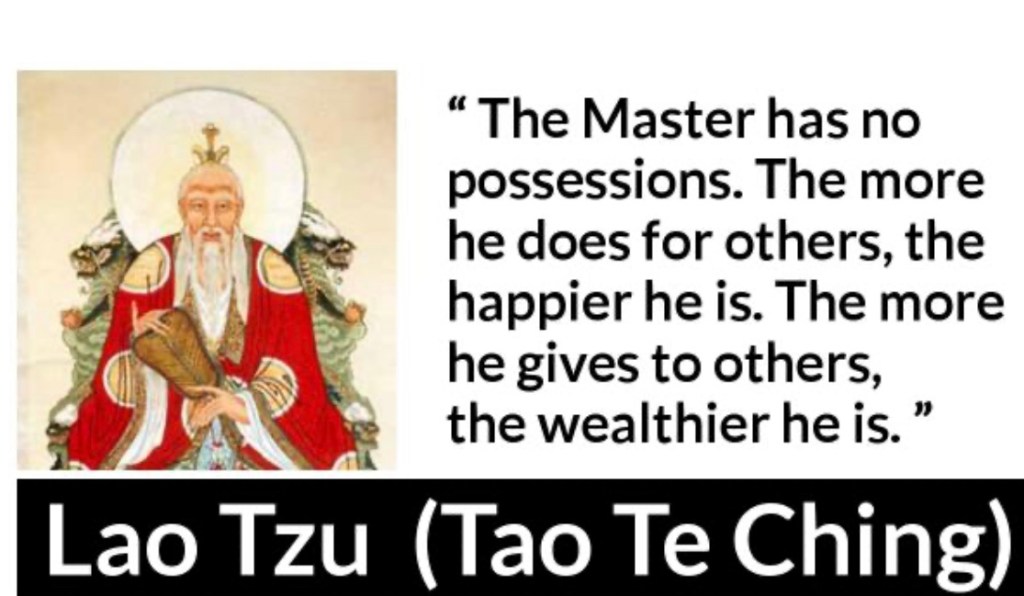
When we treat people as possessions, we run into two main problems. First, people are autonomous beings with their own desires and needs, not objects to be owned or controlled. Trying to ‘possess’ a person invariably leads to conflict and harm. Second, like with material possessions, the security and happiness we seek in ‘possessing’ others are elusive. People change, relationships end, and the sense of security we hoped to find proves fleeting.
The idea of possession also often extends to the intangible elements of our lives, such as ideas, beliefs, and ideologies. These can also become ‘possessions’ we fiercely cling to and defend. For instance, political, religious, or philosophical beliefs often become integral parts of our identity. Just as with material possessions, we can react negatively if these beliefs are challenged, seeing such challenges as attacks on ourselves.
One reason we attach so deeply to these kinds of possessions is that they help to structure our understanding of the world. They provide a framework that makes sense of our experiences, giving us a sense of control and predictability. Therefore, when these beliefs are threatened, it can feel as though our whole understanding of the world is under threat, triggering a defensive reaction.
However, just as with physical possessions, this attachment can lead to problems. When we’re so deeply invested in a particular belief or ideology, it can close our minds to new ideas and perspectives. We can become rigid and inflexible, unable to adapt to new information or changing circumstances.
This rigidity can also lead to conflict with others who hold different beliefs. When our identities are so tied up with our beliefs, it can be challenging to engage in open, respectful dialogue with those who see the world differently. Instead, we may feel threatened by these differing viewpoints and respond with hostility.
Yet, one might ask, how can we not hold onto beliefs? Aren’t they necessary for making sense of the world? While it’s true that beliefs play a crucial role in our understanding of the world, the problem arises when we cling to them rigidly, refusing to consider alternative viewpoints or update our beliefs in the light of new information.
Just as we can enjoy material possessions without being attached to them, we can hold beliefs without being enslaved by them. This requires a certain level of open-mindedness, a willingness to question our beliefs and consider new ideas. It also requires a level of humility, an acknowledgment that our understanding of the world is always limited and imperfect.
By developing this kind of flexible, open-minded approach to our beliefs, we can avoid much of the conflict and suffering that comes with rigid attachment. We can engage more productively with those who hold different views, seeing these interactions not as threats, but as opportunities for learning and growth.
The concept of possessions, whether tangible or intangible, thus challenges us to reassess our relationship with the world around us. While possessions can provide a sense of security and identity, our attachment to them can also lead to suffering and conflict.
 Abhishek Fanse