Into the Heart of Now: “NOW” Unveiled
We are what we are doing right now” taps into the philosophical and psychological realms of existence, perception, and human behaviour. Going further, we begin to see a confluence of various factors, which draw us away from the present moment, and push us into the embrace of either the past or the future. At the very heart of human existence is our incessant need to find meaning. We seek purpose, direction, and a sense of understanding about our lives. This pursuit often becomes a bridge connecting the past, present, and future. Our past experiences, both triumphant and traumatic, linger in our minds, continuously shaping our present perceptions. They become stories we tell ourselves, lessons we’ve learned, and at times, scars that haven’t fully healed. The future, on the other hand, represents our hopes, fears, dreams, and anxieties. It’s a canvas upon which we project our desires and apprehensions.
The expectation of outcomes is an inherent human trait. It is rooted in our evolutionary drive for predictability and control. For our ancestors, predicting potential dangers and outcomes was a matter of survival. Over millennia, this instinct has got inculcated with our complex cognitive structures, resulting in our modern-day anxieties about the future and ruminations on the past. However, the irony lies in the fact that the more we seek to control outcomes, the more we find ourselves entangled in a web of expectations. These expectations often lead to inner conflicts. When the present doesn’t align with our anticipated future, dissatisfaction ensues. And when the weight of past regrets is heavy, it dims the light of the present. Furthermore, the very act of striving to stay in the ‘now’ can itself become a source of distraction. If one is perpetually conscious about remaining anchored in the present, then this very consciousness becomes a barrier. The effort to stay present can sometimes be as distracting as the past memories or future anxieties that pull us away.
In today’s world, there’s also the influence of societal structures and norms. We live in societies that prize outcomes—success is often defined not by the journey, but by the destination. From a young age, we’re conditioned to focus on results, whether it’s grades in school or milestones in personal and professional lives. This societal molding further deepens our attachment to outcomes and amplifies our detachment from the present.
It is also crucial to understand the role of human consciousness in shaping our experience of time. Our consciousness is not just a passive observer; it actively constructs our sense of reality. Every moment we live is filtered through a myriad of cognitive processes, memories, and emotions. This complexity means that we often don’t experience the world “as it is” but rather “as we are.”

Neurologically speaking, our brain’s default mode network, an intricate web of interconnected brain regions, becomes most active when our attention is not occupied by tasks. This network is linked with thinking about others, thinking about oneself, remembering the past, and planning for the future. Thus, even when we aim to be in the present, our brains often naturally drift towards contemplations of the past and future. The challenges in remaining present can also be attributed to our cognitive structures, which include biases, such as the “negativity bias” – our innate human tendency to give more weight to negative experiences than positive ones. This bias can cause past traumas or failures to overshadow current joys, anchoring us in bygone moments of pain or disappointment. On the other hand, the future holds the allure of the unknown. This uncertainty can be both enticing and anxiety-inducing. Our modern societies, with their rapid changes and technological advancements, amplify this by creating an environment where change is the only constant. The evolving landscapes of our personal and professional lives mean that the future is more unpredictable than ever, making it a potent magnet for our attention and energy. Yet, amidst these complexities, lies a simple truth: the only tangible reality is the present. While memories shape and color our past and aspirations carve out our perceived futures, the ‘now’ is the only temporal space where action occurs, where life is truly lived.
Let’s explore this further!
What if “Now” encapsulates everything – past, present, and future ? This perspective challenges traditional temporal distinctions or divisions we create in and between Past, Present and Future. This viewpoint reframes our understanding of time and our place within its continuum. When we speak of living in the now, it’s often portrayed as a juxtaposition against being lost in memories of the past or anxieties about the future. However, what if everything is indeed a part of the “now” ?
Imagine time as a vast river. In this river, every drop of water represents a moment. While some drops are behind us (the past) and others ahead (the future), they all collectively belong to the river, which is the “now”. In this perspective, the entirety of existence – our memories, current experiences, and anticipations – are interconnected and concurrently present in an expansive “now”. From this viewpoint, distractions aren’t diversions from the present moment; they are simply different facets of the ever-expanding “now”. The reminiscences of a childhood memory or the contemplation about a future event are as much a part of our current experience as the sensation of the chair we’re sitting on. Every thought, emotion, and sensation, regardless of the temporal context it references, emerges and is experienced in the present moment.

The division we often make between the past, present, and future might be a result of our cognitive architecture. The human mind, in its quest for order and understanding, categorizes experiences. This compartmentalization aids in processing complex information. For instance, labeling an experience as a “memory” helps us contextualize it, discern lessons from it, or even prevent future mistakes. Similarly, projecting into the future can be a survival mechanism, allowing us to anticipate potential threats or opportunities.
However, by understanding that everything occurs in the “now”, we can achieve a form of holistic consciousness. This realization offers liberation. It frees us from the confines of linear temporality and allows a more integrated experience of existence. Such a perspective is echoed in various spiritual and philosophical traditions. For instance, in Eastern philosophies, there’s an emphasis on the interconnectedness of all things, where dichotomies are more apparent than real. Yet, while this concept is enlightening, it’s also challenging. Our societal structures, languages, and even our neurobiology are geared towards a linear understanding of time. Overcoming this deeply ingrained perspective requires consistent introspection and possibly even a paradigm shift in our consciousness.

Let’s delve deeper into the expansive Present:
Linear time, where events occur in a sequence from past to present to future, might be more of a cognitive construct than an intrinsic property of the universe. Physics, especially in the realm of relativity and quantum mechanics, has already shown us that time doesn’t always behave in the ways our everyday experiences might suggest. The famous physicist John Wheeler once proposed the idea of a “participatory universe,” suggesting that observers play a role in shaping their own realities, which includes the experience of time. Every thought, emotion, or memory we experience happens in the present moment of consciousness. Even when we recall a past event or anticipate a future one, that activity occurs in the current moment of awareness. This raises the idea that consciousness itself might be beyond time. It’s a continuous stream where “past” and “future” are merely parts of the grander “now.”
If we fully embrace the idea that everything is part of the “now,” it alters how we relate to our experiences. Regret, nostalgia, anxiety, and hope, which are emotions anchored in our traditional understanding of time, undergo a transformation. For example, instead of feeling regretful for a past decision, understanding its occurrence in the vastness of “now” might lead to acceptance and integration of that experience. Memory plays a crucial role in our understanding of time. Our memories, though referencing past events, are dynamic and malleable. They’re reconstructed every time we recall them. In essence, every time we remember something, we’re experiencing it anew in the present moment. This blurs the boundaries between past events and current experiences, reinforcing the idea of an all-encompassing “now.” While the concept is philosophically and spiritually enriching, it poses challenges in our day-to-day lives dominated by schedules, deadlines, and plans. How does one reconcile the linear demands of modern life with a non-linear understanding of time? This balance requires us to function efficiently in the world while internally maintaining an awareness of the deeper, interconnected reality.
Let’s delve further into More finer details: what if we kill “Now”?
When we speak of “killing” the now, we’re essentially talking about transcending our typical awareness of time and moving into a state of pure being, a consciousness unfettered by the confines of temporal experience. The idea that time itself might be an illusion is not new. From the ancient Eastern philosophies to cutting-edge quantum mechanics, there are suggestions that what we experience as the flow of time might be a cognitive and perceptual construct. Our brains organize experiences in a linear fashion, from cause to effect, creating the sense of a flowing river of moments, from the past, through the present, and into the future. But if we could step outside this stream, what would consciousness look like? If we “kill” the now, we’re essentially trying to access a state of pure awareness—a consciousness devoid of content, without thoughts, perceptions, or sensations. Many meditative practices aim to reach this state, often described as “thoughtless awareness” or “contentless consciousness.” In this state, the meditator isn’t focused on any particular thing (like the breath, a mantra, or an image), but instead simply exists. It’s a state of being rather than doing.
Attempting to attain a state of pure awareness can be paradoxical. The very effort to reach this state can prevent one from achieving it, as effort and intention are temporal and future-oriented in nature. It’s like trying to smooth turbulent water with one’s hand—the act of trying only creates more turbulence. It requires a letting go rather than a striving, a surrender rather than a pursuit. To “kill” the now is to step beyond dualities—the past and future, cause and effect, self and other. This is a realm often spoken of in mysticism and spirituality, where one transcends the perceived divisions of existence. It’s a state of unity, of oneness, where the individual self melts away into the all-encompassing whole.
While these states of consciousness can be transformative, they can be challenging to maintain in our everyday, pragmatic world. Our society operates on schedules, plans, and routines. However, even fleeting experiences of this transcendent state can profoundly affect our daily lives. It can offer insights, change perspectives, and create a deep-seated sense of peace. From the perspective of many ancient traditions, the universe is in a constant dance of creation and destruction. The “now” that we experience is just one beat of this cosmic dance. To “kill” the now is not to negate or nullify it, but to merge with the dance itself, to become one with the rhythm of existence.

Choice “Paralysis“
A choice implies that there is an alternative, and with every alternative comes the weight of consequences, perceived or real.
You speak of a ‘neutral’ stand, but let’s investigate what that really means. In reality, the idea of a neutral stance is a contradiction in terms. The very act of choosing neutrality is in itself a choice, made in opposition to other possible choices. So, the notion of being ‘neutral’ is inherently paradoxical because it cannot exist without the conditions that make it a choice to begin with.
For example, When you agree to a certain dosage of medication, you exercise control by making an informed decision. However, you also surrender control to the effects of that dosage, which may not be entirely predictable. This brings emotional complexity into play: the comfort of taking action (choosing the dosage) juxtaposed against the uncertainty of outcome. When we agree to disagree, we are on the contrary acknowledging that a middle ground is unreachable, yet we’re finding a sort of middle ground in that very acknowledgment. The challenge lies in our psychological need for validation and agreement, which often feels at odds with the more rational understanding that it’s perfectly okay for different viewpoints to coexist. We often fail to agree to disagree because our conditionings, our egos, don’t allow us to let go without a ‘win’ or a ‘loss.’
Every choice, by definition, is a rejection of its alternative. Therefore, choices are always relative, biased, and limited by the options that exist. In that sense, a choice cannot be independent because it is defined by the conditions that make it a choice. The idea of a ‘choice’ presupposes the existence of an alternative, of a comparison. In a context where there is only one thing that exists independently, the notion of ‘choice’ would be meaningless because there would be nothing to choose from. Therefore, it wouldn’t be a choice; it would simply be a state of being. The paradox exists because we try to define and understand choice within the limited framework of language and duality. However, once you recognize that the very nature of choice is paradoxical and conditional, and you embrace that paradox rather than trying to resolve it, you arrive at a sort of meta-clarity. This does not mean you’ve resolved the paradox; it simply means you’ve stepped outside of it. You’ve transcended the limitations that come with the dualistic thinking of ‘this or that,’ ‘yes or no,’ ‘neutral or biased.’
Choices are never made in emotional vacuums. They are laden with expectations, fears, and desires that stem from our past experiences, conditionings, and inherent personality traits. Even the seemingly most “logical” choice is often deeply influenced by emotions we may not even be fully aware of. The emotional charge of expectations is often the heaviest. When we make a choice, it is often governed by what we expect the outcome will bring us—pleasure, validation, success, or the avoidance of pain and conflict. The emotion here is one of anticipation, coupled with anxiety about whether our expectations will be met.
Then there’s desire, an emotion that often masquerades as need. The choices we make based on desire are emotionally charged with hopes for fulfillment, achievement, or recognition. But desire is a double-edged sword: while it motivates us, it also sets us up for disappointment if things don’t go as planned.
Even when we think we are making a “neutral” choice, what we are often trying to do is distance ourselves emotionally from the implications of the decision. We might say it’s “purely logical,” but the underlying emotion is often one of self-preservation—we wish to remain unscathed by the emotional weight that comes with making a more obviously partial choice.

One reason choices are emotionally charged is that they give us the illusion of control. Making a decision allows us to feel like we have some say over our fate. However, this control is always somewhat illusory. Life’s unpredictability ensures that our choices, no matter how well-considered, often have unexpected outcomes. The realization that our control is limited can bring up a host of emotions like helplessness or existential dread. Every choice we make, big or small, adds a brick to the edifice of our self-identity. We look for validation through our choices; when they lead to desired outcomes, it reinforces our sense of self-worth. When they don’t, it challenges our self-image and can lead to emotions like self-doubt, shame, or regret.
Our choices also affect how we are viewed by others, adding another layer of emotional complexity. Sometimes we make choices that conform to societal norms or expectations to avoid judgment or gain approval. The emotions at play here are often related to a fear of rejection or a need for social cohesion. At other times, we may make choices that go against the grain, driven by a desire for individuality or authenticity. This can lead to a complicated cocktail of pride, liberation, but also potential loneliness.
When it comes to seemingly paradoxical choices—like choosing wisdom over a loved one or maintaining a “neutral” stance—the emotional texture becomes even more intricate. For instance, choosing wisdom over a loved one might be a defense mechanism to protect oneself from future emotional pain, yet it can also lead to immediate emotional pain due to the distancing from the loved one. Here, both foresight and dread, love and rationality, are locked in an emotional tussle.
In cases where we choose to be “neutral,” what we are really doing is choosing not to engage emotionally in a way that makes us vulnerable. We might convince ourselves that we’re staying above the fray, but deep down, the need to protect ourselves emotionally is dictating that ‘neutral’ choice. The emotion behind neutrality is often a fear of emotional engagement, wrapped up in a protective layer of rationality. Ultimately, emotional maturity plays a large role in how we navigate the sea of choices and their associated feelings. Being aware of our emotional drivers allows us to make more ‘informed’ choices, even if that information is coming from within ourselves. This kind of self-awareness can temper the more reactive emotions like fear and desire and allow room for more nuanced feelings like contentment, acceptance, and genuine love to inform our decisions.
Choice is often seen as liberating, an act of free will that puts us in the driver’s seat of our destiny. However, with every choice we make, we also close off other possibilities, limiting ourselves in certain ways. The emotional paradox here is the simultaneous existence of freedom and constraint within the same action. We may feel exuberant for choosing a particular path, but there can be a latent sadness or anxiety about the paths left unexplored.
While choices often feel monumental in the moment, their impact can wane over time, sometimes even reversing in significance. What seemed like a terrible choice in the past may later appear wise, or vice versa. This fluidity can generate complex emotions, such as regret for past choices or anxiety about the unpredictability of future choices and their unforeseeable emotional implications.
Ultimately, where every action presents us with a choice and counter choices, we sometimes find ourselves paralyzed, suspended in a moment of indecision. Yet, this paralysis isn’t a dead end; it’s a pause, a sacred space that invites us to reflect, to feel, and to become keenly aware of our humanity.
What if we reframe this so-called “choice paralysis” not as a dilemma but as a moment of pause in the great narrative of our lives? It becomes not a prison, but a platform; not a quagmire, but a quest. In this paused state, we are philosophers, artists, and explorers of the inner cosmos. We grapple not just with options but with identities, not merely with pros and cons but with hopes and fears, love and loss.
In this pause, we are not frozen; we are fervently alive. We are composing in our minds the symphony of our future, writing the next act of our life’s drama, sculpting the clay of our becoming.
And when the pause lifts—as it always does—we make a choice, yes, but we also do something more profound: we embrace our capacity to choose, even when the choices are hard, even when the path is foggy. For it’s in the wrestling with choices that we come to know who we truly are.
So, the next time you find yourself in the clutches of choice paralysis, remember: you are standing at the confluence of many rivers, each leading to a different ocean but all part of the same Earth. And it’s okay to stand there for a while, to feel the currents, to listen to their distinct murmurs, before stepping into the stream that will carry you to your next adventure.
And so, we are forever navigating, forever choosing. Not in search of resolution, but in pursuit of growth. In the end, it’s not about making the perfect choice, but about making our choices perfect us.
The Fluidity of Stillness: Understanding Stagnation Amidst Movement
“Movement in Stagnation” captures the tension between seemingly opposite states—feeling spiritually stuck or stagnant while simultaneously experiencing inner changes or shifts. This suggests that even within periods of seeming inertia, movement is happening, whether you recognize it or not.
The experience of feeling both movement and stagnation simultaneously—or alternately—can be influenced by various factors, including your emotional state, external circumstances, and perspective. On a day-to-day basis, there are changes, interactions, and new experiences, which might seem like movement. However, these might not register on the long-term scale, where overarching goals and life trajectories are considered.
ertain philosophies and spiritual perspectives propose that time is not linear but cyclical. Thus, the repetition or perceived stagnation may actually be a part of natural cycles. However, Emotions are incredibly transient; they can change from moment to moment. This emotional flux might be what you’re identifying as “movement” within the stagnation. Emotional highs feel even higher when coming out of a low and vice versa. This contrast might contribute to the sensation of significant movement even when your situation hasn’t drastically changed.
Humans are wired to identify patterns. When you start noticing recurring themes or experiences, your brain flags these as patterns, which can feel like you’re stuck in a loop. Once you recognize a pattern or feel stuck, you’re more likely to notice information that confirms this belief, thereby reinforcing the feeling of being stuck.
Some spiritual teachings suggest that life inherently consists of repetitive cycles—birth, growth, decay, death, and rebirth—and that recognizing this can free you from the illusion of stagnation. Certain philosophies like Buddhism focus on the present moment as the only “real” moment, suggesting that both the past (stagnation) and the future (movement) are constructs of the mind.
When you look at your life on a daily basis, you can see a lot of activities, interactions, and events that unfold. The sun rises and sets, you go to work, eat, sleep, talk to people, perhaps engage in some hobbies. This flurry of activity can give you the impression that things are constantly moving and changing. However, if you were to zoom out and look at a larger slice of your life, say a year or a decade, the feeling is often quite different. Major life circumstances—your job, where you live, your relationship status—may not change as frequently. Even if they do, the underlying patterns of behavior, the kinds of relationships you engage in, and your day-to-day experiences might not undergo a significant transformation. This is where the feeling of “stagnation” often comes in. Despite the constant activity and interactions, there may be an underlying sense that nothing much has really changed—or is going to change.
Emotions, by their very nature, are transient and fluid. Even within a single day, you might experience a range of emotions—joy, frustration, excitement, boredom, love, irritation—and these emotions have a way of coloring your perception. When you’re joyful, the world seems vibrant, full of possibilities; you feel like you’re “moving.” When you’re frustrated or bored, the world can seem dull, repetitive; hence the feeling of “stagnation.”
The mind has certain tendencies that influence this dual experience of movement and stillness. One of these is the brain’s knack for pattern recognition. We make sense of the world by recognizing patterns; it’s how we learn and navigate complex realities. However, this strength can turn into a trap when the patterns you recognize lead to a sense of helplessness or stagnation. For instance, if you’ve had several failed relationships, you may start to believe that all relationships are doomed to fail, leading to a feeling of being “stuck.”
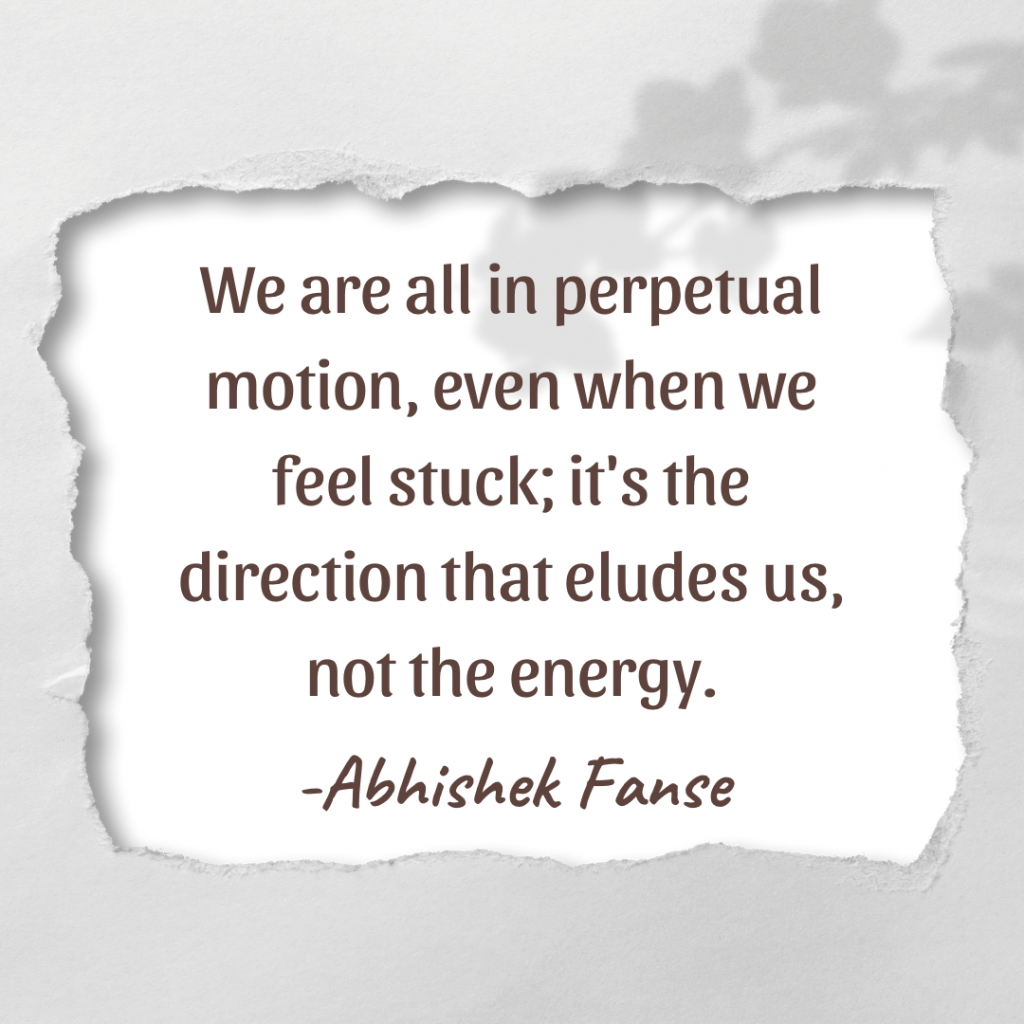
Finally from a more spiritual or existential standpoint, the very idea of movement and stagnation can be questioned. Certain spiritual teachings suggest that the material world is an illusion, and that true “movement” is a journey inward, toward understanding one’s own nature and the nature of reality. In this context, both the feeling of “moving” and “being stuck” can be seen as distractions from the true journey, which is neither about moving nor staying but about understanding and being.
Ego and its death
The concept of the ego is deeply rooted in both psychology and philosophy, contributing to the overall understanding of human behavior, cognition, and identity. It’s a multifaceted term that has been interpreted and employed in various ways by different scholars. To understand the ego in depth, we need to examine its theoretical origins, its functions, its influence on our behavior and relationships, and the role it plays in personal growth and self-awareness.
The term “ego” has its roots in Latin, where it means “I.” However, its contemporary psychological and philosophical meanings draw mainly from the works of Sigmund Freud, the founder of psychoanalysis, and Carl Jung, the founder of analytical psychology.
Freud used the term ego to describe one of the three components of the psychic apparatus in his structural model of the mind. According to him, the human psyche comprises the id, the ego, and the superego. The id is the primitive part of our psyche that contains our basic instincts and drives. It operates on the pleasure principle, seeking immediate gratification of needs and desires.
The superego, on the other hand, is the moral compass, formed as we internalize societal and parental norms and values. The ego, according to Freud, is the mediator between the id and the superego. It operates on the reality principle, trying to satisfy the id’s desires in socially acceptable ways that also align with the superego’s moral standards. The ego, thus, helps us navigate the external world while managing our internal drives and moral values.
In contrast, Carl Jung saw the ego as the conscious mind, encompassing our thoughts, memories, and perceptions. It forms the center of our conscious identity but not the entirety of the self, which also includes the unconscious elements. For Jung, the ego is essential for self-awareness and plays a vital role in the process of individuation, which is the journey toward wholeness and self-realization.

The ego, as understood from these perspectives, plays a vital role in our lives. It helps us manage our impulses, maintain our relationships, make decisions, and develop a coherent sense of self. Without the ego, we would struggle to function effectively in the world.
However, when the ego is too dominant or rigid, it can become a source of problems. It may cause us to become overly attached to our self-image, leading us to defend it vehemently against any perceived threats. This can manifest as excessive pride, stubbornness, defensiveness, or inability to accept criticism. In its extreme form, it can lead to narcissistic tendencies, where one’s self-absorption becomes detrimental to their relationships and overall well-being.
In the realm of personal growth and self-awareness, the ego is often perceived as a barrier. This is because the ego, by its very nature, clings to the familiar and resists change. It likes to be in control and tends to see things in dualities (right-wrong, good-bad, etc.), making it difficult for us to embrace uncertainty, see different perspectives, or step out of our comfort zones. This can limit our growth and prevent us from realizing our full potential.
At the same time, the ego can also be a gateway to growth and transformation. By becoming aware of our ego—its patterns, its fears, its defenses—we can begin to understand ourselves better. This awareness can give us the insight and courage we need to challenge our old ways of being and forge a new path.
Moreover, the ego can provide valuable clues to our unconscious elements. Our reactions, defenses, and fears often point to unresolved issues or repressed aspects of ourselves. By exploring these aspects, we can bring them to light, integrate them, and become more whole and self-aware.
To fully understand what “dies” when we become fully aware and conscious, and what it is we naturally let go of when we begin to understand ourselves, it’s crucial to delve into the depths of human consciousness, self-awareness, and the fundamental elements of our identity. This inquiry involves a deep dive into psychology, philosophy, neuroscience, and spirituality.
Becoming fully aware and conscious implies a shift from a state of unconsciousness or lesser awareness to one of higher consciousness. Here, unconsciousness refers to automatic, habitual behaviors and thought patterns which we often engage in without any conscious control or intention. These patterns, formed through years of conditioning, might include biases, assumptions, prejudices, or learned behaviors that operate under the surface of our everyday awareness.
When we reach a state of full awareness or consciousness, these patterns can no longer exist in their previous form. Essentially, what “dies” here is the old self – the unconscious patterns and the egoic self that is driven by them. The ego, in psychological terms, can be seen as the aspect of identity that we consider our “self.” It’s constructed from our experiences, memories, cultural conditioning, and our reactions to external stimuli.
The ego is characterized by attachment to certain ideas about ourselves and the world around us. These ideas may include beliefs about what we should be, what we need to be happy, what we fear, and how others should behave. Often, these ideas are not based on conscious decisions but are ingrained in us through past experiences and societal conditioning.
Becoming fully aware or conscious means recognizing these patterns and seeing them for what they are—temporary constructs rather than inherent aspects of our identity. This allows us to break free from these habitual patterns, essentially causing the egoic self or the old self to “die.” This doesn’t mean we lose our sense of self; rather, it signifies a transformation of self.
As we reach this state of full consciousness, we naturally begin to let go of the attachments that the egoic self held. Attachments, in this context, refer to rigid beliefs, preconceived notions, desires, fears, and expectations that we unknowingly cling to. They are deeply entrenched within our psyches and often steer our thoughts, emotions, and actions without our conscious awareness.
When we start to understand ourselves – our motivations, our fears, our reactions – we naturally begin to see these attachments for what they are. We see that they are not fixed parts of our identity but constructs that we have the power to change or let go of. Understanding ourselves means recognizing that we are not solely the sum of our experiences, thoughts, emotions, or societal conditioning. We are conscious beings capable of introspection, change, and growth.
In the process of self-understanding, we let go of these attachments because we realize that they limit our potential and obstruct our well-being. Letting go is not about forgetting or ignoring our past experiences or emotions. Instead, it’s about recognizing these elements for what they are, understanding their impact, and then making the conscious decision not to let them dictate our present and future.
Moreover, letting go is an act of acceptance—acceptance of our past, our mistakes, our flaws, and our vulnerabilities. It’s about accepting that we are human beings capable of change and growth. We acknowledge our past experiences and emotions, learn from them, and then free ourselves from their hold.
In the process of becoming fully aware and conscious, what dies is not the individual’s sense of self, but the old, unexamined sense of self. The egoic self that was once controlled by unconscious patterns and attachments undergoes a transformation. This transformation is a process of death and rebirth—death of the old self and birth of the conscious self.
On this journey, the individual learns to let go of rigid beliefs, fears, and expectations that once held them back. They start to live from a place of conscious choice rather than habitual reaction. As a result, they experience a profound sense of freedom and openness, which enables them to navigate life with greater flexibility and resilience.

The journey to full awareness and self-understanding is not a linear one, and it’s not without challenges. It requires courage, patience, and persistence. But the rewards it brings—a profound sense of peace, freedom, and fulfillment—are well worth the effort.
Seeking the Unseen: A Journey of Zen Awakening
Once upon a time, in a small village nestled at the foot of a majestic mountain, there lived a young villager named Takeshi. Takeshi was known for his strong desire to seek enlightenment and uncover the mysteries of life. He had heard tales of Zen masters and their profound teachings, and he yearned to experience the depths of wisdom they possessed.
One day, Takeshi decided to embark on a journey to the nearby Zen monastery, where renowned Zen master, Master Hakuin, resided. He believed that under the guidance of the master, he would find the answers he sought. With determination in his heart and curiosity driving him forward, Takeshi set off on the path to the monastery.
After several days of traveling through forests, across rivers, and over hills, Takeshi arrived at the monastery gates. The grandeur of the temple and the serene atmosphere left him in awe. He was greeted by the head monk, who informed him that Master Hakuin was known for his unconventional teaching methods and the use of enigmatic stories called koans.
Eager to begin his spiritual quest, Takeshi immersed himself in the monastic routine, attending meditation sessions, participating in communal work, and seeking moments of solitude for contemplation. But as the days turned into weeks, and the weeks into months, Takeshi’s frustration began to grow. He yearned for direct guidance from the master, believing that a few words of wisdom would instantly unlock the doors of enlightenment.
One evening, after a particularly arduous day of meditation, Takeshi sat alone in the garden, gazing at the moon illuminating the night sky. In his weariness, he wondered if his efforts were in vain. Doubts plagued his mind, and he began to question his own abilities and worthiness to attain enlightenment.
Just as he was about to give in to despair, a figure appeared before him. It was Master Hakuin, clad in simple robes and radiating an aura of tranquility. Takeshi’s heart skipped a beat, and he bowed respectfully to the master.

The master smiled knowingly and began to speak. “Takeshi, my young seeker, what is it that you truly seek?” he asked, his voice filled with compassion.
Takeshi hesitated for a moment, unsure of how to articulate his deepest longings. Finally, he replied, “Master, I seek enlightenment. I yearn to understand the nature of reality, to transcend suffering, and to find true peace.”
Master Hakuin nodded and said, “Enlightenment is not found by seeking something external. It is not a destination to be reached. Rather, it is a deep realization of your own true nature, the nature of existence itself.”
Takeshi was taken aback by the simplicity of the master’s words. He had expected complex teachings and profound revelations. But Master Hakuin continued, “To understand the nature of existence, you must go beyond the limitations of your conceptual thinking. You must embrace the paradoxes, the uncertainties, and the contradictions of life.”
Curiosity sparked within Takeshi as he listened intently to the master’s words. The master continued, “In the garden of your mind, there are seeds of longingness, seeking, and attachment. These seeds create a maze of illusions that perpetuate suffering. To find the truth, you must let go of these attachments and be fully present in each moment.”
Takeshi contemplated the master’s words, realizing the depth of their meaning. He understood that his constant seeking was a product of his own conditioned mind, always grasping for answers and validation. In that moment, he felt a sense of liberation, as if a heavy burden had been lifted from his shoulders.
Master Hakuin gently touched Takeshi’s shoulder and said, Remember, Takeshi, that the essence of Zen lies not in the words spoken or the concepts understood, but in the direct experience of this very moment. The truth cannot be found in the past or the future; it can only be realized in the present.
With these words echoing in his mind, Takeshi embarked on a new phase of his spiritual journey. He embraced the practice of mindfulness, bringing a heightened awareness to each moment, whether it was walking in the monastery gardens, sipping tea, or engaging in daily tasks. He learned to observe the thoughts and emotions that arose within him without clinging to them or getting lost in their stories.
As Takeshi delved deeper into the practice of mindfulness, he discovered that the compulsive need to seek and the attachments that fueled his suffering began to lose their grip on him. He realized that the nature of seeking itself was rooted in a misconception—that true fulfillment lay in acquiring something external, whether it be knowledge, possessions, or spiritual experiences. Through his dedicated practice, he cultivated a sense of inner contentment and realized that he already had everything he needed within him.
Takeshi also learned to embrace the paradoxes and uncertainties of life. He understood that seeking certainty in an ever-changing world was futile. Instead, he surrendered to the ebb and flow of existence, allowing himself to fully experience both the joys and sorrows that life presented. He recognized that the seeking mind was a source of perpetual dissatisfaction, always chasing after an illusory idea of perfection. By letting go of the need for certainty and control, he found a profound sense of freedom.
Over time, Takeshi’s practice deepened, and he became a source of inspiration for others on the path. He shared his insights with fellow seekers, guiding them to look within and discover the truth for themselves. His presence radiated a calmness and clarity that touched the hearts of those around him, inviting them to embark on their own journey of self-discovery.
As the years passed, Takeshi’s understanding continued to evolve. He realized that the seeking mind and the attachments that arise from it were not to be eradicated but to be understood and transcended. They were like passing clouds in the vast sky of awareness. Through the practice of mindfulness, he cultivated a profound sense of presence and aliveness, fully embracing the richness of each moment.
Takeshi’s journey was a testament to the transformative power of Zen. It taught him that true liberation lies not in the accumulation of knowledge or external accomplishments, but in the direct experience of life as it unfolds. He realized that the greatest treasure was not to be found in some distant destination, but in the present moment, in the deep understanding that the seeking mind and the sought-after are ultimately inseparable.
In the end, Takeshi understood that the path of Zen is not a linear journey with a final destination. It is a continuous exploration, an ever-deepening understanding of the nature of existence and our own true nature. The seeking mind gradually fades away, replaced by a profound acceptance and appreciation of life in its entirety.
And so, Takeshi continued on his path, walking the way of Zen with an open heart and a mind free from the entanglements of seeking. He reveled in the simple joy of being, fully embracing the mysteries of existence, and inspiring others to embark on their own journey of self-discovery and awakening.
May we all find the courage to let go of our seeking minds and discover the boundless beauty that lies within each and every moment.
 Abhishek Fanse