Perceptions – Consensus Subjectivity vs. Objective Truth
Perception is the process by which sensory information is interpreted, organized, and consciously experienced. This involves not just the mechanical aspects of sensation, but also the psychological elements that interpret and prioritize this data, often filtered through individual beliefs, experiences, and cultural norms. Perception is an interface between an individual’s interior world and the objective reality surrounding them.
In a perfect, objective world, there would be a single, indisputable truth about everything. But humans aren’t perfectly objective beings; our cognitive and sensory apparatus has its limitations. A snake perceives heat differently than a human; a dog perceives scent differently than a human. While the world itself might possess a “universal truth,” our ability to perceive it is shaped by our limitations. If you act with “100% completeness,” it would mean that you have acted in full alignment with your capabilities and intentions. But people perceive your actions based on their own sets of experiences, expectations, and biases, not necessarily based on your intentions. Hence, perceptions can vary even for a universally “complete” action. While the act itself might be independent, its interpretation is not. That’s where perception comes in. Perceptions may be “limited” and “formed by other or for other,” but they play a critical role in social dynamics, ethical considerations, and interpersonal relations.
People rely on perceptions because it’s an accessible way to interpret and navigate the complex world. But it is essential to differentiate between individual perceptions and collective or societal ones. The latter often serves as a “consensus reality,” providing a common framework for communication and understanding. So, while perceptions are limited by their very nature, they are a necessary component of human interaction and society. The real issue arises when perceptions are mistaken for objective truth, ignoring their inherently subjective and conditional nature. We can indeed question the “reality” of different perceptions and argue that they’re all illusory in some way, but as long as humans have subjective experiences, perceptions will continue to differ. And in that diversity of perception lies the complexity, and beauty, of human experience.
Question: can we have any objective experience?
The notion of “objective experience” is a bit of an oxymoron. Experiences are inherently subjective because they are mediated by individual sensory apparatus, psychological states, and sociocultural backgrounds. However, certain frameworks try to minimize subjectivity to get as close to “objectivity” as possible. In the scientific method, for example, experiments are designed to be replicable regardless of who performs them. The idea is to eliminate as much human subjectivity as possible so that the results point to some “objective” truth about the world.
There can be cracks in achieving objectivity in scoring or mathematical experiments as Measurement tools are designed and interpreted by humans, who bring their own sets of assumptions and limitations to the table.
When a majority of individuals agree on a particular experience or observation, this doesn’t necessarily make it “objective” in the sense of an unchanging truth that exists independent of human perception. Rather, it forms a “consensus reality”—a shared framework of understanding that facilitates communal living and communication. While this consensus reality may be treated as “objective” within a specific cultural or social context, it’s not the same as a universal truth that holds across all times and places.
For example, money is a societal consensus. We agree to give paper and metal tokens a certain value. Within the context of a particular economy, the value of a dollar or euro is an “objective” fact, but this objectivity is contingent on shared belief and participation in economic systems. The material paper has no intrinsic value; its worth is entirely constructed and agreed upon.
However, Truth, in its purest form, shouldn’t have different meanings or interpretations. In philosophy, something that is “objectively true” would be true regardless of individual or cultural beliefs—a universal fact. However, accessing or understanding such truths is a challenging endeavor precisely because we are subjective beings.
Understanding Confidence: Beyond the Binary of “more” or “less“
It’s a term thrown around often, in self-help books, motivational speeches, and even casual conversations. But what exactly is confidence? Is it an intangible force that some people possess while others lack, or is it an inherent aspect of every individual that remains unaffected by external circumstances? Let’s dive deep into this paradoxical phenomenon.

If one looks closely, the term has been constructed based on societal norms and standards. It is believed that certain behaviors, decisions, or characteristics project a sense of certainty, while others indicate a lack of the same. Over time, these beliefs have formed the structure we identify as confidence. However, considering the vast spectrum of human emotions and the varied circumstances everyone faces, is it valid to classify them under the binary of confidence and its lack?
For instance, a deer running from a predator is often acting out of fear. However, the very act of running, the determination to escape, indicates a level of confidence in its ability to survive. Similarly, when a person is fearful, that fear doesn’t necessarily negate their confidence. The act of acknowledging fear and responding to it can be viewed as an act performed with complete confidence in that particular emotion.
While it’s argued that confidence is unaffected by external situations, one can’t deny the impact of external validation on perceived self-worth. A student praised continuously may seem more confident than one who’s always criticized. But this brings forth another question: Is the confidence of the praised student genuine, or is it a facade built upon external validation? The underlying belief here is that true confidence remains unaffected by external factors. It is an internal compass, guiding one through life’s challenges. The student who seems less confident due to criticism might very well have an inherent belief in their abilities but chooses not to display it openly.
The intricate relationship between fear and confidence is captivating. While at first glance, they might seem opposing, a deeper introspection suggests they coexist harmoniously. As mentioned before, acknowledging fear can be an act of confidence in itself. Embracing one’s vulnerabilities, doubts, and fears can be seen as the highest form of confidence because it stems from self-awareness.
If we view confidence as neither a trait one can gain nor lose but as a constant presence, it reshapes our understanding. In this perspective, every act, regardless of its nature, is executed with full confidence. A person displaying apprehension is confidently apprehensive. A person in doubt is confidently doubtful. Modern society often categorizes confidence in degrees – more or less, high or low. This categorization restricts our understanding. When we say someone is “more confident,” we’re comparing their current state to a previous one or juxtaposing them against someone else. However, by acknowledging that every act is executed with complete alignment to a particular emotion or state of being, the need for comparison dissipates.
Confidence, in its true essence, is not about loud declarations or silent sufferings. It’s about recognizing and accepting the inherent completeness in every emotion, decision, and action. It’s about understanding that every response to a situation, be it with enthusiasm, fear, doubt, or joy, is done with utmost confidence in that response. If confidence is inherent, it would imply that any action performed in a state of fear, joy, or doubt is done with a level of assurance. In a crisis, for example, a hesitant decision to call for help is executed with as much confidence as a swift decision to solve the problem. This inherent nature of confidence, therefore, suggests that the concept is not binary but rather a spectrum, or perhaps beyond a spectrum—a state of consistent existence.
When we look at external circumstances affecting confidence, it becomes apparent that this so-called “influence” is transient. If confidence is genuinely inherent, then external factors may create an illusion of change but cannot alter its core. That said, constant external validation can create a clouded perception of self-worth, often mistaken for genuine self-confidence. The distinction between inherent confidence and externally-induced confidence is crucial for holistic understanding. If confidence is a constant presence, the degrees of “more” or “less” cease to have real meaning. It suggests that everyone, at any point in time, is fully committed to their actions or reactions, be it hesitancy or decisiveness. In such a framework, everyone is performing at their own level of 100% confidence tailored to the specific situation or emotion they are dealing with. Therefore, to say that one is ‘lacking’ in confidence is to misunderstand its inherent nature.

If every act is performed in complete alignment with the emotion or thought process governing it, it removes the need for comparison or valuation, which are tools the ego uses to identify itself. The notion of someone being “more confident” than someone else arises from a place of duality, from distinguishing the self from the ‘other.’ When one’s existence is in complete harmony with the intrinsic nature of confidence, these comparisons become irrelevant.
Love and Longing – A paradox ??
The experience of longing for love is universal and deeply rooted in our humanity. This longing, often described as an unquenchable thirst, is both a blessing and a burden, driving us to form connections, seek fulfillment, and explore the depths of our own emotions.
Delving into the realm of quantum physics, there’s an intriguing principle known as quantum entanglement. It suggests that two particles, once entwined, will remain connected irrespective of distance. A change in the state of one will instantly affect the state of the other, no matter how far apart they are.

Drawing a parallel to human emotions, particularly longing, one could argue that individuals form ’emotional entanglements.’ The sense of connection might not be physical but is as intense, enduring, and mystifying as quantum entanglements. This could be the reason why, even in separation, our emotions remain tethered to another person, place, or memory. Longing is a complex emotion that can arise from various sources. At its core, it’s a yearning for something that seems to be just out of reach. We might long for a loved one, for a sense of belonging, for an idealized version of the world, or for a deeper connection with ourselves.
Our longing for love can be seen as a biological imperative. Our ancestors who formed strong social bonds and felt a deep connection to their kin were more likely to survive and reproduce. As a result, the longing for love and connection is deeply ingrained in our genetic makeup. Our experiences shape our emotional responses. For instance, early attachment experiences with caregivers can influence our future relationships and how we perceive love. Similarly, our psychological makeup, shaped by both nature and nurture, affects how we experience longing.
The relationship between love and longing is paradoxical. On the one hand, love can make us feel whole, bringing joy and fulfillment. On the other hand, it can also create a sense of longing, especially when faced with separation or unfulfilled desires. This tension is often evident in poetry and art, where love and longing are intertwined in complex ways. When we are in love, we often feel a sense of completeness. The world seems brighter, and we may experience a deep sense of contentment. This feeling arises from the connection and emotional intimacy that love brings. In these moments, longing may fade into the background. Despite the fulfillment that love offers, it can also create a sense of longing. When separated from a loved one, the intensity of our love can manifest as a deep yearning for their presence. This longing can also arise from unmet emotional needs, unfulfilled desires, or the idealization of love.
Love and longing are not mutually exclusive; they often coexist. The very act of loving someone can make us more aware of their absence when they are not around. Similarly, longing can intensify our love, making us cherish our moments of connection even more. This dynamic interplay adds depth to our emotional experiences.
Longing is not a singular emotion; it encompasses a range of feelings, including hope, desire, melancholy, and even pain. Longing often involves a strong desire for something or someone. This desire can create a sense of anticipation, making us look forward to future possibilities. The act of longing can be both exciting and agonizing, as we await the fulfillment of our desires. Longing can also be rooted in the past. We may long for a time when we felt loved, accepted, or understood. This sense of nostalgia can be accompanied by melancholy, as we realize that the past cannot be recaptured. Sometimes, longing arises from idealization. We may create a mental image of the perfect partner, the ideal life, or a utopian world. These idealized visions can make us feel discontented with our current reality, fueling a sense of longing. Longing can be painful, especially when it feels unending or unrequited. The intensity of our yearning can create a sense of suffering, as we grapple with the gap between our desires and reality.
Wrestling with the feelings associated with longing can lead to deeper emotional intelligence. Through introspection, we can learn more about ourselves, our needs, and our desires. Understanding the root of our longing can help us address underlying issues or unmet needs in our lives. everyone has felt it at some point. Recognizing this shared experience can foster empathy towards others and deepen our human connections. By understanding our own feelings of longing, we become better equipped to empathize with others.
Life is characterized by dualities: happiness and sorrow, presence and absence, fulfillment and yearning. While these might seem contradictory, they often exist side by side and give depth to our experiences.
Presence in Absence: Even in the absence of what we long for, there’s a certain presence of that object or person in our thoughts and emotions. This phenomenon speaks to the power of our minds and hearts to transcend physical limitations.
Completeness in Incompleteness: The very feeling of longing suggests that there’s something we deem essential for our completeness. However, the journey of life is about realizing that, in many ways, we are already complete in our incompleteness. The gaps and spaces create room for growth, evolution, and understanding.
Stability in Flux: Our feelings, including longing, are in constant flux. They come and go, intensify and wane. But beneath these changing emotions, there’s a stable core of self, a foundational aspect of our being that remains unswayed.
Amidst Peace!!
What brings you peace?

In the vast expanse where desires entwine, Detachment emerges, a beacon so fine.
While many chase starts, and beginnings anew, It’s in the echo of endings where peace rings true.
The tempest of life, in its fervent embrace, Urges us forward, a relentless race. Yet peace isn’t found in the heart of the storm, But in letting go, in a formless form.
In the depth of the night, where visions lie deep, Peace flourishes best where eyes don’t leap. For too often, our sight might lead us awry, But in the unseen’s embrace, our worries will die.
Seek not in the masses, the throngs or the crowd, Turn to the self, silent, not loud. For deep in one’s core, past chaos and spin, Rests the sanctuary of peace, glowing from within.
When we chase after shadows, our energy spent, It’s the introspective journey that’s heaven-sent. So remember these thoughts, when the world feels askew, Peace is an inside journey, forever true.
Is harmony defined by us is really harmonious ?
The universe operates on a balance. Dualities like light and dark, joy and sorrow, and so on, are not in contention with each other but rather two sides of the same coin. They provide context and meaning. It’s akin to understanding that one cannot truly appreciate light without having known darkness. Our existence is enigmatic, where a myriad of elements interplay in a vast cosmic dance. Every action, no matter how minute, sends ripples across the fabric of the universe. Such is the interconnectedness and oneness that defines the cosmos. But amidst this vastness, we humans grapple with the age-old questions: Why are we here? Why do we feel disconnected when everything is intrinsically connected? And, why is our life, despite being a part of this vast universe, so often defined by duality?
Consider the universe as an immense symphony, where every entity is like a note, contributing to an eternal, harmonious melody. From the most massive stars to the tiniest organisms, everything is in sync, vibrating in tune with the universe. This sense of harmony is a constant, even if it’s not always immediately apparent. However, the human experience often feels at odds with this cosmic harmony. We frequently perceive life through the lens of duality: good vs. evil, happiness vs. sorrow, success vs. failure. Such bifurcations arise primarily from our mental frameworks, shaped by societal norms, personal experiences, and evolutionary predispositions.
In our evolutionary journey, the human brain developed cognitive systems to categorize, discriminate, and simplify the complex stimuli of the external world, making it digestible and navigable. This cognitive system is a survival tool, enabling us to swiftly identify threats from non-threats, edible food from inedible, and so on. Over time, as societies became more sophisticated, these dualistic mental models began to govern not just our interactions with the environment but also our self-perception, aspirations, and relationships. This dualistic approach further feeds into the illusion of separateness — a feeling that we are distinct from the rest of the universe. Despite being made of stardust and sharing common atomic ancestors with everything around us, we often feel isolated or alienated. Such feelings intensify when we face adversities, leading many to question the harmony and purpose of existence.
Our understanding of freedom is entwined with our perception of duality. True freedom is not just liberation from external constraints but also from internal ones, like prejudices, fears, and limiting beliefs. To break free from the life’s cycle, one needs to reconcile with dualities, recognizing them as constructs rather than inherent truths. As we delve deeper into the framework of existence, we find that duality isn’t inherently detrimental. Instead, it provides contrast, lending depth and dimension to our experiences. Just as the contrasting strokes of a painting give it life and depth, the dualities of our lives add vibrancy and richness to our existence. Without dark, there would be no understanding of light; without sorrow, the true essence of joy would remain unknown.
Much of our attachment to duality stems from societal and cultural conditioning. From childhood, we’re taught to label and categorize experiences: winning is good, losing is bad; happiness is desirable, sadness is not. Over time, these labels solidify into beliefs, shaping our perceptions and reactions. For instance, consider the universally accepted notion of success. Societal metrics of success often revolve around material wealth, social status, and professional achievements. However, if we were to strip away these conditioned beliefs and look at life through an unfiltered lens, we might find that true success lies in inner contentment, meaningful relationships, and personal growth.
Our fixation on the ephemeral aspects of life — fleeting emotions, transient experiences, and temporal possessions — further entrenches us in the duality trap. In the rush of life, we often overlook the eternal — the unchanging, omnipresent essence that underlies all existence. This essence, often referred to in spiritual contexts as the ‘Self’ or ‘Consciousness,’ remains unaffected by the dualities that play out on the surface.
By connecting with this eternal aspect of ourselves, we begin to view dualities with a sense of detachment. They appear as passing clouds against the vast sky of our existence, impactful in the moment but not defining our eternal essence. Aligning with the duality doesn’t mean becoming passive or indifferent. It means engaging with life wholeheartedly, experiencing every emotion, every high and low, but without letting them dictate our inner state. With heightened awareness, we can navigate the complexities of life with grace, recognizing the transient nature of our experiences.
This awareness doesn’t diminish our experiences but rather enriches them. When we embrace both the joys and sorrows of life with equanimity, we live more fully, more authentically. We begin to see challenges as opportunities for growth, failures as lessons, and successes as moments of gratitude.
Our perception of disharmony is influenced by our thoughts, emotions, and our attachments to outcomes. When we find ourselves in situations we didn’t desire or anticipate, our immediate response is resistance. This resistance, this non-acceptance, creates friction – a perceived disharmony.
The journey to non-duality is a continuous process of introspection, reflection, and growth. Various spiritual traditions offer paths to transcend duality: the Yogic tradition advocates for meditation and self-inquiry, Buddhism emphasizes mindfulness and compassion, while Taoism teaches the art of flowing with life, embracing both its yin and yang.
The common thread across these traditions is the idea of returning to one’s true nature — a state of pure consciousness, free from the constraints of duality.
Selflessly selfish or selfishly selfless ??
Selfishness, in its most basic sense, involves prioritizing one’s own needs, wants, and interests over those of others. This characteristic is often deemed negative due to its potential to harm others or disrupt social cohesion. However, at its root, selfishness can be traced back to our biological survival instincts. From an evolutionary perspective, selfish behavior can be seen as a natural response to the need for self-preservation. The urge to prioritize one’s own needs – for food, safety, reproduction, etc., has been integral to the survival of individuals and species across the natural world.
Psychologically, selfishness also emerges from a basic human need for self-esteem and self-actualization. We all desire to fulfill our potential, realize our dreams, and feel good about ourselves, which often involves prioritizing our needs over others. Furthermore, cognitive biases like the self-serving bias, where individuals tend to perceive situations in ways that are beneficial to themselves, can also contribute to selfish behavior.
At a socio-cultural level, factors such as upbringing, societal norms, and cultural values play a significant role in shaping our propensity towards selfishness. For example, individualistic societies that emphasize personal achievement and independence might foster more selfish behaviors than collectivist societies, where the group’s needs are prioritized over the individual’s.
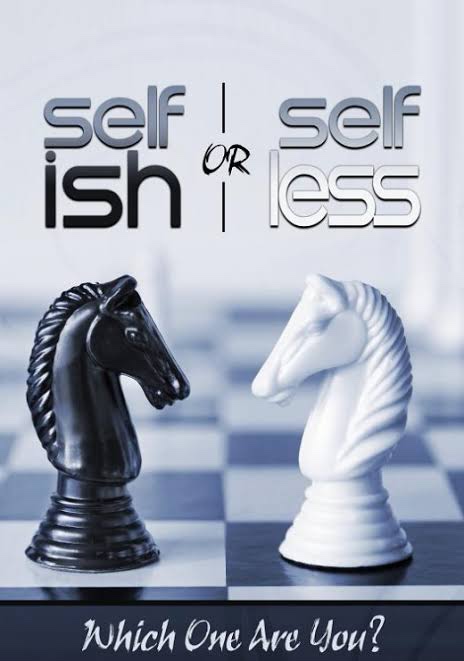
Selflessness, on the other hand, involves prioritizing others’ needs and interests over one’s own. This behavior is generally regarded positively, associated with qualities like kindness, altruism, and generosity. Like selfishness, selflessness also has biological, psychological, and socio-cultural origins.
From a biological perspective, selfless behaviors can be seen as an extension of the survival instinct – not just for the individual, but for the group or species as a whole. This is evident in many social animals’ behavior, where individuals often sacrifice their interests for the group’s benefit. This is especially pronounced in kin selection, where organisms exhibit behaviors that favor the survival of their relatives, even at a cost to their own survival or reproduction.
Psychologically, selflessness is linked to empathy, the ability to understand and share others’ feelings. Empathy allows us to form deep emotional connections with others and motivates us to act in ways that benefit them. Moreover, selfless behaviors can lead to increased self-esteem and well-being, as they often elicit positive social feedback and a sense of purpose and fulfillment.
At a socio-cultural level, selflessness is often encouraged through moral and religious teachings, societal norms, and cultural values. Many societies promote altruistic behaviors as virtues, reinforcing these behaviors through social approval and other forms of positive reinforcement.
Yet, it’s important to understand that neither selfishness nor selflessness is inherently “good” or “bad.” Instead, these behaviors exist along a spectrum, and their impacts can vary greatly depending on the context. Excessive selfishness can lead to social discord and harm others, but a total lack of selfishness might result in self-neglect or exploitation. Similarly, while selflessness can foster social harmony and cooperation, excessive selflessness can lead to self-sacrifice or martyrdom, which may not always be healthy or beneficial.
Balancing selfishness and selflessness is a constant human endeavor, shaped by our biological instincts, psychological needs, and socio-cultural influences. This balance allows us to care for our own needs while also considering the needs of others, fostering mutual respect, understanding, and cooperation – vital elements for personal well-being and social harmony.
On nature’s selflessness, it’s crucial to understand that what we perceive as ‘selflessness’ is an anthropomorphic projection. Nature operates on principles of interconnectedness and interdependence, where each entity plays its role in maintaining the balance and harmony of the whole system. What we deem as ‘selfless’ is nature’s way of existing and sustaining.
It all comes down to our definitions, our intentions, and the subtleties of human behavior and consciousness.
While at first glance, selfishness and selflessness seem to represent opposite ends of the behavioral spectrum, a deeper understanding can reveal surprising overlaps. Let’s unpack this.
Firstly, it’s important to understand that our actions, whether selfish or selfless, are inherently tied to the pursuit of well-being, satisfaction, or some form of positive outcome, which in itself can be considered a ‘selfish’ motivation.
In the case of selfish actions, this is easy to understand – we engage in selfish behavior when we believe that it will bring us personal gain, happiness, or satisfaction. We are directly seeking a beneficial outcome for ourselves, often without considering the impacts on others.
However, when we look at selfless actions, things get a little more complex. When we act selflessly, we prioritize the needs and well-being of others above our own. But why do we do this? There are several reasons, and this is where the idea of selflessness potentially being ‘selfish’ comes into play.
We might act selflessly because helping others makes us feel good – it satisfies a deep-seated emotional need for connection, purpose, or moral fulfillment. In this sense, we can say that selflessness is ‘selfish’ because we are indirectly seeking a beneficial outcome for ourselves – a sense of emotional satisfaction.
This is not to say that selfless actions are insincere or less valuable because they bring us satisfaction. Quite the opposite – it demonstrates that our well-being is intricately linked with the well-being of others. When we help others, we also help ourselves. This interconnectedness is a fundamental aspect of human nature and society, and it’s what allows empathy, altruism, and cooperation to thrive.
We might also act selflessly out of a recognition of the inherent worth of others – a deep respect for life and consciousness that transcends self-interest. This kind of selflessness can be seen as ‘pure’ in the sense that it’s not motivated by a desire for personal gain. However, even this can be seen as ‘selfish’ in a broader, existential sense. If we consider ourselves as part of a larger whole – whether it’s a community, society, or the universe itself – then working towards the well-being of that whole is in our interest, as we are part of it.
To bring these thoughts full circle, consider this: both selfishness and selflessness are natural aspects of human behavior, deeply rooted in our survival instincts, emotional needs, and socio-cultural contexts. While they might seem contradictory, they are both tools we use to navigate the world, foster connections, and seek well-being. The key lies in finding a balance – understanding when to prioritize our needs and when to consider the needs of others. This delicate equilibrium enables us to live harmoniously, both with ourselves and with the world around us.
Selflessly selfish or selfishly selfless is paradoxical nature of human behavior. To be “selflessly selfish” is to act with apparent selflessness, but with an underlying self-serving motive, perhaps gaining a sense of satisfaction, a good reputation, or a subconscious expectation of reciprocation. Alternatively, to be “selfishly selfless” implies acting for personal gain, but in a way that also benefits others. It’s a reminder that pure selflessness or pure selfishness rarely exist; human motivations are often a complex mix of both.
The overlap between selfishness and selflessness could also be a reflection of our interconnectedness. From an evolutionary standpoint, altruistic behaviors can enhance the survival of our kin or social group, and thereby our own genetic legacy. In a socially interconnected world, self-interest and the interest of the community often align. In this sense, one could argue that acting in the interest of others (selflessness) is ultimately a form of self-preservation (selfishness). However, the key lies in understanding these motivations without judgment, acknowledging their existence, and seeking balance. It’s about striving to act in ways that respect our needs and those of others. After all, a healthy sense of self-interest is necessary for self-care and survival, just as a degree of selflessness is essential for social harmony and cooperation.
Our actions often serve both ourselves and others, blurring the lines between selfishness and selflessness in a beautifully complex dance of human nature.
Can actions be detached?
The origin of action can be traced back to the very fabric of life itself. Every living entity, whether it’s a single-celled organism or a complex human being, is in a continuous state of action. Even in states of seeming inactivity, there are countless actions taking place within our bodies – cells dividing, heart beating, neurons firing. These actions are not born out of attachment, but rather out of the inherent nature of life and its ceaseless dynamism.
In human beings, actions become more complex. Many of our actions stem from cognitive processes, decision-making, emotions, motivations, desires, and fears. Some of these might be influenced by past experiences or expectations of future outcomes. While it’s true that past experiences can inform our actions, it doesn’t necessarily mean that every action is an outcome of attachment to past results.
Let’s take the example of learning to ride a bike. The initial attempts are informed by the desire to learn, and perhaps the fear of falling. Each attempt, whether successful or not, provides a learning experience which informs future attempts. Over time, as we master the skill, the act of riding a bike becomes almost second nature. It’s no longer driven by the initial desire or fear, but instead becomes an integrated action that we can perform almost effortlessly. In this scenario, the action of riding the bike is not an outcome of attachment, but a manifestation of learned skills and understanding.

Now, let’s consider the concept of detached action as explained in the Bhagavad Gita. Detachment in this context does not mean indifference or lack of care, but rather a state of being where one is not excessively attached to the fruits of their actions. When we perform an action with an attached mindset, we are often excessively focused on the outcome. This focus on the future can rob the action of its full potential, as our mind is not fully present in the action itself.
Detached action, on the other hand, allows us to be fully present in the act of doing. This presence can liberate the action from the constraints of past experiences or future expectations, allowing it to unfold with its full potential. A detached action is one that is performed with a sense of duty, with full attention, and without excessive attachment to the outcome. This doesn’t mean that we don’t care about the result. Instead, it means that we perform the action to the best of our ability, accepting whatever result comes as a consequence.
An important aspect to consider here is the interconnectedness of life. Our actions do not exist in a vacuum; they are part of an interconnected web of actions, reactions, and interactions. Understanding this can help us realise that while we have control over our own actions, the results are influenced by countless other factors, many of which are beyond our control. This realisation can foster a sense of humility, acceptance, and detachment, which can free us from the psychological burden of excessively identifying with the outcomes of our actions.

Moving further into the philosophy of actions, let’s delve into the concept of ‘free will’ and ‘determinism’. These two philosophical positions often clash when we try to understand the nature of our actions.
Free will posits that we, as conscious beings, have the power to make choices and act independently of any external constraints. It suggests that our actions originate from our conscious decisions and, thus, we bear full responsibility for them.
Determinism, on the other hand, suggests that every event, including human actions, is determined by previously existing causes. It argues that all our actions are the result of some cause, whether it is our genetic predisposition, upbringing, social environment, or other factors.
Both of these positions hold some truth. While we may feel that we have the freedom to choose our actions, we cannot deny that our choices are influenced by our past experiences, genetic predisposition, and external circumstances. So, our actions are both free and determined, depending on the perspective we adopt.
When we examine our actions closely, we find that they are not purely the result of our conscious decisions. Our subconscious mind, conditioned by past experiences and deep-seated beliefs, plays a significant role in our decision-making process. So, while we might believe that we are acting freely, many of our actions are habitual reactions conditioned by our past.
Understanding this can liberate us from the illusion of absolute control and the burden of excessive self-blame or self-congratulation. It can also foster a sense of compassion for ourselves and others, as we recognise that our actions are often the result of deep-seated conditioning and external circumstances, rather than purely intentional choices.
The key lies in the practice of mindfulness and self-awareness. By becoming more aware of our thoughts, feelings, and motivations, we can start to understand the forces that drive our actions. We can recognise our habitual patterns and start to make more conscious choices.
In the Bhagavad Gita, Krishna advises Arjuna to act without attachment to the fruits of action. This does not mean acting without care or intention. Rather, it means acting with full attention and commitment, without getting caught up in the anxiety about the outcome. This attitude allows us to act with greater freedom and effectiveness, as we are not burdened by excessive worry about the future or regrets about the past.
When we act, we set into motion a series of events, and the consequences of those actions ripple out into the world. The impact of our actions is not confined to ourselves; it influences those around us, our environment, and ultimately the world at large. This chain of cause and effect is constantly in motion and is dictated by the nature and intent of the action.
Duality arises from the perceived differentiation between good and bad, positive and negative, joy and pain, and so forth. This perceived differentiation often causes conflict and suffering because we instinctively cling to what we perceive as good and resist what we perceive as bad. We are pleased when our actions yield positive outcomes and disappointed when they do not.
However, the Bhagavad Gita teaches us that the dichotomy of good and bad is a construct of our mind and that every action simply is. This is a difficult concept to understand because it runs counter to our instinctual desire to classify and judge things based on our subjective perspective.

In reality, an action is neither good nor bad; it is our attachment to the outcome that labels it so. When we act without attachment to the outcome, we act in the fullest expression of our being, free from the constraints of expectation or fear of failure. This state of detachment does not mean that we do not care about the outcome, but rather that we understand we cannot control every aspect of it.
Instead, our focus shifts to the process, the action itself. By doing so, we become more present, more mindful, and more engaged in our actions. We start to see our actions not as a means to an end but as an end in themselves.
Therefore, to navigate the duality of actions and their effects, we must cultivate awareness and detachment. By observing our thoughts, emotions, and actions without judgment or expectation, we can experience life as it is, without the filter of duality.
In the grand scheme of life, our actions are but tiny ripples in a vast ocean. They may cause waves, they may create turbulence, but eventually, they will settle, leaving the water calm and clear once more. It is in this state of calmness, free from the duality of actions and their effects, that we find true freedom and peace.
Divinity – an escape to fear ?
As we delve into the concept of divinity, we encounter a landscape of varying interpretations and perceptions, shaped by the human quest for understanding and meaning. Divinity refers to the state of things that are believed to come from a supernatural power or deity, such as a god, or spirit beings, and are therefore regarded as sacred and holy. Such things are regarded as divine due to their transcendental origins or because their attributes or qualities are superior or supreme relative to things of the earthly world.
But why, one might ask, is divinity interpreted differently by different individuals and cultures? And how can something considered divine and universal also be understood subjectively?
While it may seem paradoxical, the reason lies in the intersection of the human cognitive apparatus with the profound mystery that the concept of divinity embodies. Even though divinity may represent universal principles or realities, the ways in which we understand, relate to, and express these principles are inherently influenced by our cultural, psychological, and experiential contexts.
Cultural factors play a significant role in shaping our views of the divine. Different religions and spiritual traditions have unique ways of conceptualizing and relating to divinity, reflecting their historical, cultural, and philosophical contexts. For instance, monotheistic religions like Christianity, Islam, and Judaism conceive of divinity as a single, all-powerful God, while polytheistic traditions like Hinduism and ancient Greek religion portray divinity in the form of many gods and goddesses, each representing different aspects of reality.
Psychological factors also contribute to the subjective experience of divinity. Our personal beliefs, emotions, experiences, and cognitive processes shape our understanding and experience of the divine. Some people might experience divinity as a personal relationship with a divine being, while others might perceive it as a transcendent state of consciousness or a profound sense of connection with all of life.
As for why divinity appears to wear ‘multiple masks,’ this is again a reflection of the diversity and complexity of human understanding and experience. Just as a multifaceted diamond reflects light in various ways, the concept of divinity can manifest in countless forms, reflecting the myriad ways in which human beings perceive and relate to the mystery of existence.
One might wonder: if the laws of nature are universal, why is our understanding of divinity so diverse? This discrepancy can be understood by considering the difference between objective and subjective realms of knowledge.
The laws of nature belong to the realm of objective knowledge. They can be studied, tested, and validated using the scientific method, which is designed to minimize the influence of individual bias and subjective perception. This is why scientific knowledge, including our understanding of the laws of nature, is largely consistent across different cultures and societies.
On the other hand, our understanding of divinity belongs primarily to the realm of subjective knowledge. It’s rooted in personal experience, cultural context, and introspective understanding, all of which are inherently subjective. While subjective knowledge can be deeply meaningful and transformative, it is also diverse and multi-dimensional, reflecting the complexity of human perception and experience.
Despite this diversity, there may be universal principles or realities underlying our various perceptions of the divine. These might include principles like the interconnectedness of all life, the transformative power of love and compassion, or the existence of a reality that transcends our ordinary perception.
However, just as a map is not the territory it represents, our concepts and images of the divine are not the divine itself. They are human-made representations, shaped by our cognitive capacities and cultural contexts. The divine itself, whatever it may be, likely transcends our human capacities for understanding and conceptualization.
To further elaborate, let’s consider an analogy. Picture a group of people standing around a magnificent sculpture placed in the center of a room, each person looking at the sculpture from a different angle. While they’re all observing the same object, the perspective they have of the sculpture is unique to their standpoint. Some will notice features that are invisible to others, while some aspects remain hidden to everyone. In essence, they are all viewing the same objective reality, yet their individual subjective experiences differ.
This analogy provides some insight into how people perceive divinity. Even though there may exist an objective divine reality (the sculpture), the way people perceive and experience it (their view of the sculpture) is dependent on their individual perspectives. These perspectives are shaped by a variety of factors including personal experiences, cultural backgrounds, religious beliefs, and individual psychological make-up.

In other words, the “masks” of divinity that different cultures, religions, and individuals see are representations tailored to their unique viewpoints and contexts. This diversity in divine interpretation does not necessarily imply that divinity itself is subjective or inconsistent, but rather that our understanding and experiences of it are.
Moving forward, it’s important to differentiate between the objectivity of the laws of nature and the subjectivity of our experience and understanding of divinity. The laws of nature operate independently of human perception or consciousness; they govern the physical world whether or not anyone is aware of them. Scientists strive to discover and understand these laws through a methodical, systematic process that aims to be as objective and unbiased as possible.
In contrast, our relationship with divinity is deeply personal and subjective. It depends largely on individual consciousness, belief systems, and experiences. Unlike the laws of nature, our experiences of the divine cannot be measured or empirically verified. They lie beyond the domain of scientific investigation and are instead in the realm of personal and spiritual exploration.
This doesn’t mean that our experiences of the divine are less “real” or valuable than scientific knowledge, just that they operate within a different sphere of human experience and understanding. Both realms – the objective and the subjective, the scientific and the spiritual – are crucial aspects of our quest for knowledge and meaning.
Many of the world’s religious and spiritual traditions point towards the possibility of experiencing divinity directly, beyond conceptual understanding. This direct experience, sometimes described as “mystical” or “transcendent,” is often said to transcend ordinary categories of thought and perception, providing a profound sense of unity, sacredness, or ultimate reality.
However, the path to such experiences is highly individual and cannot be standardized or prescribed. It often involves practices like meditation, contemplation, devotion, ethical living, or service to others, aimed at cultivating qualities like mindfulness, compassion, humility, and openness to the divine.
Ultimately, our understanding and experience of divinity are part of the rich tapestry of human existence, reflecting our deepest yearnings, questions, and potentials. They invite us to explore the mysteries of life, to cultivate virtues and wisdom, and to connect with something greater than ourselves. Despite the diversity of divine interpretations, they all point towards a reality that transcends the limitations of our ordinary perception, inviting us on a journey of discovery, transformation, and awakening.
Prayer – is it measurable ?
Prayer is an age-old human practice that transcends the boundaries of culture, geography, and faith. As we explore whether there is a measure of prayer, be it qualitative or quantitative, we find ourselves diving into the intricate layers of human spirituality, psychology, and the subjective experiences that weave the tapestry of our existence. In this exploration, we consider the motivations behind prayer, the outcomes of this practice, and the existential questions that propel human beings towards the realm of the divine.
Prayer, at its core, is a form of communication with a higher power, deity, or the universe, depending on one’s faith or personal belief system. It’s a practice steeped in ritual and tradition, manifesting in different ways across the world’s religions. Prayers may be expressed in silence, in spoken or sung words, through physical prostrations, or even via dance, as seen in some indigenous spiritual traditions. Some pray using prescribed words and formulas, while others engage in spontaneous, personal dialogues with the divine.
While a quantitative measure of prayer might seem straightforward – one could, in theory, count the number of prayers, their frequency, or duration – this approach fails to grasp the true essence of prayer. Prayer is fundamentally a subjective experience that eludes objective measurement. The “effectiveness” of a prayer isn’t necessarily proportional to the number of times it’s uttered or its length. It’s an act that holds significance beyond numbers and metrics.
The qualitative measure of prayer, on the other hand, poses a challenge due to its highly personal and subjective nature. Every person experiences prayer differently, which can be influenced by their beliefs, emotional state, intentions, and many other factors. The impact of prayer on an individual’s life, their sense of peace, or their connection to their faith are deeply personal matters that resist standard measurement.
However, some elements are often considered in assessing the qualitative “effectiveness” of prayer. These include the sense of peace and comfort it provides, its impact on one’s behavior or attitudes, and its ability to cultivate qualities like gratitude, compassion, and humility. Some also speak of experiencing a deep sense of connection or communion with the divine, which, to them, signifies a “successful” prayer. Nevertheless, these remain personal and subjective aspects that may vary significantly from person to person.
The reasons why people pray are as diverse as humanity itself. Some people pray to seek comfort, to express gratitude, to seek guidance, or to find inner peace. Others pray to foster a connection with the divine, to seek intercession for themselves or others, or as an act of worship and devotion.

Many individuals find in prayer a source of solace and strength. It provides a space to voice their fears, hopes, regrets, and gratitude, often bringing a sense of peace and clarity. It can serve as a means to navigate life’s challenges and uncertainties, fostering resilience and hope.
Prayer can also be a powerful tool for personal growth and transformation. It invites introspection and self-reflection, helping individuals to align with their values, cultivate virtues, and transform negative emotions. It can lead to improved relationships, greater compassion, and a heightened sense of purpose and fulfillment.
Regarding the question of whether people pray out of fear or belief in the unknown, or if they have an experience of the unknown, the answer is likely all of the above. The unknown, with all its mystery and uncertainty, has always been a profound trigger for human contemplation and spiritual seeking.
Some may pray because they fear the unknown – death, illness, misfortune, the cosmic scale of existence – and seek protection or comfort. Others pray not out of fear, but out of awe and wonder, driven by a desire to connect with the grandeur of existence that extends beyond the limits of human understanding.
There are also individuals who, through their spiritual practices, claim to have experienced glimpses of the unknown, encounters with the divine, or states of consciousness that transcend the ordinary. These experiences, often described as mystical or transcendent, may inspire a deepening of their prayer practice.
It’s crucial to acknowledge that the motivations for prayer and the experiences associated with it are diverse and complex, reflecting the profound complexity of human existence.
Ego and its death
The concept of the ego is deeply rooted in both psychology and philosophy, contributing to the overall understanding of human behavior, cognition, and identity. It’s a multifaceted term that has been interpreted and employed in various ways by different scholars. To understand the ego in depth, we need to examine its theoretical origins, its functions, its influence on our behavior and relationships, and the role it plays in personal growth and self-awareness.
The term “ego” has its roots in Latin, where it means “I.” However, its contemporary psychological and philosophical meanings draw mainly from the works of Sigmund Freud, the founder of psychoanalysis, and Carl Jung, the founder of analytical psychology.
Freud used the term ego to describe one of the three components of the psychic apparatus in his structural model of the mind. According to him, the human psyche comprises the id, the ego, and the superego. The id is the primitive part of our psyche that contains our basic instincts and drives. It operates on the pleasure principle, seeking immediate gratification of needs and desires.
The superego, on the other hand, is the moral compass, formed as we internalize societal and parental norms and values. The ego, according to Freud, is the mediator between the id and the superego. It operates on the reality principle, trying to satisfy the id’s desires in socially acceptable ways that also align with the superego’s moral standards. The ego, thus, helps us navigate the external world while managing our internal drives and moral values.
In contrast, Carl Jung saw the ego as the conscious mind, encompassing our thoughts, memories, and perceptions. It forms the center of our conscious identity but not the entirety of the self, which also includes the unconscious elements. For Jung, the ego is essential for self-awareness and plays a vital role in the process of individuation, which is the journey toward wholeness and self-realization.

The ego, as understood from these perspectives, plays a vital role in our lives. It helps us manage our impulses, maintain our relationships, make decisions, and develop a coherent sense of self. Without the ego, we would struggle to function effectively in the world.
However, when the ego is too dominant or rigid, it can become a source of problems. It may cause us to become overly attached to our self-image, leading us to defend it vehemently against any perceived threats. This can manifest as excessive pride, stubbornness, defensiveness, or inability to accept criticism. In its extreme form, it can lead to narcissistic tendencies, where one’s self-absorption becomes detrimental to their relationships and overall well-being.
In the realm of personal growth and self-awareness, the ego is often perceived as a barrier. This is because the ego, by its very nature, clings to the familiar and resists change. It likes to be in control and tends to see things in dualities (right-wrong, good-bad, etc.), making it difficult for us to embrace uncertainty, see different perspectives, or step out of our comfort zones. This can limit our growth and prevent us from realizing our full potential.
At the same time, the ego can also be a gateway to growth and transformation. By becoming aware of our ego—its patterns, its fears, its defenses—we can begin to understand ourselves better. This awareness can give us the insight and courage we need to challenge our old ways of being and forge a new path.
Moreover, the ego can provide valuable clues to our unconscious elements. Our reactions, defenses, and fears often point to unresolved issues or repressed aspects of ourselves. By exploring these aspects, we can bring them to light, integrate them, and become more whole and self-aware.
To fully understand what “dies” when we become fully aware and conscious, and what it is we naturally let go of when we begin to understand ourselves, it’s crucial to delve into the depths of human consciousness, self-awareness, and the fundamental elements of our identity. This inquiry involves a deep dive into psychology, philosophy, neuroscience, and spirituality.
Becoming fully aware and conscious implies a shift from a state of unconsciousness or lesser awareness to one of higher consciousness. Here, unconsciousness refers to automatic, habitual behaviors and thought patterns which we often engage in without any conscious control or intention. These patterns, formed through years of conditioning, might include biases, assumptions, prejudices, or learned behaviors that operate under the surface of our everyday awareness.
When we reach a state of full awareness or consciousness, these patterns can no longer exist in their previous form. Essentially, what “dies” here is the old self – the unconscious patterns and the egoic self that is driven by them. The ego, in psychological terms, can be seen as the aspect of identity that we consider our “self.” It’s constructed from our experiences, memories, cultural conditioning, and our reactions to external stimuli.
The ego is characterized by attachment to certain ideas about ourselves and the world around us. These ideas may include beliefs about what we should be, what we need to be happy, what we fear, and how others should behave. Often, these ideas are not based on conscious decisions but are ingrained in us through past experiences and societal conditioning.
Becoming fully aware or conscious means recognizing these patterns and seeing them for what they are—temporary constructs rather than inherent aspects of our identity. This allows us to break free from these habitual patterns, essentially causing the egoic self or the old self to “die.” This doesn’t mean we lose our sense of self; rather, it signifies a transformation of self.
As we reach this state of full consciousness, we naturally begin to let go of the attachments that the egoic self held. Attachments, in this context, refer to rigid beliefs, preconceived notions, desires, fears, and expectations that we unknowingly cling to. They are deeply entrenched within our psyches and often steer our thoughts, emotions, and actions without our conscious awareness.
When we start to understand ourselves – our motivations, our fears, our reactions – we naturally begin to see these attachments for what they are. We see that they are not fixed parts of our identity but constructs that we have the power to change or let go of. Understanding ourselves means recognizing that we are not solely the sum of our experiences, thoughts, emotions, or societal conditioning. We are conscious beings capable of introspection, change, and growth.
In the process of self-understanding, we let go of these attachments because we realize that they limit our potential and obstruct our well-being. Letting go is not about forgetting or ignoring our past experiences or emotions. Instead, it’s about recognizing these elements for what they are, understanding their impact, and then making the conscious decision not to let them dictate our present and future.
Moreover, letting go is an act of acceptance—acceptance of our past, our mistakes, our flaws, and our vulnerabilities. It’s about accepting that we are human beings capable of change and growth. We acknowledge our past experiences and emotions, learn from them, and then free ourselves from their hold.
In the process of becoming fully aware and conscious, what dies is not the individual’s sense of self, but the old, unexamined sense of self. The egoic self that was once controlled by unconscious patterns and attachments undergoes a transformation. This transformation is a process of death and rebirth—death of the old self and birth of the conscious self.
On this journey, the individual learns to let go of rigid beliefs, fears, and expectations that once held them back. They start to live from a place of conscious choice rather than habitual reaction. As a result, they experience a profound sense of freedom and openness, which enables them to navigate life with greater flexibility and resilience.

The journey to full awareness and self-understanding is not a linear one, and it’s not without challenges. It requires courage, patience, and persistence. But the rewards it brings—a profound sense of peace, freedom, and fulfillment—are well worth the effort.
 Abhishek Fanse