Depths of Hurt: An Intriguing Emotion
At its core, hurt is an emotional response to a perceived loss or violation. This loss can be tangible, such as the loss of a loved one, or intangible, like the loss of respect or love. The perception of this loss is crucial; it’s not the objective situation that determines hurt, but how one interprets and internalizes it. The origins of hurt can be traced back to our earliest human experiences. As infants, we are utterly dependent on others for our survival, leading to a deep-rooted need for attachment and acceptance. This need, while essential for survival, also becomes the breeding ground for hurt. When our expectations of support, love, or acknowledgment are unmet, we experience hurt.
Hurt often manifests differently in personal and professional contexts, yet the underlying mechanics are surprisingly similar. In personal relationships, hurt is often more directly linked to emotional bonds and expectations of love, loyalty, and understanding. In professional settings, while the emotional stakes may seem lower, the hurt can still be profound. It often stems from unmet expectations regarding respect, recognition, or the outcome of our efforts. The statement “don’t take it personally” in professional environments is an acknowledgment of this complexity. It attempts to draw a boundary between the personal self and the professional role. Yet, this separation is often not as clear-cut as it seems. Our professional lives are an extension of our personal selves; the values, aspirations, and efforts we put into our work are deeply personal. Thus, when we face criticism, rejection, or failure at work, it can still impact our personal self-esteem and sense of worth.

The hurt one experiences is often a reflection of internal expectations and self-perception. When others do not meet our expectations, or when we fail to meet our own, we experience a sense of loss. This loss is not just about the external situation but also about our internal narrative. We construct stories about who we are and how the world should respond to us. When reality diverges from these stories, we feel hurt. Understanding hurt requires dissecting the dichotomy between external causes and internal reactions. Is hurt caused by others, or is it self-inflicted? The answer is nuanced. Others can act as triggers, but the actual experience of hurt is an internal process. It is our interpretation of events, filtered through our personal beliefs and past experiences, that generates hurt. human experience. We are beings of desire and expectation, living in a world that is constantly changing and often unpredictable. This disconnect between our desires and reality is a fertile ground for hurt. However, this inevitability doesn’t imply helplessness. It requires a shift from external validation to internal self-acceptance, and from rigid expectations to flexible aspirations. This journey towards resilience is not about becoming indifferent or uncaring, but about cultivating a grounded sense of self that can navigate the ups and downs of life with equanimity.
Developmental psychology, for instance, sheds light on how early experiences shape our vulnerability to hurt. Childhood, where the foundation of our self-esteem and worldviews are formed, significantly influences how we perceive and react to potential hurts in later life. Attachment suggests that our early bonding experiences with caregivers form templates for future relationships. Secure attachments lead to resilience, while insecure attachments can heighten our sensitivity to rejection and loss, predisposing us to deeper hurt.
Hurt also stems from conflicts of human existence – our search for meaning in an indifferent universe, the realization of our freedoms and limitations, and the ultimate confrontation with our mortality. Our self-perception plays a critical role in this process. If we perceive ourselves as capable and deserving, failing to meet expectations can lead to self-criticism and hurt. Conversely, if we see ourselves as unworthy, we may internalize external negative outcomes as confirmations of this belief, perpetuating cycles of hurt and low self-esteem.
Let us take a simple example where you feel hurt due to a longing for more time and attention from a loved one, even though you recognize they are doing their best. At the heart of your experience lies a paradox: you have an expectation (desiring more time and attention) and simultaneously an understanding (knowing your loved one is doing their best). This dichotomy is not just a matter of conflicting thoughts, but a reflection of the complex nature of human needs and empathy. On one hand, your need for time and attention is genuine – a fundamental aspect of human relationships where such connections and affirmations are essential for emotional bonding and fulfillment. On the other hand, your empathetic understanding of your loved one’s circumstances shows a depth of maturity and compassion. Feeling hurt in this context may arise from an unmet need, which is central to your emotional wellbeing. It’s important to recognize that such needs are not just whimsical desires; they are integral to our sense of connection and belonging. When these needs are not fully met, even in the presence of understanding and rationalization, it creates an emotional void, often experienced as hurt. The consequences of this paradox can be profound. When the fear of burdening outweighs the need for communication, individuals might choose to suppress or hide their feelings. This suppression, while it might seem to maintain harmony in the short term, can lead to several negative outcomes like emotional distance, resentment or misunderstanding. However, this need for emotional expression often collides with an equally powerful force – the fear of overburdening others. This fear stems from a place of empathy and concern, where we become acutely aware of the other person’s potential struggles and challenges. It also arises from our own vulnerabilities; the fear of being seen as needy, weak, or burdensome. Moreover, there’s an underlying concern about the dynamics of the relationship itself – the worry that being too open about our troubles or desires might alter the equilibrium of the relationship, potentially leading to conflict, distance, or discomfort.
At the heart of this paradox is our self-concept, the multifaceted perception we hold of ourselves. This self-concept is not static; it is shaped by our experiences, beliefs, and the feedback we receive from our environment. When we consider communicating our innermost thoughts and feelings, we are also negotiating with our self-concept. Are we someone who burdens others? Are we worthy of being heard and understood? These questions reflect deeper insecurities and beliefs about our worthiness and role in our relationships. The fear of being a burden often stems from a vulnerable place in our self-concept, where we doubt our value in the eyes of others. The complexity of this paradox also lies in the dynamic nature of human relationships. Each relationship we form is a unique intersection of personalities, histories, and expectations. In some relationships, there may be an established pattern of one person being the caregiver and the other the receiver. Attempting to reverse or alter these roles by expressing one’s own vulnerabilities can feel disruptive and fraught with uncertainty. There’s also the aspect of reciprocity – the balance of give and take. In healthy relationships, this balance is fluid and flexible, but the fear of disturbing this balance can make the act of communication seem daunting.
Psychologically, this paradox is intersecting with our deepest fears and vulnerabilities. It often triggers core issues related to self-worth, rejection, and abandonment. When we contemplate sharing our burdens, we are not just sharing a specific problem or feeling; we are also, on a deeper level, testing our acceptability and worthiness in the eyes of others. The fear that our vulnerabilities might make us less worthy of love or respect can be a powerful deterrent to open communication…
Understanding Dussehra: The morality spectrum
One of the most ancient concepts that explain duality is the Chinese philosophy of Yin and Yang. Everything has an opposite: where there’s light, there’s shadow; for life, there’s death. These dualities aren’t necessarily in opposition but rather in harmony, feeding into and defining each other.
Ravana’s Ten Heads: Ravana, the primary antagonist of the Ramayana whose defeat is celebrated on Dussehra, had ten heads. These are often seen as symbolic of ten human flaws. The act of Lord Rama killing Ravana isn’t about annihilating evil in its entirety but rather about overcoming these flaws.

The war in Ramayana, and by extension Dussehra, can be seen as an allegory for the inner battles we all face. It’s about making choices that align more with our higher self than our base instincts. Good and evil, in many ways, are relative. What’s “good” in one culture or time period might be seen as “evil” in another. They’re constructs that help humans navigate complex social and moral landscapes. What’s deemed good or evil can be relative, varying across cultures, religions, and individual beliefs. For example, a warrior killing an enemy might be considered heroic in one culture but a grave sin in another.
While Ravana is the antagonist in the Ramayana, he’s also a complex figure. A devout Shiva worshiper, an accomplished scholar, and a powerful king, his multifaceted personality blurs the lines between good and evil, suggesting that these concepts aren’t always black and white. After Ravana’s defeat, Sita undergoes a trial by fire to prove her purity. This episode raises questions about societal judgments, honor, and the complexities of righteousness.

Good Within Evil: Often, acts categorized as “evil” might have underlying “good” intentions or vice versa. A person may commit a crime to feed their starving family—how do we reconcile the act’s morality? The very existence of “good” necessitates “evil.” Without shadows, there’s no appreciation of light. This balance is essential for growth, evolution, and understanding. The cyclical celebration of Dussehra may symbolize the perpetual battle between our higher aspirations and our baser instincts, emphasizing the ongoing nature of personal evolution. By celebrating the triumph of good over evil, we’re also acknowledging the existence and importance of the dark side. It’s a recognition that the path to wisdom and righteousness involves confronting and understanding our own inner demons.
In today’s world, where moral lines often blur, the external representation of Dussehra’s battle might symbolize the internal conflicts we face in determining what’s right, navigating societal expectations, and personal desires. Ravana’s downfall began with his attachment and desire for Sita. This can serve as a reflection on how attachments can lead to one’s undoing, emphasizing the importance of detachment and self-awareness.
While the core message of Dussehra remains consistent, its interpretation and celebration can vary. In some parts, it’s about Rama’s victory over Ravana, while in others, it’s Goddess Durga’s triumph over the buffalo demon Mahishasura. This variance underlines how societies adapt stories to reflect their values and lessons they find most pertinent.
Annually commemorating the triumph of good over evil serves as a reminder for individuals to assess their moral compass, encouraging them to uphold righteousness in the face of wrongdoing. With changing times, the interpretations of ancient tales also evolve. For the newer generation, Ravana might not just symbolize a demonic force but could represent systemic societal issues like corruption, prejudice, or environmental neglect. The battle is then between collective societal good and these modern ‘evils’. In an era of individualism, many use Dussehra as a time of personal reflection, confronting their own Ravanas, be it anger, jealousy, greed, or other personal challenges.
The Clarity in Uncertainty – Dance between Fog and Focus
The tension between clarity and unclarity seems to be rooted in the human condition itself. Our minds are built to seek patterns, to make sense of the world, and to resolve ambiguity. When things are unclear, we often experience discomfort because it conflicts with our innate desire for resolution and understanding. Unclarity poses a challenge, and humans are generally wired to confront and solve challenges; it’s a basic survival instinct.
However, once we achieve clarity, the “puzzle” is solved, the “problem” is resolved, and the thing that engaged our curiosity and problem-solving abilities no longer does so in the same way. The mind then moves on to the next challenge. It’s a kind of restlessness that keeps us evolving, learning, and growing, but it can also be a source of dissatisfaction or even suffering.
The reason why unclarity is challenging could be because it disrupts our sense of control. Clarity gives us the illusion of control, of being able to predict and manipulate our environment effectively. However, life is full of complexities and dualities that resist simple explanations or solutions. That’s why even when we feel we’ve achieved some clarity, it often seems limited or provisional.

This issue also brushes up against existential and spiritual concerns that have fascinated philosophers and religious thinkers for centuries. The idea that life is fundamentally uncertain and that we must find a way to live with this uncertainty is a central theme in many worldviews. It raises questions about how to live a meaningful life within the constraints of our limited understanding and control. Our relationship with unclarity can also change over time and with experience. As we age, we might find that we become more comfortable with shades of gray, more accepting of the limitations of our knowledge and control. Some people find great peace in embracing the mysteries of life, in recognizing the limitations of human cognition and the vastness of what we don’t know.
But this is often a hard-won wisdom, coming after years, or even decades, of grappling with the discomfort and challenges that unclarity brings. Some of the greatest minds in history have discussed the virtue of embracing uncertainty. Scientists, for example, thrive on it; it’s the engine that drives scientific inquiry. For artists, ambiguity can be a rich source of inspiration, a space where new ideas and forms can emerge. In spiritual practices, the embracing of mystery is often considered a path to deeper understanding and enlightenment.
This doesn’t make the process of dealing with unclarity any less challenging, but it may offer a different perspective on why this is such a universal human experience. It might not be something to be solved or eradicated but a fundamental aspect of the human condition to be explored, understood, and even embraced.
In other words, both clarity and unclarity have their roles in our lives, offering different kinds of lessons and opportunities for growth. Clarity can offer us direction and a sense of purpose, but it can also make us complacent or narrow in our thinking. Unclarity, on the other hand, while often uncomfortable, pushes us to question, explore, and stretch our boundaries.
Think of it as a sort of dance. Sometimes, life leads with clarity, providing us with straightforward answers, well-defined goals, and unambiguous directions. At other times, it leads with unclarity, challenging us with questions, uncertainties, and complex dilemmas that don’t have easy answers. Both stances have their own unique beauty and can enrich our lives in different ways.

The key might be learning how to navigate between these two states, knowing when to seek clarity and when to embrace uncertainty, how to balance our need for concrete answers with a willingness to dwell in ambiguity. And most importantly, how to find a sense of peace and even joy in that ongoing dance between the known and the unknown. So while the discomfort and challenge of unclarity can be difficult to live with, they also serve as catalysts for growth, pushing us to evolve and adapt in ways we might not have otherwise. After all, if life were entirely predictable and clear-cut, would it hold the same richness and potential for growth? Perhaps not.
Human nature is inclined toward a preference for clarity because it gives us a sense of control. When things are clear, we know what to expect, how to behave, what choices to make, and that gives us comfort. Clarity aligns with our need for stability and security.
On the other hand, unclarity often provokes discomfort because it takes away our sense of control. When situations are unclear or when we’re facing ambiguity, it triggers our brain’s threat detection systems, making us feel unsettled or anxious.
However, there’s an ironic twist to this natural inclination for clarity: the thrill of the unknown. Humans are also explorers, innovators, and problem solvers. These traits are activated by unclarity. We are drawn to mysteries, puzzles, and challenges because they promise the reward of discovery and growth. So, while our first reaction to unclarity may be discomfort, that same discomfort can motivate us to explore, to understand, and to grow.
But why do we pay more attention to what is unclear even after achieving clarity? Because clarity often brings resolution, and with resolution comes the end of that particular cycle of exploration or growth. On the other hand, unclarity sustains a continual process of seeking and questioning. Even when we solve one puzzle, another often takes its place. This continuous seeking can be stressful, but it’s also how we grow and evolve as individuals.
This is the paradox: Clarity and unclarity are two sides of the same coin, each with its own set of challenges and rewards. Clarity provides comfort but can lead to complacency. Unclarity creates discomfort but also fuels growth. Both are necessary for a fulfilling, well-rounded life.
The challenge, then, isn’t to eliminate unclarity but to engage with it in a way that is constructive rather than paralyzing. This often involves a level of acceptance that some questions might not have straightforward answers, and some situations will involve navigating through grey areas. Yet, it is precisely these challenges that enable us to grow mentally, emotionally, and spiritually. So, living with unclarity is not about finding a final state of total clarity, but about developing the resilience and wisdom to navigate life’s inherent uncertainties in a meaningful way.
In the realm of philosophy, this dual need for both clarity and unclarity echoes the dialectic process—where contradictory ideas coexist, inform each other, and even enable progress. To engage constructively with unclarity, one can apply a similar approach—acknowledging both the comforting aspects of clarity and the growth-oriented elements of unclarity without seeking to completely eliminate either one.
The act of accepting unclarity as a natural part of life can also be seen as an exercise in humility. No matter how much we know, there will always be elements that are out of our control, questions that don’t have immediate answers, and complexities that don’t yield to simple explanations. Acknowledging these uncertainties can open us to deeper understanding, greater empathy, and even wisdom. It frees us from the paralyzing quest for perfect certainty and allows us to make meaningful decisions despite incomplete information.
In practice, this might mean being okay with not having all the answers before taking action, or recognizing that it’s alright to change our minds when faced with new information. It could involve embracing ‘not knowing’ as a state that propels inquiry rather than stifles it. It also encourages a dynamic state of learning, where the lines between teacher and student blur, and every experience becomes an opportunity to grow.
In many philosophical frameworks, absolute clarity or certainty is considered an illusion or an ideal that can never be fully attained. We might strive for clarity but should recognize that it will often be provisional and subject to change.
Perhaps we can think of clarity not as an endpoint, but as a spectrum. At one end is complete confusion or lack of understanding, and at the other is perfect clarity. Most of the time, we find ourselves somewhere in between. Clarity, in this sense, becomes not a destination but a process—a movement along that spectrum towards greater understanding.
When we say we “have clarity,” it might simply mean we’ve moved far enough along this spectrum to make a confident decision or to understand a situation to our own satisfaction. This doesn’t mean we’ve solved the puzzle entirely, just that we have enough pieces in place to see the image taking shape. But clarity is often elusive because life is inherently complex, unpredictable, and full of uncertainties. Our plans and perspectives are always subject to change due to new information, experiences, and insights. Thus, even when we achieve a state of clarity, it’s often temporary and subject to change.
The search for clarity often seems like an endless endeavor precisely because life is complex and ever-changing. When we seek clarity, what we’re often looking for is a framework or paradigm that allows us to make sense of our experiences and observations. But each framework has its limitations; no single lens can capture the full depth and complexity of reality.
The existentialist philosophers, for example, posited that life is inherently ambiguous. There is rarely a single, clear-cut answer to complex questions. The more we learn, the more we recognize the limits of our knowledge. This is what Socrates meant when he said, “I know that I know nothing.” His wisdom lay in recognizing his own ignorance.
Similarly, Eastern philosophies like Buddhism speak of “beginner’s mind,” the idea of approaching life with openness, eagerness, and a lack of preconceptions, much like a beginner or a child. This is not the same as saying one should be ignorant, but rather that one should be open to multiple perspectives and willing to revise one’s understanding as more information becomes available.
In modern psychology, this ongoing quest for clarity amidst uncertainty can sometimes be framed as “tolerance for ambiguity,” a psychological trait that defines one’s ability to function well in situations that are uncertain, unclear, or chaotic. People with high tolerance for ambiguity are generally more flexible and find it easier to adapt to new situations, while those with low tolerance may find ambiguity to be stressful and may seek to resolve it as quickly as possible, even if it means settling for a simplistic answer.
So why do we seek clarity? From an evolutionary standpoint, being able to quickly assess and understand our environment could have survival benefits. However, the modern world is much more complex than the environments in which our ancestors lived, and the “clarity” we seek may not always be achievable or may require us to accept some level of uncertainty or paradox.
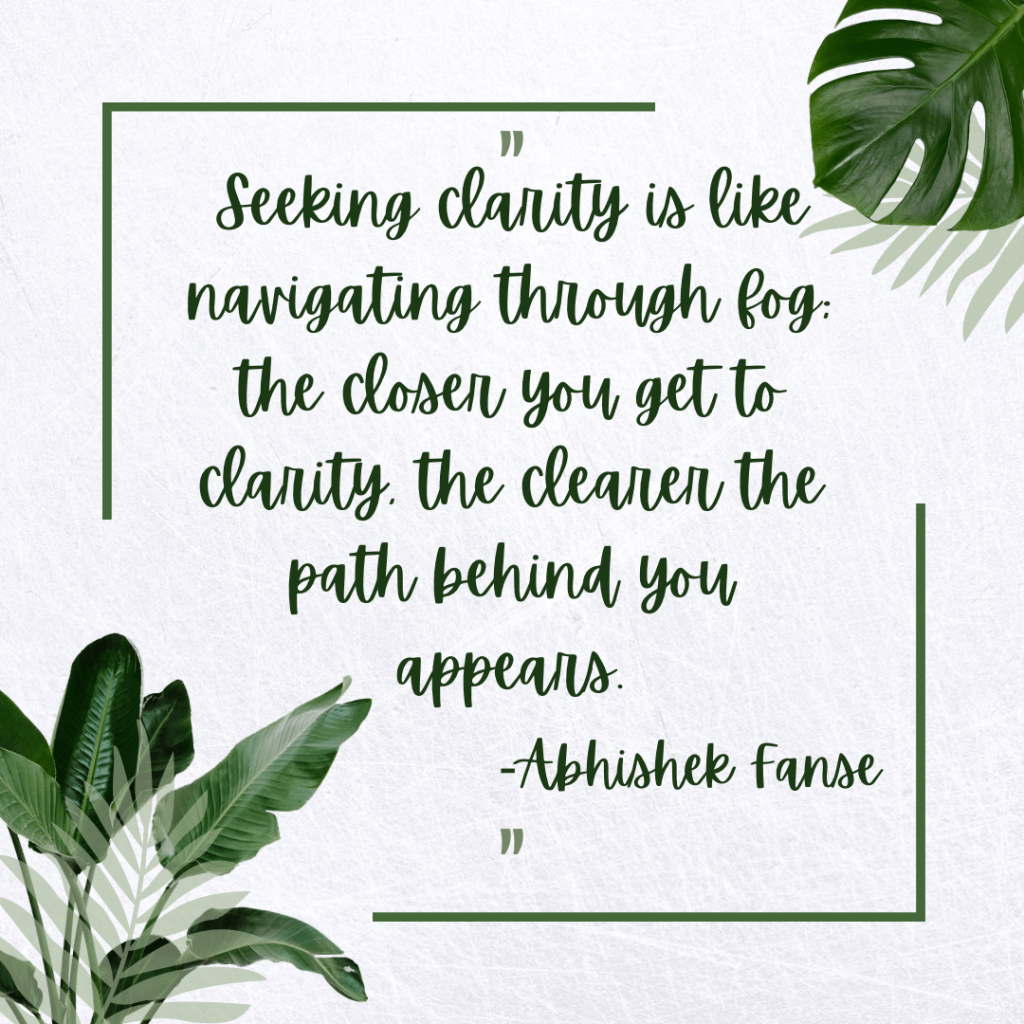
The pursuit of clarity, then, is both a psychological and philosophical endeavor. It involves developing the cognitive and emotional skills needed to navigate uncertainty and the wisdom to recognize that our understanding of any given situation is likely to be partial and contingent on various factors.
If we can get comfortable with the idea that absolute clarity is an ideal rather than a constant state, we can free ourselves to seek understanding in a more nuanced and open-minded way. We learn to appreciate the journey of intellectual and emotional growth, even if it never leads to a single, unambiguous destination.
 Abhishek Fanse