Is harmony defined by us is really harmonious ?
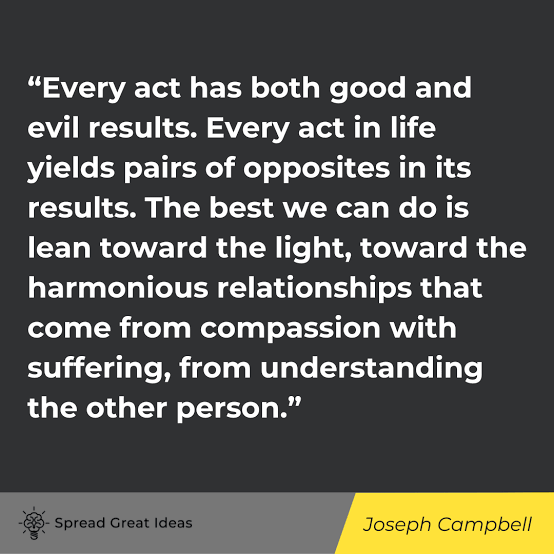
The universe operates on a balance. Dualities like light and dark, joy and sorrow, and so on, are not in contention with each other but rather two sides of the same coin. They provide context and meaning. It’s akin to understanding that one cannot truly appreciate light without having known darkness. Our existence is enigmatic, where a myriad of elements interplay in a vast cosmic dance. Every action, no matter how minute, sends ripples across the fabric of the universe. Such is the interconnectedness and oneness that defines the cosmos. But amidst this vastness, we humans grapple with the age-old questions: Why are we here? Why do we feel disconnected when everything is intrinsically connected? And, why is our life, despite being a part of this vast universe, so often defined by duality?
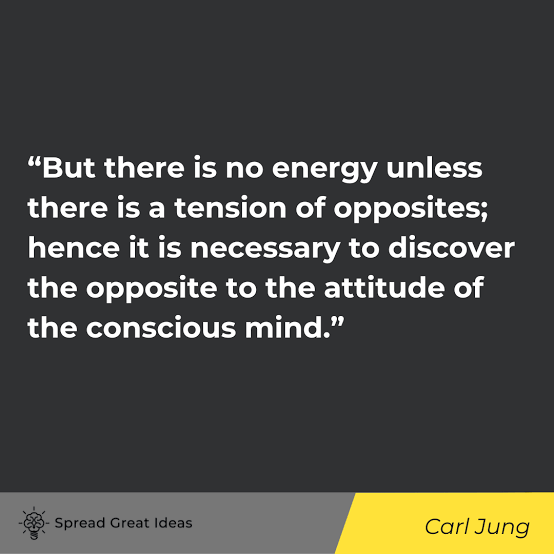
Consider the universe as an immense symphony, where every entity is like a note, contributing to an eternal, harmonious melody. From the most massive stars to the tiniest organisms, everything is in sync, vibrating in tune with the universe. This sense of harmony is a constant, even if it’s not always immediately apparent. However, the human experience often feels at odds with this cosmic harmony. We frequently perceive life through the lens of duality: good vs. evil, happiness vs. sorrow, success vs. failure. Such bifurcations arise primarily from our mental frameworks, shaped by societal norms, personal experiences, and evolutionary predispositions.
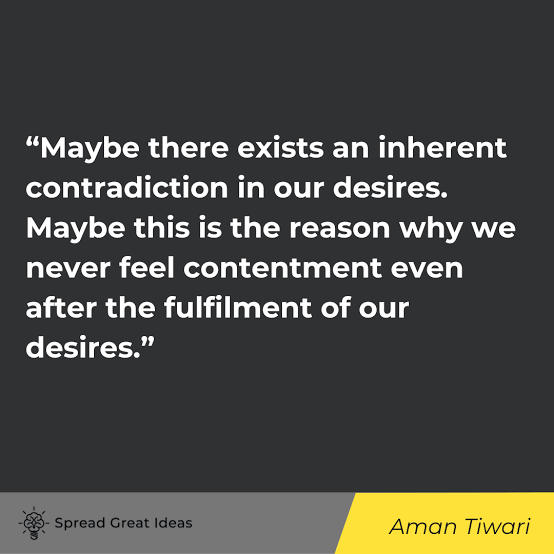
In our evolutionary journey, the human brain developed cognitive systems to categorize, discriminate, and simplify the complex stimuli of the external world, making it digestible and navigable. This cognitive system is a survival tool, enabling us to swiftly identify threats from non-threats, edible food from inedible, and so on. Over time, as societies became more sophisticated, these dualistic mental models began to govern not just our interactions with the environment but also our self-perception, aspirations, and relationships. This dualistic approach further feeds into the illusion of separateness — a feeling that we are distinct from the rest of the universe. Despite being made of stardust and sharing common atomic ancestors with everything around us, we often feel isolated or alienated. Such feelings intensify when we face adversities, leading many to question the harmony and purpose of existence.
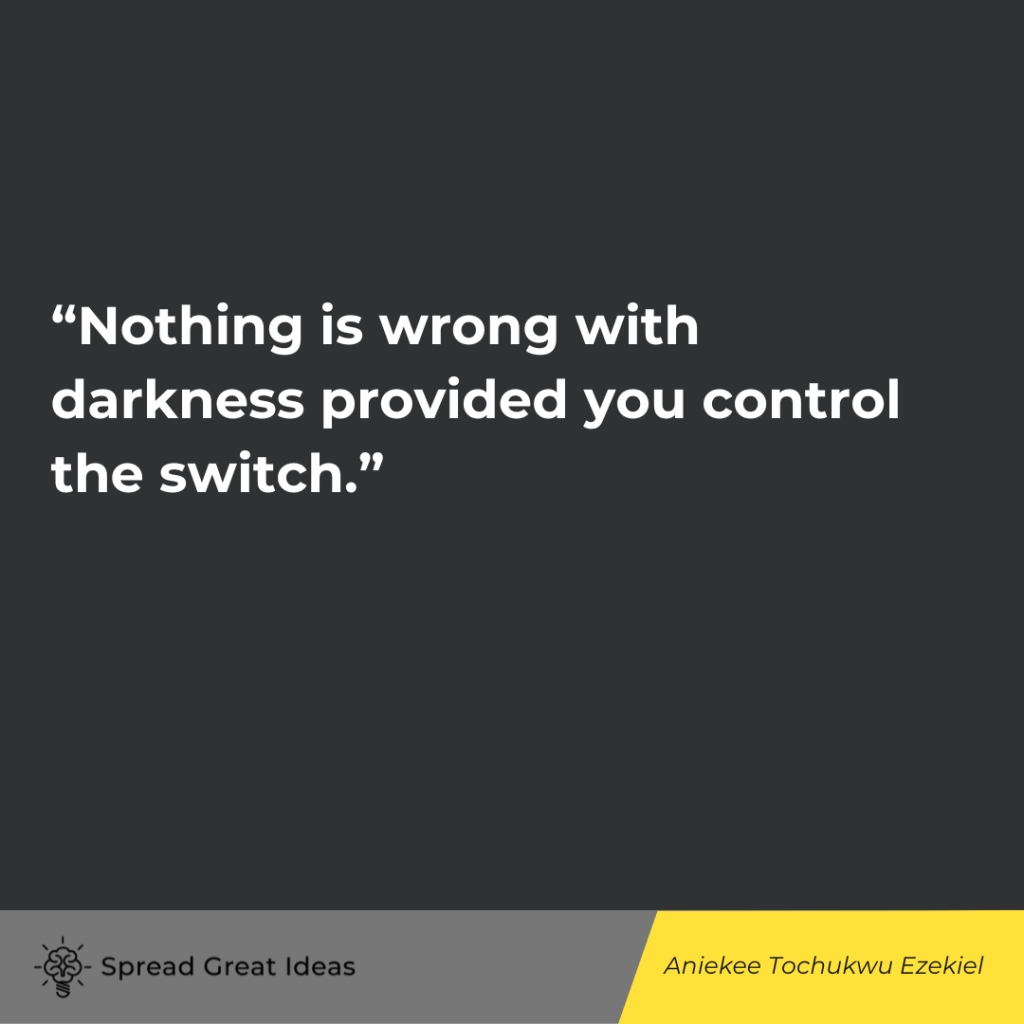
Our understanding of freedom is entwined with our perception of duality. True freedom is not just liberation from external constraints but also from internal ones, like prejudices, fears, and limiting beliefs. To break free from the life’s cycle, one needs to reconcile with dualities, recognizing them as constructs rather than inherent truths. As we delve deeper into the framework of existence, we find that duality isn’t inherently detrimental. Instead, it provides contrast, lending depth and dimension to our experiences. Just as the contrasting strokes of a painting give it life and depth, the dualities of our lives add vibrancy and richness to our existence. Without dark, there would be no understanding of light; without sorrow, the true essence of joy would remain unknown.
Much of our attachment to duality stems from societal and cultural conditioning. From childhood, we’re taught to label and categorize experiences: winning is good, losing is bad; happiness is desirable, sadness is not. Over time, these labels solidify into beliefs, shaping our perceptions and reactions. For instance, consider the universally accepted notion of success. Societal metrics of success often revolve around material wealth, social status, and professional achievements. However, if we were to strip away these conditioned beliefs and look at life through an unfiltered lens, we might find that true success lies in inner contentment, meaningful relationships, and personal growth.
Our fixation on the ephemeral aspects of life — fleeting emotions, transient experiences, and temporal possessions — further entrenches us in the duality trap. In the rush of life, we often overlook the eternal — the unchanging, omnipresent essence that underlies all existence. This essence, often referred to in spiritual contexts as the ‘Self’ or ‘Consciousness,’ remains unaffected by the dualities that play out on the surface.
By connecting with this eternal aspect of ourselves, we begin to view dualities with a sense of detachment. They appear as passing clouds against the vast sky of our existence, impactful in the moment but not defining our eternal essence. Aligning with the duality doesn’t mean becoming passive or indifferent. It means engaging with life wholeheartedly, experiencing every emotion, every high and low, but without letting them dictate our inner state. With heightened awareness, we can navigate the complexities of life with grace, recognizing the transient nature of our experiences.
This awareness doesn’t diminish our experiences but rather enriches them. When we embrace both the joys and sorrows of life with equanimity, we live more fully, more authentically. We begin to see challenges as opportunities for growth, failures as lessons, and successes as moments of gratitude.
Our perception of disharmony is influenced by our thoughts, emotions, and our attachments to outcomes. When we find ourselves in situations we didn’t desire or anticipate, our immediate response is resistance. This resistance, this non-acceptance, creates friction – a perceived disharmony.
The journey to non-duality is a continuous process of introspection, reflection, and growth. Various spiritual traditions offer paths to transcend duality: the Yogic tradition advocates for meditation and self-inquiry, Buddhism emphasizes mindfulness and compassion, while Taoism teaches the art of flowing with life, embracing both its yin and yang.
The common thread across these traditions is the idea of returning to one’s true nature — a state of pure consciousness, free from the constraints of duality.
The Liberation of the Present
What are the most important things needed to live a good life?
Once upon a time, in a bustling city, there lived a young man named Siddharth. Siddharth was a bright and ambitious individual, but he often found himself trapped in the patterns of conditioned behavior. His mind was always preoccupied with thoughts of the past and worries about the future. He longed for a sense of freedom and spontaneity in his life.
One day, as Siddharth was walking through a park, he came across an old man sitting peacefully under a tree. Intrigued by the man’s serene presence, Siddharth approached him and asked, “Sir, how do I break free from the shackles of conditioned behavior and embrace the present moment?”
The old man smiled warmly and began to share a story.
“There was once a bird confined in a golden cage,” the old man began. “The bird had wings to fly and explore, yet it remained trapped within the boundaries of its cage. It yearned for the freedom of the open sky, where it could soar without limitations.”
Siddharth listened attentively, relating to the bird’s longing for freedom. The old man continued, “One day, a gentle breeze blew open the door of the cage, inviting the bird to step out. However, the bird hesitated, as it had become accustomed to the security of the cage. It was afraid of the unknown and the risks that lay beyond.”
The old man paused for a moment, allowing Siddharth to absorb the lesson. He then continued, “Like the bird in the cage, we too often confine ourselves within the walls of our conditioning. We cling to the familiar, afraid to step into the unknown. But true liberation lies in embracing the present moment and letting go of the attachments that hold us back.”
Intrigued by the old man’s wisdom, Siddharth asked, “But how can we break free from the grip of conditioned behavior and live with spontaneity?”
The old man smiled and replied, “It starts with self-awareness and a willingness to let go. Observe the patterns of your thoughts and behaviors without judgment. Notice the ways in which the past and future influence your actions in the present. Cultivate a deep sense of presence and openness to each moment.”
Siddharth realized that breaking free from conditioned behavior required a conscious effort to be fully present. He decided to embark on a journey of self-discovery and transformation. He began practicing meditation, engaging in self-reflection, and embracing the teachings of wise masters.
As Siddharth delved deeper into the practice of presence, he noticed a subtle shift within himself. He became aware of the moments when the past and future clouded his perception of the present. With each breath, he let go of attachments and surrendered to the flow of life. As a result, he experienced moments of pure spontaneity and joy.
With newfound clarity and freedom, Siddharth’s life began to transform. He let go of old grudges, forgave past mistakes, and embraced the unknown with open arms. He approached each day with curiosity and enthusiasm, fully immersed in the richness of the present moment.
People around Siddharth noticed a radiant energy emanating from him. They were drawn to his authenticity and genuine presence. Siddharth’s relationships deepened, and he discovered a profound connection with others, free from the constraints of conditioned expectations.
In time, Siddharth became an inspiration to those around him. He shared his journey of liberation from conditioned behavior and encouraged others to embrace the power of the present moment. His story touched the hearts of many, igniting a spark of awareness and transformation in their lives as well.
And so, Siddharth’s journey continued to unfold, and he realized that the liberation of the present was not a destination but a continuous process. He understood that every moment held the potential for growth and self-discovery. Each day presented new opportunities to let go of the past and embrace the gift of the present.
Siddharth encountered various challenges along the way, moments when the pull of conditioned behavior threatened to take hold once again. But he had developed the tools and awareness to recognize those patterns and consciously choose a different path. He understood that true freedom came from breaking free from the constraints of the mind and living in alignment with the truth of each moment.
Through his own transformation, Siddharth became a source of inspiration and guidance for others seeking liberation. He held workshops and retreats, sharing his wisdom and experiences. People from all walks of life resonated with his message and were drawn to the possibility of living in the present moment.
One day, during a retreat in a serene mountain setting, Siddharth gathered a group of individuals who were seeking a deeper understanding of themselves and the nature of existence. As they sat in a circle, Siddharth shared his insights on the power of the present moment and the freedom that comes with letting go of conditioned behavior.
He spoke of the beauty and richness that can be found in fully embracing life as it unfolds, without the burdens of past regrets or future worries. He encouraged the participants to observe their own thoughts and actions, to question the beliefs that kept them trapped in patterns of conditioning. He urged them to be open to the infinite possibilities that arise when one surrenders to the flow of the present.
As the days passed, the participants engaged in meditation, self-reflection, and group discussions. They shared their stories, fears, and aspirations. The energy in the retreat space was palpable, as each person experienced glimpses of their own liberation from conditioned behavior.
On the final day of the retreat, as they gathered one last time, Siddharth looked into the eyes of each participant and acknowledged their journey. He reminded them that the path to freedom was not always easy, but it was worth every step. He encouraged them to continue their practice, to stay committed to the present moment, and to trust in the wisdom that arises from within.
As the participants departed, they carried with them a renewed sense of purpose and a deepened connection to the present. They understood that the liberation of the present was not an isolated event but a lifelong journey of self-discovery and transformation. They were inspired to integrate the teachings into their daily lives, bringing the essence of the present moment into every interaction and experience.
And so, Siddharth’s story of liberation from conditioned behavior continued to ripple out into the world, touching the lives of countless individuals. His journey reminded others that the power to break free from the past and live with spontaneity resided within each one of them. The path was not always easy, but the rewards were immeasurable—a life lived fully, authentically, and in harmony with the present.
What is fear ? Source of fear and how to deal with it ?
What fears have you overcome and how?
Fear, in its most basic form, is a response to perceived danger. It is a survival mechanism, a primal instinct that alerts us to threats and prepares us to either fight or flee. However, fear is not merely a physiological response. It is deeply intertwined with our thoughts, beliefs, and perceptions. It is not the external threat that causes fear, but our interpretation of it.
The root of fear lies in the mind. It is the product of thought, a projection of the future based on past experiences. We fear the unknown because we cannot predict or control it. We fear loss because we are attached to what we have. We fear pain because we have experienced it in the past and wish to avoid it in the future.
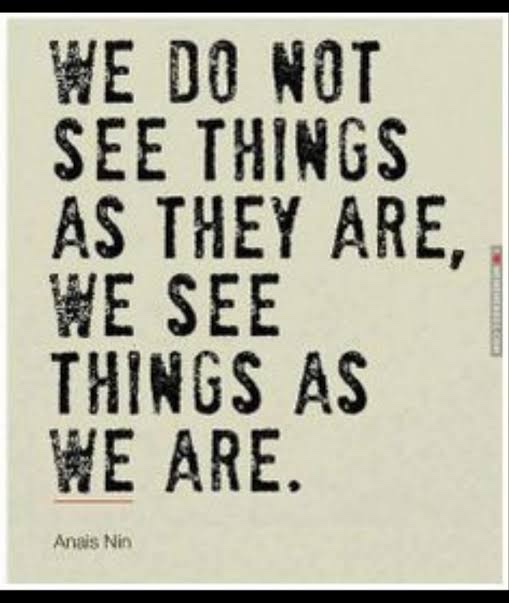
Fear is also a product of the self, the ‘I’, the ‘me’. The self is a construct of the mind, a collection of memories, experiences, and beliefs that we identify with. The self is inherently fragile, constantly changing, and ultimately, transient. Yet, we cling to it, seeking to preserve and protect it. It is this attachment to the self that gives rise to fear. We fear anything that threatens the self – loss, change, rejection, failure, death.
So, how can we address fear? The first step is to understand it. To observe it without judgment, without resistance. To see it for what it is – a product of thought, a projection of the mind. When we observe fear in this way, we begin to see its transient nature. We see that it comes and goes, that it changes and evolves. We see that it is not a fixed or permanent part of our being, but a passing emotion.
Observation also brings awareness. When we are aware of our fear, we can begin to understand its triggers. We can see how certain thoughts, beliefs, or situations give rise to fear. This understanding allows us to address these triggers, to question the beliefs that underlie our fear, to change the thought patterns that perpetuate it.
However, addressing fear is not about eliminating it. Fear is a part of the human experience, a natural response to the uncertainties of life. The aim is not to eradicate fear, but to learn to live with it, to accept it, to move through it.
This is where mindfulness comes in. Mindfulness is the practice of being fully present in the moment, of observing our thoughts, emotions, and sensations without judgment. When we practice mindfulness, we learn to sit with our fear, to observe it without reacting to it. We learn to see it as a passing emotion, not a defining characteristic of our being.
In the light of mindfulness, fear loses its power. It is no longer a terrifying force that controls us, but a transient emotion that we can observe and understand. We see that fear is not an inherent part of us, but a product of our thoughts and perceptions. And with this realization, we find freedom. Freedom from the grip of fear, freedom to live fully and authentically, freedom to embrace the uncertainties of life with courage and grace.
Fear is not an entity that exists independently of us. It is a creation of the mind, born out of our thoughts, beliefs, and perceptions. It arises when we project our past experiences into the future, when we anticipate danger or loss, when we feel threatened or insecure. It is tied to our sense of self, to our attachment to our identities, possessions, relationships, and achievements.
Understanding this is the first step towards addressing fear. When we see fear for what it is – a product of the mind, a transient emotion – we can begin to detach ourselves from it. We can observe it without judgment, without resistance, without fear of the fear itself. We can allow it to be, to come and go, to rise and fall, without trying to control or suppress it.
This is not to say that we should ignore our fears or pretend they don’t exist. On the contrary, we should acknowledge them, explore them, understand them. We should delve into their roots, uncover their triggers, dissect their mechanisms. We should see how they are tied to our thoughts, beliefs, and perceptions, how they are linked to our sense of self.
But we should also see beyond them. We should see the impermanence of fear, its lack of substance, its ultimate unreality. We should see that just as fear arises, it also subsides. Just as it comes, it also goes. Just as it is born, it also dies. We should see that fear, like all emotions, is not a fixed or permanent part of us, but a passing phenomenon, a fleeting experience.
This understanding can free us from the grip of fear. It can allow us to face our fears with courage and equanimity, to navigate through them with grace and wisdom, to emerge from them stronger and more resilient. It can help us to live not in fear, but in spite of it. Not driven by fear, but driven by love, by passion, by purpose, by the sheer joy of being alive.
In the end, the question is not whether we can completely put away fear. The question is whether we can live fully, authentically, courageously, in spite of fear. The question is whether we can embrace the uncertainties of life, the unpredictability of the future, the inevitability of change, without being paralyzed by fear. The question is whether we can face fear, understand fear, transcend fear, and in doing so, find freedom, find peace, find joy.
So, let us not strive to be fearless, but to be courageous. Let us not seek to eliminate fear, but to understand it. Let us not aim to control fear, but to transcend it. Let us not wish for a life without fear, but for a life that is so much more than fear. A life of freedom, of peace, of joy. A life that is not dictated by fear, but inspired by love. A life that is not limited by fear, but expanded by courage. A life that is not overshadowed by fear, but illuminated by wisdom. A life that is not defined by fear, but defined by who we truly are!!!
Patanjali Yoga Sutra: Yama Niyama Asana Pranayama Pratyahara Dharana Dhyana Samadhayo Ashtavangani
Describe one simple thing you do that brings joy to your life.
Sutra 8: “Yama Niyama Asana Pranayama Pratyahara Dharana Dhyana Samadhayo Ashtavangani” – The Eight Limbs of Yoga are Yama, Niyama, Asana, Pranayama, Pratyahara, Dharana, Dhyana, and Samadhi.
Sutra 8 encapsulates the essence of Ashtanga Yoga, which consists of eight limbs or steps that collectively guide us on the path of self-discovery, spiritual growth, and union with the divine.
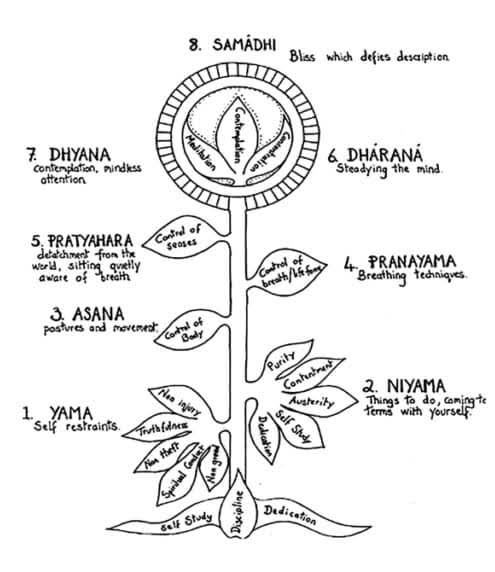
Ashtanga Yoga, as outlined in Sutra 8, serves as a roadmap for the seeker’s journey towards self-realization. The Eight Limbs of Yoga provide a systematic and holistic approach to harmonizing the body, mind, and spirit. Each limb represents a crucial aspect of the yogic path, and together, they form a complete framework for personal transformation.
The Eight Limbs of Yoga:
- Yama (Ethical Principles): Yama refers to the moral and ethical principles that guide our behavior towards ourselves and others. It encompasses concepts such as non-violence (ahimsa), truthfulness (satya), non-stealing (asteya), moderation (brahmacharya), and non-possessiveness (aparigraha). By cultivating these principles, we establish a foundation of integrity and harmonious living.
- Niyama (Personal Observances): Niyama focuses on self-discipline and personal observances. It includes practices such as cleanliness (saucha), contentment (santosha), self-discipline (tapas), self-study (svadhyaya), and surrender to a higher power (ishvara pranidhana). Niyama supports the cultivation of inner strength, self-reflection, and spiritual growth.
- Asana (Physical Postures): Asana refers to the physical postures practiced in yoga. It involves adopting and holding various poses that enhance strength, flexibility, and balance in the body. Asanas prepare the physical body for deeper practices and serve as a means to develop mindfulness, focus, and presence.
- Pranayama (Breath Control): Pranayama involves breath control techniques that harness the life force energy (prana) within us. By regulating the breath through practices such as alternate nostril breathing (nadi shodhana) and breath retention (kumbhaka), we balance and energize the body-mind complex, calming the mind and expanding our vital energy.
- Pratyahara (Withdrawal of the Senses): Pratyahara is the practice of withdrawing the senses from external distractions and turning inward. By detaching from sensory stimuli, we cultivate a state of inner focus, allowing us to navigate our internal landscape with clarity and introspection.
- Dharana (Concentration): Dharana involves developing focused concentration on a single point of focus, such as the breath, a mantra, or an image. It cultivates the ability to hold the mind steady, free from distractions, and prepares the ground for deeper states of meditation.
- Dhyana (Meditation): Dhyana is the state of meditation, characterized by uninterrupted flow of awareness and deep absorption. In Dhyana, the meditator merges with the object of meditation, experiencing a profound sense of oneness and inner stillness. It is a state of expanded consciousness, where the boundaries between the self and the object dissolve.
- Samadhi (Union with the Divine): Samadhi is the ultimate goal of yoga, representing the state of complete union with the divine. It is a state of pure awareness and transcendence, where the meditator experiences the merging of the individual self with the universal consciousness. In Samadhi, the seeker attains a profound realization of their true nature and experiences profound peace, bliss, and liberation.
Ashtanga Yoga, with its Eight Limbs, offers a holistic approach to self-realization and transformation. Each limb builds upon the other, creating a comprehensive system for harmonizing the body, mind, and spirit. By engaging in the practices of Yama and Niyama, we cultivate ethical living and inner discipline, creating a strong foundation for the physical practices of Asana and Pranayama. Pratyahara prepares us for deeper states of concentration (Dharana) and meditation (Dhyana), leading us ultimately to the state of Samadhi, where we experience the unity of all existence.
Benefits:
- Physical Well-being: Ashtanga Yoga enhances physical strength, flexibility, and balance. Regular practice of the asanas improves posture, tones the muscles, and promotes overall health and vitality.
- Emotional Balance: Ashtanga Yoga cultivates emotional stability and resilience. The practices of Pranayama, Dharana, and Dhyana help calm the mind, reduce stress, and foster emotional well-being.
- Mental Clarity: Ashtanga Yoga enhances mental clarity and focus. The practices of Dharana and Dhyana improve concentration, expand awareness, and promote clarity of thought.
- Self-awareness and Self-discovery: Ashtanga Yoga facilitates self-exploration and self-discovery. Through the observance of Yama and Niyama, self-reflection, and meditation, we gain deeper insights into our true nature and develop a greater sense of self-awareness.
- Spiritual Growth: Ashtanga Yoga provides a path for spiritual growth and self-realization. The practices of meditation and Samadhi offer a direct experience of the divine and facilitate the realization of our interconnectedness with all beings.
Understanding the Complexities of Communication beyond Expectations and Conflict
How do you know when it’s time to unplug? What do you do to make it happen?
Communication is a fundamental aspect of human interaction, connecting us with one another on various levels. However, despite our best intentions, we often find ourselves in situations where communication becomes difficult, leading to misunderstandings, conflicts, and unmet expectations.
One of the primary reasons communication becomes challenging is our tendency to hold expectations of how others should respond or behave. We create mental scripts of how conversations should unfold, and when reality doesn’t align with our expectations, frustration and conflict arise. communication often gets entangled in the web of our own needs and desires. We may approach conversations with the underlying motivation of seeking validation, acceptance, or care from others. This creates an imbalance and makes authentic communication difficult.

Some possible reasons of communication being difficult:
Assumptions and Misinterpretations: When we withhold our thoughts and emotions, assuming that the other person might get hurt, we leave room for assumptions and misinterpretations to arise. Our silence may be misinterpreted as disapproval or indifference, leading to misunderstandings and potential conflict.
Lack of Clarity and Openness: By not expressing ourselves openly, we deprive the other person of an opportunity to understand our perspective fully. Without clear communication, there is a higher likelihood of miscommunication or projection of our own assumptions onto the situation, which can fuel conflict.
Unresolved Emotions: Suppressing our thoughts and feelings in an attempt to prevent conflict can lead to the accumulation of unresolved emotions. Over time, these pent-up emotions may build up and eventually explode, causing an intense conflict that could have been avoided through open and honest communication.
Ineffective Communication Patterns: If we consistently choose silence to avoid conflict, it can become a pattern in our communication. This pattern may create a sense of distance and lack of connection between individuals, further exacerbating the potential for conflict when issues do arise.
Unmet Needs and Expectations: By choosing not to express ourselves, we may unintentionally create a gap between our own needs and the other person’s understanding of them. This mismatch can result in unmet expectations and unaddressed concerns, which can eventually lead to frustration and conflict.
Loss of Authenticity and Intimacy: When we withhold our thoughts and emotions, we sacrifice authenticity and genuine connection in our relationships. This can create a sense of disconnection and hinder the development of deep, meaningful bonds, potentially leading to conflicts arising from unexpressed needs and unspoken desires.
Conflicts can emerge even when we choose not to say anything out of concern for the other person’s feelings. Understanding the underlying dynamics and cultivating effective communication skills can help us navigate these situations with greater clarity, empathy, and harmony.
Dancing with Life: A Zen Perspective on Compulsiveness
We live in a world that thrives on habit and repetition. Our days are often filled with routines, activities, thoughts, and emotions that repeat themselves over and over again. This can lead to a state of compulsiveness, where we are constantly being driven by our habitual patterns and conditioned responses. The problem arises when we become enslaved by these patterns, forgetting that we are the ones who hold the reins of our lives.
From a Zen perspective, compulsiveness arises from a lack of awareness and understanding of our true nature. It is a product of the illusion that we are separate entities, disconnected from the flow of life. This illusion fosters desire, fear, and clinging, which in turn feed our compulsive behaviors.
In Zen teachings, the remedy to compulsiveness is not to suppress or fight against it, but rather to observe it, understand it, and transcend it through the power of mindfulness and insight. By becoming aware of our compulsive tendencies, we can start to see them for what they truly are: empty phenomena arising and passing away.
Through mindful observation, we can see that our compulsive thoughts, emotions, and behaviors are not truly ours. They are conditioned responses arising due to various causes and conditions. With this insight, we can start to let go of our identification with them.
The Zen practice of zazen or seated meditation is a powerful tool in this process. In zazen, we sit silently and observe the workings of our mind without judgment or interference. As we sit, we can start to see our compulsive patterns more clearly. We can see how they arise, how they persist, and how they cease.
But understanding and observing compulsiveness is not enough. We also need to cultivate a new way of being, one that is based on presence, openness, and flexibility. Instead of clinging to our habitual patterns, we can learn to dance with life, to move with the ebb and flow of experiences without losing our balance.
The purpose of Zen practice is not to become a passive observer of life, but to fully engage with it in a free and spontaneous way. It is about learning to respond to each moment with freshness and creativity, free from the constraints of habitual patterns.
So, let us take up the challenge of understanding and transcending our compulsiveness. Let us cultivate mindfulness and insight, and learn to dance freely with life. Only then can we taste the true freedom and joy that is our birthright.
The Effortless Beauty of Being: Lessons from the Lily and the Rose
Nature has long been a source of inspiration and wisdom for humanity. The lily and the rose, two of the most admired flowers in the world, provide a potent lesson in authenticity and effortless beauty. Their essence is found not in pretension, but in their innate ability to be what they are. This blog post delves into this beautiful metaphor and the profound lessons it holds for us as human beings.
The Lily and the Rose:
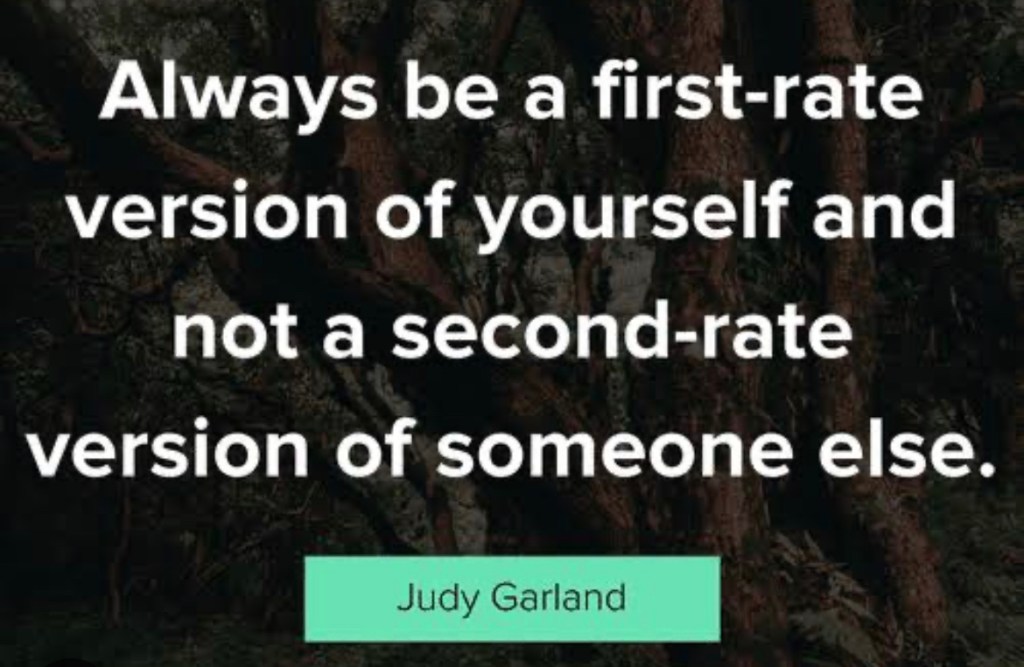
Lilies and roses, beloved by poets, artists, and nature enthusiasts alike, have a unique beauty and grace. This beauty doesn’t arise from attempting to be something else, but from the effortless expression of their true nature. A lily doesn’t strain to become a rose, nor does a rose yearn to resemble a lily. They bloom as themselves, unfettered by comparison or imitation.
Authenticity – The True Beauty:
Just like the lily and the rose, our true beauty as individuals lies in our authenticity, in being ourselves without pretense. In a world often governed by comparison and conformity, it can be tempting to shape ourselves according to societal standards and expectations. However, this external shaping often leads us away from our true nature.
The lily and the rose teach us that true beauty isn’t found in pretense or imitation, but in expressing our genuine selves. There’s an effortless beauty in being what we truly are, a beauty that shines forth when we are in alignment with our true nature.
Embracing Our Uniqueness:
Just as each lily and each rose is unique in its shape, size, and scent, so too are we as individuals. Our uniqueness isn’t a flaw to be corrected but a gift to be celebrated. When we embrace our distinctiveness, we allow our authentic selves to shine forth.
This doesn’t mean we should not strive for growth or self-improvement. Rather, it is about honoring and accepting our true selves as the foundation for genuine growth. It’s about understanding that true transformation doesn’t come from pretense or forced change, but from an authentic embrace of who we truly are.
The lily and the rose remind us of the effortless beauty of authenticity. They teach us that we don’t need to pretend or strive to be something we’re not. Our greatest beauty, like theirs, lies in the simple, unpretentious expression of our true nature.
In a world that often encourages us to compare ourselves to others and to conform to societal expectations, let’s remember the wisdom of the lily and the rose. Let us embrace our own unique beauty and let it shine forth, as effortlessly as a flower blooming in the sun. Our beauty, like that of the lily or the rose, is in being what we are, unapologetically and with grace.
The Wholeness of Being: When Nothing is Lacking, the World Belongs to You
At the heart of many spiritual traditions lies the profound understanding that, in essence, we lack nothing. This understanding is not about physical possession or material abundance, but rather a deeper, more essential sense of completeness within oneself. This blog post explores the profound realization that when we understand that nothing is lacking within us, we feel as though the whole world belongs to us.

The Illusion of Lack:
In our everyday lives, it is easy to feel a sense of lack or deficiency. We often believe we need something more – more money, more recognition, more love, a better job, or a different body – to be complete and happy. This perceived lack can lead to feelings of dissatisfaction, anxiety, and longing. However, this sense of insufficiency is often a product of our conditioned mind, not an inherent aspect of our true nature.
The Realization of Wholeness:
At a deeper level of our being, beyond the constructs of the mind, we are already whole and complete. This wholeness is not dependent on external factors or circumstances. It is an inherent aspect of our true nature. When we realize this fundamental wholeness, we understand that nothing is lacking. We are complete, just as we are, here and now.
This realization often arises from a deep inner journey that may involve meditation, contemplation, mindfulness, or other spiritual practices. It requires us to look beyond our surface-level wants and desires to the deeper reality of our inherent completeness.
The World Belongs to You:
When we realize that nothing is lacking, our perspective of the world around us transforms. We begin to experience life from a place of abundance rather than scarcity. This shift in perception is not about owning the world in a literal sense. Rather, it’s about experiencing a profound sense of unity and connection with all of existence.
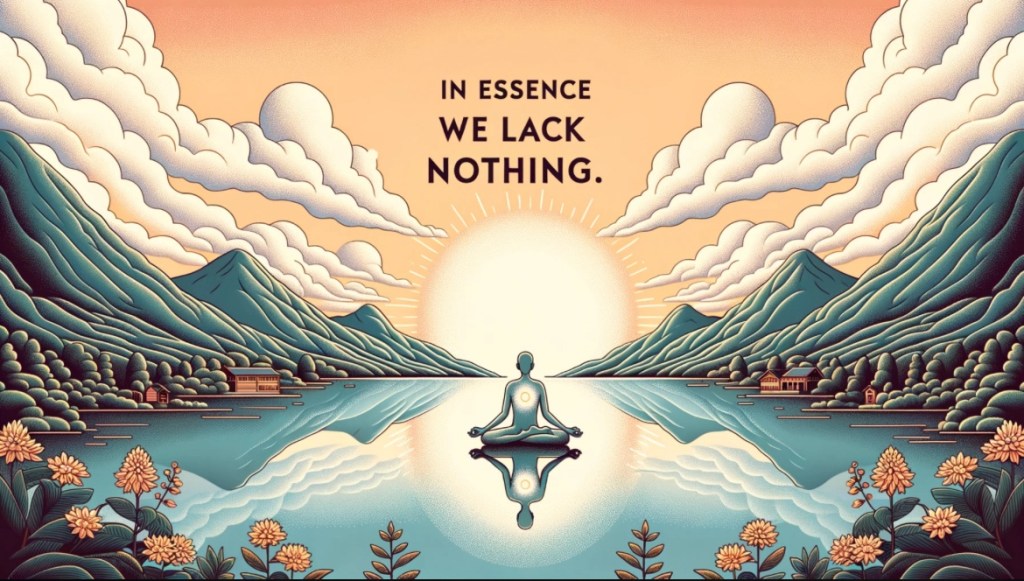
Feeling that the world belongs to us means experiencing a deep resonance with life itself. We can appreciate and love the world without needing to possess or control it. We can enjoy the beauty of a sunset, the scent of a flower, or the smile of a loved one without needing to cling to these experiences.
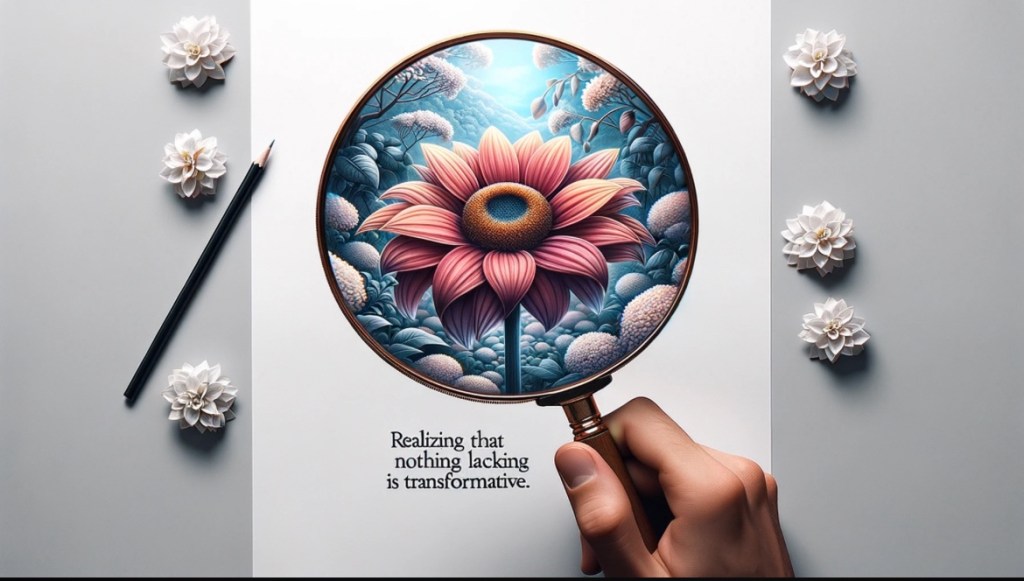
Realizing that nothing is lacking is a powerful and transformative understanding. It invites us to see beyond the surface-level perceptions of lack and deficiency that often cloud our experience of life. This realization helps us to connect with our inherent wholeness and to experience the world from a place of abundance and completeness. When we understand that we lack nothing, we can truly feel as though the world belongs to us, not in a sense of possession, but in a profound sense of unity and interconnectedness.
The Innate Perfection of ‘The Way’: An Exploration of Ineffable Experience
The spiritual path, often referred to as ‘The Way’, is an enduring theme across diverse religious and philosophical traditions. The concept is frequently associated with notions of divine will, cosmic order, or the natural flow of existence. This blog post is an exploration of ‘The Way’ as an innately perfect, ineffable, and subtly perceived experience.
The Innate Perfection of ‘The Way’:
To assert that ‘The Way’ is basically perfect is to acknowledge the innate perfection of existence itself. This is not to say that every event, action, or condition is flawless, but rather that the underlying essence, the natural flow of life, is intrinsically complete and does not need perfecting.
This perfection is not a static state of being, but rather a dynamic, ever-unfolding process. It’s not a destination to be reached but the journey itself, constantly unfolding in the here and now. It’s about realizing that every moment, every situation, every experience is just as it should be, even when it doesn’t conform to our ideas of what is desirable or perfect.
The Formless and Soundless Nature of ‘The Way’:
‘The Way’ is often described as having no form or sound, signifying that it is not an object that can be perceived through our conventional senses. It is a subtle presence, an underlying essence that permeates all of existence yet eludes direct sensory perception.
It is like the silence in music, which is as crucial as the notes themselves. It is like the emptiness of a pot, which makes it useful. We can’t directly see, hear, touch, taste, or smell ‘The Way’, yet its influence is evident in everything that exists.
The Subtle and Personal Perception of ‘The Way’:
The subtlety of ‘The Way’ makes it hard to perceive and even harder to communicate. It’s akin to drinking water and knowing how hot or cold it is but being unable to convey that sensation to others. This metaphor beautifully captures the deeply personal and subjective nature of spiritual experiences.
No two people experience ‘The Way’ in exactly the same manner. Each individual’s encounter with the ineffable is unique and deeply personal. Moreover, these experiences often defy our standard modes of communication, making them hard to articulate.
‘The Way’ represents the innately perfect, formless, and subtly perceived essence of existence. Recognizing and aligning ourselves with ‘The Way’ can bring about a profound shift in our perspective, allowing us to experience life with greater depth, richness, and authenticity. Though we may find it challenging to convey our experiences of ‘The Way’, it’s important to remember that these ineffable moments are not meant to be captured in words, but to be lived, felt, and experienced in the silent chambers of our hearts.
There was no one there to tell me that I couldn’t.
Share a story about someone who had a positive impact on your life.
In the bustling city of Mumbai lived a girl named Riya. She came from a modest background, with her father working as a security guard and her mother a housekeeper. From a young age, Riya had a fascination for books. She loved the adventures they held within their pages and the places they took her to, all from the safety of her humble home.
Riya’s family, though supportive, could not afford many luxuries. Books were considered one such luxury. Her parents would often remind her, “Books are expensive, Riya, we should be spending on necessities, not luxuries.” Yet, the fire of her passion for reading was undeterred.
One day, on her way back from school, she noticed an old man struggling with his load of books. With a heart full of kindness, Riya rushed to help him. The old man turned out to be the owner of a small, second-hand bookstore. To thank her, he offered Riya a book of her choice. That day, she returned home with a gleaming smile and a copy of ‘The Secret Garden’.
Following this, Riya began to visit the bookstore regularly, helping the old man with his daily chores. In return, she was allowed to read the books. She spent hours engrossed in the world of words, losing herself in the tales of courage, love, and adventure.
One day, the old man noticed Riya reading a book on programming. He was surprised and asked her why she was interested in such a complex subject. Riya replied, “I want to become a software engineer, but everyone tells me it’s a dream too big for a girl like me.” The old man just smiled and said, “Dear child, there’s no one here to tell you that you can’t.”
Emboldened by the old man’s words, Riya threw herself into learning programming languages from the books available in the bookstore. She began to create small applications, using the old, discarded computer in the bookstore.
Word soon spread about the talented young coder. A local NGO, aiming to promote education among underprivileged children, heard about Riya. They offered her a scholarship to pursue her studies in computer science. Riya’s dream was finally becoming a reality.
Riya’s story illustrates how powerful self-belief can be. Despite her humble background and the societal norms that attempted to limit her ambitions, she dared to dream big. She didn’t let her circumstances define her future. Instead, she used every opportunity to inch closer to her dream, reminding herself, “There was no one there to tell me that I couldn’t.”
The moral of this story echoes the spirit of- Believe in yourself, Utilise the resources available to you, and don’t let others’ perceptions limit your potential. You are the creator of your own destiny!!
 Abhishek Fanse