Honesty and Dishonesty: Beyond the surface
The concepts of honesty and dishonesty, fidelity and infidelity, often evoke strong reactions from people, shaped by moral, cultural, and societal conditioning. These binaries dominate much of human interaction, creating judgments about what is right and wrong, what is ethical and unethical. However, when we delve deeper into these ideas, we begin to see that these distinctions are part of a broader illusion of duality—a construct that humanity has built over millennia to navigate the complexities of life.
The very act of labeling actions as “honest” or “dishonest,” “faithful” or “unfaithful” stems from a worldview that is bound by dualistic thinking. In such a worldview, life is divided into opposites—good and bad, right and wrong, true and false. Yet, as we explore the nature of consciousness and presence, it becomes clear that these dichotomies are not fixed, but rather fluid, shaped by the limited perceptions of the human mind.
At the heart of this inquiry lies the question: what happens when one operates with complete presence, in a state of being where the mind is free from the constructs of past and future, of moral judgments, and of conditioned responses? In such a state, does the very notion of honesty and dishonesty, fidelity and infidelity, dissolve? Can we transcend the dualities that dominate our understanding of reality? And if so, what does that reveal about the nature of the “real world” we think we live in?
In this exploration, we will dive deep into these questions, dissecting the nature of honesty, dishonesty, fidelity, and infidelity, and ultimately aiming to dissolve the myths and illusions that surround them.
From an early age, we are taught that honesty is a virtue, a moral standard by which we should live. To be honest is to tell the truth, to be transparent, and to act in alignment with what is considered ethical. Dishonesty, on the other hand, is seen as a vice—deceiving, hiding the truth, or acting in ways that betray trust. Society has built intricate structures around these concepts, embedding them in legal systems, educational frameworks, and interpersonal relationships.
However, what we often fail to recognize is that both honesty and dishonesty are constructed within the realm of thought. They are ideas that arise from the human mind, shaped by cultural and historical contexts. What may be considered honest in one culture could be viewed as dishonest in another. For instance, in some cultures, withholding certain information is seen as a way to protect others, while in other societies, it may be seen as deceit. Thus, honesty and dishonesty are not objective truths; they are relative concepts that depend on context, perception, and belief systems. This recognition opens the door to questioning the very foundations of these moral judgments.
Honesty and dishonesty, as we commonly understand them, are rooted in dualistic thinking—the division of the world into opposites. Duality, in this sense, is a mental construct that allows us to navigate the complexities of life. It simplifies the world into categories of right and wrong, true and false, and gives us a sense of control over the moral and ethical landscape we inhabit.
But this division is inherently limiting. It creates conflict, both internally and externally, because it forces us to align with one side of the dichotomy and reject the other. When we view honesty and dishonesty as fixed opposites, we become trapped in a cycle of judgment, always measuring ourselves and others against these standards.
In relationships, fidelity is often equated with loyalty, faithfulness, and commitment. To be faithful is to remain true to one’s partner, to honor the bond of trust that has been established. Infidelity, by contrast, is seen as a betrayal—a breaking of that trust, a violation of the commitment made. These concepts are deeply ingrained in societal norms and expectations, particularly in romantic and marital relationships.
However, like honesty and dishonesty, fidelity and infidelity are also socially constructed. The very notion of what it means to be faithful or unfaithful varies across cultures and historical periods. In some societies, monogamy is seen as the ultimate expression of fidelity, while in others, polygamy or open relationships are accepted norms. The rules that govern fidelity are not universal; they are shaped by cultural, religious, and personal beliefs.
At the heart of fidelity and infidelity lies the idea of ownership—ownership of another person’s body, mind, and emotions. When we commit to a relationship, particularly in the context of marriage or long-term partnership, there is often an implicit expectation that we “own” each other in some way. This ownership manifests in the form of expectations about exclusivity, loyalty, and the boundaries of the relationship.
But this notion of ownership is illusory. No one can truly own another person, and attempting to do so creates a sense of possessiveness that is rooted in fear and insecurity. Fidelity, when seen through the lens of ownership, becomes a way of controlling the other person, of ensuring that they remain within the boundaries we have set for them.
True love is not possessive or conditional. When we love someone, we do not seek to control them or to bind them to our expectations. Instead, we allow them the freedom to be who they are, without judgment or restriction. This kind of love transcends the dualities of fidelity and infidelity because it is not based on ownership or attachment.
Infidelity, when it occurs, is often seen as the ultimate betrayal. It brings up feelings of hurt, anger, and rejection. But from a deeper perspective, infidelity can be understood as a mirror—an opportunity to examine the underlying dynamics of the relationship and the expectations that have been placed on it.
When someone is unfaithful, it is not necessarily a reflection of their character or moral standing. Rather, it can be a reflection of the unmet needs and desires that exist within the relationship. These unmet needs may be emotional, physical, or psychological, and they often stem from a lack of true connection or understanding between partners. Infidelity, in this sense, is not the cause of the problem but a symptom of deeper issues that have been ignored or suppressed. It forces us to confront the illusions we have built around relationships—the illusion of ownership, the illusion of permanence, and the illusion of control.
To operate with 100% presence in the moment is to be fully aware, fully engaged, and fully alive in the here and now. It means to live without the interference of past conditioning or future projections, to see reality as it is, without the filters of judgment, expectation, or attachment. Presence is the state of pure awareness, where the mind is not divided into opposites, and the self is not fragmented by thought. When we are truly present, the concepts of honesty and dishonesty, fidelity and infidelity, dissolve. In the state of presence, there is no division between right and wrong, true and false, because these are constructs of the mind. Presence transcends duality and brings us into direct contact with reality as it is—without the distortions of thought or emotion.
In the state of presence, honesty and dishonesty lose their meaning. Honesty is often defined as telling the truth, but what is truth? Truth, in its most profound sense, is not a fixed concept; it is fluid, dynamic, and constantly changing. When we are present, we do not cling to fixed ideas of truth or falsehood; we simply respond to the reality of the moment. Dishonesty, in this sense, is not about lying or deceiving others. It is about being out of alignment with the present moment—about acting from a place of conditioning, fear, or attachment, rather than from a place of awareness. When we are fully present, there is no need for dishonesty because we are in harmony with the flow of life. We do not need to manipulate or control the situation; we simply respond with clarity and integrity.
The concept of fidelity, too, dissolves when one operates in the present moment with full awareness. Fidelity, in its conventional sense, is often tied to promises, contracts, and the expectation of a continuous future. In relationships, it becomes a pledge to behave in certain ways over time, to stay within defined boundaries, and to remain “true” to another person. But these pledges are built upon mental constructs and future projections—on an imagined continuity that is bound by time and expectation.
When one is fully present, these future projections lose their weight, and fidelity is no longer about promises made for tomorrow but about the authenticity of being in relationship here and now. In presence, fidelity is not something forced or negotiated, but an expression of truth in the moment. One cannot be unfaithful in presence because one is not operating from a divided mind that clings to past commitments or fears future betrayals. Instead, there is simply an unfolding of truth as it is, unconditioned by the past and unconcerned with future outcomes.
Infidelity, often seen as the antithesis of fidelity, also loses its traditional meaning when approached from a place of presence. Infidelity typically arises from dissatisfaction, a feeling that something is lacking in the current relationship or situation. This dissatisfaction propels one to seek fulfillment elsewhere, outside the bounds of the established relationship. But what is at the root of this dissatisfaction? Often, it is the mind’s attachment to desires, projections, and unexamined needs that fuel the urge to look beyond the present relationship. In presence, there is no room for such projections. The mind, when it is fully attuned to the present, does not dwell on what is lacking or seek fulfillment outside of what is unfolding in the here and now. When one is present with a partner or in any relationship, the relationship is no longer bound by the rigid labels of fidelity and infidelity. There is simply a connection, a flow of being, that is not controlled by societal norms or personal insecurities. In this way, presence dissolves the very constructs that give rise to infidelity, not by imposing rules or boundaries, but by making them irrelevant.
Choice “Paralysis“
A choice implies that there is an alternative, and with every alternative comes the weight of consequences, perceived or real.
You speak of a ‘neutral’ stand, but let’s investigate what that really means. In reality, the idea of a neutral stance is a contradiction in terms. The very act of choosing neutrality is in itself a choice, made in opposition to other possible choices. So, the notion of being ‘neutral’ is inherently paradoxical because it cannot exist without the conditions that make it a choice to begin with.
For example, When you agree to a certain dosage of medication, you exercise control by making an informed decision. However, you also surrender control to the effects of that dosage, which may not be entirely predictable. This brings emotional complexity into play: the comfort of taking action (choosing the dosage) juxtaposed against the uncertainty of outcome. When we agree to disagree, we are on the contrary acknowledging that a middle ground is unreachable, yet we’re finding a sort of middle ground in that very acknowledgment. The challenge lies in our psychological need for validation and agreement, which often feels at odds with the more rational understanding that it’s perfectly okay for different viewpoints to coexist. We often fail to agree to disagree because our conditionings, our egos, don’t allow us to let go without a ‘win’ or a ‘loss.’
Every choice, by definition, is a rejection of its alternative. Therefore, choices are always relative, biased, and limited by the options that exist. In that sense, a choice cannot be independent because it is defined by the conditions that make it a choice. The idea of a ‘choice’ presupposes the existence of an alternative, of a comparison. In a context where there is only one thing that exists independently, the notion of ‘choice’ would be meaningless because there would be nothing to choose from. Therefore, it wouldn’t be a choice; it would simply be a state of being. The paradox exists because we try to define and understand choice within the limited framework of language and duality. However, once you recognize that the very nature of choice is paradoxical and conditional, and you embrace that paradox rather than trying to resolve it, you arrive at a sort of meta-clarity. This does not mean you’ve resolved the paradox; it simply means you’ve stepped outside of it. You’ve transcended the limitations that come with the dualistic thinking of ‘this or that,’ ‘yes or no,’ ‘neutral or biased.’
Choices are never made in emotional vacuums. They are laden with expectations, fears, and desires that stem from our past experiences, conditionings, and inherent personality traits. Even the seemingly most “logical” choice is often deeply influenced by emotions we may not even be fully aware of. The emotional charge of expectations is often the heaviest. When we make a choice, it is often governed by what we expect the outcome will bring us—pleasure, validation, success, or the avoidance of pain and conflict. The emotion here is one of anticipation, coupled with anxiety about whether our expectations will be met.
Then there’s desire, an emotion that often masquerades as need. The choices we make based on desire are emotionally charged with hopes for fulfillment, achievement, or recognition. But desire is a double-edged sword: while it motivates us, it also sets us up for disappointment if things don’t go as planned.
Even when we think we are making a “neutral” choice, what we are often trying to do is distance ourselves emotionally from the implications of the decision. We might say it’s “purely logical,” but the underlying emotion is often one of self-preservation—we wish to remain unscathed by the emotional weight that comes with making a more obviously partial choice.

One reason choices are emotionally charged is that they give us the illusion of control. Making a decision allows us to feel like we have some say over our fate. However, this control is always somewhat illusory. Life’s unpredictability ensures that our choices, no matter how well-considered, often have unexpected outcomes. The realization that our control is limited can bring up a host of emotions like helplessness or existential dread. Every choice we make, big or small, adds a brick to the edifice of our self-identity. We look for validation through our choices; when they lead to desired outcomes, it reinforces our sense of self-worth. When they don’t, it challenges our self-image and can lead to emotions like self-doubt, shame, or regret.
Our choices also affect how we are viewed by others, adding another layer of emotional complexity. Sometimes we make choices that conform to societal norms or expectations to avoid judgment or gain approval. The emotions at play here are often related to a fear of rejection or a need for social cohesion. At other times, we may make choices that go against the grain, driven by a desire for individuality or authenticity. This can lead to a complicated cocktail of pride, liberation, but also potential loneliness.
When it comes to seemingly paradoxical choices—like choosing wisdom over a loved one or maintaining a “neutral” stance—the emotional texture becomes even more intricate. For instance, choosing wisdom over a loved one might be a defense mechanism to protect oneself from future emotional pain, yet it can also lead to immediate emotional pain due to the distancing from the loved one. Here, both foresight and dread, love and rationality, are locked in an emotional tussle.
In cases where we choose to be “neutral,” what we are really doing is choosing not to engage emotionally in a way that makes us vulnerable. We might convince ourselves that we’re staying above the fray, but deep down, the need to protect ourselves emotionally is dictating that ‘neutral’ choice. The emotion behind neutrality is often a fear of emotional engagement, wrapped up in a protective layer of rationality. Ultimately, emotional maturity plays a large role in how we navigate the sea of choices and their associated feelings. Being aware of our emotional drivers allows us to make more ‘informed’ choices, even if that information is coming from within ourselves. This kind of self-awareness can temper the more reactive emotions like fear and desire and allow room for more nuanced feelings like contentment, acceptance, and genuine love to inform our decisions.
Choice is often seen as liberating, an act of free will that puts us in the driver’s seat of our destiny. However, with every choice we make, we also close off other possibilities, limiting ourselves in certain ways. The emotional paradox here is the simultaneous existence of freedom and constraint within the same action. We may feel exuberant for choosing a particular path, but there can be a latent sadness or anxiety about the paths left unexplored.
While choices often feel monumental in the moment, their impact can wane over time, sometimes even reversing in significance. What seemed like a terrible choice in the past may later appear wise, or vice versa. This fluidity can generate complex emotions, such as regret for past choices or anxiety about the unpredictability of future choices and their unforeseeable emotional implications.
Ultimately, where every action presents us with a choice and counter choices, we sometimes find ourselves paralyzed, suspended in a moment of indecision. Yet, this paralysis isn’t a dead end; it’s a pause, a sacred space that invites us to reflect, to feel, and to become keenly aware of our humanity.
What if we reframe this so-called “choice paralysis” not as a dilemma but as a moment of pause in the great narrative of our lives? It becomes not a prison, but a platform; not a quagmire, but a quest. In this paused state, we are philosophers, artists, and explorers of the inner cosmos. We grapple not just with options but with identities, not merely with pros and cons but with hopes and fears, love and loss.
In this pause, we are not frozen; we are fervently alive. We are composing in our minds the symphony of our future, writing the next act of our life’s drama, sculpting the clay of our becoming.
And when the pause lifts—as it always does—we make a choice, yes, but we also do something more profound: we embrace our capacity to choose, even when the choices are hard, even when the path is foggy. For it’s in the wrestling with choices that we come to know who we truly are.
So, the next time you find yourself in the clutches of choice paralysis, remember: you are standing at the confluence of many rivers, each leading to a different ocean but all part of the same Earth. And it’s okay to stand there for a while, to feel the currents, to listen to their distinct murmurs, before stepping into the stream that will carry you to your next adventure.
And so, we are forever navigating, forever choosing. Not in search of resolution, but in pursuit of growth. In the end, it’s not about making the perfect choice, but about making our choices perfect us.
The Fluidity of Stillness: Understanding Stagnation Amidst Movement
“Movement in Stagnation” captures the tension between seemingly opposite states—feeling spiritually stuck or stagnant while simultaneously experiencing inner changes or shifts. This suggests that even within periods of seeming inertia, movement is happening, whether you recognize it or not.
The experience of feeling both movement and stagnation simultaneously—or alternately—can be influenced by various factors, including your emotional state, external circumstances, and perspective. On a day-to-day basis, there are changes, interactions, and new experiences, which might seem like movement. However, these might not register on the long-term scale, where overarching goals and life trajectories are considered.
ertain philosophies and spiritual perspectives propose that time is not linear but cyclical. Thus, the repetition or perceived stagnation may actually be a part of natural cycles. However, Emotions are incredibly transient; they can change from moment to moment. This emotional flux might be what you’re identifying as “movement” within the stagnation. Emotional highs feel even higher when coming out of a low and vice versa. This contrast might contribute to the sensation of significant movement even when your situation hasn’t drastically changed.
Humans are wired to identify patterns. When you start noticing recurring themes or experiences, your brain flags these as patterns, which can feel like you’re stuck in a loop. Once you recognize a pattern or feel stuck, you’re more likely to notice information that confirms this belief, thereby reinforcing the feeling of being stuck.
Some spiritual teachings suggest that life inherently consists of repetitive cycles—birth, growth, decay, death, and rebirth—and that recognizing this can free you from the illusion of stagnation. Certain philosophies like Buddhism focus on the present moment as the only “real” moment, suggesting that both the past (stagnation) and the future (movement) are constructs of the mind.
When you look at your life on a daily basis, you can see a lot of activities, interactions, and events that unfold. The sun rises and sets, you go to work, eat, sleep, talk to people, perhaps engage in some hobbies. This flurry of activity can give you the impression that things are constantly moving and changing. However, if you were to zoom out and look at a larger slice of your life, say a year or a decade, the feeling is often quite different. Major life circumstances—your job, where you live, your relationship status—may not change as frequently. Even if they do, the underlying patterns of behavior, the kinds of relationships you engage in, and your day-to-day experiences might not undergo a significant transformation. This is where the feeling of “stagnation” often comes in. Despite the constant activity and interactions, there may be an underlying sense that nothing much has really changed—or is going to change.
Emotions, by their very nature, are transient and fluid. Even within a single day, you might experience a range of emotions—joy, frustration, excitement, boredom, love, irritation—and these emotions have a way of coloring your perception. When you’re joyful, the world seems vibrant, full of possibilities; you feel like you’re “moving.” When you’re frustrated or bored, the world can seem dull, repetitive; hence the feeling of “stagnation.”
The mind has certain tendencies that influence this dual experience of movement and stillness. One of these is the brain’s knack for pattern recognition. We make sense of the world by recognizing patterns; it’s how we learn and navigate complex realities. However, this strength can turn into a trap when the patterns you recognize lead to a sense of helplessness or stagnation. For instance, if you’ve had several failed relationships, you may start to believe that all relationships are doomed to fail, leading to a feeling of being “stuck.”
Finally from a more spiritual or existential standpoint, the very idea of movement and stagnation can be questioned. Certain spiritual teachings suggest that the material world is an illusion, and that true “movement” is a journey inward, toward understanding one’s own nature and the nature of reality. In this context, both the feeling of “moving” and “being stuck” can be seen as distractions from the true journey, which is neither about moving nor staying but about understanding and being.
Understanding Confidence: Beyond the Binary of “more” or “less“
It’s a term thrown around often, in self-help books, motivational speeches, and even casual conversations. But what exactly is confidence? Is it an intangible force that some people possess while others lack, or is it an inherent aspect of every individual that remains unaffected by external circumstances? Let’s dive deep into this paradoxical phenomenon.

If one looks closely, the term has been constructed based on societal norms and standards. It is believed that certain behaviors, decisions, or characteristics project a sense of certainty, while others indicate a lack of the same. Over time, these beliefs have formed the structure we identify as confidence. However, considering the vast spectrum of human emotions and the varied circumstances everyone faces, is it valid to classify them under the binary of confidence and its lack?
For instance, a deer running from a predator is often acting out of fear. However, the very act of running, the determination to escape, indicates a level of confidence in its ability to survive. Similarly, when a person is fearful, that fear doesn’t necessarily negate their confidence. The act of acknowledging fear and responding to it can be viewed as an act performed with complete confidence in that particular emotion.
While it’s argued that confidence is unaffected by external situations, one can’t deny the impact of external validation on perceived self-worth. A student praised continuously may seem more confident than one who’s always criticized. But this brings forth another question: Is the confidence of the praised student genuine, or is it a facade built upon external validation? The underlying belief here is that true confidence remains unaffected by external factors. It is an internal compass, guiding one through life’s challenges. The student who seems less confident due to criticism might very well have an inherent belief in their abilities but chooses not to display it openly.
The intricate relationship between fear and confidence is captivating. While at first glance, they might seem opposing, a deeper introspection suggests they coexist harmoniously. As mentioned before, acknowledging fear can be an act of confidence in itself. Embracing one’s vulnerabilities, doubts, and fears can be seen as the highest form of confidence because it stems from self-awareness.
If we view confidence as neither a trait one can gain nor lose but as a constant presence, it reshapes our understanding. In this perspective, every act, regardless of its nature, is executed with full confidence. A person displaying apprehension is confidently apprehensive. A person in doubt is confidently doubtful. Modern society often categorizes confidence in degrees – more or less, high or low. This categorization restricts our understanding. When we say someone is “more confident,” we’re comparing their current state to a previous one or juxtaposing them against someone else. However, by acknowledging that every act is executed with complete alignment to a particular emotion or state of being, the need for comparison dissipates.
Confidence, in its true essence, is not about loud declarations or silent sufferings. It’s about recognizing and accepting the inherent completeness in every emotion, decision, and action. It’s about understanding that every response to a situation, be it with enthusiasm, fear, doubt, or joy, is done with utmost confidence in that response. If confidence is inherent, it would imply that any action performed in a state of fear, joy, or doubt is done with a level of assurance. In a crisis, for example, a hesitant decision to call for help is executed with as much confidence as a swift decision to solve the problem. This inherent nature of confidence, therefore, suggests that the concept is not binary but rather a spectrum, or perhaps beyond a spectrum—a state of consistent existence.
When we look at external circumstances affecting confidence, it becomes apparent that this so-called “influence” is transient. If confidence is genuinely inherent, then external factors may create an illusion of change but cannot alter its core. That said, constant external validation can create a clouded perception of self-worth, often mistaken for genuine self-confidence. The distinction between inherent confidence and externally-induced confidence is crucial for holistic understanding. If confidence is a constant presence, the degrees of “more” or “less” cease to have real meaning. It suggests that everyone, at any point in time, is fully committed to their actions or reactions, be it hesitancy or decisiveness. In such a framework, everyone is performing at their own level of 100% confidence tailored to the specific situation or emotion they are dealing with. Therefore, to say that one is ‘lacking’ in confidence is to misunderstand its inherent nature.

If every act is performed in complete alignment with the emotion or thought process governing it, it removes the need for comparison or valuation, which are tools the ego uses to identify itself. The notion of someone being “more confident” than someone else arises from a place of duality, from distinguishing the self from the ‘other.’ When one’s existence is in complete harmony with the intrinsic nature of confidence, these comparisons become irrelevant.
Selflessly selfish or selfishly selfless ??
Selfishness, in its most basic sense, involves prioritizing one’s own needs, wants, and interests over those of others. This characteristic is often deemed negative due to its potential to harm others or disrupt social cohesion. However, at its root, selfishness can be traced back to our biological survival instincts. From an evolutionary perspective, selfish behavior can be seen as a natural response to the need for self-preservation. The urge to prioritize one’s own needs – for food, safety, reproduction, etc., has been integral to the survival of individuals and species across the natural world.
Psychologically, selfishness also emerges from a basic human need for self-esteem and self-actualization. We all desire to fulfill our potential, realize our dreams, and feel good about ourselves, which often involves prioritizing our needs over others. Furthermore, cognitive biases like the self-serving bias, where individuals tend to perceive situations in ways that are beneficial to themselves, can also contribute to selfish behavior.
At a socio-cultural level, factors such as upbringing, societal norms, and cultural values play a significant role in shaping our propensity towards selfishness. For example, individualistic societies that emphasize personal achievement and independence might foster more selfish behaviors than collectivist societies, where the group’s needs are prioritized over the individual’s.
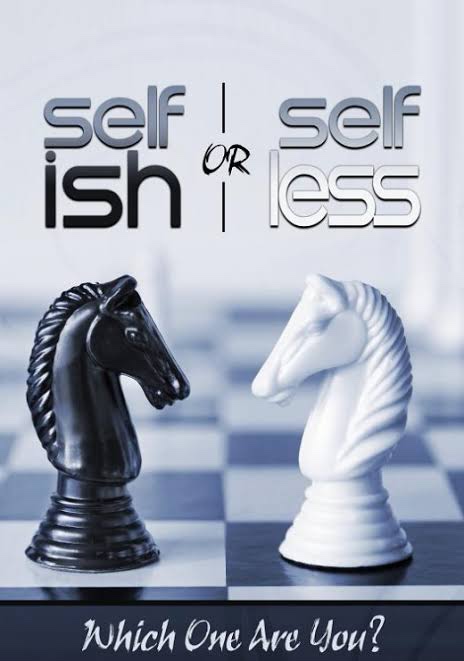
Selflessness, on the other hand, involves prioritizing others’ needs and interests over one’s own. This behavior is generally regarded positively, associated with qualities like kindness, altruism, and generosity. Like selfishness, selflessness also has biological, psychological, and socio-cultural origins.
From a biological perspective, selfless behaviors can be seen as an extension of the survival instinct – not just for the individual, but for the group or species as a whole. This is evident in many social animals’ behavior, where individuals often sacrifice their interests for the group’s benefit. This is especially pronounced in kin selection, where organisms exhibit behaviors that favor the survival of their relatives, even at a cost to their own survival or reproduction.
Psychologically, selflessness is linked to empathy, the ability to understand and share others’ feelings. Empathy allows us to form deep emotional connections with others and motivates us to act in ways that benefit them. Moreover, selfless behaviors can lead to increased self-esteem and well-being, as they often elicit positive social feedback and a sense of purpose and fulfillment.
At a socio-cultural level, selflessness is often encouraged through moral and religious teachings, societal norms, and cultural values. Many societies promote altruistic behaviors as virtues, reinforcing these behaviors through social approval and other forms of positive reinforcement.
Yet, it’s important to understand that neither selfishness nor selflessness is inherently “good” or “bad.” Instead, these behaviors exist along a spectrum, and their impacts can vary greatly depending on the context. Excessive selfishness can lead to social discord and harm others, but a total lack of selfishness might result in self-neglect or exploitation. Similarly, while selflessness can foster social harmony and cooperation, excessive selflessness can lead to self-sacrifice or martyrdom, which may not always be healthy or beneficial.
Balancing selfishness and selflessness is a constant human endeavor, shaped by our biological instincts, psychological needs, and socio-cultural influences. This balance allows us to care for our own needs while also considering the needs of others, fostering mutual respect, understanding, and cooperation – vital elements for personal well-being and social harmony.
On nature’s selflessness, it’s crucial to understand that what we perceive as ‘selflessness’ is an anthropomorphic projection. Nature operates on principles of interconnectedness and interdependence, where each entity plays its role in maintaining the balance and harmony of the whole system. What we deem as ‘selfless’ is nature’s way of existing and sustaining.
It all comes down to our definitions, our intentions, and the subtleties of human behavior and consciousness.
While at first glance, selfishness and selflessness seem to represent opposite ends of the behavioral spectrum, a deeper understanding can reveal surprising overlaps. Let’s unpack this.
Firstly, it’s important to understand that our actions, whether selfish or selfless, are inherently tied to the pursuit of well-being, satisfaction, or some form of positive outcome, which in itself can be considered a ‘selfish’ motivation.
In the case of selfish actions, this is easy to understand – we engage in selfish behavior when we believe that it will bring us personal gain, happiness, or satisfaction. We are directly seeking a beneficial outcome for ourselves, often without considering the impacts on others.
However, when we look at selfless actions, things get a little more complex. When we act selflessly, we prioritize the needs and well-being of others above our own. But why do we do this? There are several reasons, and this is where the idea of selflessness potentially being ‘selfish’ comes into play.
We might act selflessly because helping others makes us feel good – it satisfies a deep-seated emotional need for connection, purpose, or moral fulfillment. In this sense, we can say that selflessness is ‘selfish’ because we are indirectly seeking a beneficial outcome for ourselves – a sense of emotional satisfaction.
This is not to say that selfless actions are insincere or less valuable because they bring us satisfaction. Quite the opposite – it demonstrates that our well-being is intricately linked with the well-being of others. When we help others, we also help ourselves. This interconnectedness is a fundamental aspect of human nature and society, and it’s what allows empathy, altruism, and cooperation to thrive.
We might also act selflessly out of a recognition of the inherent worth of others – a deep respect for life and consciousness that transcends self-interest. This kind of selflessness can be seen as ‘pure’ in the sense that it’s not motivated by a desire for personal gain. However, even this can be seen as ‘selfish’ in a broader, existential sense. If we consider ourselves as part of a larger whole – whether it’s a community, society, or the universe itself – then working towards the well-being of that whole is in our interest, as we are part of it.
To bring these thoughts full circle, consider this: both selfishness and selflessness are natural aspects of human behavior, deeply rooted in our survival instincts, emotional needs, and socio-cultural contexts. While they might seem contradictory, they are both tools we use to navigate the world, foster connections, and seek well-being. The key lies in finding a balance – understanding when to prioritize our needs and when to consider the needs of others. This delicate equilibrium enables us to live harmoniously, both with ourselves and with the world around us.
Selflessly selfish or selfishly selfless is paradoxical nature of human behavior. To be “selflessly selfish” is to act with apparent selflessness, but with an underlying self-serving motive, perhaps gaining a sense of satisfaction, a good reputation, or a subconscious expectation of reciprocation. Alternatively, to be “selfishly selfless” implies acting for personal gain, but in a way that also benefits others. It’s a reminder that pure selflessness or pure selfishness rarely exist; human motivations are often a complex mix of both.
The overlap between selfishness and selflessness could also be a reflection of our interconnectedness. From an evolutionary standpoint, altruistic behaviors can enhance the survival of our kin or social group, and thereby our own genetic legacy. In a socially interconnected world, self-interest and the interest of the community often align. In this sense, one could argue that acting in the interest of others (selflessness) is ultimately a form of self-preservation (selfishness). However, the key lies in understanding these motivations without judgment, acknowledging their existence, and seeking balance. It’s about striving to act in ways that respect our needs and those of others. After all, a healthy sense of self-interest is necessary for self-care and survival, just as a degree of selflessness is essential for social harmony and cooperation.
Our actions often serve both ourselves and others, blurring the lines between selfishness and selflessness in a beautifully complex dance of human nature.
 Abhishek Fanse