
Understanding Dussehra: The morality spectrum
One of the most ancient concepts that explain duality is the Chinese philosophy of Yin and Yang. Everything has an opposite: where there’s light, there’s shadow; for life, there’s death. These dualities aren’t necessarily in opposition but rather in harmony, feeding into and defining each other.
Ravana’s Ten Heads: Ravana, the primary antagonist of the Ramayana whose defeat is celebrated on Dussehra, had ten heads. These are often seen as symbolic of ten human flaws. The act of Lord Rama killing Ravana isn’t about annihilating evil in its entirety but rather about overcoming these flaws.

The war in Ramayana, and by extension Dussehra, can be seen as an allegory for the inner battles we all face. It’s about making choices that align more with our higher self than our base instincts. Good and evil, in many ways, are relative. What’s “good” in one culture or time period might be seen as “evil” in another. They’re constructs that help humans navigate complex social and moral landscapes. What’s deemed good or evil can be relative, varying across cultures, religions, and individual beliefs. For example, a warrior killing an enemy might be considered heroic in one culture but a grave sin in another.
While Ravana is the antagonist in the Ramayana, he’s also a complex figure. A devout Shiva worshiper, an accomplished scholar, and a powerful king, his multifaceted personality blurs the lines between good and evil, suggesting that these concepts aren’t always black and white. After Ravana’s defeat, Sita undergoes a trial by fire to prove her purity. This episode raises questions about societal judgments, honor, and the complexities of righteousness.

Good Within Evil: Often, acts categorized as “evil” might have underlying “good” intentions or vice versa. A person may commit a crime to feed their starving family—how do we reconcile the act’s morality? The very existence of “good” necessitates “evil.” Without shadows, there’s no appreciation of light. This balance is essential for growth, evolution, and understanding. The cyclical celebration of Dussehra may symbolize the perpetual battle between our higher aspirations and our baser instincts, emphasizing the ongoing nature of personal evolution. By celebrating the triumph of good over evil, we’re also acknowledging the existence and importance of the dark side. It’s a recognition that the path to wisdom and righteousness involves confronting and understanding our own inner demons.
In today’s world, where moral lines often blur, the external representation of Dussehra’s battle might symbolize the internal conflicts we face in determining what’s right, navigating societal expectations, and personal desires. Ravana’s downfall began with his attachment and desire for Sita. This can serve as a reflection on how attachments can lead to one’s undoing, emphasizing the importance of detachment and self-awareness.
While the core message of Dussehra remains consistent, its interpretation and celebration can vary. In some parts, it’s about Rama’s victory over Ravana, while in others, it’s Goddess Durga’s triumph over the buffalo demon Mahishasura. This variance underlines how societies adapt stories to reflect their values and lessons they find most pertinent.
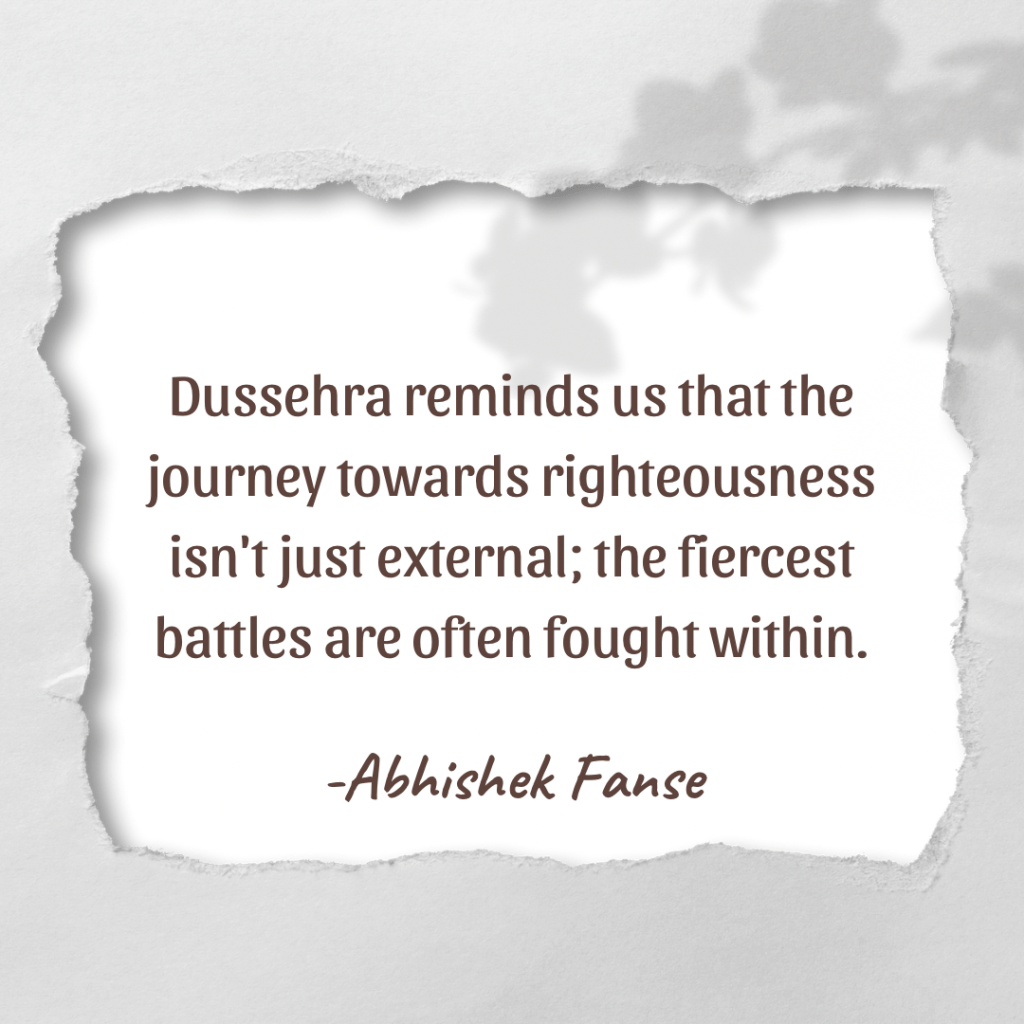
Annually commemorating the triumph of good over evil serves as a reminder for individuals to assess their moral compass, encouraging them to uphold righteousness in the face of wrongdoing. With changing times, the interpretations of ancient tales also evolve. For the newer generation, Ravana might not just symbolize a demonic force but could represent systemic societal issues like corruption, prejudice, or environmental neglect. The battle is then between collective societal good and these modern ‘evils’. In an era of individualism, many use Dussehra as a time of personal reflection, confronting their own Ravanas, be it anger, jealousy, greed, or other personal challenges.
 Abhishek Fanse