Understanding Confidence: Beyond the Binary of “more” or “less“
It’s a term thrown around often, in self-help books, motivational speeches, and even casual conversations. But what exactly is confidence? Is it an intangible force that some people possess while others lack, or is it an inherent aspect of every individual that remains unaffected by external circumstances? Let’s dive deep into this paradoxical phenomenon.

If one looks closely, the term has been constructed based on societal norms and standards. It is believed that certain behaviors, decisions, or characteristics project a sense of certainty, while others indicate a lack of the same. Over time, these beliefs have formed the structure we identify as confidence. However, considering the vast spectrum of human emotions and the varied circumstances everyone faces, is it valid to classify them under the binary of confidence and its lack?
For instance, a deer running from a predator is often acting out of fear. However, the very act of running, the determination to escape, indicates a level of confidence in its ability to survive. Similarly, when a person is fearful, that fear doesn’t necessarily negate their confidence. The act of acknowledging fear and responding to it can be viewed as an act performed with complete confidence in that particular emotion.
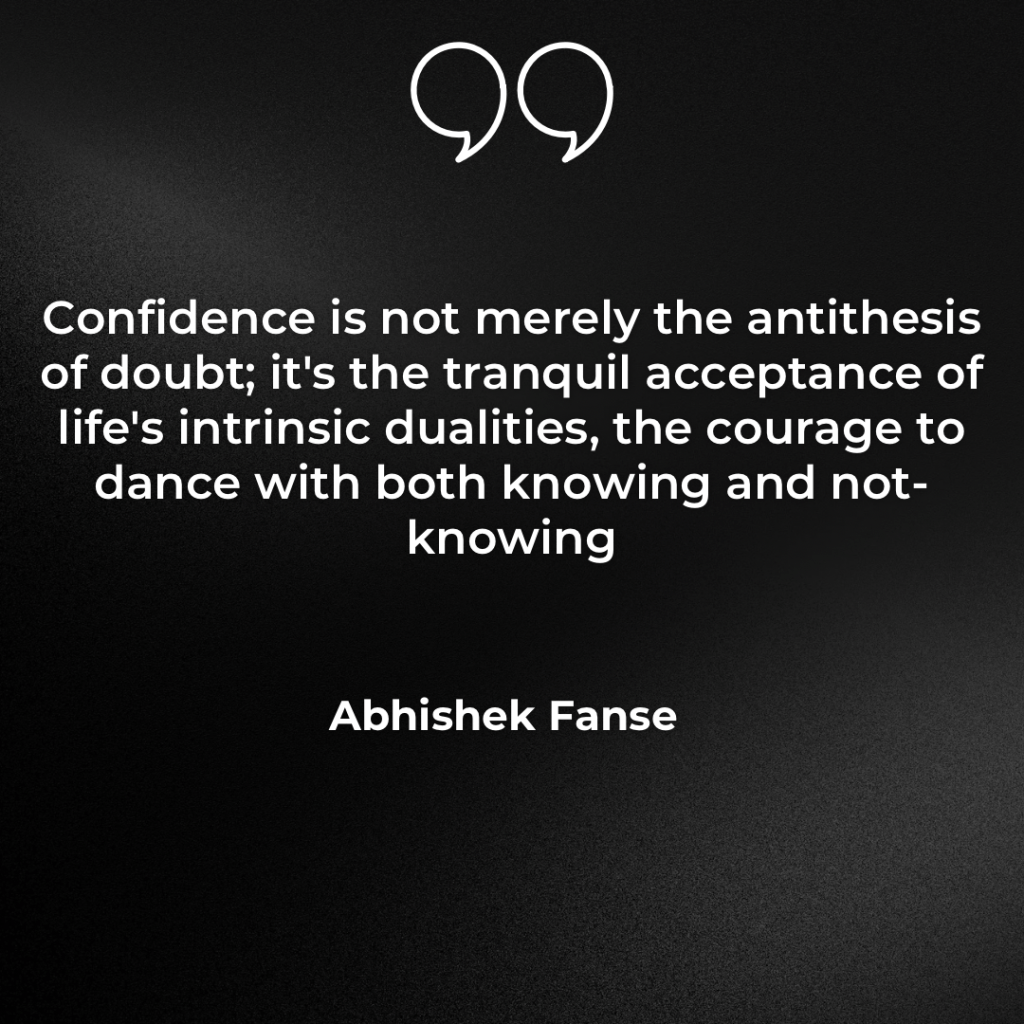
While it’s argued that confidence is unaffected by external situations, one can’t deny the impact of external validation on perceived self-worth. A student praised continuously may seem more confident than one who’s always criticized. But this brings forth another question: Is the confidence of the praised student genuine, or is it a facade built upon external validation? The underlying belief here is that true confidence remains unaffected by external factors. It is an internal compass, guiding one through life’s challenges. The student who seems less confident due to criticism might very well have an inherent belief in their abilities but chooses not to display it openly.
The intricate relationship between fear and confidence is captivating. While at first glance, they might seem opposing, a deeper introspection suggests they coexist harmoniously. As mentioned before, acknowledging fear can be an act of confidence in itself. Embracing one’s vulnerabilities, doubts, and fears can be seen as the highest form of confidence because it stems from self-awareness.
If we view confidence as neither a trait one can gain nor lose but as a constant presence, it reshapes our understanding. In this perspective, every act, regardless of its nature, is executed with full confidence. A person displaying apprehension is confidently apprehensive. A person in doubt is confidently doubtful. Modern society often categorizes confidence in degrees – more or less, high or low. This categorization restricts our understanding. When we say someone is “more confident,” we’re comparing their current state to a previous one or juxtaposing them against someone else. However, by acknowledging that every act is executed with complete alignment to a particular emotion or state of being, the need for comparison dissipates.
Confidence, in its true essence, is not about loud declarations or silent sufferings. It’s about recognizing and accepting the inherent completeness in every emotion, decision, and action. It’s about understanding that every response to a situation, be it with enthusiasm, fear, doubt, or joy, is done with utmost confidence in that response. If confidence is inherent, it would imply that any action performed in a state of fear, joy, or doubt is done with a level of assurance. In a crisis, for example, a hesitant decision to call for help is executed with as much confidence as a swift decision to solve the problem. This inherent nature of confidence, therefore, suggests that the concept is not binary but rather a spectrum, or perhaps beyond a spectrum—a state of consistent existence.
When we look at external circumstances affecting confidence, it becomes apparent that this so-called “influence” is transient. If confidence is genuinely inherent, then external factors may create an illusion of change but cannot alter its core. That said, constant external validation can create a clouded perception of self-worth, often mistaken for genuine self-confidence. The distinction between inherent confidence and externally-induced confidence is crucial for holistic understanding. If confidence is a constant presence, the degrees of “more” or “less” cease to have real meaning. It suggests that everyone, at any point in time, is fully committed to their actions or reactions, be it hesitancy or decisiveness. In such a framework, everyone is performing at their own level of 100% confidence tailored to the specific situation or emotion they are dealing with. Therefore, to say that one is ‘lacking’ in confidence is to misunderstand its inherent nature.

If every act is performed in complete alignment with the emotion or thought process governing it, it removes the need for comparison or valuation, which are tools the ego uses to identify itself. The notion of someone being “more confident” than someone else arises from a place of duality, from distinguishing the self from the ‘other.’ When one’s existence is in complete harmony with the intrinsic nature of confidence, these comparisons become irrelevant.
Possessive possessions
As human beings, our relationship with possessions is multi-faceted and complex, steeped in a variety of psychological, sociological, and cultural influences. Why do we cherish and cling to material objects? How do these objects gain such profound significance in our lives that their loss can trigger profound distress?
The roots of possessiveness can be traced back to our earliest stages of development. Attachment theory, proposed by psychologist John Bowlby, suggests that as infants, we form attachments to our caregivers, perceiving them as a source of security. Objects, such as a favourite blanket or toy, can also become “attachment objects,” imbued with emotional significance and seen as sources of comfort and safety.
As we grow older, this tendency to form attachments does not diminish but simply evolves. We begin to assign emotional significance to a wider range of objects: a cherished book, a childhood home, a prized car, an heirloom passed down through generations. These objects are no longer just inanimate items; they become extensions of our identity, symbolic representations of our personal history, achievements, relationships, and aspirations.
These possessions reflect who we are, who we have been, and who we aspire to be. They’re a reflection of our interests, experiences, values, and dreams. A stamp collection is not just a bunch of stamps; it’s a testament to a person’s love for history and travel. A guitar is not just an instrument; it’s an emblem of someone’s passion for music and creativity.
However, our deep emotional attachment to our possessions has a flip side: the fear of losing them. The possibility of someone taking away our prized possessions triggers a fear of losing a part of ourselves, of our identities being eroded. This fear is the seed of possessiveness. We resist anyone interfering with our possessions, seeing such interference as an intrusion into our personal domain, a threat to our sense of self.
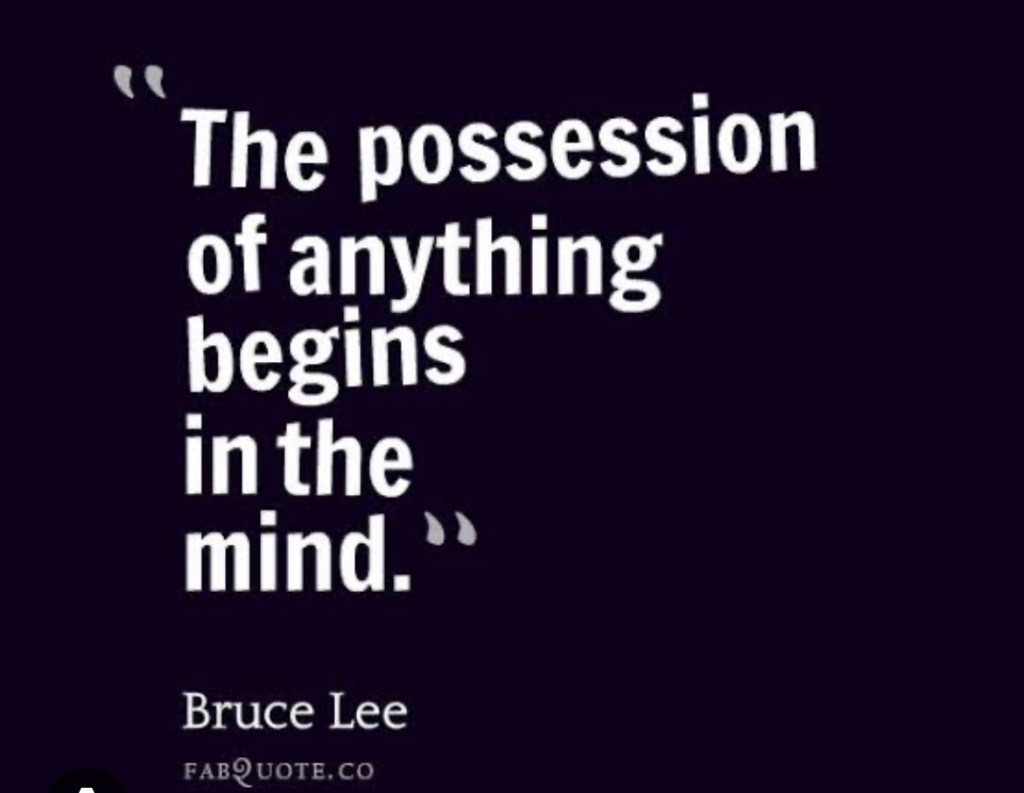
Our possessions also offer us a sense of control in a world often marked by uncertainty and unpredictability. In a life full of variables beyond our control, our possessions are something we can manage, organize, and control. This perceived control can offer us comfort, helping us navigate the unpredictability of life.
This dynamic of possession and control extends to our relationships as well. We might view our partners, friends, or family members as ‘ours,’ a part of our identity. In healthy relationships, this feeling manifests as a deep sense of connection and commitment. However, when driven by insecurity or fear of loss, it can devolve into possessiveness, stifling the other person’s freedom and autonomy.
Ironically, the attachment to possessions can create both a sense of fullness and emptiness. Fullness, because these objects can offer comfort, joy, and a sense of identity. Emptiness, because possessions, being impermanent, can be lost, damaged, or taken away. We might also feel empty when we realize that possessions, while they can offer temporary happiness, cannot provide the deep, lasting fulfillment we ultimately seek.
In this journey of understanding possessions, it’s critical to consider another aspect, the societal and cultural influences that shape our attitudes towards ownership and possession. Our societies, through advertising, media, and peer pressure, often promote materialism and the idea that acquiring possessions is a path to happiness and success. We’re constantly bombarded with messages that equate possessions with personal worth and social status. This reinforces our attachment to material objects, making them seem even more essential to our identities and well-being.
Take, for example, the car someone drives. It’s more than just a vehicle for transportation; it’s often seen as a status symbol, an outward sign of wealth and success. We assign value to the person based on the value of their car. This societal norm can significantly reinforce our desire to possess and protect our belongings, linking them directly to our self-worth and societal standing.
However, this attachment can lead us into a cycle of endless striving, where we’re constantly seeking the next thing to acquire, hoping it will bring us the satisfaction we crave. But as we’ve often seen, this satisfaction is usually temporary. The excitement of a new purchase eventually fades, and we’re left seeking the next thing, caught in an endless cycle of desire and dissatisfaction.
This cycle of possession and dissatisfaction is also reflected in our relationships. In an attempt to find security and happiness, we may seek to ‘possess’ people, to make them ‘ours.’ This can manifest in various ways, from the relatively benign (e.g., wanting to spend lots of time with a loved one) to the more harmful (e.g., trying to control a partner’s behavior or friendships).
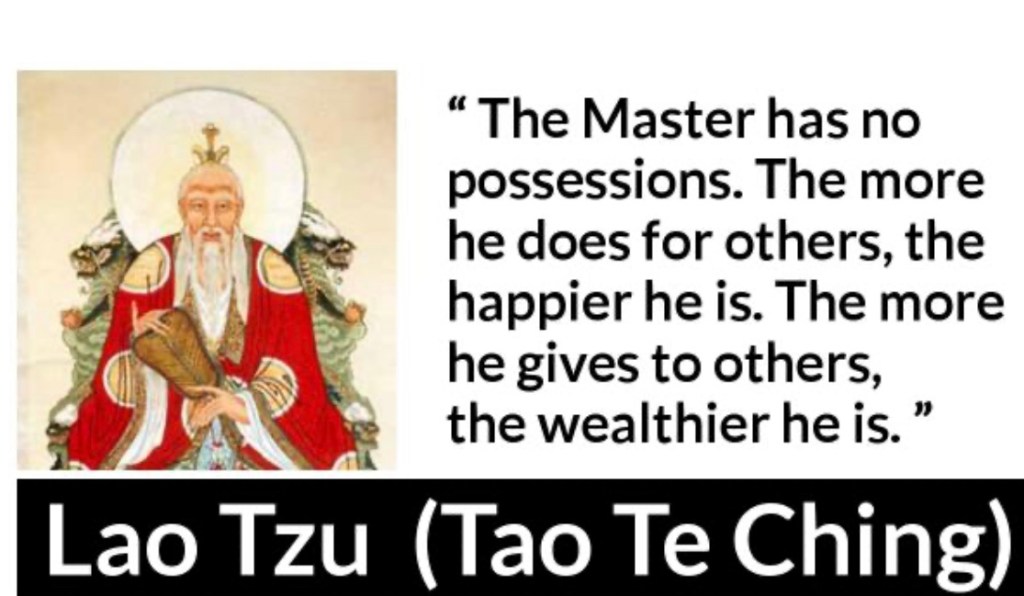
When we treat people as possessions, we run into two main problems. First, people are autonomous beings with their own desires and needs, not objects to be owned or controlled. Trying to ‘possess’ a person invariably leads to conflict and harm. Second, like with material possessions, the security and happiness we seek in ‘possessing’ others are elusive. People change, relationships end, and the sense of security we hoped to find proves fleeting.
The idea of possession also often extends to the intangible elements of our lives, such as ideas, beliefs, and ideologies. These can also become ‘possessions’ we fiercely cling to and defend. For instance, political, religious, or philosophical beliefs often become integral parts of our identity. Just as with material possessions, we can react negatively if these beliefs are challenged, seeing such challenges as attacks on ourselves.
One reason we attach so deeply to these kinds of possessions is that they help to structure our understanding of the world. They provide a framework that makes sense of our experiences, giving us a sense of control and predictability. Therefore, when these beliefs are threatened, it can feel as though our whole understanding of the world is under threat, triggering a defensive reaction.
However, just as with physical possessions, this attachment can lead to problems. When we’re so deeply invested in a particular belief or ideology, it can close our minds to new ideas and perspectives. We can become rigid and inflexible, unable to adapt to new information or changing circumstances.
This rigidity can also lead to conflict with others who hold different beliefs. When our identities are so tied up with our beliefs, it can be challenging to engage in open, respectful dialogue with those who see the world differently. Instead, we may feel threatened by these differing viewpoints and respond with hostility.
Yet, one might ask, how can we not hold onto beliefs? Aren’t they necessary for making sense of the world? While it’s true that beliefs play a crucial role in our understanding of the world, the problem arises when we cling to them rigidly, refusing to consider alternative viewpoints or update our beliefs in the light of new information.
Just as we can enjoy material possessions without being attached to them, we can hold beliefs without being enslaved by them. This requires a certain level of open-mindedness, a willingness to question our beliefs and consider new ideas. It also requires a level of humility, an acknowledgment that our understanding of the world is always limited and imperfect.
By developing this kind of flexible, open-minded approach to our beliefs, we can avoid much of the conflict and suffering that comes with rigid attachment. We can engage more productively with those who hold different views, seeing these interactions not as threats, but as opportunities for learning and growth.
The concept of possessions, whether tangible or intangible, thus challenges us to reassess our relationship with the world around us. While possessions can provide a sense of security and identity, our attachment to them can also lead to suffering and conflict.
Ego and its death
The concept of the ego is deeply rooted in both psychology and philosophy, contributing to the overall understanding of human behavior, cognition, and identity. It’s a multifaceted term that has been interpreted and employed in various ways by different scholars. To understand the ego in depth, we need to examine its theoretical origins, its functions, its influence on our behavior and relationships, and the role it plays in personal growth and self-awareness.
The term “ego” has its roots in Latin, where it means “I.” However, its contemporary psychological and philosophical meanings draw mainly from the works of Sigmund Freud, the founder of psychoanalysis, and Carl Jung, the founder of analytical psychology.
Freud used the term ego to describe one of the three components of the psychic apparatus in his structural model of the mind. According to him, the human psyche comprises the id, the ego, and the superego. The id is the primitive part of our psyche that contains our basic instincts and drives. It operates on the pleasure principle, seeking immediate gratification of needs and desires.
The superego, on the other hand, is the moral compass, formed as we internalize societal and parental norms and values. The ego, according to Freud, is the mediator between the id and the superego. It operates on the reality principle, trying to satisfy the id’s desires in socially acceptable ways that also align with the superego’s moral standards. The ego, thus, helps us navigate the external world while managing our internal drives and moral values.
In contrast, Carl Jung saw the ego as the conscious mind, encompassing our thoughts, memories, and perceptions. It forms the center of our conscious identity but not the entirety of the self, which also includes the unconscious elements. For Jung, the ego is essential for self-awareness and plays a vital role in the process of individuation, which is the journey toward wholeness and self-realization.

The ego, as understood from these perspectives, plays a vital role in our lives. It helps us manage our impulses, maintain our relationships, make decisions, and develop a coherent sense of self. Without the ego, we would struggle to function effectively in the world.
However, when the ego is too dominant or rigid, it can become a source of problems. It may cause us to become overly attached to our self-image, leading us to defend it vehemently against any perceived threats. This can manifest as excessive pride, stubbornness, defensiveness, or inability to accept criticism. In its extreme form, it can lead to narcissistic tendencies, where one’s self-absorption becomes detrimental to their relationships and overall well-being.
In the realm of personal growth and self-awareness, the ego is often perceived as a barrier. This is because the ego, by its very nature, clings to the familiar and resists change. It likes to be in control and tends to see things in dualities (right-wrong, good-bad, etc.), making it difficult for us to embrace uncertainty, see different perspectives, or step out of our comfort zones. This can limit our growth and prevent us from realizing our full potential.
At the same time, the ego can also be a gateway to growth and transformation. By becoming aware of our ego—its patterns, its fears, its defenses—we can begin to understand ourselves better. This awareness can give us the insight and courage we need to challenge our old ways of being and forge a new path.
Moreover, the ego can provide valuable clues to our unconscious elements. Our reactions, defenses, and fears often point to unresolved issues or repressed aspects of ourselves. By exploring these aspects, we can bring them to light, integrate them, and become more whole and self-aware.
To fully understand what “dies” when we become fully aware and conscious, and what it is we naturally let go of when we begin to understand ourselves, it’s crucial to delve into the depths of human consciousness, self-awareness, and the fundamental elements of our identity. This inquiry involves a deep dive into psychology, philosophy, neuroscience, and spirituality.
Becoming fully aware and conscious implies a shift from a state of unconsciousness or lesser awareness to one of higher consciousness. Here, unconsciousness refers to automatic, habitual behaviors and thought patterns which we often engage in without any conscious control or intention. These patterns, formed through years of conditioning, might include biases, assumptions, prejudices, or learned behaviors that operate under the surface of our everyday awareness.
When we reach a state of full awareness or consciousness, these patterns can no longer exist in their previous form. Essentially, what “dies” here is the old self – the unconscious patterns and the egoic self that is driven by them. The ego, in psychological terms, can be seen as the aspect of identity that we consider our “self.” It’s constructed from our experiences, memories, cultural conditioning, and our reactions to external stimuli.
The ego is characterized by attachment to certain ideas about ourselves and the world around us. These ideas may include beliefs about what we should be, what we need to be happy, what we fear, and how others should behave. Often, these ideas are not based on conscious decisions but are ingrained in us through past experiences and societal conditioning.
Becoming fully aware or conscious means recognizing these patterns and seeing them for what they are—temporary constructs rather than inherent aspects of our identity. This allows us to break free from these habitual patterns, essentially causing the egoic self or the old self to “die.” This doesn’t mean we lose our sense of self; rather, it signifies a transformation of self.
As we reach this state of full consciousness, we naturally begin to let go of the attachments that the egoic self held. Attachments, in this context, refer to rigid beliefs, preconceived notions, desires, fears, and expectations that we unknowingly cling to. They are deeply entrenched within our psyches and often steer our thoughts, emotions, and actions without our conscious awareness.
When we start to understand ourselves – our motivations, our fears, our reactions – we naturally begin to see these attachments for what they are. We see that they are not fixed parts of our identity but constructs that we have the power to change or let go of. Understanding ourselves means recognizing that we are not solely the sum of our experiences, thoughts, emotions, or societal conditioning. We are conscious beings capable of introspection, change, and growth.
In the process of self-understanding, we let go of these attachments because we realize that they limit our potential and obstruct our well-being. Letting go is not about forgetting or ignoring our past experiences or emotions. Instead, it’s about recognizing these elements for what they are, understanding their impact, and then making the conscious decision not to let them dictate our present and future.
Moreover, letting go is an act of acceptance—acceptance of our past, our mistakes, our flaws, and our vulnerabilities. It’s about accepting that we are human beings capable of change and growth. We acknowledge our past experiences and emotions, learn from them, and then free ourselves from their hold.
In the process of becoming fully aware and conscious, what dies is not the individual’s sense of self, but the old, unexamined sense of self. The egoic self that was once controlled by unconscious patterns and attachments undergoes a transformation. This transformation is a process of death and rebirth—death of the old self and birth of the conscious self.
On this journey, the individual learns to let go of rigid beliefs, fears, and expectations that once held them back. They start to live from a place of conscious choice rather than habitual reaction. As a result, they experience a profound sense of freedom and openness, which enables them to navigate life with greater flexibility and resilience.

The journey to full awareness and self-understanding is not a linear one, and it’s not without challenges. It requires courage, patience, and persistence. But the rewards it brings—a profound sense of peace, freedom, and fulfillment—are well worth the effort.
The Art of Non-Identification: Dissolving the Ego and Embracing the Infinite
In this blog, we will try to understand nature of identification, its impact on our lives, and the path towards dissolving the ego and embracing the infinite. By understanding the art of non-identification, we can free ourselves from the shackles of the ego and awaken to our true nature as boundless, eternal beings.
The Nature of Identification
Identification is the process through which we attach ourselves to certain aspects of our existence, such as our thoughts, emotions, roles, relationships, possessions, and experiences. This attachment arises from the ego, which seeks to create a sense of separateness and individuality, in order to maintain its existence and control over our lives.
The Impact of Identification
When we identify with various aspects of our lives, we become trapped in the limitations and constraints imposed by these identifications. Our sense of self becomes defined and confined by the ego’s attachments, preventing us from experiencing the infinite and eternal nature of our being. The more we identify, the more we suffer, as our happiness and well-being become contingent upon the fluctuating circumstances of our lives.
The Path towards Non-Identification
- Cultivate Awareness: The first step in dissolving identification is to cultivate awareness of the ego’s attachments and the ways in which they manifest in our lives. Observe your thoughts, emotions, and experiences without judgment or identification, and recognize the transient nature of these phenomena.
- Embrace the Witness: Develop the capacity to witness your thoughts, emotions, and experiences from a place of detached awareness, allowing them to arise and pass without becoming entangled in their content. In this space of witnessing, you can observe the ego’s attempts to identify without becoming drawn into its games.
- Understand the Impermanence of All Phenomena: Recognize the impermanent nature of all things, including the ego and its identifications. By understanding the transient nature of existence, we can begin to loosen our grip on our attachments and see through the illusion of the ego.
- Practice Meditation: Engage in meditation practices that cultivate a state of non-identification, such as mindfulness, self-inquiry, or witnessing meditation. Through regular practice, we can train ourselves to maintain a state of non-identification, even in the midst of our daily lives.
- Surrender to the Divine: Release your attachments and identifications to the Divine, surrendering your ego and its illusions to the infinite wisdom and love that lies within you. By surrendering to the Divine, we can dissolve the ego and merge with the boundless, eternal essence of our being.
Non-identification is not an act of denial or suppression, but rather a process of transcending the ego and its illusions, in order to experience the true essence of existence.
 Abhishek Fanse