Honesty and Dishonesty: Beyond the surface
The concepts of honesty and dishonesty, fidelity and infidelity, often evoke strong reactions from people, shaped by moral, cultural, and societal conditioning. These binaries dominate much of human interaction, creating judgments about what is right and wrong, what is ethical and unethical. However, when we delve deeper into these ideas, we begin to see that these distinctions are part of a broader illusion of duality—a construct that humanity has built over millennia to navigate the complexities of life.
The very act of labeling actions as “honest” or “dishonest,” “faithful” or “unfaithful” stems from a worldview that is bound by dualistic thinking. In such a worldview, life is divided into opposites—good and bad, right and wrong, true and false. Yet, as we explore the nature of consciousness and presence, it becomes clear that these dichotomies are not fixed, but rather fluid, shaped by the limited perceptions of the human mind.
At the heart of this inquiry lies the question: what happens when one operates with complete presence, in a state of being where the mind is free from the constructs of past and future, of moral judgments, and of conditioned responses? In such a state, does the very notion of honesty and dishonesty, fidelity and infidelity, dissolve? Can we transcend the dualities that dominate our understanding of reality? And if so, what does that reveal about the nature of the “real world” we think we live in?
In this exploration, we will dive deep into these questions, dissecting the nature of honesty, dishonesty, fidelity, and infidelity, and ultimately aiming to dissolve the myths and illusions that surround them.
From an early age, we are taught that honesty is a virtue, a moral standard by which we should live. To be honest is to tell the truth, to be transparent, and to act in alignment with what is considered ethical. Dishonesty, on the other hand, is seen as a vice—deceiving, hiding the truth, or acting in ways that betray trust. Society has built intricate structures around these concepts, embedding them in legal systems, educational frameworks, and interpersonal relationships.
However, what we often fail to recognize is that both honesty and dishonesty are constructed within the realm of thought. They are ideas that arise from the human mind, shaped by cultural and historical contexts. What may be considered honest in one culture could be viewed as dishonest in another. For instance, in some cultures, withholding certain information is seen as a way to protect others, while in other societies, it may be seen as deceit. Thus, honesty and dishonesty are not objective truths; they are relative concepts that depend on context, perception, and belief systems. This recognition opens the door to questioning the very foundations of these moral judgments.
Honesty and dishonesty, as we commonly understand them, are rooted in dualistic thinking—the division of the world into opposites. Duality, in this sense, is a mental construct that allows us to navigate the complexities of life. It simplifies the world into categories of right and wrong, true and false, and gives us a sense of control over the moral and ethical landscape we inhabit.
But this division is inherently limiting. It creates conflict, both internally and externally, because it forces us to align with one side of the dichotomy and reject the other. When we view honesty and dishonesty as fixed opposites, we become trapped in a cycle of judgment, always measuring ourselves and others against these standards.
In relationships, fidelity is often equated with loyalty, faithfulness, and commitment. To be faithful is to remain true to one’s partner, to honor the bond of trust that has been established. Infidelity, by contrast, is seen as a betrayal—a breaking of that trust, a violation of the commitment made. These concepts are deeply ingrained in societal norms and expectations, particularly in romantic and marital relationships.
However, like honesty and dishonesty, fidelity and infidelity are also socially constructed. The very notion of what it means to be faithful or unfaithful varies across cultures and historical periods. In some societies, monogamy is seen as the ultimate expression of fidelity, while in others, polygamy or open relationships are accepted norms. The rules that govern fidelity are not universal; they are shaped by cultural, religious, and personal beliefs.
At the heart of fidelity and infidelity lies the idea of ownership—ownership of another person’s body, mind, and emotions. When we commit to a relationship, particularly in the context of marriage or long-term partnership, there is often an implicit expectation that we “own” each other in some way. This ownership manifests in the form of expectations about exclusivity, loyalty, and the boundaries of the relationship.
But this notion of ownership is illusory. No one can truly own another person, and attempting to do so creates a sense of possessiveness that is rooted in fear and insecurity. Fidelity, when seen through the lens of ownership, becomes a way of controlling the other person, of ensuring that they remain within the boundaries we have set for them.
True love is not possessive or conditional. When we love someone, we do not seek to control them or to bind them to our expectations. Instead, we allow them the freedom to be who they are, without judgment or restriction. This kind of love transcends the dualities of fidelity and infidelity because it is not based on ownership or attachment.
Infidelity, when it occurs, is often seen as the ultimate betrayal. It brings up feelings of hurt, anger, and rejection. But from a deeper perspective, infidelity can be understood as a mirror—an opportunity to examine the underlying dynamics of the relationship and the expectations that have been placed on it.
When someone is unfaithful, it is not necessarily a reflection of their character or moral standing. Rather, it can be a reflection of the unmet needs and desires that exist within the relationship. These unmet needs may be emotional, physical, or psychological, and they often stem from a lack of true connection or understanding between partners. Infidelity, in this sense, is not the cause of the problem but a symptom of deeper issues that have been ignored or suppressed. It forces us to confront the illusions we have built around relationships—the illusion of ownership, the illusion of permanence, and the illusion of control.
To operate with 100% presence in the moment is to be fully aware, fully engaged, and fully alive in the here and now. It means to live without the interference of past conditioning or future projections, to see reality as it is, without the filters of judgment, expectation, or attachment. Presence is the state of pure awareness, where the mind is not divided into opposites, and the self is not fragmented by thought. When we are truly present, the concepts of honesty and dishonesty, fidelity and infidelity, dissolve. In the state of presence, there is no division between right and wrong, true and false, because these are constructs of the mind. Presence transcends duality and brings us into direct contact with reality as it is—without the distortions of thought or emotion.
In the state of presence, honesty and dishonesty lose their meaning. Honesty is often defined as telling the truth, but what is truth? Truth, in its most profound sense, is not a fixed concept; it is fluid, dynamic, and constantly changing. When we are present, we do not cling to fixed ideas of truth or falsehood; we simply respond to the reality of the moment. Dishonesty, in this sense, is not about lying or deceiving others. It is about being out of alignment with the present moment—about acting from a place of conditioning, fear, or attachment, rather than from a place of awareness. When we are fully present, there is no need for dishonesty because we are in harmony with the flow of life. We do not need to manipulate or control the situation; we simply respond with clarity and integrity.
The concept of fidelity, too, dissolves when one operates in the present moment with full awareness. Fidelity, in its conventional sense, is often tied to promises, contracts, and the expectation of a continuous future. In relationships, it becomes a pledge to behave in certain ways over time, to stay within defined boundaries, and to remain “true” to another person. But these pledges are built upon mental constructs and future projections—on an imagined continuity that is bound by time and expectation.
When one is fully present, these future projections lose their weight, and fidelity is no longer about promises made for tomorrow but about the authenticity of being in relationship here and now. In presence, fidelity is not something forced or negotiated, but an expression of truth in the moment. One cannot be unfaithful in presence because one is not operating from a divided mind that clings to past commitments or fears future betrayals. Instead, there is simply an unfolding of truth as it is, unconditioned by the past and unconcerned with future outcomes.
Infidelity, often seen as the antithesis of fidelity, also loses its traditional meaning when approached from a place of presence. Infidelity typically arises from dissatisfaction, a feeling that something is lacking in the current relationship or situation. This dissatisfaction propels one to seek fulfillment elsewhere, outside the bounds of the established relationship. But what is at the root of this dissatisfaction? Often, it is the mind’s attachment to desires, projections, and unexamined needs that fuel the urge to look beyond the present relationship. In presence, there is no room for such projections. The mind, when it is fully attuned to the present, does not dwell on what is lacking or seek fulfillment outside of what is unfolding in the here and now. When one is present with a partner or in any relationship, the relationship is no longer bound by the rigid labels of fidelity and infidelity. There is simply a connection, a flow of being, that is not controlled by societal norms or personal insecurities. In this way, presence dissolves the very constructs that give rise to infidelity, not by imposing rules or boundaries, but by making them irrelevant.
Into the Heart of Now: “NOW” Unveiled
We are what we are doing right now” taps into the philosophical and psychological realms of existence, perception, and human behaviour. Going further, we begin to see a confluence of various factors, which draw us away from the present moment, and push us into the embrace of either the past or the future. At the very heart of human existence is our incessant need to find meaning. We seek purpose, direction, and a sense of understanding about our lives. This pursuit often becomes a bridge connecting the past, present, and future. Our past experiences, both triumphant and traumatic, linger in our minds, continuously shaping our present perceptions. They become stories we tell ourselves, lessons we’ve learned, and at times, scars that haven’t fully healed. The future, on the other hand, represents our hopes, fears, dreams, and anxieties. It’s a canvas upon which we project our desires and apprehensions.
The expectation of outcomes is an inherent human trait. It is rooted in our evolutionary drive for predictability and control. For our ancestors, predicting potential dangers and outcomes was a matter of survival. Over millennia, this instinct has got inculcated with our complex cognitive structures, resulting in our modern-day anxieties about the future and ruminations on the past. However, the irony lies in the fact that the more we seek to control outcomes, the more we find ourselves entangled in a web of expectations. These expectations often lead to inner conflicts. When the present doesn’t align with our anticipated future, dissatisfaction ensues. And when the weight of past regrets is heavy, it dims the light of the present. Furthermore, the very act of striving to stay in the ‘now’ can itself become a source of distraction. If one is perpetually conscious about remaining anchored in the present, then this very consciousness becomes a barrier. The effort to stay present can sometimes be as distracting as the past memories or future anxieties that pull us away.
In today’s world, there’s also the influence of societal structures and norms. We live in societies that prize outcomes—success is often defined not by the journey, but by the destination. From a young age, we’re conditioned to focus on results, whether it’s grades in school or milestones in personal and professional lives. This societal molding further deepens our attachment to outcomes and amplifies our detachment from the present.
It is also crucial to understand the role of human consciousness in shaping our experience of time. Our consciousness is not just a passive observer; it actively constructs our sense of reality. Every moment we live is filtered through a myriad of cognitive processes, memories, and emotions. This complexity means that we often don’t experience the world “as it is” but rather “as we are.”

Neurologically speaking, our brain’s default mode network, an intricate web of interconnected brain regions, becomes most active when our attention is not occupied by tasks. This network is linked with thinking about others, thinking about oneself, remembering the past, and planning for the future. Thus, even when we aim to be in the present, our brains often naturally drift towards contemplations of the past and future. The challenges in remaining present can also be attributed to our cognitive structures, which include biases, such as the “negativity bias” – our innate human tendency to give more weight to negative experiences than positive ones. This bias can cause past traumas or failures to overshadow current joys, anchoring us in bygone moments of pain or disappointment. On the other hand, the future holds the allure of the unknown. This uncertainty can be both enticing and anxiety-inducing. Our modern societies, with their rapid changes and technological advancements, amplify this by creating an environment where change is the only constant. The evolving landscapes of our personal and professional lives mean that the future is more unpredictable than ever, making it a potent magnet for our attention and energy. Yet, amidst these complexities, lies a simple truth: the only tangible reality is the present. While memories shape and color our past and aspirations carve out our perceived futures, the ‘now’ is the only temporal space where action occurs, where life is truly lived.
Let’s explore this further!
What if “Now” encapsulates everything – past, present, and future ? This perspective challenges traditional temporal distinctions or divisions we create in and between Past, Present and Future. This viewpoint reframes our understanding of time and our place within its continuum. When we speak of living in the now, it’s often portrayed as a juxtaposition against being lost in memories of the past or anxieties about the future. However, what if everything is indeed a part of the “now” ?
Imagine time as a vast river. In this river, every drop of water represents a moment. While some drops are behind us (the past) and others ahead (the future), they all collectively belong to the river, which is the “now”. In this perspective, the entirety of existence – our memories, current experiences, and anticipations – are interconnected and concurrently present in an expansive “now”. From this viewpoint, distractions aren’t diversions from the present moment; they are simply different facets of the ever-expanding “now”. The reminiscences of a childhood memory or the contemplation about a future event are as much a part of our current experience as the sensation of the chair we’re sitting on. Every thought, emotion, and sensation, regardless of the temporal context it references, emerges and is experienced in the present moment.

The division we often make between the past, present, and future might be a result of our cognitive architecture. The human mind, in its quest for order and understanding, categorizes experiences. This compartmentalization aids in processing complex information. For instance, labeling an experience as a “memory” helps us contextualize it, discern lessons from it, or even prevent future mistakes. Similarly, projecting into the future can be a survival mechanism, allowing us to anticipate potential threats or opportunities.
However, by understanding that everything occurs in the “now”, we can achieve a form of holistic consciousness. This realization offers liberation. It frees us from the confines of linear temporality and allows a more integrated experience of existence. Such a perspective is echoed in various spiritual and philosophical traditions. For instance, in Eastern philosophies, there’s an emphasis on the interconnectedness of all things, where dichotomies are more apparent than real. Yet, while this concept is enlightening, it’s also challenging. Our societal structures, languages, and even our neurobiology are geared towards a linear understanding of time. Overcoming this deeply ingrained perspective requires consistent introspection and possibly even a paradigm shift in our consciousness.

Let’s delve deeper into the expansive Present:
Linear time, where events occur in a sequence from past to present to future, might be more of a cognitive construct than an intrinsic property of the universe. Physics, especially in the realm of relativity and quantum mechanics, has already shown us that time doesn’t always behave in the ways our everyday experiences might suggest. The famous physicist John Wheeler once proposed the idea of a “participatory universe,” suggesting that observers play a role in shaping their own realities, which includes the experience of time. Every thought, emotion, or memory we experience happens in the present moment of consciousness. Even when we recall a past event or anticipate a future one, that activity occurs in the current moment of awareness. This raises the idea that consciousness itself might be beyond time. It’s a continuous stream where “past” and “future” are merely parts of the grander “now.”
If we fully embrace the idea that everything is part of the “now,” it alters how we relate to our experiences. Regret, nostalgia, anxiety, and hope, which are emotions anchored in our traditional understanding of time, undergo a transformation. For example, instead of feeling regretful for a past decision, understanding its occurrence in the vastness of “now” might lead to acceptance and integration of that experience. Memory plays a crucial role in our understanding of time. Our memories, though referencing past events, are dynamic and malleable. They’re reconstructed every time we recall them. In essence, every time we remember something, we’re experiencing it anew in the present moment. This blurs the boundaries between past events and current experiences, reinforcing the idea of an all-encompassing “now.” While the concept is philosophically and spiritually enriching, it poses challenges in our day-to-day lives dominated by schedules, deadlines, and plans. How does one reconcile the linear demands of modern life with a non-linear understanding of time? This balance requires us to function efficiently in the world while internally maintaining an awareness of the deeper, interconnected reality.
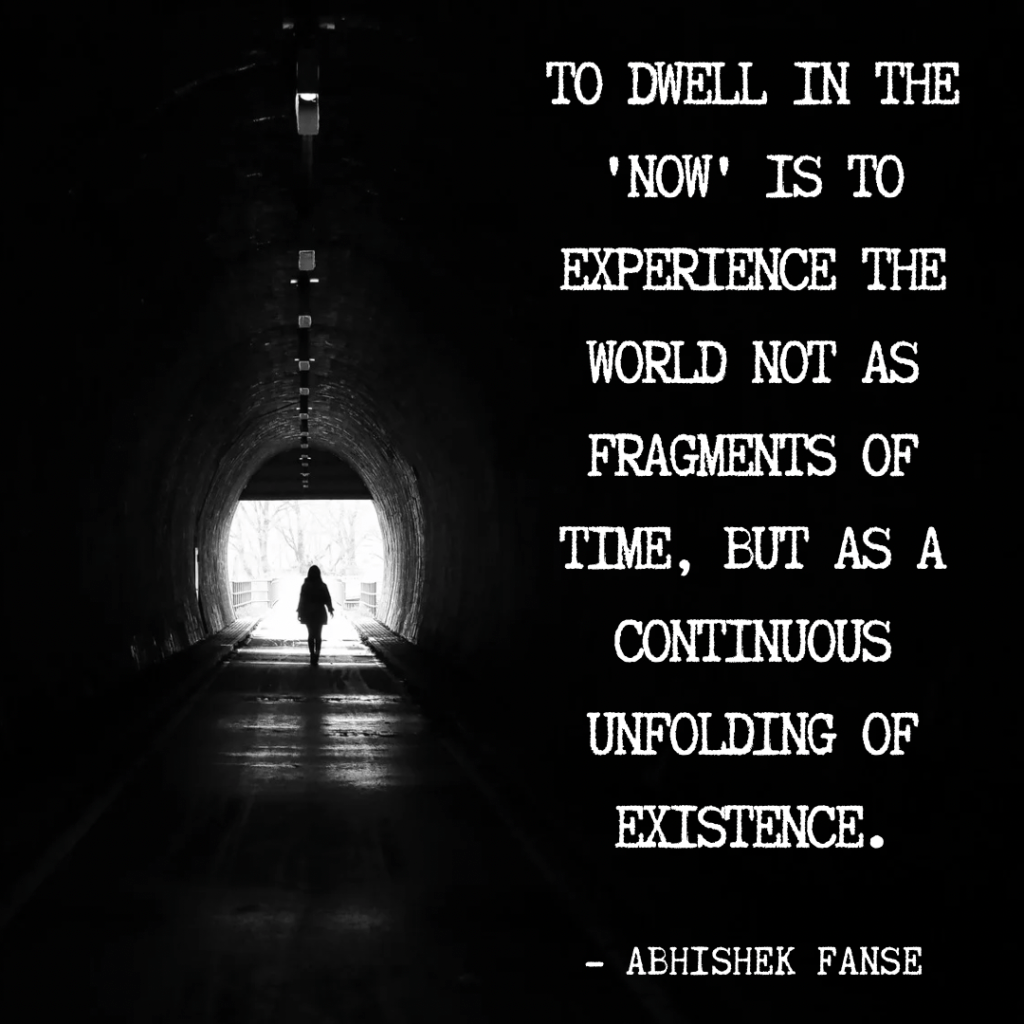
Let’s delve further into More finer details: what if we kill “Now”?
When we speak of “killing” the now, we’re essentially talking about transcending our typical awareness of time and moving into a state of pure being, a consciousness unfettered by the confines of temporal experience. The idea that time itself might be an illusion is not new. From the ancient Eastern philosophies to cutting-edge quantum mechanics, there are suggestions that what we experience as the flow of time might be a cognitive and perceptual construct. Our brains organize experiences in a linear fashion, from cause to effect, creating the sense of a flowing river of moments, from the past, through the present, and into the future. But if we could step outside this stream, what would consciousness look like? If we “kill” the now, we’re essentially trying to access a state of pure awareness—a consciousness devoid of content, without thoughts, perceptions, or sensations. Many meditative practices aim to reach this state, often described as “thoughtless awareness” or “contentless consciousness.” In this state, the meditator isn’t focused on any particular thing (like the breath, a mantra, or an image), but instead simply exists. It’s a state of being rather than doing.
Attempting to attain a state of pure awareness can be paradoxical. The very effort to reach this state can prevent one from achieving it, as effort and intention are temporal and future-oriented in nature. It’s like trying to smooth turbulent water with one’s hand—the act of trying only creates more turbulence. It requires a letting go rather than a striving, a surrender rather than a pursuit. To “kill” the now is to step beyond dualities—the past and future, cause and effect, self and other. This is a realm often spoken of in mysticism and spirituality, where one transcends the perceived divisions of existence. It’s a state of unity, of oneness, where the individual self melts away into the all-encompassing whole.
While these states of consciousness can be transformative, they can be challenging to maintain in our everyday, pragmatic world. Our society operates on schedules, plans, and routines. However, even fleeting experiences of this transcendent state can profoundly affect our daily lives. It can offer insights, change perspectives, and create a deep-seated sense of peace. From the perspective of many ancient traditions, the universe is in a constant dance of creation and destruction. The “now” that we experience is just one beat of this cosmic dance. To “kill” the now is not to negate or nullify it, but to merge with the dance itself, to become one with the rhythm of existence.
Understanding Dussehra: The morality spectrum
One of the most ancient concepts that explain duality is the Chinese philosophy of Yin and Yang. Everything has an opposite: where there’s light, there’s shadow; for life, there’s death. These dualities aren’t necessarily in opposition but rather in harmony, feeding into and defining each other.
Ravana’s Ten Heads: Ravana, the primary antagonist of the Ramayana whose defeat is celebrated on Dussehra, had ten heads. These are often seen as symbolic of ten human flaws. The act of Lord Rama killing Ravana isn’t about annihilating evil in its entirety but rather about overcoming these flaws.

The war in Ramayana, and by extension Dussehra, can be seen as an allegory for the inner battles we all face. It’s about making choices that align more with our higher self than our base instincts. Good and evil, in many ways, are relative. What’s “good” in one culture or time period might be seen as “evil” in another. They’re constructs that help humans navigate complex social and moral landscapes. What’s deemed good or evil can be relative, varying across cultures, religions, and individual beliefs. For example, a warrior killing an enemy might be considered heroic in one culture but a grave sin in another.
While Ravana is the antagonist in the Ramayana, he’s also a complex figure. A devout Shiva worshiper, an accomplished scholar, and a powerful king, his multifaceted personality blurs the lines between good and evil, suggesting that these concepts aren’t always black and white. After Ravana’s defeat, Sita undergoes a trial by fire to prove her purity. This episode raises questions about societal judgments, honor, and the complexities of righteousness.

Good Within Evil: Often, acts categorized as “evil” might have underlying “good” intentions or vice versa. A person may commit a crime to feed their starving family—how do we reconcile the act’s morality? The very existence of “good” necessitates “evil.” Without shadows, there’s no appreciation of light. This balance is essential for growth, evolution, and understanding. The cyclical celebration of Dussehra may symbolize the perpetual battle between our higher aspirations and our baser instincts, emphasizing the ongoing nature of personal evolution. By celebrating the triumph of good over evil, we’re also acknowledging the existence and importance of the dark side. It’s a recognition that the path to wisdom and righteousness involves confronting and understanding our own inner demons.
In today’s world, where moral lines often blur, the external representation of Dussehra’s battle might symbolize the internal conflicts we face in determining what’s right, navigating societal expectations, and personal desires. Ravana’s downfall began with his attachment and desire for Sita. This can serve as a reflection on how attachments can lead to one’s undoing, emphasizing the importance of detachment and self-awareness.
While the core message of Dussehra remains consistent, its interpretation and celebration can vary. In some parts, it’s about Rama’s victory over Ravana, while in others, it’s Goddess Durga’s triumph over the buffalo demon Mahishasura. This variance underlines how societies adapt stories to reflect their values and lessons they find most pertinent.
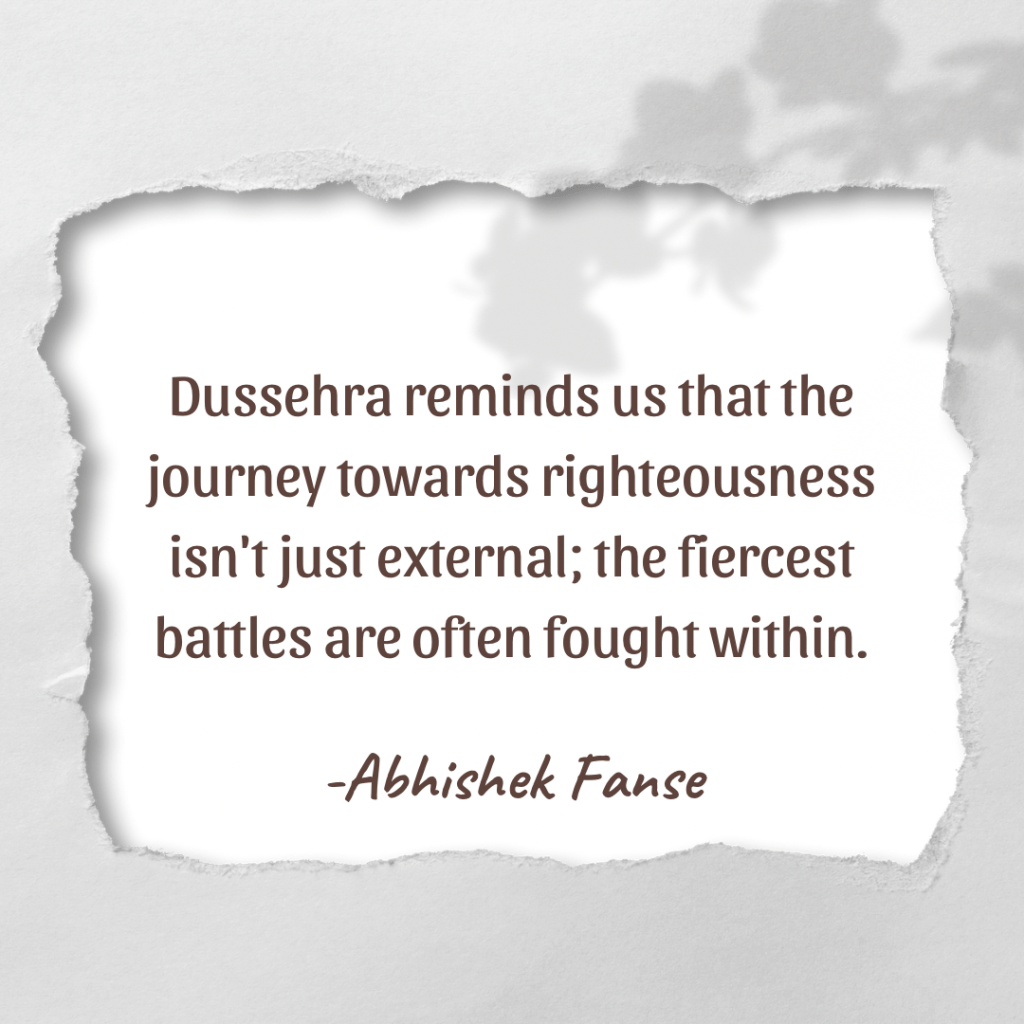
Annually commemorating the triumph of good over evil serves as a reminder for individuals to assess their moral compass, encouraging them to uphold righteousness in the face of wrongdoing. With changing times, the interpretations of ancient tales also evolve. For the newer generation, Ravana might not just symbolize a demonic force but could represent systemic societal issues like corruption, prejudice, or environmental neglect. The battle is then between collective societal good and these modern ‘evils’. In an era of individualism, many use Dussehra as a time of personal reflection, confronting their own Ravanas, be it anger, jealousy, greed, or other personal challenges.
The Mirrored Self: Reflections of the Experiencer and Experienced
Experience, by its very nature, is inherently subjective. It is the culmination of one’s perceptions, interpretations, emotions, and cognitive processes. Every individual, with their unique personal history, values, beliefs, and physiological makeup, encounters the world in a way that is uniquely their own. For instance, two people might stand before a work of art—one sees profound beauty and feels deep emotion, while the other simply sees colors on canvas. Both are valid experiences, but they differ drastically based on the individual’s subjective lens.
Yet, the objective reality of the world persists. The artwork, the physical colors, and brushstrokes remain constant. It’s this duality of the objective and subjective that creates the richness of human experience. We all share the same objective world, but our subjective interpretations of it vary widely, leading to an immense diversity of human thought, emotion, and expression.
Despite the deeply personal nature of experience, there exists within us a contrary desire to communicate and validate our experiences with others. This need can be attributed to our inherently social nature. As social beings, we have an innate drive to connect, to be understood, and to find commonality with others.
However, the act of communication is fraught with challenges. Language, while powerful, often falls short of capturing the full depth and nuance of our experiences. Words are mere approximations, often failing to convey the entirety of what we feel or perceive. When faced with the ineffability of certain experiences, humans may resort to crafting stories, metaphors, or beliefs to encapsulate and convey the essence of their experiences to others. While these may not represent the experience in its entirety, they offer a bridge, a means to connect with others and share a glimpse of our internal world.
Consider an example of observing a tree. The act of seeing is immediate and direct, but the moment we try to articulate the experience, we find ourselves grappling with memory, association, and linguistic constraints. If the tree is of a kind we’ve never seen before, we still try to relate it to what we know, drawing parallels and making distinctions. This process, while it can enrich our understanding, can also distance us from the immediacy of the experience itself.
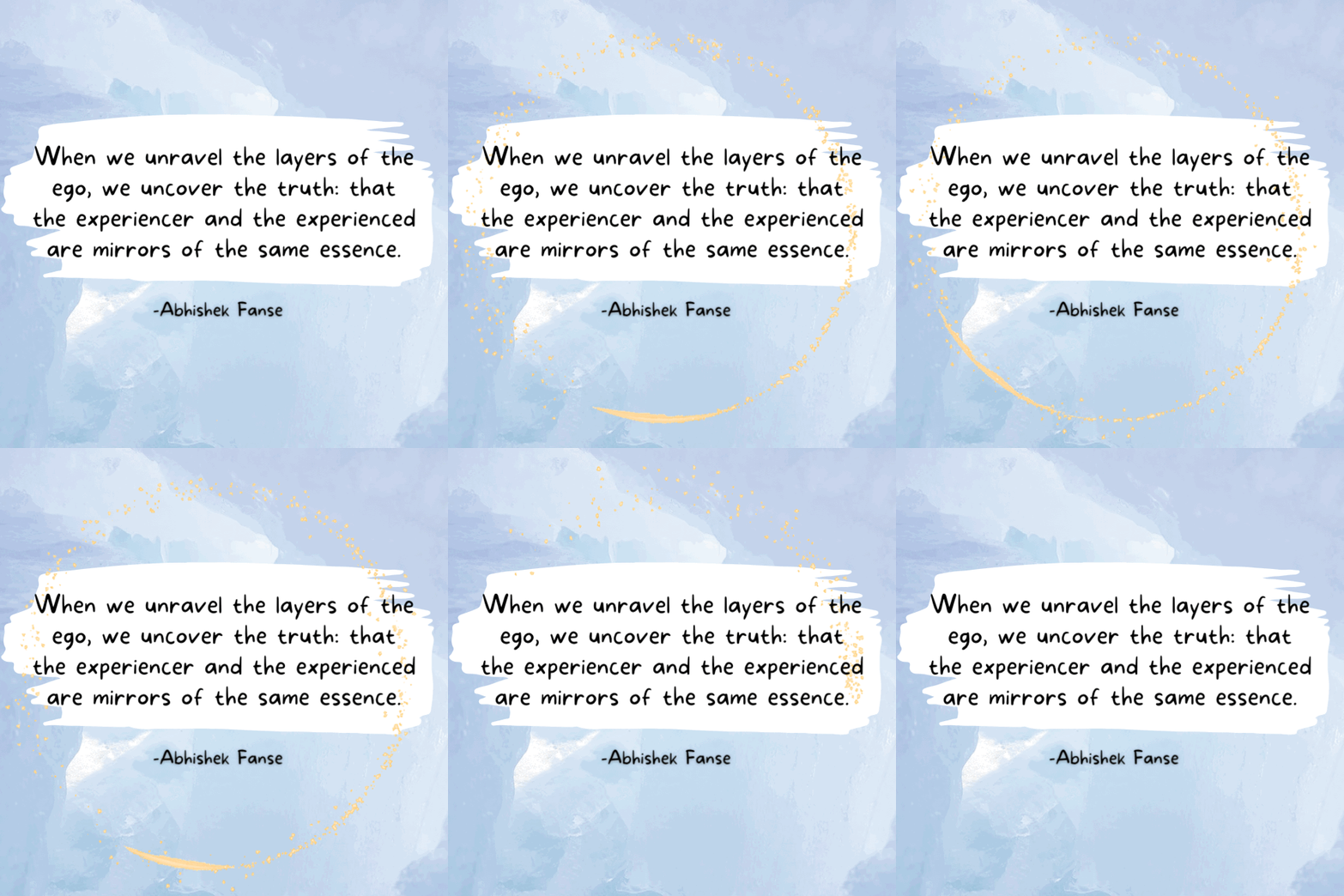
This leads us to the profound realization that perhaps the “experiencer” is indeed the “experienced.” Every thought, sensation, or emotion we have is not just a passive observation but an active engagement with our internal and external realities. The very act of experiencing reshapes our understanding, influencing future experiences in a continuously evolving cycle. One could argue that the realm of art, music, poetry, and other forms of non-verbal expression arises from this very challenge. When words fail, a painting, a melody, or a dance can capture and convey those intangible feelings and thoughts. They provide a medium that transcends linguistic barriers, offering glimpses into those profound depths of human experience. It’s no surprise that many people, when moved by a piece of art or music, often exclaim, “That’s exactly how I feel!” even if they couldn’t previously articulate that feeling.
Every individual, in their quest to understand and make sense of their experiences, inevitably draws from the collective knowledge and wisdom of humanity. Philosophies, religious teachings, scientific discoveries, and cultural narratives all play a role in shaping how one interprets and understands their experiences. They provide frameworks and lenses through which experiences are viewed, digested, and integrated.
This interplay between the individual and the collective further emphasizes the inherent tension between subjectivity and objectivity. While personal experiences are deeply subjective, the frameworks we use to understand them often have objective, shared components. A sunset viewed by an individual might evoke a personal memory or emotion, but the scientific understanding of why sunsets appear as they do, or the cultural or poetic interpretations of sunsets, come from collective human knowledge. Moreover, as individuals continue to share and communicate their experiences, they contribute to the collective understanding, which in turn shapes future individual and collective experiences. It’s a dynamic, reciprocal relationship, highlighting the interconnectedness of humanity.
The inherent elusiveness of pure experience, the ever-present gap between what is felt and what can be communicated, reminds us of the limitations of our human condition. Yet, it also highlights the beauty and depth of our existence. In our attempts to bridge this gap, we engage in some of the most profound human endeavors: art, literature, philosophy, and spirituality. Through these mediums, we continuously strive to touch the intangible, to grasp the ungraspable, and to share the very essence of what it means to be human.
Experience, in its fullest form, requires presence. To truly experience is to be fully in the moment, unburdened by the past and undistracted by the future. It’s here, in the pure and unfiltered present, that the experiencer and the experienced merge. This idea echoes in various spiritual traditions which posit that in moments of true presence, the duality of observer and observed collapses. Such moments, where one feels at one with the world, are often described as transcendent or mystical. They hint at a deeper interconnectedness, a web of existence that binds all things.
Yet, despite these profound moments, the human condition is also characterized by a fundamental sense of separateness. It’s this very separateness that gives rise to the desire to communicate, to reach out, to bridge the gap between self and other. We yearn to share, to be understood, and to understand. This yearning, however, is fraught with challenges. As earlier mentioned, the depth and richness of personal experience often evade linguistic encapsulation. But it’s not just about the inadequacy of language; it’s also about the limitations of perception.
Going into depths, In day-to-day life, we’re accustomed to distinguishing ourselves from our environment. We say “I am looking at the tree,” naturally separating the ‘I’ (experiencer) from the ‘tree’ (experienced). However, if we deconstruct this process, things become more intriguing. When you observe a tree, light reflected from its leaves and bark enters your eyes, gets processed by your brain, and forms an image. Here, the ‘tree’ you perceive isn’t the physical entity outside; it’s a manifestation within your consciousness. The tree, as you know it, exists within you, blurring the lines between the observer and the observed. Now, extend this idea to all experiences. Sounds you hear, emotions you feel, even thoughts that arise — all these are not ‘external’ or ‘separate’ events, but transformations within your field of consciousness. You never truly experience the world directly; you experience your consciousness’s interpretation of the world. This realization is profound: it suggests that what we consider ‘external’ is intricately woven into our ‘internal’ realms of experience. The division between us and the universe isn’t as sharp as it might seem.
Many spiritual traditions suggest that this feeling of separateness is a kind of illusion, often termed ‘maya’ in Hinduism. Beneath this illusion, it is proposed that there’s a deeper, unified reality where all distinctions merge. The Zen Buddhist concept of ‘interbeing’ beautifully encapsulates this: nothing exists independently; everything inter-is with everything else. So, in this interconnected dance of existence, to say “I am experiencing the tree” might be more aptly expressed as “The universe, in the form of ‘me’, is experiencing the universe in the form of ‘tree’.”
Exploring this further, we confront the nature of the ‘self’. If the experiencer and the experienced are one, what does this mean for our sense of identity? Who is the ‘I’ that experiences? These questions lie at the heart of self-inquiry in traditions like Advaita Vedanta, where meditative introspection is used to peel back layers of identity, seeking the true Self or ‘Atman’ beneath.

When one begins to deeply contemplate these ideas, the boundaries of self start to dissolve. This can lead to transformative experiences, often described as feelings of oneness or unity with all of existence. Such experiences are marked by a dissolution of the ego, a fading of the habitual sense of separateness. Individuals who have undergone such experiences often describe them as the most profound and meaningful of their lives, reshaping their understanding of themselves and the universe. However, embodying this perspective consistently in daily life is challenging. We’re evolutionarily wired to perceive separateness, as it’s useful for survival. But periodic glimpses into the interconnectedness of all things can offer solace, meaning, and a sense of belonging in a vast universe. They remind us that even amidst the diversity and multiplicity of existence, at the deepest levels, perhaps the experiencer truly is the experienced.
If we consider consciousness to be all-encompassing, then everything we experience is a manifestation within this field of awareness. This perspective aligns with the concept of non-duality, where there’s no division between the self and the rest of existence. In this view, consciousness isn’t something we have; it’s what we are. Our individual sense of self, our thoughts, emotions, and the world we perceive are all arising within and made of this same foundational consciousness.
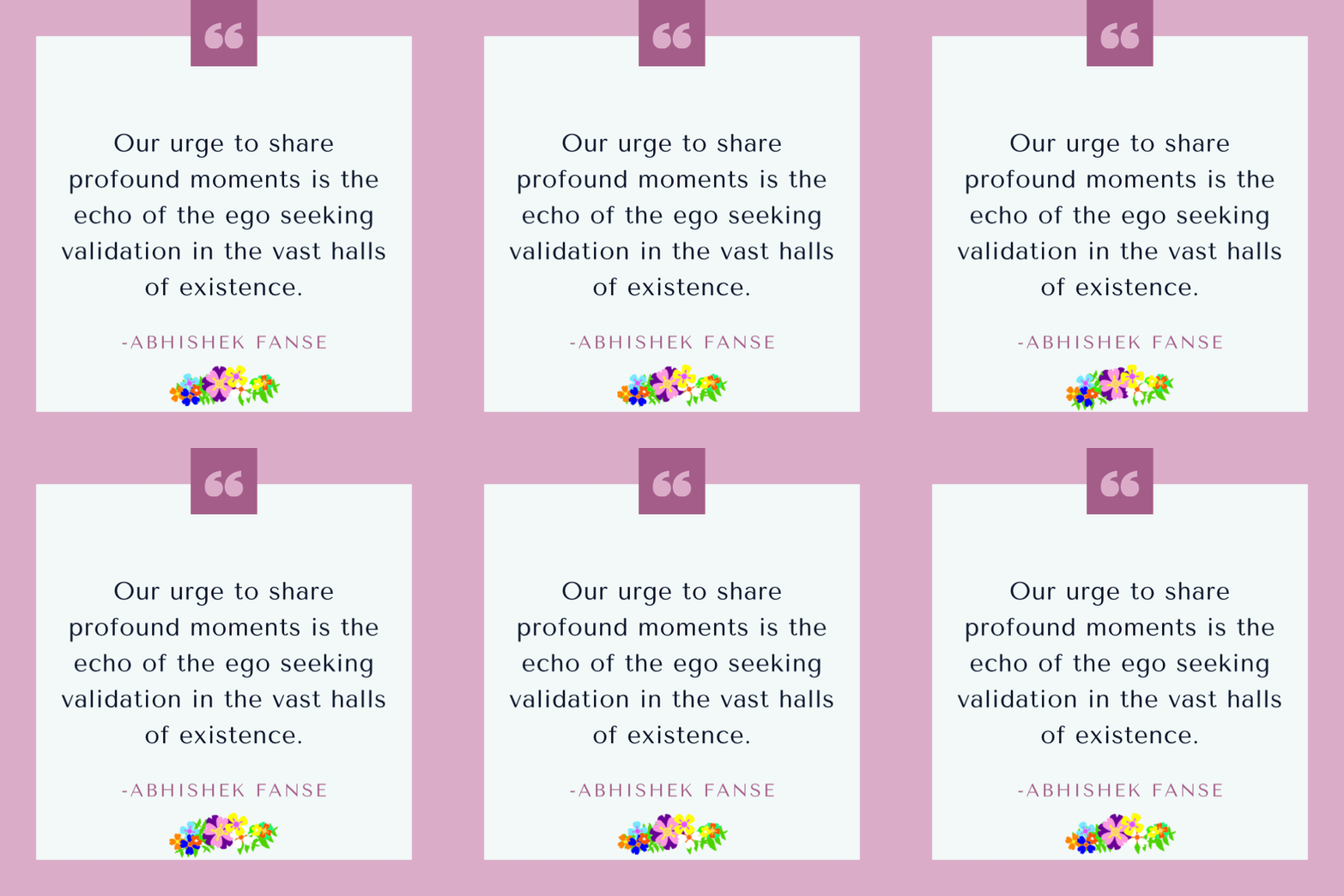
When we say “I am experiencing this,” who is this ‘I’? Psychologically, it refers to the ego—a mental construct that represents our individual identity. The ego is essential for our survival and functioning, but it also gives us a sense of separateness. From birth, we’re conditioned by society, family, and culture, creating layers of beliefs, desires, and fears that shape this ego. We start identifying with our thoughts, our bodies, our roles, and possessions, forgetting our intrinsic connection with the wider universe. The ego, being a construct, is fragile. It seeks validation and fears annihilation. This is why even after a profound experience, there’s an urge to share or validate it. The ego wants assurance that its interpretation of the experience is ‘real’ or ‘valid’. In moments of deep meditation or spiritual insight, the boundaries of the ego can dissolve, giving a person a glimpse of a reality beyond the constructed self—a state where the experiencer and the experienced merge.
Our understanding of reality is based on our sensory perceptions and cognitive interpretations. But our senses have limits. There’s a vast spectrum of light we can’t see, sounds we can’t hear, and dimensions of reality we might be oblivious to. Quantum mechanics, for instance, has shown that at fundamental levels, particles don’t have definite states until observed, challenging our classical views of reality. Could it be that reality, as we perceive it, is just a sliver of what’s truly out there? And if our very observation shapes reality (as quantum mechanics suggests), then the distinction between the observer and the observed becomes even more blurred. The act of experiencing might be intrinsically linked to the shaping of reality itself. Finally, the experience, consciousness, and reality challenges our conventional beliefs and invites us question, to meditate, introspect and to realize that our fundamental nature might be far more interconnected and expansive than our day-to-day experiences suggest. The dance between the experiencer and the experienced isn’t just a philosophical or spiritual inquiry; it’s a journey into the very heart of existence!!
The Fluidity of Stillness: Understanding Stagnation Amidst Movement
“Movement in Stagnation” captures the tension between seemingly opposite states—feeling spiritually stuck or stagnant while simultaneously experiencing inner changes or shifts. This suggests that even within periods of seeming inertia, movement is happening, whether you recognize it or not.
The experience of feeling both movement and stagnation simultaneously—or alternately—can be influenced by various factors, including your emotional state, external circumstances, and perspective. On a day-to-day basis, there are changes, interactions, and new experiences, which might seem like movement. However, these might not register on the long-term scale, where overarching goals and life trajectories are considered.
ertain philosophies and spiritual perspectives propose that time is not linear but cyclical. Thus, the repetition or perceived stagnation may actually be a part of natural cycles. However, Emotions are incredibly transient; they can change from moment to moment. This emotional flux might be what you’re identifying as “movement” within the stagnation. Emotional highs feel even higher when coming out of a low and vice versa. This contrast might contribute to the sensation of significant movement even when your situation hasn’t drastically changed.
Humans are wired to identify patterns. When you start noticing recurring themes or experiences, your brain flags these as patterns, which can feel like you’re stuck in a loop. Once you recognize a pattern or feel stuck, you’re more likely to notice information that confirms this belief, thereby reinforcing the feeling of being stuck.
Some spiritual teachings suggest that life inherently consists of repetitive cycles—birth, growth, decay, death, and rebirth—and that recognizing this can free you from the illusion of stagnation. Certain philosophies like Buddhism focus on the present moment as the only “real” moment, suggesting that both the past (stagnation) and the future (movement) are constructs of the mind.
When you look at your life on a daily basis, you can see a lot of activities, interactions, and events that unfold. The sun rises and sets, you go to work, eat, sleep, talk to people, perhaps engage in some hobbies. This flurry of activity can give you the impression that things are constantly moving and changing. However, if you were to zoom out and look at a larger slice of your life, say a year or a decade, the feeling is often quite different. Major life circumstances—your job, where you live, your relationship status—may not change as frequently. Even if they do, the underlying patterns of behavior, the kinds of relationships you engage in, and your day-to-day experiences might not undergo a significant transformation. This is where the feeling of “stagnation” often comes in. Despite the constant activity and interactions, there may be an underlying sense that nothing much has really changed—or is going to change.
Emotions, by their very nature, are transient and fluid. Even within a single day, you might experience a range of emotions—joy, frustration, excitement, boredom, love, irritation—and these emotions have a way of coloring your perception. When you’re joyful, the world seems vibrant, full of possibilities; you feel like you’re “moving.” When you’re frustrated or bored, the world can seem dull, repetitive; hence the feeling of “stagnation.”
The mind has certain tendencies that influence this dual experience of movement and stillness. One of these is the brain’s knack for pattern recognition. We make sense of the world by recognizing patterns; it’s how we learn and navigate complex realities. However, this strength can turn into a trap when the patterns you recognize lead to a sense of helplessness or stagnation. For instance, if you’ve had several failed relationships, you may start to believe that all relationships are doomed to fail, leading to a feeling of being “stuck.”
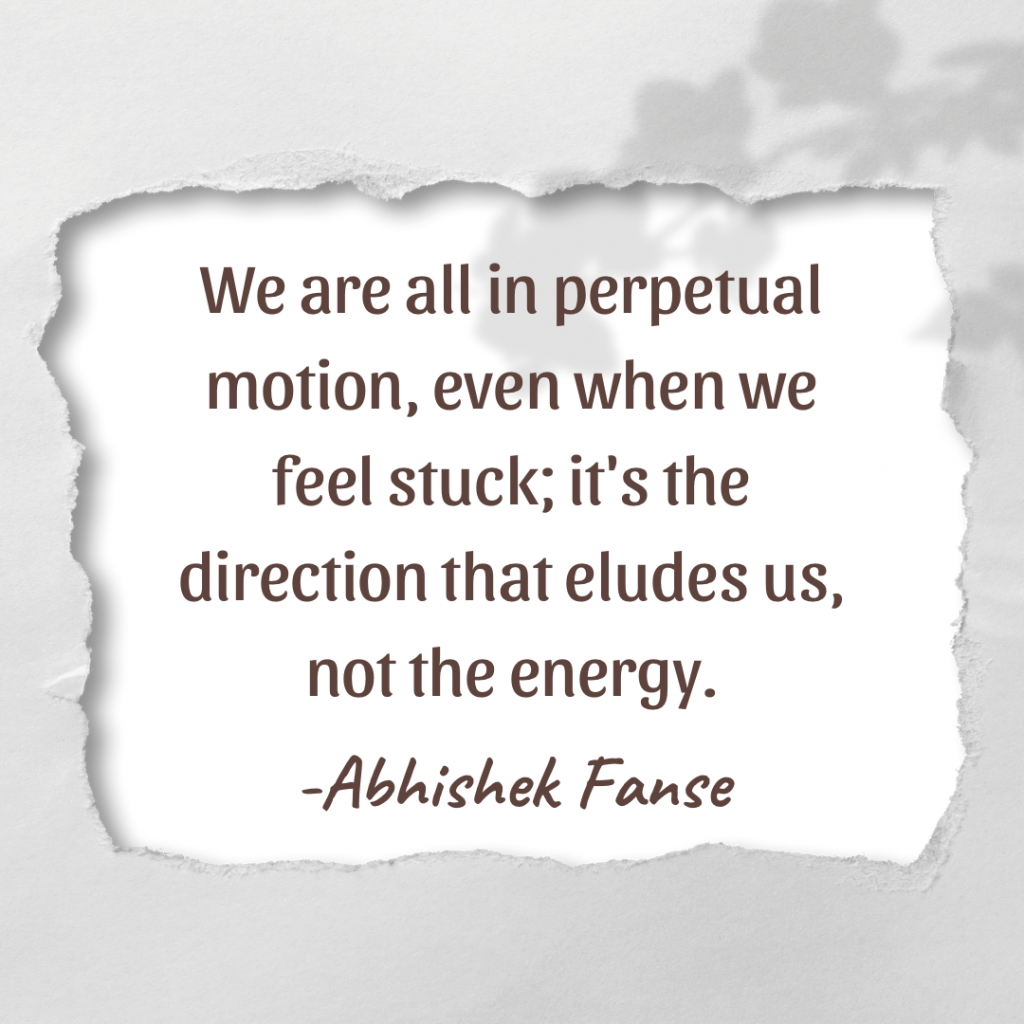
Finally from a more spiritual or existential standpoint, the very idea of movement and stagnation can be questioned. Certain spiritual teachings suggest that the material world is an illusion, and that true “movement” is a journey inward, toward understanding one’s own nature and the nature of reality. In this context, both the feeling of “moving” and “being stuck” can be seen as distractions from the true journey, which is neither about moving nor staying but about understanding and being.
Is harmony defined by us is really harmonious ?
The universe operates on a balance. Dualities like light and dark, joy and sorrow, and so on, are not in contention with each other but rather two sides of the same coin. They provide context and meaning. It’s akin to understanding that one cannot truly appreciate light without having known darkness. Our existence is enigmatic, where a myriad of elements interplay in a vast cosmic dance. Every action, no matter how minute, sends ripples across the fabric of the universe. Such is the interconnectedness and oneness that defines the cosmos. But amidst this vastness, we humans grapple with the age-old questions: Why are we here? Why do we feel disconnected when everything is intrinsically connected? And, why is our life, despite being a part of this vast universe, so often defined by duality?
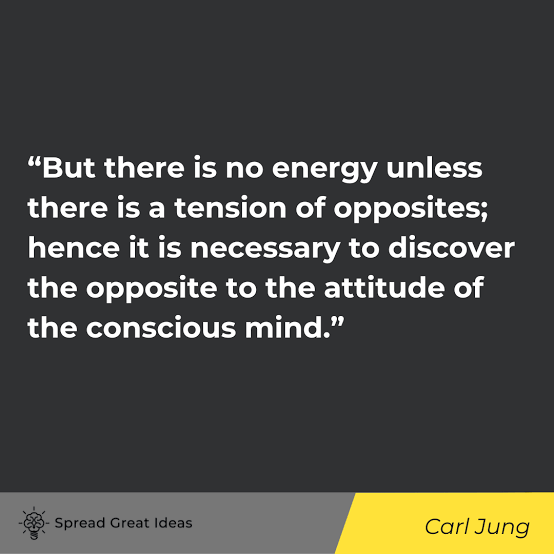
Consider the universe as an immense symphony, where every entity is like a note, contributing to an eternal, harmonious melody. From the most massive stars to the tiniest organisms, everything is in sync, vibrating in tune with the universe. This sense of harmony is a constant, even if it’s not always immediately apparent. However, the human experience often feels at odds with this cosmic harmony. We frequently perceive life through the lens of duality: good vs. evil, happiness vs. sorrow, success vs. failure. Such bifurcations arise primarily from our mental frameworks, shaped by societal norms, personal experiences, and evolutionary predispositions.
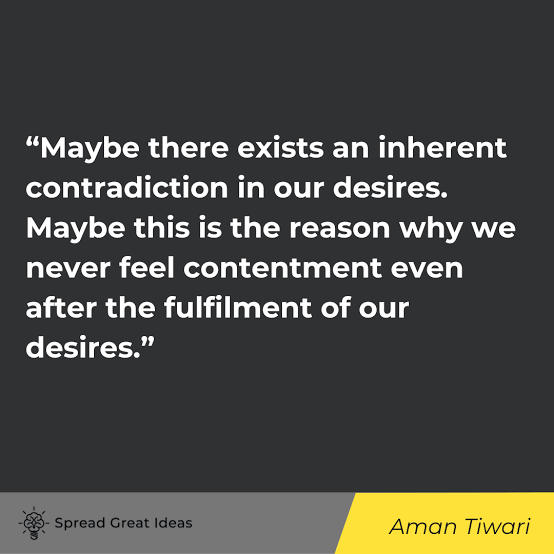
In our evolutionary journey, the human brain developed cognitive systems to categorize, discriminate, and simplify the complex stimuli of the external world, making it digestible and navigable. This cognitive system is a survival tool, enabling us to swiftly identify threats from non-threats, edible food from inedible, and so on. Over time, as societies became more sophisticated, these dualistic mental models began to govern not just our interactions with the environment but also our self-perception, aspirations, and relationships. This dualistic approach further feeds into the illusion of separateness — a feeling that we are distinct from the rest of the universe. Despite being made of stardust and sharing common atomic ancestors with everything around us, we often feel isolated or alienated. Such feelings intensify when we face adversities, leading many to question the harmony and purpose of existence.
Our understanding of freedom is entwined with our perception of duality. True freedom is not just liberation from external constraints but also from internal ones, like prejudices, fears, and limiting beliefs. To break free from the life’s cycle, one needs to reconcile with dualities, recognizing them as constructs rather than inherent truths. As we delve deeper into the framework of existence, we find that duality isn’t inherently detrimental. Instead, it provides contrast, lending depth and dimension to our experiences. Just as the contrasting strokes of a painting give it life and depth, the dualities of our lives add vibrancy and richness to our existence. Without dark, there would be no understanding of light; without sorrow, the true essence of joy would remain unknown.
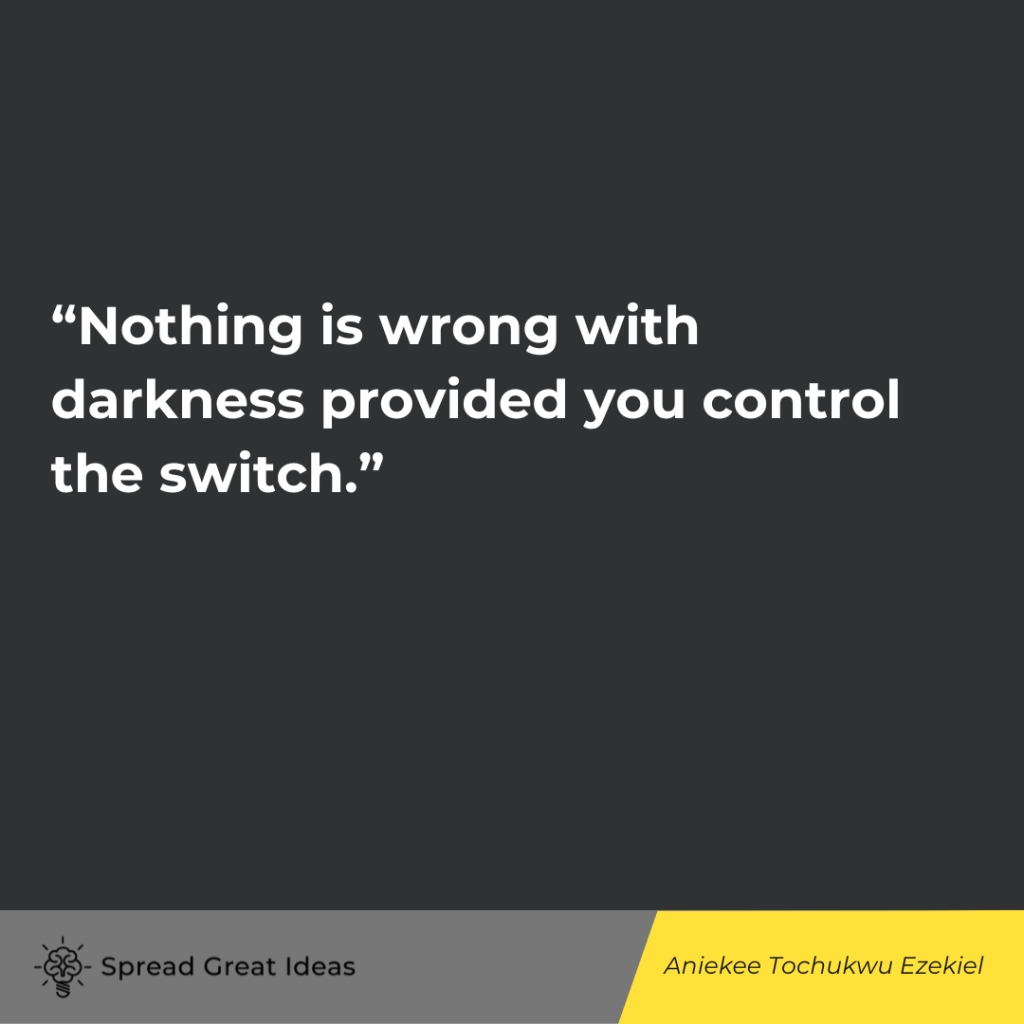
Much of our attachment to duality stems from societal and cultural conditioning. From childhood, we’re taught to label and categorize experiences: winning is good, losing is bad; happiness is desirable, sadness is not. Over time, these labels solidify into beliefs, shaping our perceptions and reactions. For instance, consider the universally accepted notion of success. Societal metrics of success often revolve around material wealth, social status, and professional achievements. However, if we were to strip away these conditioned beliefs and look at life through an unfiltered lens, we might find that true success lies in inner contentment, meaningful relationships, and personal growth.
Our fixation on the ephemeral aspects of life — fleeting emotions, transient experiences, and temporal possessions — further entrenches us in the duality trap. In the rush of life, we often overlook the eternal — the unchanging, omnipresent essence that underlies all existence. This essence, often referred to in spiritual contexts as the ‘Self’ or ‘Consciousness,’ remains unaffected by the dualities that play out on the surface.
By connecting with this eternal aspect of ourselves, we begin to view dualities with a sense of detachment. They appear as passing clouds against the vast sky of our existence, impactful in the moment but not defining our eternal essence. Aligning with the duality doesn’t mean becoming passive or indifferent. It means engaging with life wholeheartedly, experiencing every emotion, every high and low, but without letting them dictate our inner state. With heightened awareness, we can navigate the complexities of life with grace, recognizing the transient nature of our experiences.
This awareness doesn’t diminish our experiences but rather enriches them. When we embrace both the joys and sorrows of life with equanimity, we live more fully, more authentically. We begin to see challenges as opportunities for growth, failures as lessons, and successes as moments of gratitude.
Our perception of disharmony is influenced by our thoughts, emotions, and our attachments to outcomes. When we find ourselves in situations we didn’t desire or anticipate, our immediate response is resistance. This resistance, this non-acceptance, creates friction – a perceived disharmony.
The journey to non-duality is a continuous process of introspection, reflection, and growth. Various spiritual traditions offer paths to transcend duality: the Yogic tradition advocates for meditation and self-inquiry, Buddhism emphasizes mindfulness and compassion, while Taoism teaches the art of flowing with life, embracing both its yin and yang.
The common thread across these traditions is the idea of returning to one’s true nature — a state of pure consciousness, free from the constraints of duality.
Faith – reality in unseen ?
The concept of faith is one of the most profound yet elusive aspects of human life. Rooted in the intangible and often transcending the bounds of logical reasoning, faith is a powerful force that shapes our worldviews, influences our actions, and gives meaning to our existence. In its most fundamental form, faith is a complete trust or confidence in something or someone. However, the nature and implications of faith are much more nuanced and multifaceted.
Faith operates in various dimensions of our lives, not just in religious or spiritual contexts. We exhibit faith when we trust our loved ones, when we believe in the promise of a better future, when we have confidence in our abilities despite past failures, and even when we participate in social or economic systems. Faith, therefore, is deeply ingrained in our daily lives, influencing our decisions and perceptions, often without us consciously realizing it.
When it comes to faith in things unseen or events yet to happen, the dynamics become even more complex. This kind of faith typically involves a degree of uncertainty and mystery. It requires a leap beyond the confines of empirical evidence and tangible proof. But why do we, as rational beings, place faith in the unseen or the unknown?
Part of the answer lies in our inherent desire for meaning, purpose, and connection. As conscious beings, we yearn to understand the world around us, to make sense of our experiences, and to feel connected to something greater than ourselves. This quest for understanding and connection often leads us into the realm of the unseen, the unproven, the mysterious. It’s in this realm that faith becomes an essential tool.
Moreover, our experiences shape our faith. Experiences of love, compassion, resilience, and transformation can reinforce our faith in positive values, in humanity, or in a higher power. On the other hand, experiences of pain, loss, or injustice might challenge or even shatter our faith. Nevertheless, it’s often in the midst of adversity that faith evolves and deepens, as we grapple with questions of meaning, purpose, and hope.

The role of faith in our lives can be multifarious. For some, faith in a divine entity brings comfort and guidance. It instills hope during trials and tribulations, fosters a sense of community and belonging, and provides a moral framework for life. For others, faith in human potential and progress fuels the pursuit of knowledge, justice, and innovation.
Does faith have anything to do with what has happened and what’s going to happen? Indeed, faith is often interwoven with our perceptions of the past, present, and future. Past experiences can shape our faith, as we learn from our triumphs and failures, joys and sorrows. Our faith, in turn, influences how we navigate the present and envision the future. It can give us the courage to face challenges, the patience to endure hardships, and the inspiration to dream and create.
At the same time, faith is not about predicting the future with certainty. Rather, it’s about embracing uncertainty with hope and resilience. It’s about daring to dream, to strive, and to love, even when the outcomes are unknown. It’s about trusting in the potential for growth, transformation, and transcendence, regardless of our current circumstances or past experiences.
Is faith real? The reality of faith might not be tangible or measurable, but its impact on human life is undeniable. Across cultures and throughout history, faith has inspired art and literature, fueled social movements, shaped civilizations, and transformed individual lives. Its reality is manifested in the courage of those who dare to dream and create, in the resilience of those who endure suffering with hope, and in the love and compassion that transcend boundaries of race, religion, and ideology.
It’s worth noting, however, that faith is not about passive acceptance or blind allegiance. True faith involves questioning, seeking, and growing. It’s a dynamic, evolving journey rather than a fixed destination. It requires humility to acknowledge the unknown, courage to question and explore, and wisdom to discern truth from illusion. While the nature of faith is complex and elusive, its essence can be encapsulated in the timeless words of Martin Luther King Jr.: “Faith is taking the first step even when you don’t see the whole staircase.”

To deepen our exploration of faith, let’s consider it from various perspectives: philosophical, psychological, sociological, and spiritual.
From a philosophical perspective, faith brings up interesting questions about knowledge and belief. Philosophers have long pondered how we can justify our beliefs or knowledge claims, particularly when they concern the unseen or the unproven. Can faith be considered a form of knowledge? Does it require justification or evidence? Different philosophical traditions offer diverse answers. For instance, the school of pragmatism posits that beliefs (and by extension, faith) can be justified if they yield positive outcomes or experiences.
From a psychological perspective, faith can be viewed as a cognitive and emotional mechanism that helps us navigate uncertainty and complexity. For instance, when we face a difficult decision or an unpredictable situation, faith can provide a sense of direction and confidence. Psychological research has shown that faith (both religious and secular) can contribute to mental well-being, resilience, and prosocial behavior. For instance, faith in one’s abilities (also known as self-efficacy) is a key factor in motivation and achievement.
From a sociological perspective, faith plays a crucial role in social cohesion and collective action. Shared beliefs and values can foster a sense of community and cooperation, enabling societies to function and evolve. For example, faith in democratic values underpins democratic institutions and practices. Moreover, faith can inspire social change. The civil rights movement in the United States, led by figures like Martin Luther King Jr., is a powerful example of faith-driven social activism.
From a spiritual perspective, faith is often associated with the relationship between the human soul and the divine or the transcendent. Faith can manifest as trust in divine providence, commitment to spiritual practices, or aspiration for spiritual growth. For instance, in the Bhagavad Gita, a sacred text of Hinduism, Lord Krishna advises Arjuna to perform his duty with faith and without attachment to the results – a principle known as Karma Yoga.
Let’s consider a few examples that illuminate the multifaceted nature of faith. Imagine a student who is preparing for a challenging exam. Her faith in her abilities motivates her to study diligently. She also has faith in the fairness of the educational system and the value of her chosen field of study. This faith sustains her through the stress and uncertainty of the exam period.
Consider also the example of a social activist. He has faith in the possibility of a more just and sustainable world. This faith fuels his advocacy and activism, despite the challenges and setbacks he might face. He also has faith in the power of collective action and the potential for social change.
Finally, contemplate the faith of a spiritual seeker. She has faith in a higher power and a deeper reality beyond the material world. This faith guides her spiritual practices and informs her life choices. Even in the face of doubt or despair, her faith provides a source of strength and solace.
Let’s consider some more aspects of faith: faith as an act of surrender, faith and reason, faith and doubt, and faith as a dynamic process.
- Faith as an Act of Surrender: In many spiritual traditions, faith is often depicted as a surrender, a relinquishing of the illusion of control. When we face life’s uncertainties, we often try to manipulate outcomes according to our desires. However, faith involves trusting the flow of life, even when it does not conform to our expectations. It’s like floating on the surface of a vast ocean, trusting in its currents to guide us, rather than struggling against them. This concept of surrender is not about inaction or defeat, but about embracing life’s unpredictability and recognizing our limited perspective.
- Faith and Reason: Faith and reason are often viewed as conflicting forces, particularly in the discourse between science and religion. However, they can also be seen as complementary aspects of our human quest for understanding. Reason involves the critical examination of evidence and the logical analysis of ideas. It is indispensable in our pursuit of empirical knowledge and practical wisdom. Faith, on the other hand, steps in where reason reaches its limits. It enables us to navigate the mysteries of existence, to live with uncertainty, and to aspire for ideals that transcend empirical evidence.
- Faith and Doubt: Doubt is often seen as the antithesis of faith, but it can also be an integral part of the journey of faith. Doubt prompts us to question our beliefs, to seek deeper understanding, and to remain open to new insights. A faith that has never been challenged by doubt may be unexamined or dogmatic. As philosopher Paul Tillich put it, “Doubt is not the opposite of faith; it is one element of faith.”
- Faith as a Dynamic Process: Faith is not a static state but a dynamic process. It evolves as we encounter new experiences, insights, and challenges. Faith is not about clinging to fixed beliefs, but about cultivating a receptive and resilient spirit. It involves not only trusting in something beyond ourselves but also believing in our capacity to learn, grow, and adapt.
To illustrate these aspects, let’s revisit our previous examples. The student preparing for an exam may experience moments of self-doubt and anxiety. However, she can choose to see these challenges as opportunities for growth rather than threats to her faith in her abilities. By acknowledging her doubts, she can deepen her understanding of herself and her aspirations. By surrendering to the process, she can relieve her anxiety and focus on her effort rather than the outcome.
The social activist might face skepticism or opposition, testing his faith in his cause. But rather than deterring him, these challenges can strengthen his commitment and clarify his vision. His faith is not a blind belief but a conscious choice, informed by his understanding of social issues and his conviction in the power of change.
The spiritual seeker may grapple with profound questions about the divine and the nature of existence. Her faith does not prevent her from questioning or exploring different perspectives. Instead, it serves as a compass in her spiritual quest, guiding her through the vast and often confusing landscape of spiritual wisdom.
These examples underscore the richness and complexity of faith. Rather than a monolithic entity, faith is a kaleidoscope of perspectives, experiences, and choices. It is a multifaceted gem, whose beauty and depth are revealed in the light of our personal and collective journeys.
Divinity – an escape to fear ?
As we delve into the concept of divinity, we encounter a landscape of varying interpretations and perceptions, shaped by the human quest for understanding and meaning. Divinity refers to the state of things that are believed to come from a supernatural power or deity, such as a god, or spirit beings, and are therefore regarded as sacred and holy. Such things are regarded as divine due to their transcendental origins or because their attributes or qualities are superior or supreme relative to things of the earthly world.
But why, one might ask, is divinity interpreted differently by different individuals and cultures? And how can something considered divine and universal also be understood subjectively?
While it may seem paradoxical, the reason lies in the intersection of the human cognitive apparatus with the profound mystery that the concept of divinity embodies. Even though divinity may represent universal principles or realities, the ways in which we understand, relate to, and express these principles are inherently influenced by our cultural, psychological, and experiential contexts.
Cultural factors play a significant role in shaping our views of the divine. Different religions and spiritual traditions have unique ways of conceptualizing and relating to divinity, reflecting their historical, cultural, and philosophical contexts. For instance, monotheistic religions like Christianity, Islam, and Judaism conceive of divinity as a single, all-powerful God, while polytheistic traditions like Hinduism and ancient Greek religion portray divinity in the form of many gods and goddesses, each representing different aspects of reality.
Psychological factors also contribute to the subjective experience of divinity. Our personal beliefs, emotions, experiences, and cognitive processes shape our understanding and experience of the divine. Some people might experience divinity as a personal relationship with a divine being, while others might perceive it as a transcendent state of consciousness or a profound sense of connection with all of life.
As for why divinity appears to wear ‘multiple masks,’ this is again a reflection of the diversity and complexity of human understanding and experience. Just as a multifaceted diamond reflects light in various ways, the concept of divinity can manifest in countless forms, reflecting the myriad ways in which human beings perceive and relate to the mystery of existence.
One might wonder: if the laws of nature are universal, why is our understanding of divinity so diverse? This discrepancy can be understood by considering the difference between objective and subjective realms of knowledge.
The laws of nature belong to the realm of objective knowledge. They can be studied, tested, and validated using the scientific method, which is designed to minimize the influence of individual bias and subjective perception. This is why scientific knowledge, including our understanding of the laws of nature, is largely consistent across different cultures and societies.
On the other hand, our understanding of divinity belongs primarily to the realm of subjective knowledge. It’s rooted in personal experience, cultural context, and introspective understanding, all of which are inherently subjective. While subjective knowledge can be deeply meaningful and transformative, it is also diverse and multi-dimensional, reflecting the complexity of human perception and experience.
Despite this diversity, there may be universal principles or realities underlying our various perceptions of the divine. These might include principles like the interconnectedness of all life, the transformative power of love and compassion, or the existence of a reality that transcends our ordinary perception.
However, just as a map is not the territory it represents, our concepts and images of the divine are not the divine itself. They are human-made representations, shaped by our cognitive capacities and cultural contexts. The divine itself, whatever it may be, likely transcends our human capacities for understanding and conceptualization.
To further elaborate, let’s consider an analogy. Picture a group of people standing around a magnificent sculpture placed in the center of a room, each person looking at the sculpture from a different angle. While they’re all observing the same object, the perspective they have of the sculpture is unique to their standpoint. Some will notice features that are invisible to others, while some aspects remain hidden to everyone. In essence, they are all viewing the same objective reality, yet their individual subjective experiences differ.
This analogy provides some insight into how people perceive divinity. Even though there may exist an objective divine reality (the sculpture), the way people perceive and experience it (their view of the sculpture) is dependent on their individual perspectives. These perspectives are shaped by a variety of factors including personal experiences, cultural backgrounds, religious beliefs, and individual psychological make-up.
In other words, the “masks” of divinity that different cultures, religions, and individuals see are representations tailored to their unique viewpoints and contexts. This diversity in divine interpretation does not necessarily imply that divinity itself is subjective or inconsistent, but rather that our understanding and experiences of it are.
Moving forward, it’s important to differentiate between the objectivity of the laws of nature and the subjectivity of our experience and understanding of divinity. The laws of nature operate independently of human perception or consciousness; they govern the physical world whether or not anyone is aware of them. Scientists strive to discover and understand these laws through a methodical, systematic process that aims to be as objective and unbiased as possible.
In contrast, our relationship with divinity is deeply personal and subjective. It depends largely on individual consciousness, belief systems, and experiences. Unlike the laws of nature, our experiences of the divine cannot be measured or empirically verified. They lie beyond the domain of scientific investigation and are instead in the realm of personal and spiritual exploration.
This doesn’t mean that our experiences of the divine are less “real” or valuable than scientific knowledge, just that they operate within a different sphere of human experience and understanding. Both realms – the objective and the subjective, the scientific and the spiritual – are crucial aspects of our quest for knowledge and meaning.
Many of the world’s religious and spiritual traditions point towards the possibility of experiencing divinity directly, beyond conceptual understanding. This direct experience, sometimes described as “mystical” or “transcendent,” is often said to transcend ordinary categories of thought and perception, providing a profound sense of unity, sacredness, or ultimate reality.
However, the path to such experiences is highly individual and cannot be standardized or prescribed. It often involves practices like meditation, contemplation, devotion, ethical living, or service to others, aimed at cultivating qualities like mindfulness, compassion, humility, and openness to the divine.
Ultimately, our understanding and experience of divinity are part of the rich tapestry of human existence, reflecting our deepest yearnings, questions, and potentials. They invite us to explore the mysteries of life, to cultivate virtues and wisdom, and to connect with something greater than ourselves. Despite the diversity of divine interpretations, they all point towards a reality that transcends the limitations of our ordinary perception, inviting us on a journey of discovery, transformation, and awakening.
Prayer – is it measurable ?
Prayer is an age-old human practice that transcends the boundaries of culture, geography, and faith. As we explore whether there is a measure of prayer, be it qualitative or quantitative, we find ourselves diving into the intricate layers of human spirituality, psychology, and the subjective experiences that weave the tapestry of our existence. In this exploration, we consider the motivations behind prayer, the outcomes of this practice, and the existential questions that propel human beings towards the realm of the divine.
Prayer, at its core, is a form of communication with a higher power, deity, or the universe, depending on one’s faith or personal belief system. It’s a practice steeped in ritual and tradition, manifesting in different ways across the world’s religions. Prayers may be expressed in silence, in spoken or sung words, through physical prostrations, or even via dance, as seen in some indigenous spiritual traditions. Some pray using prescribed words and formulas, while others engage in spontaneous, personal dialogues with the divine.
While a quantitative measure of prayer might seem straightforward – one could, in theory, count the number of prayers, their frequency, or duration – this approach fails to grasp the true essence of prayer. Prayer is fundamentally a subjective experience that eludes objective measurement. The “effectiveness” of a prayer isn’t necessarily proportional to the number of times it’s uttered or its length. It’s an act that holds significance beyond numbers and metrics.
The qualitative measure of prayer, on the other hand, poses a challenge due to its highly personal and subjective nature. Every person experiences prayer differently, which can be influenced by their beliefs, emotional state, intentions, and many other factors. The impact of prayer on an individual’s life, their sense of peace, or their connection to their faith are deeply personal matters that resist standard measurement.
However, some elements are often considered in assessing the qualitative “effectiveness” of prayer. These include the sense of peace and comfort it provides, its impact on one’s behavior or attitudes, and its ability to cultivate qualities like gratitude, compassion, and humility. Some also speak of experiencing a deep sense of connection or communion with the divine, which, to them, signifies a “successful” prayer. Nevertheless, these remain personal and subjective aspects that may vary significantly from person to person.
The reasons why people pray are as diverse as humanity itself. Some people pray to seek comfort, to express gratitude, to seek guidance, or to find inner peace. Others pray to foster a connection with the divine, to seek intercession for themselves or others, or as an act of worship and devotion.

Many individuals find in prayer a source of solace and strength. It provides a space to voice their fears, hopes, regrets, and gratitude, often bringing a sense of peace and clarity. It can serve as a means to navigate life’s challenges and uncertainties, fostering resilience and hope.
Prayer can also be a powerful tool for personal growth and transformation. It invites introspection and self-reflection, helping individuals to align with their values, cultivate virtues, and transform negative emotions. It can lead to improved relationships, greater compassion, and a heightened sense of purpose and fulfillment.
Regarding the question of whether people pray out of fear or belief in the unknown, or if they have an experience of the unknown, the answer is likely all of the above. The unknown, with all its mystery and uncertainty, has always been a profound trigger for human contemplation and spiritual seeking.
Some may pray because they fear the unknown – death, illness, misfortune, the cosmic scale of existence – and seek protection or comfort. Others pray not out of fear, but out of awe and wonder, driven by a desire to connect with the grandeur of existence that extends beyond the limits of human understanding.
There are also individuals who, through their spiritual practices, claim to have experienced glimpses of the unknown, encounters with the divine, or states of consciousness that transcend the ordinary. These experiences, often described as mystical or transcendent, may inspire a deepening of their prayer practice.
It’s crucial to acknowledge that the motivations for prayer and the experiences associated with it are diverse and complex, reflecting the profound complexity of human existence.
 Abhishek Fanse