Understanding Dussehra: The morality spectrum
One of the most ancient concepts that explain duality is the Chinese philosophy of Yin and Yang. Everything has an opposite: where there’s light, there’s shadow; for life, there’s death. These dualities aren’t necessarily in opposition but rather in harmony, feeding into and defining each other.
Ravana’s Ten Heads: Ravana, the primary antagonist of the Ramayana whose defeat is celebrated on Dussehra, had ten heads. These are often seen as symbolic of ten human flaws. The act of Lord Rama killing Ravana isn’t about annihilating evil in its entirety but rather about overcoming these flaws.

The war in Ramayana, and by extension Dussehra, can be seen as an allegory for the inner battles we all face. It’s about making choices that align more with our higher self than our base instincts. Good and evil, in many ways, are relative. What’s “good” in one culture or time period might be seen as “evil” in another. They’re constructs that help humans navigate complex social and moral landscapes. What’s deemed good or evil can be relative, varying across cultures, religions, and individual beliefs. For example, a warrior killing an enemy might be considered heroic in one culture but a grave sin in another.
While Ravana is the antagonist in the Ramayana, he’s also a complex figure. A devout Shiva worshiper, an accomplished scholar, and a powerful king, his multifaceted personality blurs the lines between good and evil, suggesting that these concepts aren’t always black and white. After Ravana’s defeat, Sita undergoes a trial by fire to prove her purity. This episode raises questions about societal judgments, honor, and the complexities of righteousness.

Good Within Evil: Often, acts categorized as “evil” might have underlying “good” intentions or vice versa. A person may commit a crime to feed their starving family—how do we reconcile the act’s morality? The very existence of “good” necessitates “evil.” Without shadows, there’s no appreciation of light. This balance is essential for growth, evolution, and understanding. The cyclical celebration of Dussehra may symbolize the perpetual battle between our higher aspirations and our baser instincts, emphasizing the ongoing nature of personal evolution. By celebrating the triumph of good over evil, we’re also acknowledging the existence and importance of the dark side. It’s a recognition that the path to wisdom and righteousness involves confronting and understanding our own inner demons.
In today’s world, where moral lines often blur, the external representation of Dussehra’s battle might symbolize the internal conflicts we face in determining what’s right, navigating societal expectations, and personal desires. Ravana’s downfall began with his attachment and desire for Sita. This can serve as a reflection on how attachments can lead to one’s undoing, emphasizing the importance of detachment and self-awareness.
While the core message of Dussehra remains consistent, its interpretation and celebration can vary. In some parts, it’s about Rama’s victory over Ravana, while in others, it’s Goddess Durga’s triumph over the buffalo demon Mahishasura. This variance underlines how societies adapt stories to reflect their values and lessons they find most pertinent.
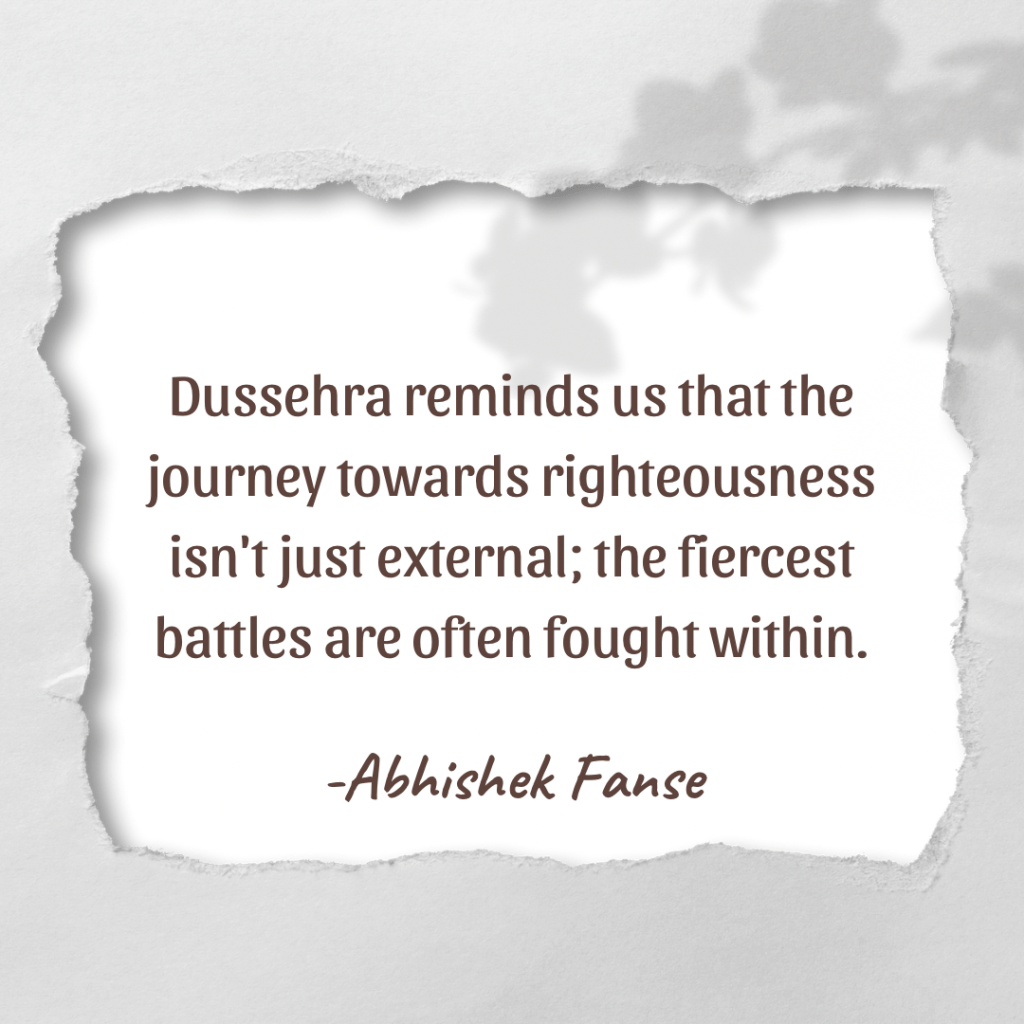
Annually commemorating the triumph of good over evil serves as a reminder for individuals to assess their moral compass, encouraging them to uphold righteousness in the face of wrongdoing. With changing times, the interpretations of ancient tales also evolve. For the newer generation, Ravana might not just symbolize a demonic force but could represent systemic societal issues like corruption, prejudice, or environmental neglect. The battle is then between collective societal good and these modern ‘evils’. In an era of individualism, many use Dussehra as a time of personal reflection, confronting their own Ravanas, be it anger, jealousy, greed, or other personal challenges.
Can a decision be good or bad?
The concept of decision making and the parameters that define its goodness or badness are both fascinating and complex. When we take a decision, we hope for a certain outcome, and the real-world result of our decision is judged in relation to this expectation. Decisions are inherently linked with the consequences they bring, and we often label them as ‘good’ or ‘bad’ based on whether the outcome was favorable or unfavorable. But should this be the only measure of a decision’s quality?
Every decision, regardless of its scale or impact, is taken within a context. Factors such as personal beliefs, values, emotions, knowledge, past experiences, as well as our estimation of future events, all feed into the decision-making process. This intricate mixture of elements makes decision-making a highly individualized and subjective process.
Given this complexity, is it then possible or even fair to categorize decisions as definitively good or bad? And what are the parameters we should use to judge them?
One viewpoint suggests that a good decision is one that is well-informed, well-considered, and aligned with one’s core values and goals. From this perspective, the goodness of a decision lies not in the outcome it produces, but rather in the process by which it was made. An individual may take a decision based on the best information available, taking into account all possible scenarios and aligning the decision with their values. If the outcome is unfavorable, does that make the decision bad? Arguably, no.
However, another viewpoint posits that decisions are inherently tied to their outcomes. If a decision leads to a positive outcome, it was a good decision. If the outcome is negative, the decision was bad. This perspective is very results-oriented, focusing on the end rather than the means. But it fails to consider that outcomes are often influenced by variables outside our control and cannot be predicted with certainty at the time of decision-making.
Considering both these viewpoints, it becomes clear that the notion of good and bad in decision-making is not absolute. It’s subjective and contextual, relying on both the decision-making process (the means) and the resulting outcome (the end).
Let’s consider an example to illustrate this: Imagine a person deciding to invest their savings in a seemingly promising startup. They do their due diligence, researching the market, the product, the team, and even consulting experts. They make a well-informed and well-considered decision to invest. But despite all their thoroughness, the startup fails after a few years, and they lose their investment. Was their decision bad?

If we judge solely based on the outcome, we might say yes. But if we look at the decision-making process, we could argue that they made a good decision given the information they had at the time. This example highlights the complexity and subjectivity involved in labeling decisions as good or bad.
The question of accountability further adds to this complexity. When we hold someone accountable for a decision, we are implying that they had control over the decision-making process and its outcome. This notion of control, however, is not always reflective of reality. As we’ve noted, decisions are influenced by numerous factors, many of which are beyond our control.
That being said, there is an aspect of decision-making where accountability does play a crucial role. When individuals make decisions, they should be held accountable for ensuring that the decision-making process is as thoughtful, ethical, and informed as possible. This means they should strive to gather all relevant information, consider all possible options, and align their decisions with their values and responsibilities.
While we cannot control all factors affecting the outcome of our decisions, we can strive to make informed, deliberate choices that reflect our values and understandings. And in the end, it’s through the experience of decision-making, both its successes and failures, that we learn and grow.
The notion of decision-making as it intersects with personal development and growth forms a vital part of this discussion. Each decision we make, whether deemed as good or bad, influences our lives, shaping us into who we become. It’s essential to understand that every decision, regardless of its outcome, provides us an opportunity for growth and learning.
Every decision, even the ones with unfavorable outcomes, provide lessons that can be harnessed to make better-informed decisions in the future. This idea ties into the concept of ‘failing forward,’ where we view failures not as dead-ends but as stepping stones to success. If we are open to learning from our missteps, we can transform even ‘bad’ decisions into useful experiences that make us wiser and more resilient.
Now, let’s explore the concept of regret, which often intertwines with our reflections on past decisions. Regret can stem from believing we made a ‘bad’ decision, which led to an unfavorable outcome. While it’s natural to experience regret, dwelling on past decisions can trap us in a cycle of guilt and self-blame. A healthier approach would be to acknowledge the decision and its consequences, extract lessons from the experience, and then use these insights to inform future decisions.
A further consideration in decision-making involves understanding the distinction between controllable and uncontrollable outcomes. This concept, often termed as ‘circle of influence’ and ‘circle of concern’ by management gurus like Stephen Covey, can be very helpful in reducing the stress around decision-making. We can focus our energies on the areas we can control or influence, rather than on areas beyond our reach. This shift in focus can help us make more empowered decisions and develop a more constructive perspective on the outcomes of those decisions.
Let’s expand this understanding with another example: A mountain climber prepares to scale a peak. She trains rigorously, equips herself with the right gear, studies weather patterns, and plans her route meticulously. Despite all these careful preparations, she could be forced to abandon her climb due to unexpected weather changes. Was her decision to climb wrong? By focusing on the process, we could argue that her decision was sound, based on her preparation and knowledge at the time.
We can also apply these principles in everyday decisions, such as choosing a career, deciding on a diet, or even selecting a movie to watch. By focusing on the decision-making process and by being open to learning from each decision’s outcomes, we enhance our ability to make better decisions in the future.
So, is there relevance to good and bad in decision-making? Yes, but it is a complex, multi-faceted relevance that cannot be boiled down to a simple binary. It includes considering our values, the information we have at hand, the potential consequences, and the context in which the decision is being made. It’s also about understanding that decision-making is a skill that can be honed over time, and every decision, whether it leads to success or failure, contributes to that learning and growth.
 Abhishek Fanse