Choice “Paralysis“
A choice implies that there is an alternative, and with every alternative comes the weight of consequences, perceived or real.
You speak of a ‘neutral’ stand, but let’s investigate what that really means. In reality, the idea of a neutral stance is a contradiction in terms. The very act of choosing neutrality is in itself a choice, made in opposition to other possible choices. So, the notion of being ‘neutral’ is inherently paradoxical because it cannot exist without the conditions that make it a choice to begin with.
For example, When you agree to a certain dosage of medication, you exercise control by making an informed decision. However, you also surrender control to the effects of that dosage, which may not be entirely predictable. This brings emotional complexity into play: the comfort of taking action (choosing the dosage) juxtaposed against the uncertainty of outcome. When we agree to disagree, we are on the contrary acknowledging that a middle ground is unreachable, yet we’re finding a sort of middle ground in that very acknowledgment. The challenge lies in our psychological need for validation and agreement, which often feels at odds with the more rational understanding that it’s perfectly okay for different viewpoints to coexist. We often fail to agree to disagree because our conditionings, our egos, don’t allow us to let go without a ‘win’ or a ‘loss.’
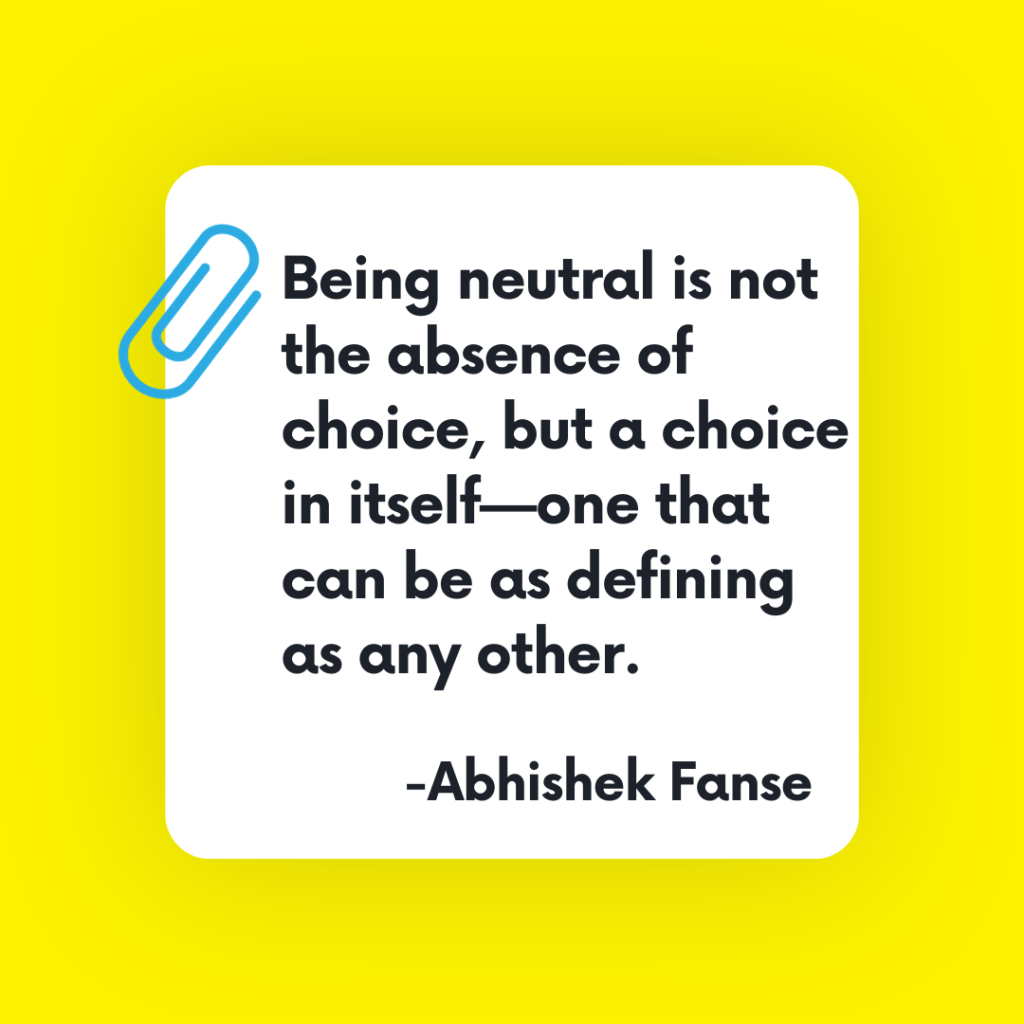
Every choice, by definition, is a rejection of its alternative. Therefore, choices are always relative, biased, and limited by the options that exist. In that sense, a choice cannot be independent because it is defined by the conditions that make it a choice. The idea of a ‘choice’ presupposes the existence of an alternative, of a comparison. In a context where there is only one thing that exists independently, the notion of ‘choice’ would be meaningless because there would be nothing to choose from. Therefore, it wouldn’t be a choice; it would simply be a state of being. The paradox exists because we try to define and understand choice within the limited framework of language and duality. However, once you recognize that the very nature of choice is paradoxical and conditional, and you embrace that paradox rather than trying to resolve it, you arrive at a sort of meta-clarity. This does not mean you’ve resolved the paradox; it simply means you’ve stepped outside of it. You’ve transcended the limitations that come with the dualistic thinking of ‘this or that,’ ‘yes or no,’ ‘neutral or biased.’
Choices are never made in emotional vacuums. They are laden with expectations, fears, and desires that stem from our past experiences, conditionings, and inherent personality traits. Even the seemingly most “logical” choice is often deeply influenced by emotions we may not even be fully aware of. The emotional charge of expectations is often the heaviest. When we make a choice, it is often governed by what we expect the outcome will bring us—pleasure, validation, success, or the avoidance of pain and conflict. The emotion here is one of anticipation, coupled with anxiety about whether our expectations will be met.
Then there’s desire, an emotion that often masquerades as need. The choices we make based on desire are emotionally charged with hopes for fulfillment, achievement, or recognition. But desire is a double-edged sword: while it motivates us, it also sets us up for disappointment if things don’t go as planned.
Even when we think we are making a “neutral” choice, what we are often trying to do is distance ourselves emotionally from the implications of the decision. We might say it’s “purely logical,” but the underlying emotion is often one of self-preservation—we wish to remain unscathed by the emotional weight that comes with making a more obviously partial choice.

One reason choices are emotionally charged is that they give us the illusion of control. Making a decision allows us to feel like we have some say over our fate. However, this control is always somewhat illusory. Life’s unpredictability ensures that our choices, no matter how well-considered, often have unexpected outcomes. The realization that our control is limited can bring up a host of emotions like helplessness or existential dread. Every choice we make, big or small, adds a brick to the edifice of our self-identity. We look for validation through our choices; when they lead to desired outcomes, it reinforces our sense of self-worth. When they don’t, it challenges our self-image and can lead to emotions like self-doubt, shame, or regret.
Our choices also affect how we are viewed by others, adding another layer of emotional complexity. Sometimes we make choices that conform to societal norms or expectations to avoid judgment or gain approval. The emotions at play here are often related to a fear of rejection or a need for social cohesion. At other times, we may make choices that go against the grain, driven by a desire for individuality or authenticity. This can lead to a complicated cocktail of pride, liberation, but also potential loneliness.
When it comes to seemingly paradoxical choices—like choosing wisdom over a loved one or maintaining a “neutral” stance—the emotional texture becomes even more intricate. For instance, choosing wisdom over a loved one might be a defense mechanism to protect oneself from future emotional pain, yet it can also lead to immediate emotional pain due to the distancing from the loved one. Here, both foresight and dread, love and rationality, are locked in an emotional tussle.
In cases where we choose to be “neutral,” what we are really doing is choosing not to engage emotionally in a way that makes us vulnerable. We might convince ourselves that we’re staying above the fray, but deep down, the need to protect ourselves emotionally is dictating that ‘neutral’ choice. The emotion behind neutrality is often a fear of emotional engagement, wrapped up in a protective layer of rationality. Ultimately, emotional maturity plays a large role in how we navigate the sea of choices and their associated feelings. Being aware of our emotional drivers allows us to make more ‘informed’ choices, even if that information is coming from within ourselves. This kind of self-awareness can temper the more reactive emotions like fear and desire and allow room for more nuanced feelings like contentment, acceptance, and genuine love to inform our decisions.
Choice is often seen as liberating, an act of free will that puts us in the driver’s seat of our destiny. However, with every choice we make, we also close off other possibilities, limiting ourselves in certain ways. The emotional paradox here is the simultaneous existence of freedom and constraint within the same action. We may feel exuberant for choosing a particular path, but there can be a latent sadness or anxiety about the paths left unexplored.
While choices often feel monumental in the moment, their impact can wane over time, sometimes even reversing in significance. What seemed like a terrible choice in the past may later appear wise, or vice versa. This fluidity can generate complex emotions, such as regret for past choices or anxiety about the unpredictability of future choices and their unforeseeable emotional implications.
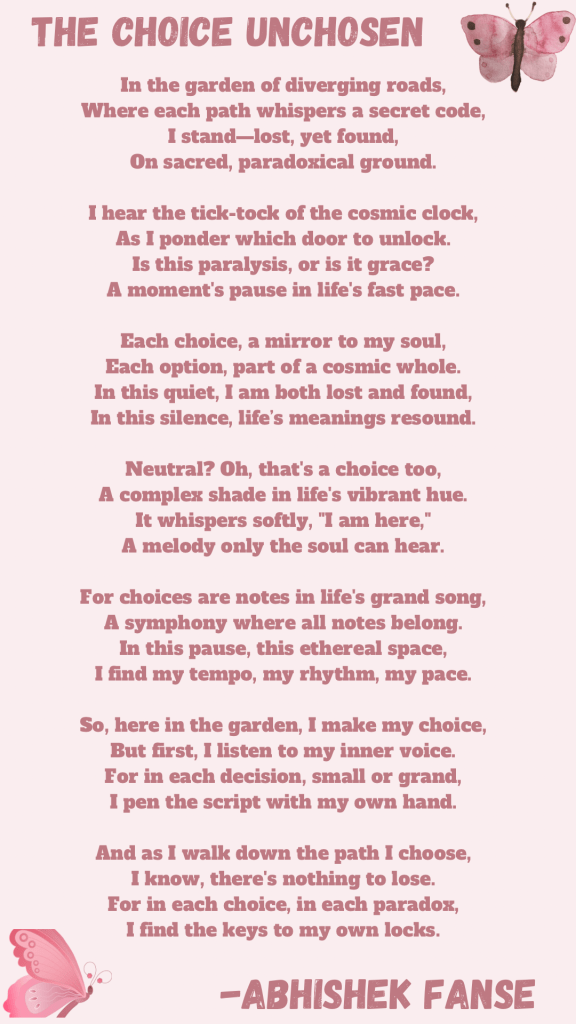
Ultimately, where every action presents us with a choice and counter choices, we sometimes find ourselves paralyzed, suspended in a moment of indecision. Yet, this paralysis isn’t a dead end; it’s a pause, a sacred space that invites us to reflect, to feel, and to become keenly aware of our humanity.
What if we reframe this so-called “choice paralysis” not as a dilemma but as a moment of pause in the great narrative of our lives? It becomes not a prison, but a platform; not a quagmire, but a quest. In this paused state, we are philosophers, artists, and explorers of the inner cosmos. We grapple not just with options but with identities, not merely with pros and cons but with hopes and fears, love and loss.
In this pause, we are not frozen; we are fervently alive. We are composing in our minds the symphony of our future, writing the next act of our life’s drama, sculpting the clay of our becoming.
And when the pause lifts—as it always does—we make a choice, yes, but we also do something more profound: we embrace our capacity to choose, even when the choices are hard, even when the path is foggy. For it’s in the wrestling with choices that we come to know who we truly are.
So, the next time you find yourself in the clutches of choice paralysis, remember: you are standing at the confluence of many rivers, each leading to a different ocean but all part of the same Earth. And it’s okay to stand there for a while, to feel the currents, to listen to their distinct murmurs, before stepping into the stream that will carry you to your next adventure.
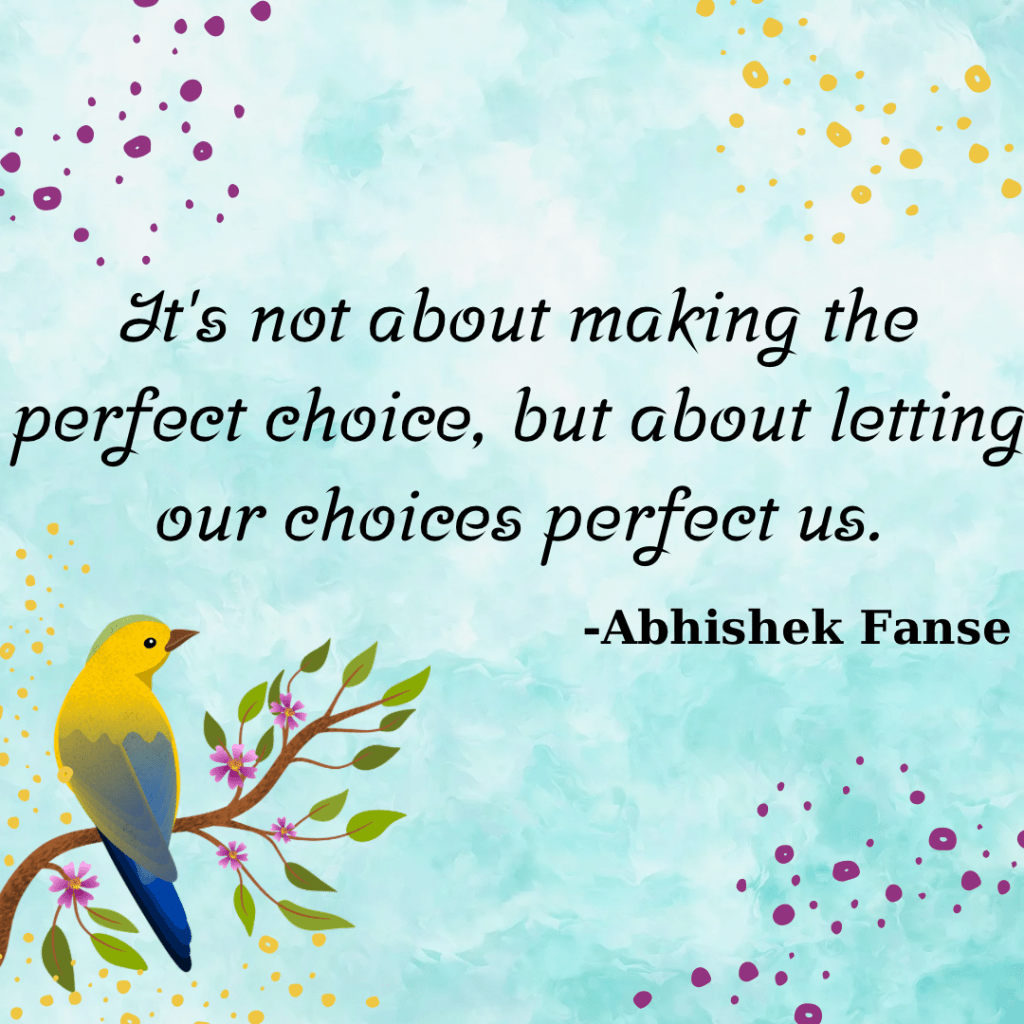
And so, we are forever navigating, forever choosing. Not in search of resolution, but in pursuit of growth. In the end, it’s not about making the perfect choice, but about making our choices perfect us.
Can a decision be good or bad?
The concept of decision making and the parameters that define its goodness or badness are both fascinating and complex. When we take a decision, we hope for a certain outcome, and the real-world result of our decision is judged in relation to this expectation. Decisions are inherently linked with the consequences they bring, and we often label them as ‘good’ or ‘bad’ based on whether the outcome was favorable or unfavorable. But should this be the only measure of a decision’s quality?
Every decision, regardless of its scale or impact, is taken within a context. Factors such as personal beliefs, values, emotions, knowledge, past experiences, as well as our estimation of future events, all feed into the decision-making process. This intricate mixture of elements makes decision-making a highly individualized and subjective process.
Given this complexity, is it then possible or even fair to categorize decisions as definitively good or bad? And what are the parameters we should use to judge them?
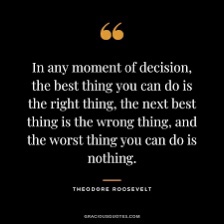
One viewpoint suggests that a good decision is one that is well-informed, well-considered, and aligned with one’s core values and goals. From this perspective, the goodness of a decision lies not in the outcome it produces, but rather in the process by which it was made. An individual may take a decision based on the best information available, taking into account all possible scenarios and aligning the decision with their values. If the outcome is unfavorable, does that make the decision bad? Arguably, no.
However, another viewpoint posits that decisions are inherently tied to their outcomes. If a decision leads to a positive outcome, it was a good decision. If the outcome is negative, the decision was bad. This perspective is very results-oriented, focusing on the end rather than the means. But it fails to consider that outcomes are often influenced by variables outside our control and cannot be predicted with certainty at the time of decision-making.
Considering both these viewpoints, it becomes clear that the notion of good and bad in decision-making is not absolute. It’s subjective and contextual, relying on both the decision-making process (the means) and the resulting outcome (the end).
Let’s consider an example to illustrate this: Imagine a person deciding to invest their savings in a seemingly promising startup. They do their due diligence, researching the market, the product, the team, and even consulting experts. They make a well-informed and well-considered decision to invest. But despite all their thoroughness, the startup fails after a few years, and they lose their investment. Was their decision bad?

If we judge solely based on the outcome, we might say yes. But if we look at the decision-making process, we could argue that they made a good decision given the information they had at the time. This example highlights the complexity and subjectivity involved in labeling decisions as good or bad.
The question of accountability further adds to this complexity. When we hold someone accountable for a decision, we are implying that they had control over the decision-making process and its outcome. This notion of control, however, is not always reflective of reality. As we’ve noted, decisions are influenced by numerous factors, many of which are beyond our control.
That being said, there is an aspect of decision-making where accountability does play a crucial role. When individuals make decisions, they should be held accountable for ensuring that the decision-making process is as thoughtful, ethical, and informed as possible. This means they should strive to gather all relevant information, consider all possible options, and align their decisions with their values and responsibilities.
While we cannot control all factors affecting the outcome of our decisions, we can strive to make informed, deliberate choices that reflect our values and understandings. And in the end, it’s through the experience of decision-making, both its successes and failures, that we learn and grow.
The notion of decision-making as it intersects with personal development and growth forms a vital part of this discussion. Each decision we make, whether deemed as good or bad, influences our lives, shaping us into who we become. It’s essential to understand that every decision, regardless of its outcome, provides us an opportunity for growth and learning.
Every decision, even the ones with unfavorable outcomes, provide lessons that can be harnessed to make better-informed decisions in the future. This idea ties into the concept of ‘failing forward,’ where we view failures not as dead-ends but as stepping stones to success. If we are open to learning from our missteps, we can transform even ‘bad’ decisions into useful experiences that make us wiser and more resilient.
Now, let’s explore the concept of regret, which often intertwines with our reflections on past decisions. Regret can stem from believing we made a ‘bad’ decision, which led to an unfavorable outcome. While it’s natural to experience regret, dwelling on past decisions can trap us in a cycle of guilt and self-blame. A healthier approach would be to acknowledge the decision and its consequences, extract lessons from the experience, and then use these insights to inform future decisions.
A further consideration in decision-making involves understanding the distinction between controllable and uncontrollable outcomes. This concept, often termed as ‘circle of influence’ and ‘circle of concern’ by management gurus like Stephen Covey, can be very helpful in reducing the stress around decision-making. We can focus our energies on the areas we can control or influence, rather than on areas beyond our reach. This shift in focus can help us make more empowered decisions and develop a more constructive perspective on the outcomes of those decisions.
Let’s expand this understanding with another example: A mountain climber prepares to scale a peak. She trains rigorously, equips herself with the right gear, studies weather patterns, and plans her route meticulously. Despite all these careful preparations, she could be forced to abandon her climb due to unexpected weather changes. Was her decision to climb wrong? By focusing on the process, we could argue that her decision was sound, based on her preparation and knowledge at the time.
We can also apply these principles in everyday decisions, such as choosing a career, deciding on a diet, or even selecting a movie to watch. By focusing on the decision-making process and by being open to learning from each decision’s outcomes, we enhance our ability to make better decisions in the future.
So, is there relevance to good and bad in decision-making? Yes, but it is a complex, multi-faceted relevance that cannot be boiled down to a simple binary. It includes considering our values, the information we have at hand, the potential consequences, and the context in which the decision is being made. It’s also about understanding that decision-making is a skill that can be honed over time, and every decision, whether it leads to success or failure, contributes to that learning and growth.
Guilt Trap of duality from Zen Perspective
In our everyday lives, we are constantly faced with dualistic concepts. Society, culture, and personal beliefs often categorize experiences, actions, and people into binaries of right and wrong, good and bad. These divisions can create a sense of judgment and guilt when we perceive ourselves or others as falling short of the ideals and standards set by these dualistic frameworks.
However, from a Zen perspective, these dualities are ultimately illusory. They are constructs of the mind, products of our conditioning and cultural influences. The truth of existence is not confined to these polarities, but rather transcends them. In Zen, we aim to penetrate the illusion of duality and recognize the interconnectedness and interdependence of all phenomena.

Guilt arises when we judge ourselves or others based on these dualistic constructs. We feel remorse or regret for actions or thoughts that are deemed morally or ethically wrong. This guilt traps us in a cycle of self-judgment and self-condemnation, creating inner turmoil and preventing us from experiencing true freedom and liberation.
In Zen practice, we are encouraged to investigate the root of guilt and the underlying assumptions and beliefs that give rise to it. We inquire into the nature of the self, asking: Who is the one feeling guilty? What is the source of this guilt? By bringing awareness to these questions, we can begin to unravel the layers of conditioning and delusion that perpetuate the guilt trap.
One of the key teachings in Zen is the concept of non-duality, or the realization that there is no inherent separation between self and other, good and bad, right and wrong. This understanding allows us to transcend the dualistic framework and embrace the inherent wholeness and interconnectedness of existence.
To transcend the guilt trap, we must cultivate self-compassion and self-acceptance. Rather than clinging to rigid notions of right and wrong, we develop an attitude of non-judgmental awareness towards our thoughts, emotions, and actions. We recognize that we are imperfect beings on a path of growth and learning, and that mistakes are inevitable in the process.
In Zen, we also emphasize the importance of mindfulness and present-moment awareness. By anchoring ourselves in the present, we can let go of regrets about the past or worries about the future. We realize that guilt arises when we dwell in the realm of memory or anticipation, rather than fully experiencing the richness of the present moment.
Another essential aspect of overcoming the guilt trap is cultivating insight and wisdom. Through meditation, introspection, and contemplative practices, we develop a deeper understanding of the nature of our thoughts, emotions, and experiences. We begin to see the impermanence and emptiness of all phenomena, including our judgments and guilt. This insight liberates us from the grip of duality and opens the door to genuine self-transformation and freedom.
It is important to recognize that the path to transcending the guilt trap is not linear or instantaneous. It requires patience, perseverance, and a commitment to self-inquiry and inner exploration. We may encounter moments of resistance, fear, or discomfort as we challenge deeply ingrained beliefs and conditioning. However, with time and dedicated practice, we can gradually loosen the grip of guilt and open ourselves to a more expansive and compassionate way of being.
In Zen, we often use the metaphor of the empty cup. When our cup is full of preconceived ideas, judgments, and guilt, there is no space for new insights and understanding to arise. By emptying our cup, we create the opportunity to see things as they truly are, beyond the limitations of dualistic thinking.
The key to transcending the guilt trap lies in cultivating awareness, acceptance, and compassion. Through mindfulness and meditation practices, we can develop the ability to observe our thoughts and emotions without attachment or judgment. We can witness the arising of guilt and gently let it go, recognizing it as a conditioned response rather than a fixed truth.
It is also important to cultivate self-compassion and self-forgiveness. Acknowledge that you are a human being with strengths and weaknesses, and that making mistakes is part of the learning process.
It is worth noting that transcending the guilt trap does not mean disregarding ethical considerations or condoning harmful actions. Rather, it is about moving beyond the narrow confines of guilt and expanding our perspective to include compassion, forgiveness, and the recognition of our shared humanity.
In the Zen tradition, we often engage in practices that cultivate mindfulness and present-moment awareness, such as seated meditation, walking meditation, or mindful eating. These practices can help bring us into direct contact with the present moment and allow us to experience the richness of life beyond the filters of guilt and judgment.
Ultimately, the journey to transcend the guilt trap is a deeply personal one. It requires self-reflection, self-inquiry, and a willingness to let go of deeply ingrained patterns of thinking and behaving. Remember that this journey is not about achieving a fixed state of perfection or enlightenment. It is about embracing the ever-unfolding nature of life, and the continuous process of self-discovery and growth. Approach it with patience, compassion, and a sense of adventure, and you will gradually find yourself experiencing greater freedom, clarity, and authenticity in your life.
 Abhishek Fanse