
Understanding the fleeting nature of “Happiness”
Realising you’re happy and consequently puncturing that happiness—is a manifestation of the self-reflexive quality of human consciousness. It reflects our ability not only to experience emotions but also to have thoughts about those experiences, including the experience of happiness. At the most immediate level, we have sensory experiences and emotional reactions. These are our raw, unfiltered engagements with the world around us. But atop this immediate experience, we have a secondary layer of experience: our thoughts about our experiences. This secondary layer is where we interpret, judge, anticipate, and reflect.
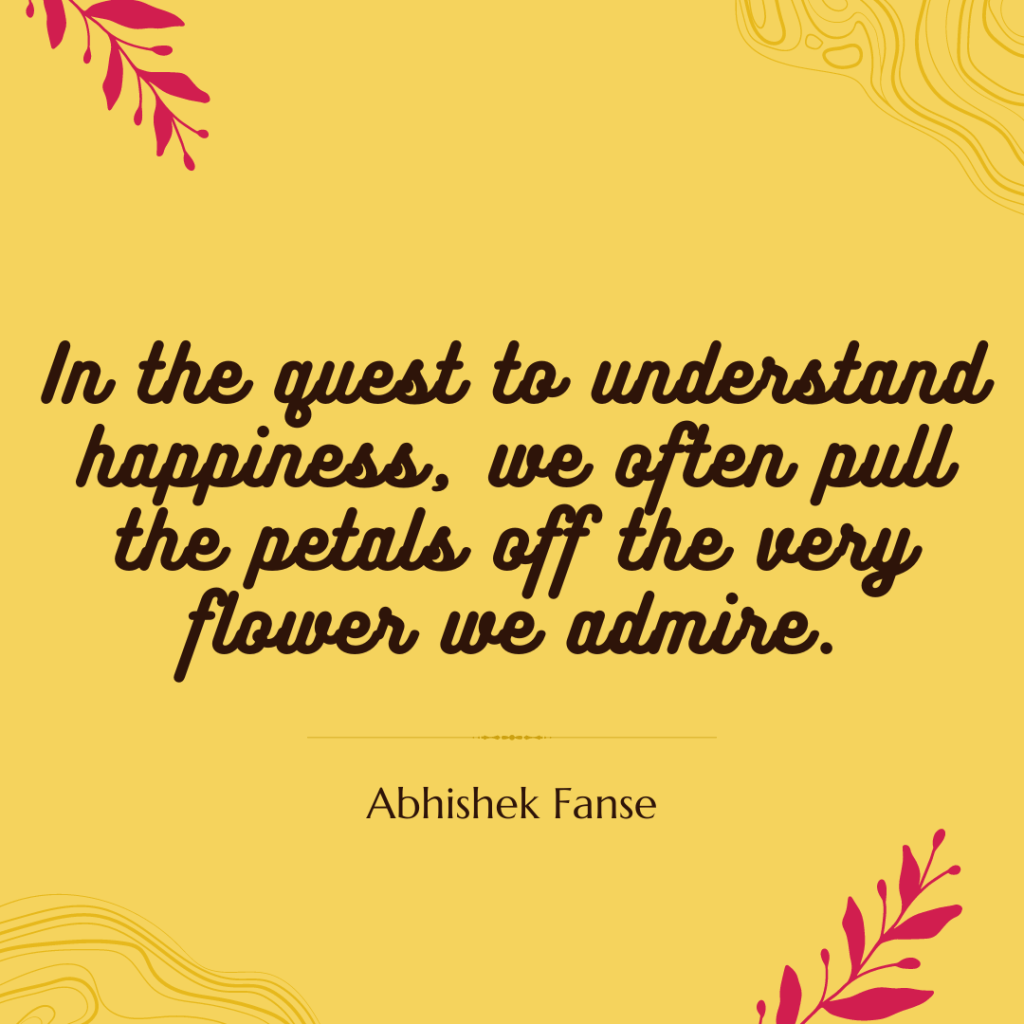
The paradox here is that this second layer of experience can intrude upon and alter the first. By realizing we’re happy, we move the experience of happiness from the immediate realm into the realm of reflection and analysis. This can have a distancing effect, making the happiness less vivid and more abstract. The “self” that is experiencing happiness is no longer fully integrated with the experience; part of it has stepped aside to observe.
The awareness of happiness can also bring about a sense of sadness or melancholy. This is because our reflective consciousness is not only evaluative but also temporal; it exists in time. When we realize we’re happy, we also realize that the moment is fleeting, that it will pass. This injects a sense of loss or nostalgia into the current experience, dampening the happiness with a layer of sadness. There’s also the pressure that once identified, the feeling of happiness must be maintained, which turns it into an object of concern.
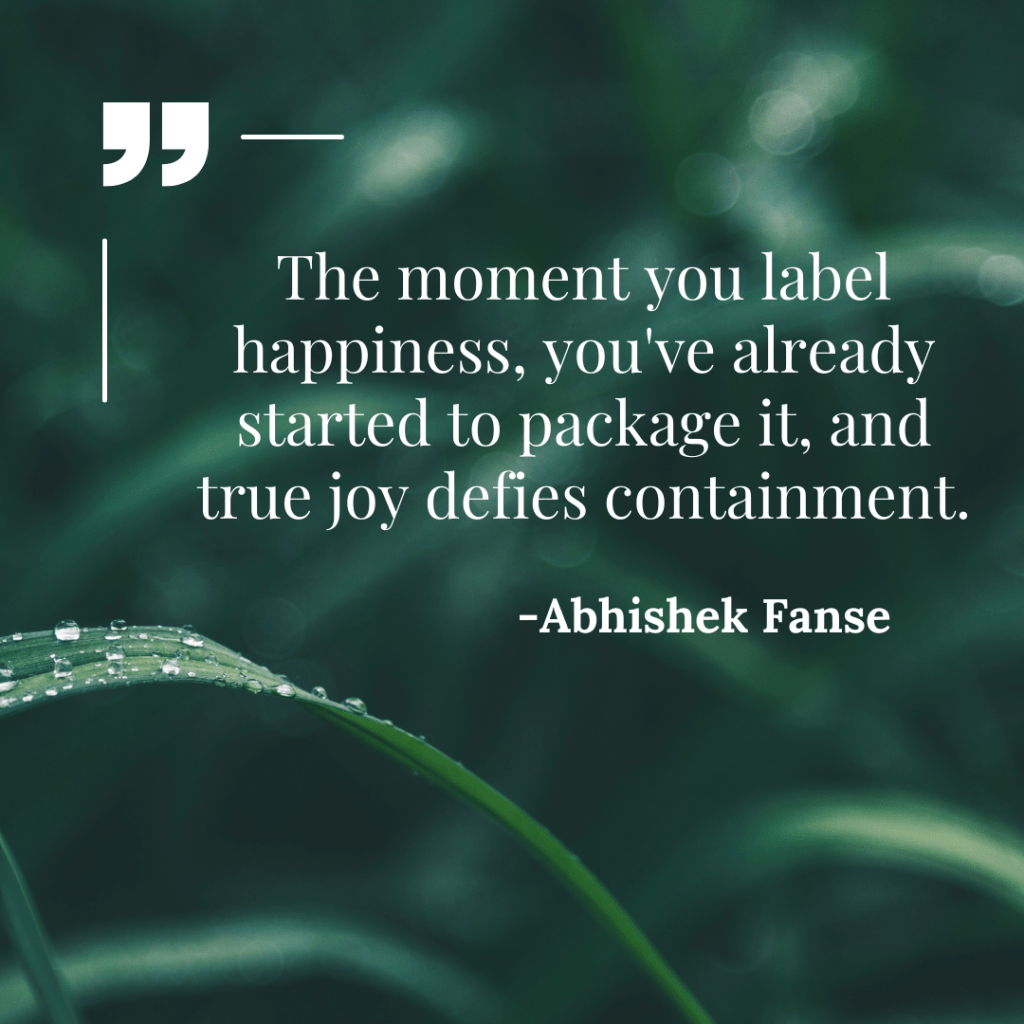
In some Eastern philosophies, for example, the ultimate state of happiness or enlightenment is one that transcends both happiness and sadness, existing in a state of pure “beingness” that is beyond dualities. Western philosophies often engage deeply with the notion of existential angst, the idea that human freedom and awareness are both a gift and a curse, capable of both elevating and diminishing our experiences. Humans are narrative creatures. We don’t just experience things; we also construct stories around our experiences, which become a part of the experience itself. Realizing you’re happy can sometimes feel like a narrative high point, a climax. But climaxes are, by their nature, transitional; they mark the point where a story begins to move toward its conclusion. This can create a sense of impending descent, which can tinge even the most joyous moments with a shade of melancholy. There’s a compelling argument to be made for the richness added to our lives by our ability to reflect on our experiences. This meta-experience, the experience of experiencing, adds depth and texture to our lives. It’s the thing that allows us to appreciate art, to fall in love, to engage in complex moral reasoning. But it comes at a cost: the cost of immediacy. The more we reflect on our experiences, the less we’re able to engage with them directly. It’s like being the actor and the audience at the same time. This dual nature of consciousness is both a blessing and a curse. While it allows us the richness of introspection and self-awareness, it also sets up a scenario where the observer can interfere with the experience.
When you realize you’re happy, you’re essentially stepping out of the experience to label it. The moment you do that, you bring in the concept of time. Emotions, when lived, are timeless. They’re states of being. But when you observe them, you also acknowledge their temporality—they become moments that have started and will eventually end. This implicit understanding of the fleeting nature of happiness casts a shadow on the experience, thereby altering its composition and introducing elements of sadness or anxiety.
The awareness of happiness can trigger broader questions about the nature of existence, purpose, and meaning. Happiness is often viewed as an ‘end,’ a goal in life. Once achieved, its realization can create a form of existential vacuum, a questioning of ‘what next?’ This moves you out of the emotional experience and into a cognitive one, involving existential questions that can often be more unsettling than comforting.
Your realization also exemplifies the duality inherent in life experiences. There’s a push and pull between opposing forces: happiness and sadness, awareness and ignorance, temporality and timelessness. Some philosophical traditions, particularly those from Eastern philosophies like Buddhism, suggest that the ultimate state of enlightenment is one that transcends this duality to experience a state of ‘oneness.’ In that state, the act of observing happiness and the experience of happiness itself become one unified experience, without a division that could puncture the emotion. When we experience happiness, it often fits into a story we have about what makes us happy and why. This narrative self can be in constant tension with the experiencing self. The act of realizing you’re happy is a narrative act—it fits this moment of joy into your broader life story. But life stories are complex and filled with ups and downs. Fitting a moment into a narrative can mean subjecting it to all the complexities and contradictions of that narrative, which can dilute the purity of the experience.
On the one hand, mindfulness and self-awareness teach us to observe our feelings, thoughts, and experiences. On the other hand, the very act of observing can sometimes alter or even negate the experience, particularly with transient states like happiness. In quantum physics, the observer effect refers to changes that the act of observation makes on the phenomenon being observed. In psychology, too, observing one’s thoughts and feelings can change them. This is the basis of therapies like Cognitive Behavioral Therapy (CBT), where the act of observing and questioning one’s thoughts can lead to emotional regulation.
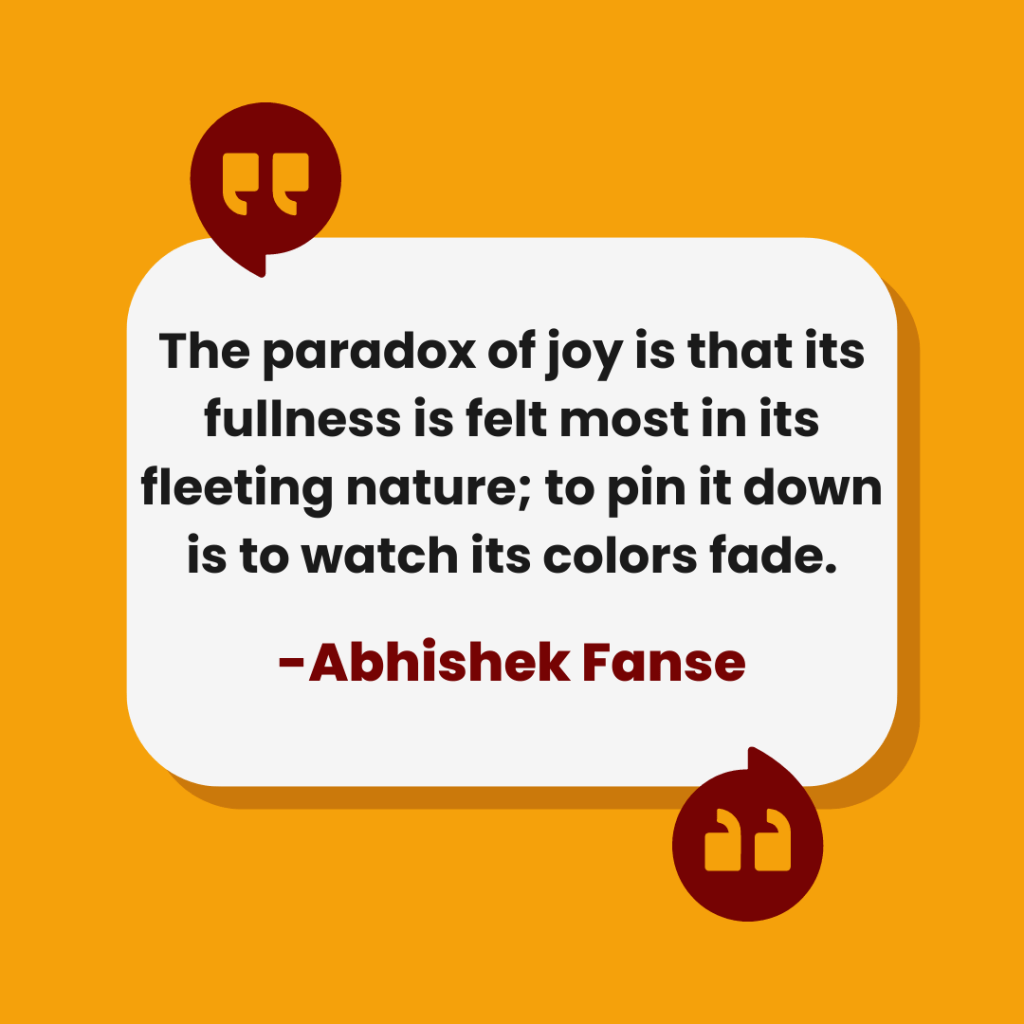
When you realize you’re happy and become acutely aware of that happiness, you might also become aware of the fleeting nature of emotions. This could potentially lead to a decrease in the intensity of your happiness, making it a self-limiting state. The joy is punctured by the awareness of its temporary nature or by the anxiety of losing it. It’s crucial to distinguish between mindfulness and hyper-awareness. Mindfulness means accepting each moment as it is, including your happiness, without clinging to it or fearing its loss. Hyper-awareness, on the other hand, involves scrutinizing the experience so closely that you can’t simply be in it. You’re essentially stepping out of the experience to examine it.
Some of the ways to deal with it:
1. The first step in navigating this paradox is to accept the transient nature of all emotional states. Once we make peace with the ebb and flow of life, the realization that our happiness is temporary becomes less threatening.
2. Aim for a detached form of observation. Observe your happiness without clinging to it, just as you would observe your breath during meditation.
3. Shifting the focus from “Being Happy” to “Being”. When your focus is simply on ‘being,’ without labeling the state you are in, you eliminate the self-imposed pressure to sustain any emotional state, be it happiness or otherwise.
4. Often the anxiety of losing happiness arises from either past experiences or future uncertainties. Dwelling in the present can alleviate that concern.
Love and Longing – A paradox ??
The experience of longing for love is universal and deeply rooted in our humanity. This longing, often described as an unquenchable thirst, is both a blessing and a burden, driving us to form connections, seek fulfillment, and explore the depths of our own emotions.
Delving into the realm of quantum physics, there’s an intriguing principle known as quantum entanglement. It suggests that two particles, once entwined, will remain connected irrespective of distance. A change in the state of one will instantly affect the state of the other, no matter how far apart they are.

Drawing a parallel to human emotions, particularly longing, one could argue that individuals form ’emotional entanglements.’ The sense of connection might not be physical but is as intense, enduring, and mystifying as quantum entanglements. This could be the reason why, even in separation, our emotions remain tethered to another person, place, or memory. Longing is a complex emotion that can arise from various sources. At its core, it’s a yearning for something that seems to be just out of reach. We might long for a loved one, for a sense of belonging, for an idealized version of the world, or for a deeper connection with ourselves.
Our longing for love can be seen as a biological imperative. Our ancestors who formed strong social bonds and felt a deep connection to their kin were more likely to survive and reproduce. As a result, the longing for love and connection is deeply ingrained in our genetic makeup. Our experiences shape our emotional responses. For instance, early attachment experiences with caregivers can influence our future relationships and how we perceive love. Similarly, our psychological makeup, shaped by both nature and nurture, affects how we experience longing.

The relationship between love and longing is paradoxical. On the one hand, love can make us feel whole, bringing joy and fulfillment. On the other hand, it can also create a sense of longing, especially when faced with separation or unfulfilled desires. This tension is often evident in poetry and art, where love and longing are intertwined in complex ways. When we are in love, we often feel a sense of completeness. The world seems brighter, and we may experience a deep sense of contentment. This feeling arises from the connection and emotional intimacy that love brings. In these moments, longing may fade into the background. Despite the fulfillment that love offers, it can also create a sense of longing. When separated from a loved one, the intensity of our love can manifest as a deep yearning for their presence. This longing can also arise from unmet emotional needs, unfulfilled desires, or the idealization of love.
Love and longing are not mutually exclusive; they often coexist. The very act of loving someone can make us more aware of their absence when they are not around. Similarly, longing can intensify our love, making us cherish our moments of connection even more. This dynamic interplay adds depth to our emotional experiences.
Longing is not a singular emotion; it encompasses a range of feelings, including hope, desire, melancholy, and even pain. Longing often involves a strong desire for something or someone. This desire can create a sense of anticipation, making us look forward to future possibilities. The act of longing can be both exciting and agonizing, as we await the fulfillment of our desires. Longing can also be rooted in the past. We may long for a time when we felt loved, accepted, or understood. This sense of nostalgia can be accompanied by melancholy, as we realize that the past cannot be recaptured. Sometimes, longing arises from idealization. We may create a mental image of the perfect partner, the ideal life, or a utopian world. These idealized visions can make us feel discontented with our current reality, fueling a sense of longing. Longing can be painful, especially when it feels unending or unrequited. The intensity of our yearning can create a sense of suffering, as we grapple with the gap between our desires and reality.
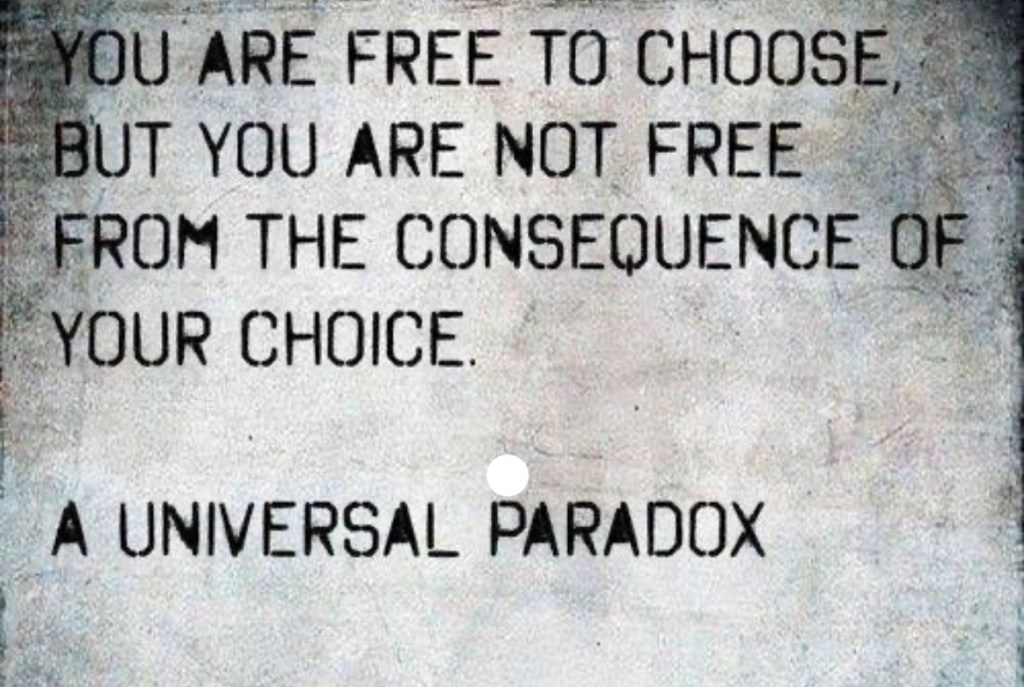
Wrestling with the feelings associated with longing can lead to deeper emotional intelligence. Through introspection, we can learn more about ourselves, our needs, and our desires. Understanding the root of our longing can help us address underlying issues or unmet needs in our lives. everyone has felt it at some point. Recognizing this shared experience can foster empathy towards others and deepen our human connections. By understanding our own feelings of longing, we become better equipped to empathize with others.
Life is characterized by dualities: happiness and sorrow, presence and absence, fulfillment and yearning. While these might seem contradictory, they often exist side by side and give depth to our experiences.
Presence in Absence: Even in the absence of what we long for, there’s a certain presence of that object or person in our thoughts and emotions. This phenomenon speaks to the power of our minds and hearts to transcend physical limitations.
Completeness in Incompleteness: The very feeling of longing suggests that there’s something we deem essential for our completeness. However, the journey of life is about realizing that, in many ways, we are already complete in our incompleteness. The gaps and spaces create room for growth, evolution, and understanding.
Stability in Flux: Our feelings, including longing, are in constant flux. They come and go, intensify and wane. But beneath these changing emotions, there’s a stable core of self, a foundational aspect of our being that remains unswayed.
 Abhishek Fanse