Depths of Hurt: An Intriguing Emotion
At its core, hurt is an emotional response to a perceived loss or violation. This loss can be tangible, such as the loss of a loved one, or intangible, like the loss of respect or love. The perception of this loss is crucial; it’s not the objective situation that determines hurt, but how one interprets and internalizes it. The origins of hurt can be traced back to our earliest human experiences. As infants, we are utterly dependent on others for our survival, leading to a deep-rooted need for attachment and acceptance. This need, while essential for survival, also becomes the breeding ground for hurt. When our expectations of support, love, or acknowledgment are unmet, we experience hurt.
Hurt often manifests differently in personal and professional contexts, yet the underlying mechanics are surprisingly similar. In personal relationships, hurt is often more directly linked to emotional bonds and expectations of love, loyalty, and understanding. In professional settings, while the emotional stakes may seem lower, the hurt can still be profound. It often stems from unmet expectations regarding respect, recognition, or the outcome of our efforts. The statement “don’t take it personally” in professional environments is an acknowledgment of this complexity. It attempts to draw a boundary between the personal self and the professional role. Yet, this separation is often not as clear-cut as it seems. Our professional lives are an extension of our personal selves; the values, aspirations, and efforts we put into our work are deeply personal. Thus, when we face criticism, rejection, or failure at work, it can still impact our personal self-esteem and sense of worth.

The hurt one experiences is often a reflection of internal expectations and self-perception. When others do not meet our expectations, or when we fail to meet our own, we experience a sense of loss. This loss is not just about the external situation but also about our internal narrative. We construct stories about who we are and how the world should respond to us. When reality diverges from these stories, we feel hurt. Understanding hurt requires dissecting the dichotomy between external causes and internal reactions. Is hurt caused by others, or is it self-inflicted? The answer is nuanced. Others can act as triggers, but the actual experience of hurt is an internal process. It is our interpretation of events, filtered through our personal beliefs and past experiences, that generates hurt. human experience. We are beings of desire and expectation, living in a world that is constantly changing and often unpredictable. This disconnect between our desires and reality is a fertile ground for hurt. However, this inevitability doesn’t imply helplessness. It requires a shift from external validation to internal self-acceptance, and from rigid expectations to flexible aspirations. This journey towards resilience is not about becoming indifferent or uncaring, but about cultivating a grounded sense of self that can navigate the ups and downs of life with equanimity.
Developmental psychology, for instance, sheds light on how early experiences shape our vulnerability to hurt. Childhood, where the foundation of our self-esteem and worldviews are formed, significantly influences how we perceive and react to potential hurts in later life. Attachment suggests that our early bonding experiences with caregivers form templates for future relationships. Secure attachments lead to resilience, while insecure attachments can heighten our sensitivity to rejection and loss, predisposing us to deeper hurt.
Hurt also stems from conflicts of human existence – our search for meaning in an indifferent universe, the realization of our freedoms and limitations, and the ultimate confrontation with our mortality. Our self-perception plays a critical role in this process. If we perceive ourselves as capable and deserving, failing to meet expectations can lead to self-criticism and hurt. Conversely, if we see ourselves as unworthy, we may internalize external negative outcomes as confirmations of this belief, perpetuating cycles of hurt and low self-esteem.
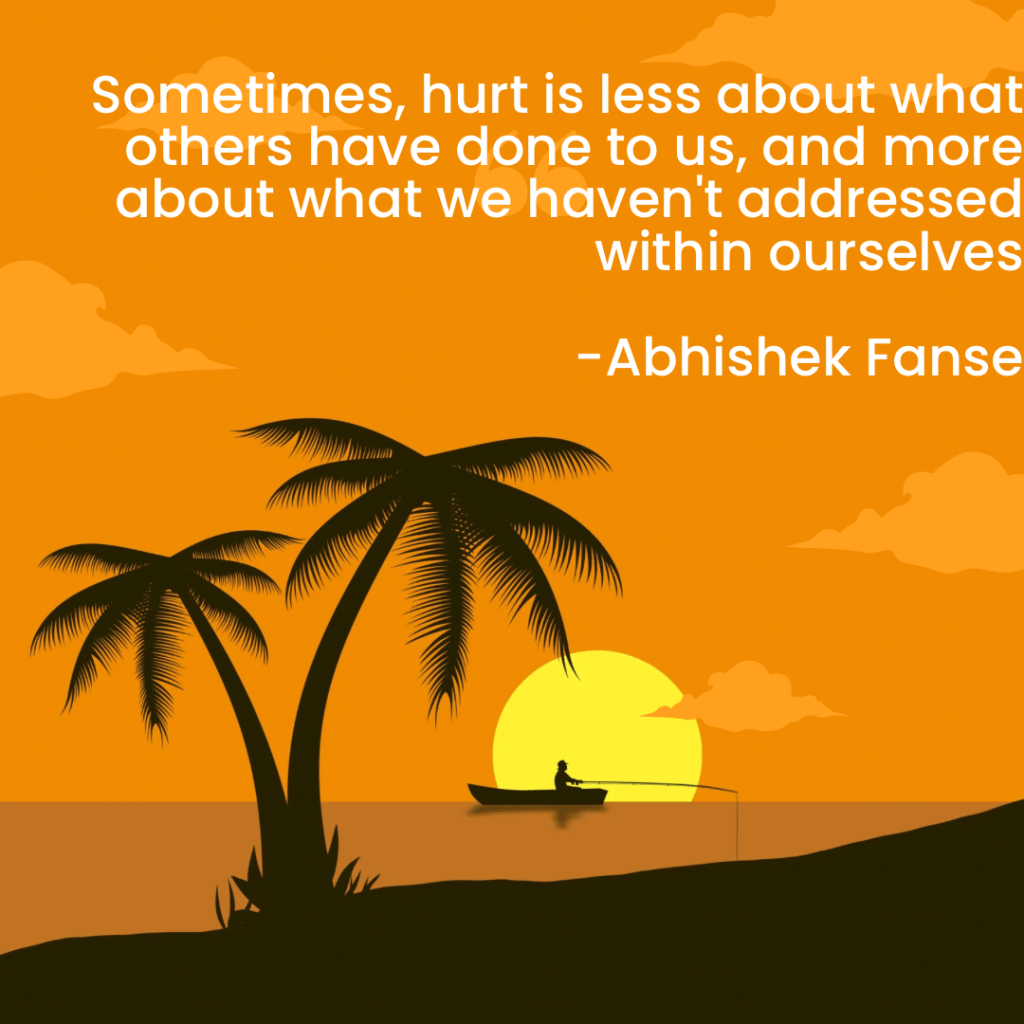
Let us take a simple example where you feel hurt due to a longing for more time and attention from a loved one, even though you recognize they are doing their best. At the heart of your experience lies a paradox: you have an expectation (desiring more time and attention) and simultaneously an understanding (knowing your loved one is doing their best). This dichotomy is not just a matter of conflicting thoughts, but a reflection of the complex nature of human needs and empathy. On one hand, your need for time and attention is genuine – a fundamental aspect of human relationships where such connections and affirmations are essential for emotional bonding and fulfillment. On the other hand, your empathetic understanding of your loved one’s circumstances shows a depth of maturity and compassion. Feeling hurt in this context may arise from an unmet need, which is central to your emotional wellbeing. It’s important to recognize that such needs are not just whimsical desires; they are integral to our sense of connection and belonging. When these needs are not fully met, even in the presence of understanding and rationalization, it creates an emotional void, often experienced as hurt. The consequences of this paradox can be profound. When the fear of burdening outweighs the need for communication, individuals might choose to suppress or hide their feelings. This suppression, while it might seem to maintain harmony in the short term, can lead to several negative outcomes like emotional distance, resentment or misunderstanding. However, this need for emotional expression often collides with an equally powerful force – the fear of overburdening others. This fear stems from a place of empathy and concern, where we become acutely aware of the other person’s potential struggles and challenges. It also arises from our own vulnerabilities; the fear of being seen as needy, weak, or burdensome. Moreover, there’s an underlying concern about the dynamics of the relationship itself – the worry that being too open about our troubles or desires might alter the equilibrium of the relationship, potentially leading to conflict, distance, or discomfort.
At the heart of this paradox is our self-concept, the multifaceted perception we hold of ourselves. This self-concept is not static; it is shaped by our experiences, beliefs, and the feedback we receive from our environment. When we consider communicating our innermost thoughts and feelings, we are also negotiating with our self-concept. Are we someone who burdens others? Are we worthy of being heard and understood? These questions reflect deeper insecurities and beliefs about our worthiness and role in our relationships. The fear of being a burden often stems from a vulnerable place in our self-concept, where we doubt our value in the eyes of others. The complexity of this paradox also lies in the dynamic nature of human relationships. Each relationship we form is a unique intersection of personalities, histories, and expectations. In some relationships, there may be an established pattern of one person being the caregiver and the other the receiver. Attempting to reverse or alter these roles by expressing one’s own vulnerabilities can feel disruptive and fraught with uncertainty. There’s also the aspect of reciprocity – the balance of give and take. In healthy relationships, this balance is fluid and flexible, but the fear of disturbing this balance can make the act of communication seem daunting.
Psychologically, this paradox is intersecting with our deepest fears and vulnerabilities. It often triggers core issues related to self-worth, rejection, and abandonment. When we contemplate sharing our burdens, we are not just sharing a specific problem or feeling; we are also, on a deeper level, testing our acceptability and worthiness in the eyes of others. The fear that our vulnerabilities might make us less worthy of love or respect can be a powerful deterrent to open communication…
Love – can it be more or less??
Love is a deeply profound and complex human emotion, often defying straightforward explanations and definitions. At its core, love can be viewed as an unconditional acceptance and appreciation of oneself or another, involving care, empathy, and a desire for the loved one’s well-being. This exploration will delve into why we sometimes feel the need for more or less love, why we keep expectations in love, and why love can sometimes result in hurt.
The expression of love involves a diverse array of feelings, behaviors, and beliefs, which are influenced by a myriad of psychological, social, cultural, and biological factors. From the perspective of evolutionary psychology, love can be seen as a survival mechanism, promoting bonding and mutual aid, which are crucial for the survival of our species.
On a psychological level, love involves the interplay of multiple elements including attachment, intimacy, commitment, passion, and care. It’s often in the dynamics of these elements that we start to perceive love as being ‘more’ or ‘less’. The need for ‘more’ love could be linked to an increased desire for emotional intimacy, assurance, or care, while the feeling of ‘too much’ love might be related to an overwhelming sense of vulnerability or loss of autonomy.
Cultural and societal norms also play a role in shaping our perceptions of love. Cultures around the world have different understandings and expectations of love, which influence how individuals perceive, express, and experience love.
The expectation in love is a widely experienced phenomenon and is closely tied to the human propensity for prediction and desire for stability. As human beings, we have an innate tendency to form expectations based on our past experiences and societal norms. These expectations can serve as a guide, helping us navigate our relationships and giving us a sense of control and predictability.
However, expectations can sometimes lead to disappointment and hurt when they are not met. This can happen when our expectations are unrealistic or when they are not aligned with the other person’s capabilities or intentions. It’s important to note that unmet expectations don’t necessarily imply a lack of love, but rather a discrepancy between our desires and reality.
The concept of love being always 100% and none when there’s less, is a philosophical interpretation that holds love as a complete, all-encompassing emotion. When we truly love, we love wholly and unconditionally. This kind of love does not fluctuate but remains constant, irrespective of circumstances. This is the ideal form of love, the one we aspire to, where love is pure, unconditional, and complete.
Yet, in our human experience, we often find ourselves in a different reality, one where love is not always perceived as complete or constant. In these instances, love can sometimes lead to hurt. This is because love involves vulnerability. To love is to open ourselves up to another, to let them affect us in a deeply personal way. This openness can sometimes lead to pain, especially if the love is not reciprocated, if there’s a betrayal, or if the loved one is lost.
Moreover, it’s crucial to distinguish between love as a pure, selfless emotion, and our human interpretations and reactions to this emotion. While love in its purest form is unconditional and constant, our perceptions and experiences of love are influenced by our individual personalities, past experiences, emotional needs, and mental health.
So, when we say we want ‘more’ love, what we often mean is that we want more demonstrations of love – more time, more affection, more understanding, more validation. Similarly, when we feel hurt in love, it’s often not love itself that hurts us, but the actions (or lack thereof) that stem from it, or rather, our interpretation of these actions.
It’s important to acknowledge that while love is a universal emotion, our understanding and experience of love are deeply personal and unique. It is through our interactions with others that we learn about love, and through introspection, we deepen our understanding of it.
As we continue our exploration of love, let’s delve into the concept of ‘contagious’ love. The contagious nature of love is deeply rooted in our evolutionary history and neurobiology. As social beings, our survival and well-being are dependent on our ability to form and maintain relationships with others. Love, being a powerful emotional bond, helps us create these social ties and foster cooperation.
On a neurological level, the contagiousness of love can be explained by the presence of mirror neurons in our brain. These are a type of brain cell that responds equally when we perform an action or when we witness someone else perform the same action. When we see a loved one expressing love, our mirror neurons fire, causing us to mimic their emotional state internally. This neural ‘mirroring’ can result in us experiencing a similar feeling of love, making it seem as if love is ‘contagious’.
The shared experience of love enhances empathy, strengthens social bonds, and promotes communal harmony. It allows us to understand and share the feelings of others, contributing to our ability to empathize and connect on a deeper level. Moreover, when we see love being expressed, it often inspires us to express our own love more freely, spreading the emotion in a ripple effect.
However, as we navigate through the realms of love, we often come face-to-face with the reality of emotional pain. Why do we get hurt in love? It’s important to remember that love in its truest, most unadulterated form doesn’t cause pain. It is the conditions, expectations, and attachments that we often associate with love that lead to suffering.
We are often hurt when our expectations in love are not met. This could be because we expect certain behaviors from our loved ones, or we assume that our expression of love should be reciprocated in a certain way. When reality does not align with these expectations, it can result in feelings of disappointment, rejection, and hurt.
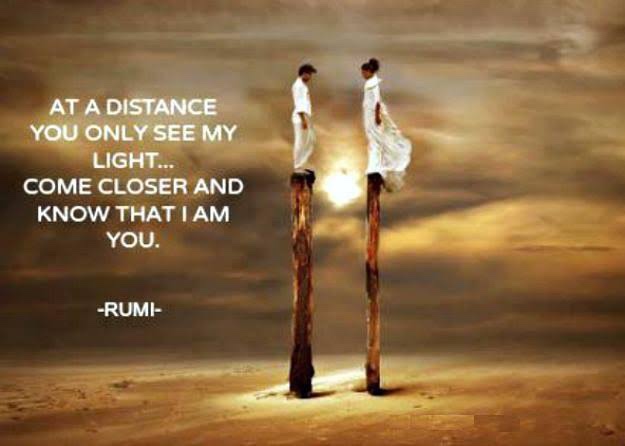
Furthermore, love inherently involves vulnerability. When we love, we open up, we share our innermost selves, our hopes, fears, dreams, and insecurities. This emotional openness leaves us susceptible to pain and hurt. If our vulnerability is not handled with care, or if our trust is broken, it can lead to deep emotional wounds.
Yet, it’s essential to note that the potential for pain should not deter us from embracing love. Love, even with its potential for hurt, brings a depth of emotion and a richness of experience that is unparalleled. The joy, connection, and growth that love can bring far outweigh the risks associated with it.
In addition, the pain that sometimes accompanies love can serve as a catalyst for personal growth and self-understanding. It can help us understand our emotional needs and patterns better, encourage us to develop healthier relationship skills, and foster emotional resilience.

In the grand tapestry of life, love weaves its own unique thread. It adds color, texture, and depth, making our human experience all the more vibrant and meaningful. Love, in its fullness, is not just an emotion; it is an experience, a journey. It is a journey of joy and pain, of connection and loss, of self-discovery and growth.
Understanding love in its entirety requires embracing its complexities, its highs and lows, its joys and pains. It involves recognizing that love is not merely about fulfilling our needs or desires, but about growth, understanding, and deep connection. It’s about seeing and accepting ourselves and others in our wholeness, with all our strengths and weaknesses, hopes and fears, perfections and imperfections.
And while love can sometimes lead to pain, it also holds the promise of healing. Love has the capacity to heal wounds, bridge divides, and transform our lives in profound ways. So, despite its complexities and challenges, we continue to seek love, to give love, to be in love. For in the end, love is not just an emotion; it is a fundamental part of our humanity, a testament to our capacity for empathy, connection, and kindness. It is a force that binds us, nurtures us, and propels us towards growth and fulfillment.
 Abhishek Fanse