Into the Heart of Now: “NOW” Unveiled
We are what we are doing right now” taps into the philosophical and psychological realms of existence, perception, and human behaviour. Going further, we begin to see a confluence of various factors, which draw us away from the present moment, and push us into the embrace of either the past or the future. At the very heart of human existence is our incessant need to find meaning. We seek purpose, direction, and a sense of understanding about our lives. This pursuit often becomes a bridge connecting the past, present, and future. Our past experiences, both triumphant and traumatic, linger in our minds, continuously shaping our present perceptions. They become stories we tell ourselves, lessons we’ve learned, and at times, scars that haven’t fully healed. The future, on the other hand, represents our hopes, fears, dreams, and anxieties. It’s a canvas upon which we project our desires and apprehensions.
The expectation of outcomes is an inherent human trait. It is rooted in our evolutionary drive for predictability and control. For our ancestors, predicting potential dangers and outcomes was a matter of survival. Over millennia, this instinct has got inculcated with our complex cognitive structures, resulting in our modern-day anxieties about the future and ruminations on the past. However, the irony lies in the fact that the more we seek to control outcomes, the more we find ourselves entangled in a web of expectations. These expectations often lead to inner conflicts. When the present doesn’t align with our anticipated future, dissatisfaction ensues. And when the weight of past regrets is heavy, it dims the light of the present. Furthermore, the very act of striving to stay in the ‘now’ can itself become a source of distraction. If one is perpetually conscious about remaining anchored in the present, then this very consciousness becomes a barrier. The effort to stay present can sometimes be as distracting as the past memories or future anxieties that pull us away.
In today’s world, there’s also the influence of societal structures and norms. We live in societies that prize outcomes—success is often defined not by the journey, but by the destination. From a young age, we’re conditioned to focus on results, whether it’s grades in school or milestones in personal and professional lives. This societal molding further deepens our attachment to outcomes and amplifies our detachment from the present.
It is also crucial to understand the role of human consciousness in shaping our experience of time. Our consciousness is not just a passive observer; it actively constructs our sense of reality. Every moment we live is filtered through a myriad of cognitive processes, memories, and emotions. This complexity means that we often don’t experience the world “as it is” but rather “as we are.”

Neurologically speaking, our brain’s default mode network, an intricate web of interconnected brain regions, becomes most active when our attention is not occupied by tasks. This network is linked with thinking about others, thinking about oneself, remembering the past, and planning for the future. Thus, even when we aim to be in the present, our brains often naturally drift towards contemplations of the past and future. The challenges in remaining present can also be attributed to our cognitive structures, which include biases, such as the “negativity bias” – our innate human tendency to give more weight to negative experiences than positive ones. This bias can cause past traumas or failures to overshadow current joys, anchoring us in bygone moments of pain or disappointment. On the other hand, the future holds the allure of the unknown. This uncertainty can be both enticing and anxiety-inducing. Our modern societies, with their rapid changes and technological advancements, amplify this by creating an environment where change is the only constant. The evolving landscapes of our personal and professional lives mean that the future is more unpredictable than ever, making it a potent magnet for our attention and energy. Yet, amidst these complexities, lies a simple truth: the only tangible reality is the present. While memories shape and color our past and aspirations carve out our perceived futures, the ‘now’ is the only temporal space where action occurs, where life is truly lived.
Let’s explore this further!
What if “Now” encapsulates everything – past, present, and future ? This perspective challenges traditional temporal distinctions or divisions we create in and between Past, Present and Future. This viewpoint reframes our understanding of time and our place within its continuum. When we speak of living in the now, it’s often portrayed as a juxtaposition against being lost in memories of the past or anxieties about the future. However, what if everything is indeed a part of the “now” ?
Imagine time as a vast river. In this river, every drop of water represents a moment. While some drops are behind us (the past) and others ahead (the future), they all collectively belong to the river, which is the “now”. In this perspective, the entirety of existence – our memories, current experiences, and anticipations – are interconnected and concurrently present in an expansive “now”. From this viewpoint, distractions aren’t diversions from the present moment; they are simply different facets of the ever-expanding “now”. The reminiscences of a childhood memory or the contemplation about a future event are as much a part of our current experience as the sensation of the chair we’re sitting on. Every thought, emotion, and sensation, regardless of the temporal context it references, emerges and is experienced in the present moment.

The division we often make between the past, present, and future might be a result of our cognitive architecture. The human mind, in its quest for order and understanding, categorizes experiences. This compartmentalization aids in processing complex information. For instance, labeling an experience as a “memory” helps us contextualize it, discern lessons from it, or even prevent future mistakes. Similarly, projecting into the future can be a survival mechanism, allowing us to anticipate potential threats or opportunities.
However, by understanding that everything occurs in the “now”, we can achieve a form of holistic consciousness. This realization offers liberation. It frees us from the confines of linear temporality and allows a more integrated experience of existence. Such a perspective is echoed in various spiritual and philosophical traditions. For instance, in Eastern philosophies, there’s an emphasis on the interconnectedness of all things, where dichotomies are more apparent than real. Yet, while this concept is enlightening, it’s also challenging. Our societal structures, languages, and even our neurobiology are geared towards a linear understanding of time. Overcoming this deeply ingrained perspective requires consistent introspection and possibly even a paradigm shift in our consciousness.

Let’s delve deeper into the expansive Present:
Linear time, where events occur in a sequence from past to present to future, might be more of a cognitive construct than an intrinsic property of the universe. Physics, especially in the realm of relativity and quantum mechanics, has already shown us that time doesn’t always behave in the ways our everyday experiences might suggest. The famous physicist John Wheeler once proposed the idea of a “participatory universe,” suggesting that observers play a role in shaping their own realities, which includes the experience of time. Every thought, emotion, or memory we experience happens in the present moment of consciousness. Even when we recall a past event or anticipate a future one, that activity occurs in the current moment of awareness. This raises the idea that consciousness itself might be beyond time. It’s a continuous stream where “past” and “future” are merely parts of the grander “now.”
If we fully embrace the idea that everything is part of the “now,” it alters how we relate to our experiences. Regret, nostalgia, anxiety, and hope, which are emotions anchored in our traditional understanding of time, undergo a transformation. For example, instead of feeling regretful for a past decision, understanding its occurrence in the vastness of “now” might lead to acceptance and integration of that experience. Memory plays a crucial role in our understanding of time. Our memories, though referencing past events, are dynamic and malleable. They’re reconstructed every time we recall them. In essence, every time we remember something, we’re experiencing it anew in the present moment. This blurs the boundaries between past events and current experiences, reinforcing the idea of an all-encompassing “now.” While the concept is philosophically and spiritually enriching, it poses challenges in our day-to-day lives dominated by schedules, deadlines, and plans. How does one reconcile the linear demands of modern life with a non-linear understanding of time? This balance requires us to function efficiently in the world while internally maintaining an awareness of the deeper, interconnected reality.
Let’s delve further into More finer details: what if we kill “Now”?
When we speak of “killing” the now, we’re essentially talking about transcending our typical awareness of time and moving into a state of pure being, a consciousness unfettered by the confines of temporal experience. The idea that time itself might be an illusion is not new. From the ancient Eastern philosophies to cutting-edge quantum mechanics, there are suggestions that what we experience as the flow of time might be a cognitive and perceptual construct. Our brains organize experiences in a linear fashion, from cause to effect, creating the sense of a flowing river of moments, from the past, through the present, and into the future. But if we could step outside this stream, what would consciousness look like? If we “kill” the now, we’re essentially trying to access a state of pure awareness—a consciousness devoid of content, without thoughts, perceptions, or sensations. Many meditative practices aim to reach this state, often described as “thoughtless awareness” or “contentless consciousness.” In this state, the meditator isn’t focused on any particular thing (like the breath, a mantra, or an image), but instead simply exists. It’s a state of being rather than doing.
Attempting to attain a state of pure awareness can be paradoxical. The very effort to reach this state can prevent one from achieving it, as effort and intention are temporal and future-oriented in nature. It’s like trying to smooth turbulent water with one’s hand—the act of trying only creates more turbulence. It requires a letting go rather than a striving, a surrender rather than a pursuit. To “kill” the now is to step beyond dualities—the past and future, cause and effect, self and other. This is a realm often spoken of in mysticism and spirituality, where one transcends the perceived divisions of existence. It’s a state of unity, of oneness, where the individual self melts away into the all-encompassing whole.
While these states of consciousness can be transformative, they can be challenging to maintain in our everyday, pragmatic world. Our society operates on schedules, plans, and routines. However, even fleeting experiences of this transcendent state can profoundly affect our daily lives. It can offer insights, change perspectives, and create a deep-seated sense of peace. From the perspective of many ancient traditions, the universe is in a constant dance of creation and destruction. The “now” that we experience is just one beat of this cosmic dance. To “kill” the now is not to negate or nullify it, but to merge with the dance itself, to become one with the rhythm of existence.

Choice “Paralysis“
A choice implies that there is an alternative, and with every alternative comes the weight of consequences, perceived or real.
You speak of a ‘neutral’ stand, but let’s investigate what that really means. In reality, the idea of a neutral stance is a contradiction in terms. The very act of choosing neutrality is in itself a choice, made in opposition to other possible choices. So, the notion of being ‘neutral’ is inherently paradoxical because it cannot exist without the conditions that make it a choice to begin with.
For example, When you agree to a certain dosage of medication, you exercise control by making an informed decision. However, you also surrender control to the effects of that dosage, which may not be entirely predictable. This brings emotional complexity into play: the comfort of taking action (choosing the dosage) juxtaposed against the uncertainty of outcome. When we agree to disagree, we are on the contrary acknowledging that a middle ground is unreachable, yet we’re finding a sort of middle ground in that very acknowledgment. The challenge lies in our psychological need for validation and agreement, which often feels at odds with the more rational understanding that it’s perfectly okay for different viewpoints to coexist. We often fail to agree to disagree because our conditionings, our egos, don’t allow us to let go without a ‘win’ or a ‘loss.’
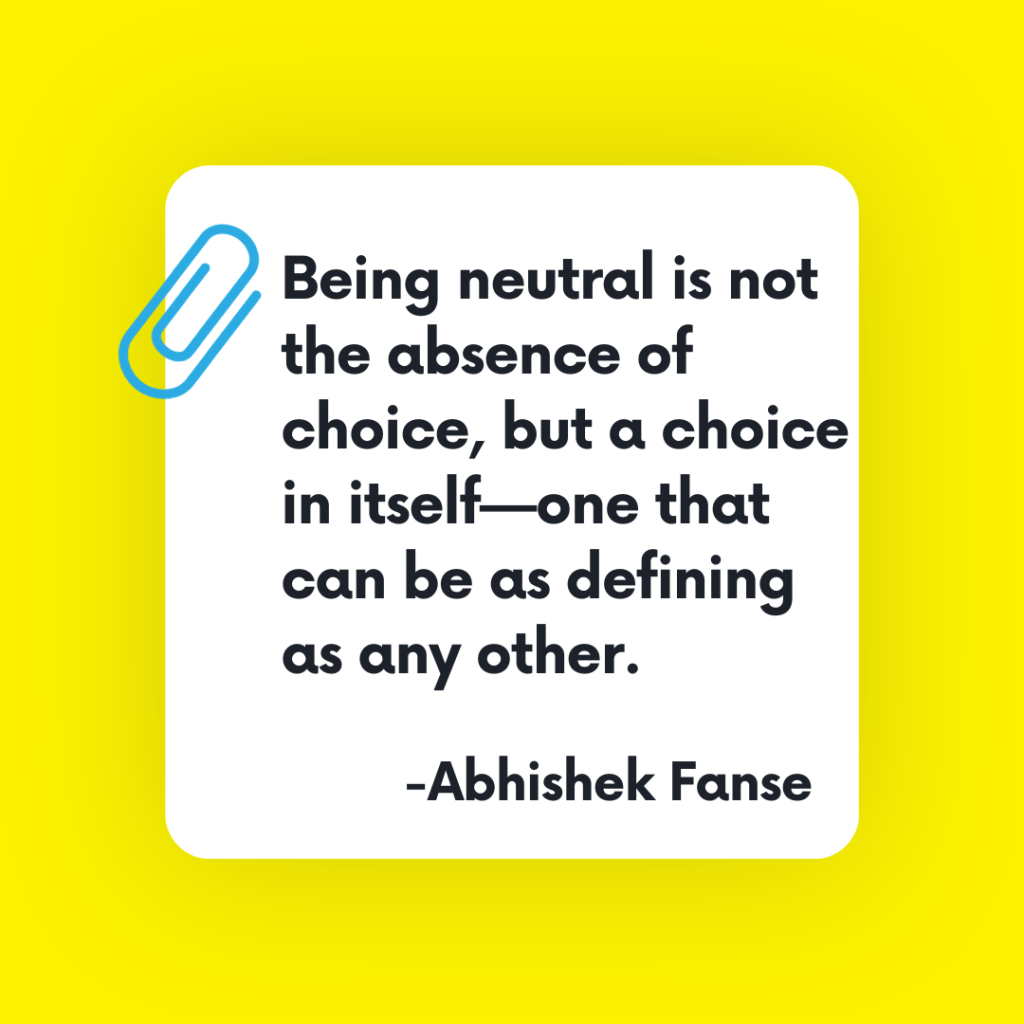
Every choice, by definition, is a rejection of its alternative. Therefore, choices are always relative, biased, and limited by the options that exist. In that sense, a choice cannot be independent because it is defined by the conditions that make it a choice. The idea of a ‘choice’ presupposes the existence of an alternative, of a comparison. In a context where there is only one thing that exists independently, the notion of ‘choice’ would be meaningless because there would be nothing to choose from. Therefore, it wouldn’t be a choice; it would simply be a state of being. The paradox exists because we try to define and understand choice within the limited framework of language and duality. However, once you recognize that the very nature of choice is paradoxical and conditional, and you embrace that paradox rather than trying to resolve it, you arrive at a sort of meta-clarity. This does not mean you’ve resolved the paradox; it simply means you’ve stepped outside of it. You’ve transcended the limitations that come with the dualistic thinking of ‘this or that,’ ‘yes or no,’ ‘neutral or biased.’
Choices are never made in emotional vacuums. They are laden with expectations, fears, and desires that stem from our past experiences, conditionings, and inherent personality traits. Even the seemingly most “logical” choice is often deeply influenced by emotions we may not even be fully aware of. The emotional charge of expectations is often the heaviest. When we make a choice, it is often governed by what we expect the outcome will bring us—pleasure, validation, success, or the avoidance of pain and conflict. The emotion here is one of anticipation, coupled with anxiety about whether our expectations will be met.
Then there’s desire, an emotion that often masquerades as need. The choices we make based on desire are emotionally charged with hopes for fulfillment, achievement, or recognition. But desire is a double-edged sword: while it motivates us, it also sets us up for disappointment if things don’t go as planned.
Even when we think we are making a “neutral” choice, what we are often trying to do is distance ourselves emotionally from the implications of the decision. We might say it’s “purely logical,” but the underlying emotion is often one of self-preservation—we wish to remain unscathed by the emotional weight that comes with making a more obviously partial choice.

One reason choices are emotionally charged is that they give us the illusion of control. Making a decision allows us to feel like we have some say over our fate. However, this control is always somewhat illusory. Life’s unpredictability ensures that our choices, no matter how well-considered, often have unexpected outcomes. The realization that our control is limited can bring up a host of emotions like helplessness or existential dread. Every choice we make, big or small, adds a brick to the edifice of our self-identity. We look for validation through our choices; when they lead to desired outcomes, it reinforces our sense of self-worth. When they don’t, it challenges our self-image and can lead to emotions like self-doubt, shame, or regret.
Our choices also affect how we are viewed by others, adding another layer of emotional complexity. Sometimes we make choices that conform to societal norms or expectations to avoid judgment or gain approval. The emotions at play here are often related to a fear of rejection or a need for social cohesion. At other times, we may make choices that go against the grain, driven by a desire for individuality or authenticity. This can lead to a complicated cocktail of pride, liberation, but also potential loneliness.
When it comes to seemingly paradoxical choices—like choosing wisdom over a loved one or maintaining a “neutral” stance—the emotional texture becomes even more intricate. For instance, choosing wisdom over a loved one might be a defense mechanism to protect oneself from future emotional pain, yet it can also lead to immediate emotional pain due to the distancing from the loved one. Here, both foresight and dread, love and rationality, are locked in an emotional tussle.
In cases where we choose to be “neutral,” what we are really doing is choosing not to engage emotionally in a way that makes us vulnerable. We might convince ourselves that we’re staying above the fray, but deep down, the need to protect ourselves emotionally is dictating that ‘neutral’ choice. The emotion behind neutrality is often a fear of emotional engagement, wrapped up in a protective layer of rationality. Ultimately, emotional maturity plays a large role in how we navigate the sea of choices and their associated feelings. Being aware of our emotional drivers allows us to make more ‘informed’ choices, even if that information is coming from within ourselves. This kind of self-awareness can temper the more reactive emotions like fear and desire and allow room for more nuanced feelings like contentment, acceptance, and genuine love to inform our decisions.
Choice is often seen as liberating, an act of free will that puts us in the driver’s seat of our destiny. However, with every choice we make, we also close off other possibilities, limiting ourselves in certain ways. The emotional paradox here is the simultaneous existence of freedom and constraint within the same action. We may feel exuberant for choosing a particular path, but there can be a latent sadness or anxiety about the paths left unexplored.
While choices often feel monumental in the moment, their impact can wane over time, sometimes even reversing in significance. What seemed like a terrible choice in the past may later appear wise, or vice versa. This fluidity can generate complex emotions, such as regret for past choices or anxiety about the unpredictability of future choices and their unforeseeable emotional implications.
Ultimately, where every action presents us with a choice and counter choices, we sometimes find ourselves paralyzed, suspended in a moment of indecision. Yet, this paralysis isn’t a dead end; it’s a pause, a sacred space that invites us to reflect, to feel, and to become keenly aware of our humanity.
What if we reframe this so-called “choice paralysis” not as a dilemma but as a moment of pause in the great narrative of our lives? It becomes not a prison, but a platform; not a quagmire, but a quest. In this paused state, we are philosophers, artists, and explorers of the inner cosmos. We grapple not just with options but with identities, not merely with pros and cons but with hopes and fears, love and loss.
In this pause, we are not frozen; we are fervently alive. We are composing in our minds the symphony of our future, writing the next act of our life’s drama, sculpting the clay of our becoming.
And when the pause lifts—as it always does—we make a choice, yes, but we also do something more profound: we embrace our capacity to choose, even when the choices are hard, even when the path is foggy. For it’s in the wrestling with choices that we come to know who we truly are.
So, the next time you find yourself in the clutches of choice paralysis, remember: you are standing at the confluence of many rivers, each leading to a different ocean but all part of the same Earth. And it’s okay to stand there for a while, to feel the currents, to listen to their distinct murmurs, before stepping into the stream that will carry you to your next adventure.
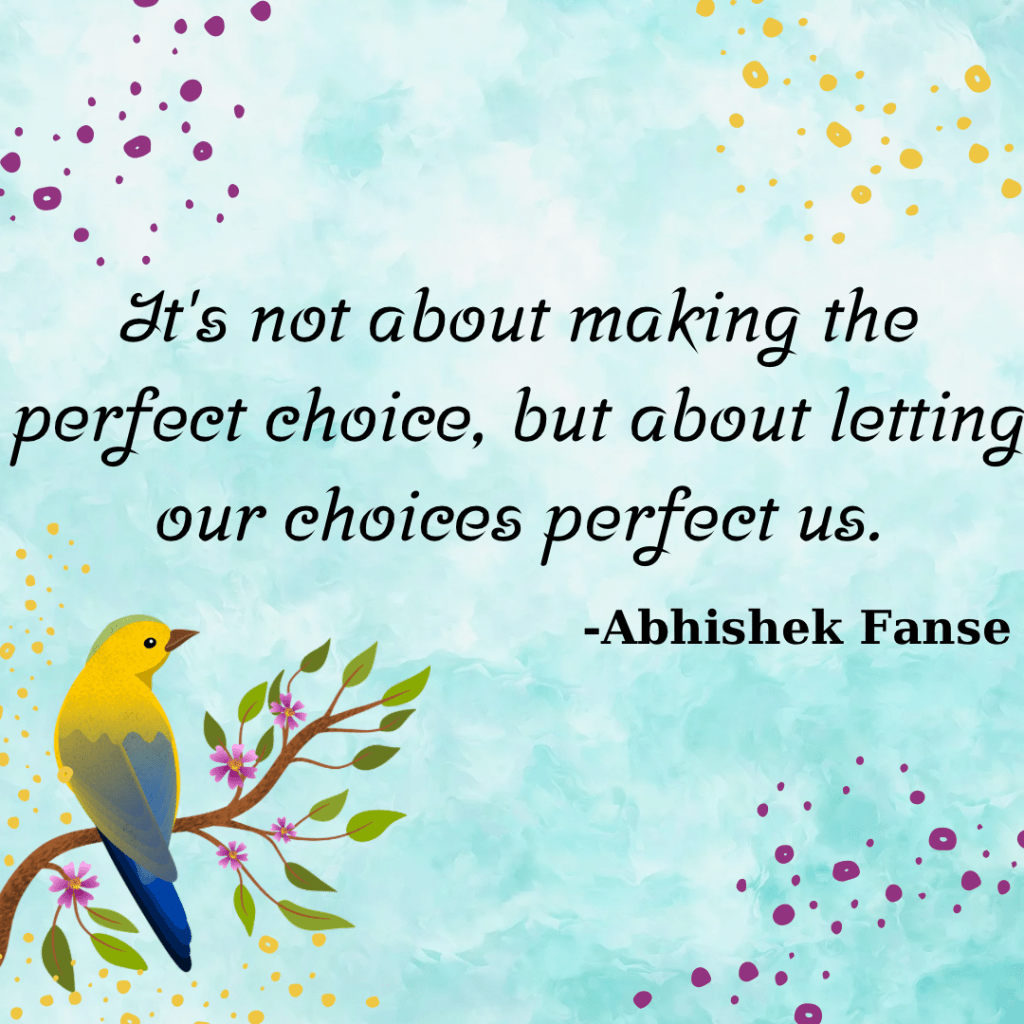
And so, we are forever navigating, forever choosing. Not in search of resolution, but in pursuit of growth. In the end, it’s not about making the perfect choice, but about making our choices perfect us.
Amidst Peace!!
What brings you peace?

In the vast expanse where desires entwine, Detachment emerges, a beacon so fine.
While many chase starts, and beginnings anew, It’s in the echo of endings where peace rings true.
The tempest of life, in its fervent embrace, Urges us forward, a relentless race. Yet peace isn’t found in the heart of the storm, But in letting go, in a formless form.
In the depth of the night, where visions lie deep, Peace flourishes best where eyes don’t leap. For too often, our sight might lead us awry, But in the unseen’s embrace, our worries will die.
Seek not in the masses, the throngs or the crowd, Turn to the self, silent, not loud. For deep in one’s core, past chaos and spin, Rests the sanctuary of peace, glowing from within.
When we chase after shadows, our energy spent, It’s the introspective journey that’s heaven-sent. So remember these thoughts, when the world feels askew, Peace is an inside journey, forever true.
The Journey Beyond Separation: A Tale of the Observer and the Observed from Krishnamurti’s insights
Once in a village nestled between the mountains and the sea, there lived a young man named Arjun. Arjun was a seeker of truth, always inquisitive and eager to understand the deeper mysteries of life. He spent his days contemplating the nature of existence, and his nights were filled with vivid dreams that seemed to offer glimpses into another realm.
One day, as Arjun sat beneath a sprawling banyan tree, he found himself pondering the nature of the observer and the observed. He thought about the way he saw the world around him, and the way he experienced his own thoughts and emotions. Arjun wondered why there always seemed to be a sense of separation between the observer – the one who experiences – and the observed – the experience itself.
As he meditated on this question, a wise old sage appeared before him. The sage, sensing Arjun’s confusion, offered to share his knowledge of the observer and the observed. With a warm smile, he began to tell Arjun a story.
“Once upon a time,” the sage said, “there was a great kingdom ruled by two powerful beings – the Observer and the Observed. The kingdom was vast, encompassing all the thoughts, emotions, and sensations that anyone could ever experience. The Observer was the ruler of this kingdom, watching over everything, while the Observed was the manifestation of every experience, taking countless forms.
The Observer and the Observed existed in a state of harmony, their existence intertwined like the roots of the banyan tree beneath which you sit. But as time went on, they began to drift apart. The Observer became more and more detached, watching from a distance, while the Observed grew increasingly fragmented, its experiences becoming more diverse and complex.
This separation led to the rise of a great wall, dividing the once-unified kingdom into two distinct realms. On one side of the wall, the Observer resided, detached and distant, while on the other side, the Observed continued to manifest in myriad forms, each one disconnected from the others.
Arjun, captivated by the story, asked the sage, “But why did they drift apart? What caused the separation between the Observer and the Observed?”
The sage replied, “The separation began when the Observer started to identify with its own thoughts, emotions, and experiences. Instead of seeing itself as an inseparable part of the whole, it began to believe that it was separate, distinct from the Observed. This belief created a false sense of identity, a sense of ‘I’ that became the root of all division and conflict.”
Arjun’s eyes widened as he realized the implications of the sage’s words. “So, the separation between the Observer and the Observed is an illusion, created by our own minds?”
The sage nodded. “Yes, Arjun. The true nature of the Observer and the Observed is one of unity, not division. To transcend this illusion, you must embark on a journey of self-discovery. You must turn your attention inward and observe your own thoughts, emotions, and sensations without judgment or attachment. Through this process of choiceless observation, you will begin to dissolve the wall that separates the Observer and the Observed.”
Arjun thanked the sage for his wisdom and set out on a journey to explore the depths of his own mind. Through years of diligent self-inquiry and observation, he began to see the interconnectedness of all things and the illusory nature of the separation between the Observer and the Observed.
And as the wall of separation crumbled, Arjun discovered a profound sense of peace, freedom, and wholeness that transcended all limitations. In this state of unity, he finally understood the true essence of existence and the boundless potential of the human spirit.
As the years passed, Arjun became a wise and compassionate teacher, guiding others on their own journeys of self-discovery. He shared the story of the Observer and the Observed with all who sought his counsel, reminding them of the illusion of separation and the unity that lies at the heart of existence.
In time, the message of unity spread throughout the land, and people from all walks of life began to embrace the wisdom of the Observer and the Observed. They learned to look within, to observe their thoughts and emotions without judgment, and to recognize the interconnected nature of all things.
The kingdom, once divided by the great wall of separation, was reunited, and harmony reigned once more. The Observer and the Observed, no longer divided, danced together in an eternal celebration of life, free from the shackles of illusion.
And so, the legacy of Arjun and the wisdom of the Observer and the Observed lived on, passed down from generation to generation, as a reminder that the true nature of existence lies not in division and conflict but in unity and harmony.
In this tale of the Observer and the Observed, we are reminded to look within, to examine our own minds and the divisions we create. Through choiceless observation and self-inquiry, we can begin to dissolve the illusion of separation, embracing the unity and interconnectedness that is our true nature.
As we embark on our own journeys of self-discovery, may we, like Arjun, find the wisdom to transcend the limitations of the conditioned mind and the courage to share this understanding with others, fostering a world in which the harmony of the Observer and the Observed reigns supreme.
 Abhishek Fanse