
Anticipatory anxiety in Human Relationships
Human relationships, particularly the relationships we share with those we deeply care about, are characterized by a multitude of emotions, experiences, and dynamics that can often seem paradoxical. One such paradox is the experience of having a rush of things to share with a loved one, only to find ourselves going blank when we finally meet them. This experience can be perplexing, but it is not uncommon.
Firstly, it’s crucial to acknowledge that communication in the context of love is not just about the exchange of words. Love is a deep, complex emotion, and our communication with those we love often extends beyond the verbal. When we meet our loved ones, our subconscious mind, which is a powerful part of our emotional processing system, comes into play. It relishes the presence of the loved one, focusing on the nonverbal cues like their expressions, their body language, the warmth in their eyes, and their overall energy. These subtle signals can trigger an emotional response, which can be so overwhelming that it temporarily clouds our conscious thoughts, leading us to experience the ‘blank’ state.
Secondly, the anticipation of sharing experiences with a loved one can create a psychological phenomenon known as ‘anticipatory anxiety’. Anticipatory anxiety refers to the anxiety that individuals experience in anticipation of an event. In this case, the event is the sharing of experiences with the loved one. This anxiety is not necessarily negative; it could just be the result of the excitement and eagerness of wanting to share and connect. However, it can sometimes lead to over-preparation, where we mentally rehearse the conversation multiple times, creating an information overload. When the actual moment of sharing comes, the overload coupled with the emotional response to being in the presence of the loved one can cause our mind to go blank.

Moreover, the desire to share our experiences with our loved ones stems from our need for connection and validation. We yearn to be seen, to be understood, and to be acknowledged. However, when we are in the presence of a loved one, especially if the love is deep and genuine, their mere presence can provide the connection and validation we seek. This can reduce the urgency of the need to share, leading to a calming effect where our thoughts settle down, and we find ourselves enjoying the moment rather than focusing on narrating our experiences.
Another angle to consider is the dynamics of vulnerability in love. Sharing our experiences, particularly those that are personal or emotionally charged, involves opening up and making ourselves vulnerable. While we may feel comfortable with this level of vulnerability at a conceptual level, the reality of opening up in person may feel more daunting, causing us to retreat into ourselves.
Furthermore, it’s essential to understand the role of ‘presence’ in love. Being ‘present’ is about being fully engaged in the here and now, immersing ourselves in the current moment without being distracted by past memories or future anticipations. When we are with our loved ones, we are often naturally pulled into the present because of the depth of our feelings for them. This state of presence can calm our mind, helping us let go of our preconceived plans to share, and instead, allowing us to just be and enjoy the moment with them.
In the realm of love, relationships, and emotional intimacy, the phenomenon of ‘going blank’ when in the presence of a loved one is multifaceted and deeply linked to our inner selves and our perception of the world around us. The depth and breadth of human emotion, particularly those we experience when we’re in love, are often too vast to put into words. This cognitive-emotional interplay can add another layer of complexity to the ‘going blank’ phenomenon.
Sometimes, the vastness of what we wish to share and the depth of our feelings can be so overwhelming that it becomes difficult to articulate them into coherent thoughts or words. This may be because language, while an effective means of communication, is sometimes limited in expressing the depth and complexity of our inner world. Some feelings, experiences, or ideas may not have exact words to define them, causing a disconnect between our internal state and our ability to express it verbally. This can result in the feeling of being ‘blank’ when we attempt to communicate our experiences to a loved one.
There’s also an element of what psychologist Carl Rogers referred to as ‘unconditional positive regard’. Unconditional positive regard involves showing complete support and acceptance of a person regardless of what they say or do. When we are in the presence of a loved one who provides us with this unconditional positive regard, it can create a deeply comforting and validating environment. This environment can be so emotionally fulfilling that our need to share or discuss our experiences diminishes, as our emotional needs are already being met through the connection itself. This can contribute to the sensation of going ‘blank’ in their presence.
This concept aligns with the Eastern philosophy of ‘being versus doing’. In the hustle and bustle of our daily lives, we are often caught up in a constant state of ‘doing’ – planning, executing, achieving, and communicating. However, when we’re with someone we deeply love and trust, we transition from ‘doing’ to ‘being’. In this state of ‘being’, we are fully present, engaged, and immersed in the moment, not driven by the need to accomplish anything or express everything. This transition can lead to the settling down of our thoughts, contributing to the ‘blank’ state.
The ‘going blank’ phenomenon also has an interesting correlation with the concept of ‘flow’ introduced by positive psychologist Mihaly Csikszentmihalyi. ‘Flow’ is a state of being completely absorbed in the current activity to the extent that we lose track of time and our surroundings. When we’re with a loved one, especially when the connection is deep and genuine, we can experience a similar state of ‘flow’, where our focus shifts from our thoughts and experiences to the shared moment. This shift can give rise to the feeling of ‘going blank’.
It’s a reminder that sometimes, words are not necessary, and that love and understanding can be conveyed through a mere look, a touch, or shared silence. As the renowned poet Rumi once said, “Silence is the language of God, all else is poor translation.” So, when we ‘go blank’, we are not experiencing a lack, but rather a transcendence from the verbal to the non-verbal, from the explicit to the implicit, from ‘doing’ to ‘being’ in love.
Love – can it be more or less??
Love is a deeply profound and complex human emotion, often defying straightforward explanations and definitions. At its core, love can be viewed as an unconditional acceptance and appreciation of oneself or another, involving care, empathy, and a desire for the loved one’s well-being. This exploration will delve into why we sometimes feel the need for more or less love, why we keep expectations in love, and why love can sometimes result in hurt.
The expression of love involves a diverse array of feelings, behaviors, and beliefs, which are influenced by a myriad of psychological, social, cultural, and biological factors. From the perspective of evolutionary psychology, love can be seen as a survival mechanism, promoting bonding and mutual aid, which are crucial for the survival of our species.
On a psychological level, love involves the interplay of multiple elements including attachment, intimacy, commitment, passion, and care. It’s often in the dynamics of these elements that we start to perceive love as being ‘more’ or ‘less’. The need for ‘more’ love could be linked to an increased desire for emotional intimacy, assurance, or care, while the feeling of ‘too much’ love might be related to an overwhelming sense of vulnerability or loss of autonomy.
Cultural and societal norms also play a role in shaping our perceptions of love. Cultures around the world have different understandings and expectations of love, which influence how individuals perceive, express, and experience love.
The expectation in love is a widely experienced phenomenon and is closely tied to the human propensity for prediction and desire for stability. As human beings, we have an innate tendency to form expectations based on our past experiences and societal norms. These expectations can serve as a guide, helping us navigate our relationships and giving us a sense of control and predictability.
However, expectations can sometimes lead to disappointment and hurt when they are not met. This can happen when our expectations are unrealistic or when they are not aligned with the other person’s capabilities or intentions. It’s important to note that unmet expectations don’t necessarily imply a lack of love, but rather a discrepancy between our desires and reality.
The concept of love being always 100% and none when there’s less, is a philosophical interpretation that holds love as a complete, all-encompassing emotion. When we truly love, we love wholly and unconditionally. This kind of love does not fluctuate but remains constant, irrespective of circumstances. This is the ideal form of love, the one we aspire to, where love is pure, unconditional, and complete.
Yet, in our human experience, we often find ourselves in a different reality, one where love is not always perceived as complete or constant. In these instances, love can sometimes lead to hurt. This is because love involves vulnerability. To love is to open ourselves up to another, to let them affect us in a deeply personal way. This openness can sometimes lead to pain, especially if the love is not reciprocated, if there’s a betrayal, or if the loved one is lost.
Moreover, it’s crucial to distinguish between love as a pure, selfless emotion, and our human interpretations and reactions to this emotion. While love in its purest form is unconditional and constant, our perceptions and experiences of love are influenced by our individual personalities, past experiences, emotional needs, and mental health.
So, when we say we want ‘more’ love, what we often mean is that we want more demonstrations of love – more time, more affection, more understanding, more validation. Similarly, when we feel hurt in love, it’s often not love itself that hurts us, but the actions (or lack thereof) that stem from it, or rather, our interpretation of these actions.
It’s important to acknowledge that while love is a universal emotion, our understanding and experience of love are deeply personal and unique. It is through our interactions with others that we learn about love, and through introspection, we deepen our understanding of it.
As we continue our exploration of love, let’s delve into the concept of ‘contagious’ love. The contagious nature of love is deeply rooted in our evolutionary history and neurobiology. As social beings, our survival and well-being are dependent on our ability to form and maintain relationships with others. Love, being a powerful emotional bond, helps us create these social ties and foster cooperation.
On a neurological level, the contagiousness of love can be explained by the presence of mirror neurons in our brain. These are a type of brain cell that responds equally when we perform an action or when we witness someone else perform the same action. When we see a loved one expressing love, our mirror neurons fire, causing us to mimic their emotional state internally. This neural ‘mirroring’ can result in us experiencing a similar feeling of love, making it seem as if love is ‘contagious’.
The shared experience of love enhances empathy, strengthens social bonds, and promotes communal harmony. It allows us to understand and share the feelings of others, contributing to our ability to empathize and connect on a deeper level. Moreover, when we see love being expressed, it often inspires us to express our own love more freely, spreading the emotion in a ripple effect.
However, as we navigate through the realms of love, we often come face-to-face with the reality of emotional pain. Why do we get hurt in love? It’s important to remember that love in its truest, most unadulterated form doesn’t cause pain. It is the conditions, expectations, and attachments that we often associate with love that lead to suffering.
We are often hurt when our expectations in love are not met. This could be because we expect certain behaviors from our loved ones, or we assume that our expression of love should be reciprocated in a certain way. When reality does not align with these expectations, it can result in feelings of disappointment, rejection, and hurt.

Furthermore, love inherently involves vulnerability. When we love, we open up, we share our innermost selves, our hopes, fears, dreams, and insecurities. This emotional openness leaves us susceptible to pain and hurt. If our vulnerability is not handled with care, or if our trust is broken, it can lead to deep emotional wounds.
Yet, it’s essential to note that the potential for pain should not deter us from embracing love. Love, even with its potential for hurt, brings a depth of emotion and a richness of experience that is unparalleled. The joy, connection, and growth that love can bring far outweigh the risks associated with it.
In addition, the pain that sometimes accompanies love can serve as a catalyst for personal growth and self-understanding. It can help us understand our emotional needs and patterns better, encourage us to develop healthier relationship skills, and foster emotional resilience.

In the grand tapestry of life, love weaves its own unique thread. It adds color, texture, and depth, making our human experience all the more vibrant and meaningful. Love, in its fullness, is not just an emotion; it is an experience, a journey. It is a journey of joy and pain, of connection and loss, of self-discovery and growth.
Understanding love in its entirety requires embracing its complexities, its highs and lows, its joys and pains. It involves recognizing that love is not merely about fulfilling our needs or desires, but about growth, understanding, and deep connection. It’s about seeing and accepting ourselves and others in our wholeness, with all our strengths and weaknesses, hopes and fears, perfections and imperfections.
And while love can sometimes lead to pain, it also holds the promise of healing. Love has the capacity to heal wounds, bridge divides, and transform our lives in profound ways. So, despite its complexities and challenges, we continue to seek love, to give love, to be in love. For in the end, love is not just an emotion; it is a fundamental part of our humanity, a testament to our capacity for empathy, connection, and kindness. It is a force that binds us, nurtures us, and propels us towards growth and fulfillment.
Divinity – an escape to fear ?
As we delve into the concept of divinity, we encounter a landscape of varying interpretations and perceptions, shaped by the human quest for understanding and meaning. Divinity refers to the state of things that are believed to come from a supernatural power or deity, such as a god, or spirit beings, and are therefore regarded as sacred and holy. Such things are regarded as divine due to their transcendental origins or because their attributes or qualities are superior or supreme relative to things of the earthly world.
But why, one might ask, is divinity interpreted differently by different individuals and cultures? And how can something considered divine and universal also be understood subjectively?
While it may seem paradoxical, the reason lies in the intersection of the human cognitive apparatus with the profound mystery that the concept of divinity embodies. Even though divinity may represent universal principles or realities, the ways in which we understand, relate to, and express these principles are inherently influenced by our cultural, psychological, and experiential contexts.
Cultural factors play a significant role in shaping our views of the divine. Different religions and spiritual traditions have unique ways of conceptualizing and relating to divinity, reflecting their historical, cultural, and philosophical contexts. For instance, monotheistic religions like Christianity, Islam, and Judaism conceive of divinity as a single, all-powerful God, while polytheistic traditions like Hinduism and ancient Greek religion portray divinity in the form of many gods and goddesses, each representing different aspects of reality.
Psychological factors also contribute to the subjective experience of divinity. Our personal beliefs, emotions, experiences, and cognitive processes shape our understanding and experience of the divine. Some people might experience divinity as a personal relationship with a divine being, while others might perceive it as a transcendent state of consciousness or a profound sense of connection with all of life.
As for why divinity appears to wear ‘multiple masks,’ this is again a reflection of the diversity and complexity of human understanding and experience. Just as a multifaceted diamond reflects light in various ways, the concept of divinity can manifest in countless forms, reflecting the myriad ways in which human beings perceive and relate to the mystery of existence.
One might wonder: if the laws of nature are universal, why is our understanding of divinity so diverse? This discrepancy can be understood by considering the difference between objective and subjective realms of knowledge.
The laws of nature belong to the realm of objective knowledge. They can be studied, tested, and validated using the scientific method, which is designed to minimize the influence of individual bias and subjective perception. This is why scientific knowledge, including our understanding of the laws of nature, is largely consistent across different cultures and societies.
On the other hand, our understanding of divinity belongs primarily to the realm of subjective knowledge. It’s rooted in personal experience, cultural context, and introspective understanding, all of which are inherently subjective. While subjective knowledge can be deeply meaningful and transformative, it is also diverse and multi-dimensional, reflecting the complexity of human perception and experience.
Despite this diversity, there may be universal principles or realities underlying our various perceptions of the divine. These might include principles like the interconnectedness of all life, the transformative power of love and compassion, or the existence of a reality that transcends our ordinary perception.
However, just as a map is not the territory it represents, our concepts and images of the divine are not the divine itself. They are human-made representations, shaped by our cognitive capacities and cultural contexts. The divine itself, whatever it may be, likely transcends our human capacities for understanding and conceptualization.
To further elaborate, let’s consider an analogy. Picture a group of people standing around a magnificent sculpture placed in the center of a room, each person looking at the sculpture from a different angle. While they’re all observing the same object, the perspective they have of the sculpture is unique to their standpoint. Some will notice features that are invisible to others, while some aspects remain hidden to everyone. In essence, they are all viewing the same objective reality, yet their individual subjective experiences differ.
This analogy provides some insight into how people perceive divinity. Even though there may exist an objective divine reality (the sculpture), the way people perceive and experience it (their view of the sculpture) is dependent on their individual perspectives. These perspectives are shaped by a variety of factors including personal experiences, cultural backgrounds, religious beliefs, and individual psychological make-up.

In other words, the “masks” of divinity that different cultures, religions, and individuals see are representations tailored to their unique viewpoints and contexts. This diversity in divine interpretation does not necessarily imply that divinity itself is subjective or inconsistent, but rather that our understanding and experiences of it are.
Moving forward, it’s important to differentiate between the objectivity of the laws of nature and the subjectivity of our experience and understanding of divinity. The laws of nature operate independently of human perception or consciousness; they govern the physical world whether or not anyone is aware of them. Scientists strive to discover and understand these laws through a methodical, systematic process that aims to be as objective and unbiased as possible.
In contrast, our relationship with divinity is deeply personal and subjective. It depends largely on individual consciousness, belief systems, and experiences. Unlike the laws of nature, our experiences of the divine cannot be measured or empirically verified. They lie beyond the domain of scientific investigation and are instead in the realm of personal and spiritual exploration.
This doesn’t mean that our experiences of the divine are less “real” or valuable than scientific knowledge, just that they operate within a different sphere of human experience and understanding. Both realms – the objective and the subjective, the scientific and the spiritual – are crucial aspects of our quest for knowledge and meaning.
Many of the world’s religious and spiritual traditions point towards the possibility of experiencing divinity directly, beyond conceptual understanding. This direct experience, sometimes described as “mystical” or “transcendent,” is often said to transcend ordinary categories of thought and perception, providing a profound sense of unity, sacredness, or ultimate reality.
However, the path to such experiences is highly individual and cannot be standardized or prescribed. It often involves practices like meditation, contemplation, devotion, ethical living, or service to others, aimed at cultivating qualities like mindfulness, compassion, humility, and openness to the divine.
Ultimately, our understanding and experience of divinity are part of the rich tapestry of human existence, reflecting our deepest yearnings, questions, and potentials. They invite us to explore the mysteries of life, to cultivate virtues and wisdom, and to connect with something greater than ourselves. Despite the diversity of divine interpretations, they all point towards a reality that transcends the limitations of our ordinary perception, inviting us on a journey of discovery, transformation, and awakening.
Prayer – is it measurable ?
Prayer is an age-old human practice that transcends the boundaries of culture, geography, and faith. As we explore whether there is a measure of prayer, be it qualitative or quantitative, we find ourselves diving into the intricate layers of human spirituality, psychology, and the subjective experiences that weave the tapestry of our existence. In this exploration, we consider the motivations behind prayer, the outcomes of this practice, and the existential questions that propel human beings towards the realm of the divine.
Prayer, at its core, is a form of communication with a higher power, deity, or the universe, depending on one’s faith or personal belief system. It’s a practice steeped in ritual and tradition, manifesting in different ways across the world’s religions. Prayers may be expressed in silence, in spoken or sung words, through physical prostrations, or even via dance, as seen in some indigenous spiritual traditions. Some pray using prescribed words and formulas, while others engage in spontaneous, personal dialogues with the divine.
While a quantitative measure of prayer might seem straightforward – one could, in theory, count the number of prayers, their frequency, or duration – this approach fails to grasp the true essence of prayer. Prayer is fundamentally a subjective experience that eludes objective measurement. The “effectiveness” of a prayer isn’t necessarily proportional to the number of times it’s uttered or its length. It’s an act that holds significance beyond numbers and metrics.
The qualitative measure of prayer, on the other hand, poses a challenge due to its highly personal and subjective nature. Every person experiences prayer differently, which can be influenced by their beliefs, emotional state, intentions, and many other factors. The impact of prayer on an individual’s life, their sense of peace, or their connection to their faith are deeply personal matters that resist standard measurement.
However, some elements are often considered in assessing the qualitative “effectiveness” of prayer. These include the sense of peace and comfort it provides, its impact on one’s behavior or attitudes, and its ability to cultivate qualities like gratitude, compassion, and humility. Some also speak of experiencing a deep sense of connection or communion with the divine, which, to them, signifies a “successful” prayer. Nevertheless, these remain personal and subjective aspects that may vary significantly from person to person.
The reasons why people pray are as diverse as humanity itself. Some people pray to seek comfort, to express gratitude, to seek guidance, or to find inner peace. Others pray to foster a connection with the divine, to seek intercession for themselves or others, or as an act of worship and devotion.

Many individuals find in prayer a source of solace and strength. It provides a space to voice their fears, hopes, regrets, and gratitude, often bringing a sense of peace and clarity. It can serve as a means to navigate life’s challenges and uncertainties, fostering resilience and hope.
Prayer can also be a powerful tool for personal growth and transformation. It invites introspection and self-reflection, helping individuals to align with their values, cultivate virtues, and transform negative emotions. It can lead to improved relationships, greater compassion, and a heightened sense of purpose and fulfillment.
Regarding the question of whether people pray out of fear or belief in the unknown, or if they have an experience of the unknown, the answer is likely all of the above. The unknown, with all its mystery and uncertainty, has always been a profound trigger for human contemplation and spiritual seeking.
Some may pray because they fear the unknown – death, illness, misfortune, the cosmic scale of existence – and seek protection or comfort. Others pray not out of fear, but out of awe and wonder, driven by a desire to connect with the grandeur of existence that extends beyond the limits of human understanding.
There are also individuals who, through their spiritual practices, claim to have experienced glimpses of the unknown, encounters with the divine, or states of consciousness that transcend the ordinary. These experiences, often described as mystical or transcendent, may inspire a deepening of their prayer practice.
It’s crucial to acknowledge that the motivations for prayer and the experiences associated with it are diverse and complex, reflecting the profound complexity of human existence.
Ego and its death
The concept of the ego is deeply rooted in both psychology and philosophy, contributing to the overall understanding of human behavior, cognition, and identity. It’s a multifaceted term that has been interpreted and employed in various ways by different scholars. To understand the ego in depth, we need to examine its theoretical origins, its functions, its influence on our behavior and relationships, and the role it plays in personal growth and self-awareness.
The term “ego” has its roots in Latin, where it means “I.” However, its contemporary psychological and philosophical meanings draw mainly from the works of Sigmund Freud, the founder of psychoanalysis, and Carl Jung, the founder of analytical psychology.
Freud used the term ego to describe one of the three components of the psychic apparatus in his structural model of the mind. According to him, the human psyche comprises the id, the ego, and the superego. The id is the primitive part of our psyche that contains our basic instincts and drives. It operates on the pleasure principle, seeking immediate gratification of needs and desires.
The superego, on the other hand, is the moral compass, formed as we internalize societal and parental norms and values. The ego, according to Freud, is the mediator between the id and the superego. It operates on the reality principle, trying to satisfy the id’s desires in socially acceptable ways that also align with the superego’s moral standards. The ego, thus, helps us navigate the external world while managing our internal drives and moral values.
In contrast, Carl Jung saw the ego as the conscious mind, encompassing our thoughts, memories, and perceptions. It forms the center of our conscious identity but not the entirety of the self, which also includes the unconscious elements. For Jung, the ego is essential for self-awareness and plays a vital role in the process of individuation, which is the journey toward wholeness and self-realization.

The ego, as understood from these perspectives, plays a vital role in our lives. It helps us manage our impulses, maintain our relationships, make decisions, and develop a coherent sense of self. Without the ego, we would struggle to function effectively in the world.
However, when the ego is too dominant or rigid, it can become a source of problems. It may cause us to become overly attached to our self-image, leading us to defend it vehemently against any perceived threats. This can manifest as excessive pride, stubbornness, defensiveness, or inability to accept criticism. In its extreme form, it can lead to narcissistic tendencies, where one’s self-absorption becomes detrimental to their relationships and overall well-being.
In the realm of personal growth and self-awareness, the ego is often perceived as a barrier. This is because the ego, by its very nature, clings to the familiar and resists change. It likes to be in control and tends to see things in dualities (right-wrong, good-bad, etc.), making it difficult for us to embrace uncertainty, see different perspectives, or step out of our comfort zones. This can limit our growth and prevent us from realizing our full potential.
At the same time, the ego can also be a gateway to growth and transformation. By becoming aware of our ego—its patterns, its fears, its defenses—we can begin to understand ourselves better. This awareness can give us the insight and courage we need to challenge our old ways of being and forge a new path.
Moreover, the ego can provide valuable clues to our unconscious elements. Our reactions, defenses, and fears often point to unresolved issues or repressed aspects of ourselves. By exploring these aspects, we can bring them to light, integrate them, and become more whole and self-aware.
To fully understand what “dies” when we become fully aware and conscious, and what it is we naturally let go of when we begin to understand ourselves, it’s crucial to delve into the depths of human consciousness, self-awareness, and the fundamental elements of our identity. This inquiry involves a deep dive into psychology, philosophy, neuroscience, and spirituality.
Becoming fully aware and conscious implies a shift from a state of unconsciousness or lesser awareness to one of higher consciousness. Here, unconsciousness refers to automatic, habitual behaviors and thought patterns which we often engage in without any conscious control or intention. These patterns, formed through years of conditioning, might include biases, assumptions, prejudices, or learned behaviors that operate under the surface of our everyday awareness.
When we reach a state of full awareness or consciousness, these patterns can no longer exist in their previous form. Essentially, what “dies” here is the old self – the unconscious patterns and the egoic self that is driven by them. The ego, in psychological terms, can be seen as the aspect of identity that we consider our “self.” It’s constructed from our experiences, memories, cultural conditioning, and our reactions to external stimuli.
The ego is characterized by attachment to certain ideas about ourselves and the world around us. These ideas may include beliefs about what we should be, what we need to be happy, what we fear, and how others should behave. Often, these ideas are not based on conscious decisions but are ingrained in us through past experiences and societal conditioning.
Becoming fully aware or conscious means recognizing these patterns and seeing them for what they are—temporary constructs rather than inherent aspects of our identity. This allows us to break free from these habitual patterns, essentially causing the egoic self or the old self to “die.” This doesn’t mean we lose our sense of self; rather, it signifies a transformation of self.
As we reach this state of full consciousness, we naturally begin to let go of the attachments that the egoic self held. Attachments, in this context, refer to rigid beliefs, preconceived notions, desires, fears, and expectations that we unknowingly cling to. They are deeply entrenched within our psyches and often steer our thoughts, emotions, and actions without our conscious awareness.
When we start to understand ourselves – our motivations, our fears, our reactions – we naturally begin to see these attachments for what they are. We see that they are not fixed parts of our identity but constructs that we have the power to change or let go of. Understanding ourselves means recognizing that we are not solely the sum of our experiences, thoughts, emotions, or societal conditioning. We are conscious beings capable of introspection, change, and growth.
In the process of self-understanding, we let go of these attachments because we realize that they limit our potential and obstruct our well-being. Letting go is not about forgetting or ignoring our past experiences or emotions. Instead, it’s about recognizing these elements for what they are, understanding their impact, and then making the conscious decision not to let them dictate our present and future.
Moreover, letting go is an act of acceptance—acceptance of our past, our mistakes, our flaws, and our vulnerabilities. It’s about accepting that we are human beings capable of change and growth. We acknowledge our past experiences and emotions, learn from them, and then free ourselves from their hold.
In the process of becoming fully aware and conscious, what dies is not the individual’s sense of self, but the old, unexamined sense of self. The egoic self that was once controlled by unconscious patterns and attachments undergoes a transformation. This transformation is a process of death and rebirth—death of the old self and birth of the conscious self.
On this journey, the individual learns to let go of rigid beliefs, fears, and expectations that once held them back. They start to live from a place of conscious choice rather than habitual reaction. As a result, they experience a profound sense of freedom and openness, which enables them to navigate life with greater flexibility and resilience.

The journey to full awareness and self-understanding is not a linear one, and it’s not without challenges. It requires courage, patience, and persistence. But the rewards it brings—a profound sense of peace, freedom, and fulfillment—are well worth the effort.
The beauty of “Beauty”
The concept of beauty has been a subject of fascination and contemplation for humanity since time immemorial. It captivates our senses, stirs our emotions, and inspires our creativity. Traditionally, beauty has been associated with physical form, such as the graceful lines of a human body or the harmonious proportions of a natural landscape. However, there is a deeper aspect of beauty that transcends form—the beauty of the formless.
Formless beauty refers to a beauty that exists beyond the realm of physical appearance. It is an intangible quality that emanates from the depths of our being and encompasses the essence of our existence. This formless beauty is not constrained by the limitations of shape, color, or physical attributes. It encompasses qualities such as love, compassion, truth, and harmony—the virtues that resonate with our innermost being and touch our souls.

Unlike the beauty associated with physical forms, which can be subjective and vary from person to person, formless beauty is universal. It transcends cultural, geographical, and temporal boundaries. It is the essence that connects all living beings and permeates the very fabric of existence. Formless beauty can be experienced in the simplest of moments—a gentle act of kindness, a shared laugh with a loved one, or a moment of deep inner peace.
One of the profound aspects of formless beauty is its ability to evoke a sense of awe and wonder. When we encounter acts of selflessness, compassion, or transcendence, we are moved by the beauty of the human spirit. These experiences touch something deep within us, igniting a spark of recognition and reminding us of our own innate capacity for goodness and transcendence. In these moments, we connect with the universal essence of formless beauty that resides within all of us.

Subjective beauty, on the other hand, is the beauty that arises from our personal perception and interpretation of the world. It is the beauty that lies in the eye of the beholder, influenced by our unique perspectives, emotions, and cultural conditioning. Subjective beauty is not limited to any particular form or object but can be found in everything we encounter.
Subjective beauty is deeply personal and can vary from person to person. It is shaped by our experiences, memories, and associations. It is influenced by our cultural background, upbringing, and individual preferences. For example, a work of art that resonates deeply with one person may leave another person indifferent. The subjective beauty we perceive in an object or experience is a reflection of our own inner landscape.
The beauty of any form encompasses both the objective attributes of the form and the subjective experience of perceiving that form. When we appreciate a natural landscape, for instance, we may be captivated by its colors, textures, and shapes. But the subjective beauty lies in the emotions, thoughts, and feelings it evokes within us—the sense of awe, tranquility, or connectedness we experience when we immerse ourselves in its presence.
The beauty of any form is not limited to its physical attributes alone. It is also influenced by the meanings, associations, and stories we attach to it. For example, a simple flower can hold profound beauty for someone who associates it with cherished memories or symbolic significance. The subjective beauty we find in forms is a reflection of our inner world, our values, and our unique experiences.
The beauty of formless and subjective beauty reminds us that beauty is a multi-dimensional experience that engages our hearts, minds, and souls. It invites us to look beyond the surface and to appreciate the inherent beauty that exists in the diversity of forms and experiences. It encourages us to explore the deeper layers of perception and connect with the universal essence that underlies all manifestations.
To fully appreciate the beauty of formless and subjective beauty, it is essential to cultivate a state of open-mindedness, curiosity, and presence. We must be willing to suspend our preconceived notions and judgments, allowing ourselves to see beyond the surface and delve into the essence of things. This requires a certain degree of inner clarity and awareness, a willingness to let go of conditioned patterns of thinking and perceiving.
The path to recognizing the formless beauty within and perceiving subjective beauty in the world around us begins with self-awareness. By becoming aware of our own thoughts, emotions, and reactions, we gain insight into the filters through which we perceive the world. We can then question our assumptions, biases, and conditioned beliefs, allowing space for new possibilities and perspectives to emerge.
Meditation and mindfulness practices can be powerful tools in cultivating this self-awareness and expanding our capacity to perceive beauty in all its forms. Through meditation, we develop the ability to observe our thoughts without getting entangled in them, creating a space of clarity and stillness within. This inner silence allows us to access a deeper level of consciousness where the formless beauty can be directly experienced.
In this state of heightened awareness, we begin to recognize that the boundaries between the perceiver and the perceived are illusory. We realize that our perception of beauty is not limited to the external world but is a reflection of our inner state. We understand that the beauty we see in others and the world around us is, in essence, a reflection of our own inner beauty and capacity for love, compassion, and appreciation.
As we deepen our understanding of the formless beauty and embrace the subjective beauty in all its diversity, we also develop a profound sense of interconnectedness. We recognize that we are part of an intricate web of existence, intimately connected with all beings and the natural world. This recognition brings a deep sense of belonging and an expanded sense of compassion and empathy.
In this expanded perception, the concept of beauty transcends the limitations of individual preferences or societal standards. We begin to appreciate the uniqueness and inherent beauty of each person, each moment, and each form of expression. We understand that beauty is not confined to what meets the eye but encompasses the vast array of human experiences, emotions, and expressions.
Formless beauty and subjective beauty invite us to embrace the present moment fully. They remind us to let go of attachments to outcomes, expectations, and judgments. Instead, they encourage us to immerse ourselves in the richness of each moment, allowing ourselves to be fully present and receptive to the beauty that unfolds before us.
In the realm of formless beauty, time loses its grip on us. We enter a state of timelessness, where the past and the future dissolve into the eternal present. In this state, we are free from the burden of regrets or anxieties about the future. We are fully engaged with the richness of the present moment, where the beauty of existence reveals itself in all its multifaceted glory.
The journey to experiencing the beauty of formless and subjective beauty is a lifelong process of self-discovery and exploration. It requires a willingness to look beyond appearances, to question our assumptions, and to cultivate a deep sense of presence and awareness. It is an invitation to embrace the mystery of life and to connect with the inherent beauty that exists within and around us.
In the realm of formless beauty, there is a profound sense of interconnectedness. We recognize that we are not separate entities, but rather interconnected threads in the tapestry of life. This awareness brings about a deep sense of compassion and empathy for all beings. We understand that the suffering of one is the suffering of all, and the joy of one is the joy of all. This interconnectedness invites us to cultivate a sense of responsibility and care for the well-being of others, knowing that their happiness and suffering are intimately linked to our own.
Subjective beauty, on the other hand, is a deeply personal experience. It is the beauty that arises from our unique perceptions, emotions, and experiences. What one person finds beautiful, another may not. It is subjective because it is colored by our individual preferences, cultural backgrounds, and personal histories. Yet, even within the realm of subjective beauty, there is a recognition of the interconnectedness and universality of human experience.
When we open ourselves to the beauty of the formless and embrace the subjective beauty of the world around us, we transcend the limitations of duality. We move beyond the notion of good and bad, right and wrong, and begin to see the inherent beauty in all experiences. We understand that even in moments of pain or difficulty, there is an underlying beauty that can be discovered if we are willing to look deeply.
The beauty of formless and subjective beauty invites us to be fully present in each moment. It calls us to let go of our expectations and judgments and to approach each experience with openness and curiosity. When we do so, we allow ourselves to see beyond the surface and to perceive the hidden beauty that lies beneath.
To cultivate an appreciation for the formless and subjective beauty, we can engage in practices that heighten our awareness and deepen our connection with the present moment. Meditation, mindfulness, and contemplative exercises can help us develop a more refined sense of perception and a greater capacity to recognize beauty in its various forms.
Ultimately, the beauty of formless and subjective beauty is a gateway to a deeper understanding of ourselves and the world around us. It is an invitation to explore the depths of our being, to awaken to our true nature, and to live with a sense of wonder and awe. It is through this exploration that we come to realize that beauty is not something to be sought externally, but rather an intrinsic aspect of our existence.
As we embrace the formless beauty within and appreciate the subjective beauty of the world, we discover that beauty is not limited to a specific form or object. It is a quality that permeates everything, from the vastness of the cosmos to the tiniest grain of sand. It is an ever-present, ever-changing expression of life itself.
Patanjali Yoga Sutra: Abhyāsa-vairāgyābhyāṁ tan-nirodhaḥ
Sutra-12: अभ्यासवैराग्याभ्यां तन्निरोधः।
(Translation: Abhyāsa-vairāgyābhyāṁ tan-nirodhaḥ)
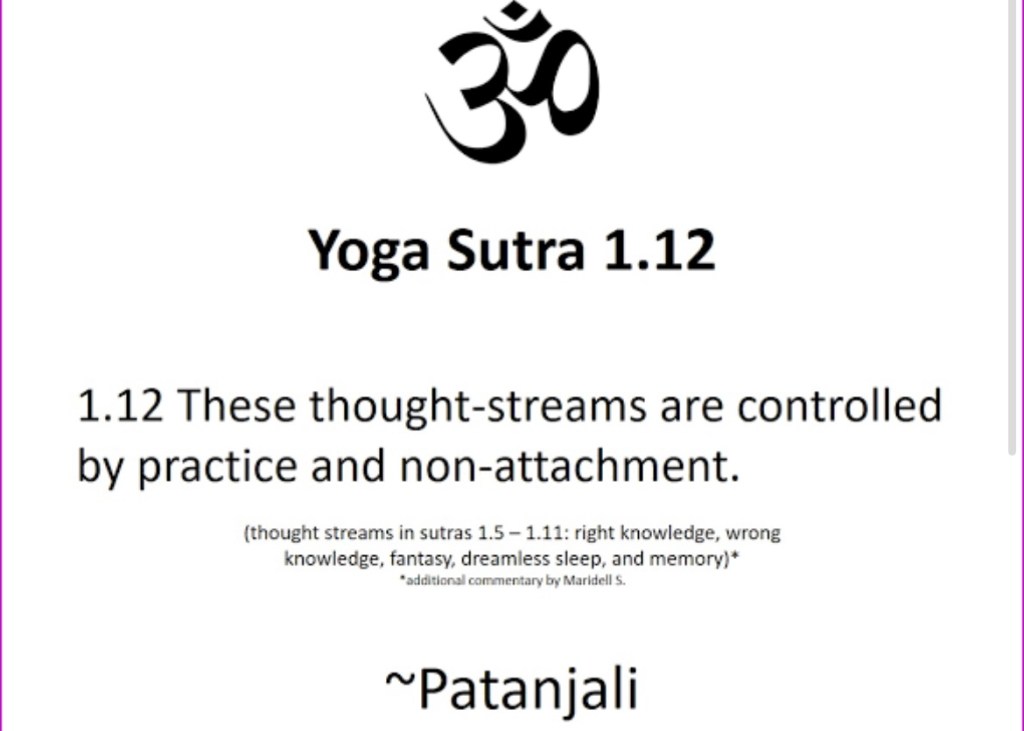
This translates to: “The cessation of all mental modifications can be achieved by practice and non-attachment.”
1. Abhyasa (Practice)
The first part of Sutra-12 mentions “Abhyasa” which directly translates to practice. The context in which it is used here refers to the practice of controlling and focusing the mind. It signifies persistent effort in a disciplined and dedicated manner. Just as physical skills, such as playing a musical instrument, require regular and consistent practice to master, so too does the calming and focusing of the mind.
By this, Patanjali suggests that to master our thoughts and control our mind, we must commit to persistent practice, to gently direct our attention back whenever it wanders. Over time, this practice can lead to deeper concentration, greater mindfulness, and, ultimately, a state of meditation.
2. Vairagya (Non-Attachment)
The second part of the sutra talks about “Vairagya” or non-attachment. Vairagya doesn’t denote a physical abandonment of worldly possessions or relationships, but it refers to an inner state of freedom from desires and attachments. It is the ability to be in the world, fully engaged, yet not bound by it.
It requires an understanding of the transient nature of all things, a recognition that clinging to the impermanent will invariably lead to suffering. By practicing Vairagya, we learn to enjoy the world around us without becoming entangled in it, to be at peace regardless of circumstances, and to maintain equanimity in all situations.
The Interplay of Abhyasa and Vairagya
Patanjali proposes that the mind’s modification and the attainment of inner tranquillity require both Abhyasa and Vairagya to work in conjunction. While Abhyasa provides the mind with the discipline it requires to maintain focus and concentration, Vairagya allows the mind to let go of distracting desires and attachments. When these two are practiced in tandem, they help one to quiet the mind and lead to a state of stillness and equanimity.
Patanjali’s Yoga Sutra-12 can be a potent guide to living a fulfilled life. In our daily existence, it encourages us to embrace a disciplined practice of mental focusing – be it through meditation, prayer, or mindfulness. Simultaneously, it advocates for a detached interaction with worldly matters, teaching us not to be swayed by success or failure, and to find peace amidst chaos.
It is a challenging yet liberating practice that can lead to increased mental clarity, reduced stress, and ultimately, a deeper understanding of oneself and the world.
Applying the Sutra in Your Yoga Practice
The teaching of this sutra can be reflected upon during asana (physical postures), pranayama (breathing exercises), and dhyana (meditation) practices. Here are some ways to do this:
- Asana Practice: While practicing yoga poses, make it a regular habit (Abhyasa) to observe your body’s alignment, breath, sensations, and thoughts. This will help in training your mind to focus and be present. Simultaneously, cultivate Vairagya by not becoming attached to any specific outcome, such as perfecting a pose. Instead, appreciate the journey of progressing in each posture.
- Pranayama Practice: Regular practice of pranayama techniques can enhance concentration and control of the mind. While practicing, cultivate Vairagya by accepting where you are in your practice, not striving for more breaths or deeper inhalations and exhalations. Accept the flow of your breath as it is.
- Meditation Practice: Meditation is the most direct form of practice (Abhyasa) for achieving the mind’s control. When you meditate, practice Vairagya by not attaching to or judging any thoughts or feelings that arise. Observe them and let them pass like clouds in the sky.
Problem and its root cause
In our lives, we all encounter problems—challenges, conflicts, and difficulties that seem to arise relentlessly. These problems often stem from the complex web of our thoughts, emotions, and conditioned patterns of behavior. We find ourselves caught in a cycle of seeking solutions, searching for escapes from the turmoil we experience.
But what if I were to tell you that the very act of seeking escapes from our problems is, in fact, a part of the problem itself? That our constant pursuit of solutions and escapes only perpetuates the cycle of suffering and prevents us from truly understanding and resolving our challenges?
Problems arise when there is a conflict between what is and what we think should be. They emerge when we resist or deny the present moment, clinging to our desires, fears, and expectations. Problems are born out of the fragmented state of mind, caught in the duality of right and wrong, good and bad, success and failure.
Our natural response to problems is to seek escapes—to find solutions that will alleviate our discomfort and restore a sense of security and harmony. We turn to various forms of distractions, addictions, and psychological defenses to shield ourselves from the discomfort and uncertainty that problems bring.
But here lies the irony: in our pursuit of escapes, we often overlook the opportunity to understand the root cause of our problems. We jump from one escape to another, seeking quick fixes, temporary relief, and external solutions. We fail to realize that the escape itself becomes another layer of the problem, trapping us in a cycle of avoidance and denial.
The truth is that genuine understanding and resolution of problems require us to face them directly, without seeking escapes. It calls for a deep inquiry into the nature of our thoughts, emotions, and conditioned responses. We must be willing to observe and question our beliefs, assumptions, and the very structure of our thinking.
To truly understand a problem, we must move beyond the habitual patterns of thought and perception. We need to cultivate a state of awareness that is free from judgment and preconceived notions. This heightened awareness allows us to observe the problem in its entirety, without being consumed by it.
In the process of observation, we begin to unravel the layers of conditioning and attachments that perpetuate the problem. We discover that the problem itself is not separate from us; it is a reflection of our own inner state, our fears, desires, and the deeply ingrained patterns of thought and behavior.
As we delve deeper into self-inquiry, we realize that the resolution of a problem does not lie in external solutions or escapes. It is an internal journey, a transformation of consciousness. The true resolution comes when we are able to transcend the limitations of our conditioned mind and tap into a deeper level of awareness.
This awakening to a higher level of consciousness brings about a radical shift in our relationship with problems. We no longer view them as obstacles to be overcome, but as opportunities for growth, self-discovery, and transformation. Problems become catalysts for inner exploration, leading us to a profound understanding of ourselves and the nature of reality.
In this process, we discover an inner freedom—a freedom that is not dependent on external circumstances or the resolution of problems. It is afreedom that arises from a deep understanding of the self and the interconnectedness of all things. It is a freedom that allows us to navigate life’s challenges with clarity, compassion, and wisdom.
But how do we make this shift from seeking escapes to facing our problems head-on? It begins with cultivating a quality of mind that is attentive, aware, and non-judgmental. We must develop the ability to observe our thoughts, emotions, and reactions without getting entangled in them.
Meditation and mindfulness practices play a crucial role in this process. Through regular meditation, we train the mind to be present, to observe the arising and passing away of thoughts and emotions without clinging to or pushing them away. We cultivate a spacious awareness that allows us to see our problems from a fresh perspective.
As we practice meditation, we become more attuned to the present moment, and our ability to stay present in the face of difficulties grows stronger. We develop the capacity to hold our problems in a spacious awareness, free from the compulsion to immediately seek solutions or escapes. This opens up the possibility of deep insight and transformation.
In the space of awareness, we can inquire into the nature of our problems. We can explore the beliefs, fears, and attachments that underlie them. We can question the validity of our assumptions and challenge the habitual patterns of thinking that keep us trapped in cycles of suffering.
It is important to remember that this journey of self-exploration is not a quick fix or a one-time effort. It requires patience, persistence, and a willingness to face discomfort. It demands that we confront our deepest fears and insecurities. But in doing so, we uncover the gems of wisdom and liberation that lie hidden within.
As we gain insight into the nature of problems, we begin to realize that they are not separate from life itself. Life is an ever-changing flow, and problems are an integral part of that flow. They arise, they transform, and they dissolve. By embracing the impermanence of problems, we free ourselves from the need for immediate resolution.
In this process, we also discover the profound interconnectedness of all beings. We recognize that our problems are not isolated occurrences but are interconnected with the problems of others. We develop empathy, compassion, and a sense of responsibility to work towards the well-being of all.
Let us embrace the challenges that life presents as opportunities for growth and transformation. Let us cultivate the capacity to stay present, to observe without judgment, and to inquire deeply into the nature of our problems.
In doing so, we open the door to a life of greater authenticity, wisdom, and freedom. We step out of the cycle of seeking escapes and enter into a realm of self-discovery and liberation. Our problems no longer hold power over us; instead, they become the catalysts for our awakening.
May we have the courage to face our problems, to embrace the unknown, and to walk the path of self-inquiry with open hearts and minds. And in this journey, may we find the inner peace and freedom that transcend the limitations of problems and lead us to the boundless expanse of our true nature.
Patanjali Yoga Sutra: Abhava Pratyaya Alambana Vritti Nidra
Sutra 10 (in Devanagari script): अभाव प्रत्ययालम्बना वृत्तिनिद्रा (Abhava Pratyaya Alambana Vritti Nidra)
Sutra 10: “Abhava Pratyaya Alambana Vritti Nidra” – Sleep is the state where the mind no longer grasps external objects due to the absence of mental modifications
Patanjali’s Yoga Sutra 10 brings our attention to the nature of sleep and its relation to the mind. Sleep is a state where our consciousness temporarily withdraws, and the mind ceases its engagement with external objects. In this state, the mental modifications or vrittis that usually arise during our waking state are absent. Patanjali points out that by understanding the dynamics of the mind and non-identification with its fluctuations, we can transcend the state of sleep.
- Sleep as Unconsciousness: Sleep is a state of temporary unconsciousness where the mind’s engagement with the external world ceases. In this state, our awareness is not actively focused on sensory perceptions or mental activities.
- Non-Identification with Mental Modifications: Patanjali emphasizes the importance of non-identification with the mental modifications or vrittis of the mind. These modifications include thoughts, emotions, and sensory experiences. By recognizing that our true nature is beyond these fluctuations, we can overcome the grip of sleep and awaken to higher states of consciousness.
- Transcending Sleep: Through self-awareness and self-realization, we can transcend the state of sleep. By understanding the impermanence of mental modifications and disidentifying from them, we become aware of the underlying consciousness that transcends all states, including sleep.
- Awakening to Pure Consciousness: Sutra 10 invites us to awaken to our true nature, which is pure consciousness. By going beyond the fluctuations of the mind, we tap into the eternal source of awareness that is unaffected by the states of waking, dreaming, or deep sleep.

How to apply:
- Cultivate Mindfulness: Practice mindfulness throughout the day to enhance your awareness of mental modifications. Observe your thoughts, emotions, and sensory experiences without judgment or attachment, cultivating a sense of detachment from the ever-changing nature of the mind.
- Practice Self-Inquiry: Engage in self-inquiry to inquire into the nature of your true self beyond the fluctuations of the mind. Reflect on questions like “Who am I?” or “What is the nature of my consciousness?” to deepen your understanding of your essential nature.
- Explore Meditation: Incorporate meditation into your daily routine to develop greater self-awareness and non-identification with the mental modifications of the mind. By observing the breath, mantra, or a chosen object of focus, you can cultivate a state of centeredness and transcendent awareness.
- Cultivate: a Sleep Routine: Establishing a consistent sleep routine can help optimize the quality of your rest. Create a conducive sleep environment, maintain regular sleep and wake times, and engage in relaxation techniques before bed, such as gentle stretching, deep breathing, or meditation.
- Practice Pranayama: Explore the practice of pranayama, the control and regulation of breath. Certain pranayama techniques, such as Nadi Shodhana (alternate nostril breathing) or Shitali Pranayama (cooling breath), can help balance the mind, calm the nervous system, and enhance overall relaxation.
- Cultivate Awareness of Consciousness: Throughout your day, pause and bring your attention to the underlying field of pure consciousness that is present in every moment. Recognize that your true essence is beyond the fluctuations of the mind and that sleep is just one aspect of your existence.
Benefits of Sutra-10:
- Enhanced Conscious Awareness: By understanding the nature of sleep and non-identification with mental modifications, we develop a deeper sense of conscious awareness. We awaken to the ever-present field of pure consciousness that transcends the limitations of the mind.
- Improved Sleep Quality: Through the practices of mindfulness, relaxation techniques, and a consistent sleep routine, we can enhance the quality of our sleep. By reducing the grip of mental fluctuations, we experience more restful and rejuvenating sleep.
- Transcendence of Limitations: Understanding Sutra 10 allows us to transcend the limitations imposed by the mind. We tap into our inherent capacity for expanded consciousness, unlocking our true potential for self-realization and spiritual growth.
Patanjali Yoga Sutra: Vyutthana Nirodha Samskarayor Abhibhava Pradurbhavau Nirodh Kshana Chitta Anvayah Nirodh Parinamah
Sutra 9: “Vyutthana Nirodha Samskarayor Abhibhava Pradurbhavau Nirodh Kshana Chitta Anvayah Nirodh Parinamah” – The control of the fluctuations of the mind is achieved through Nirodha. The result of this control is the uninterrupted flow of the mind towards the chosen object of focus.
Nirodha, as mentioned in Sutra 9, refers to the control and cessation of the incessant fluctuations and movements of the mind. It is the practice of stilling the mind, allowing it to rest in a state of focused concentration and tranquility. Nirodha provides the foundation for deeper states of meditation and paves the way for self-realization.
Nirodha holds immense transformative power on the path of yoga and self-realization. Through the practice of controlling the fluctuations of the mind, we enter into a state of deep inner stillness, heightened awareness, and expanded consciousness. Nirodha liberates us from the grip of incessant thoughts and distractions, allowing us to connect with our true nature and experience the peace and bliss that lie within.
- Control of Mental Fluctuations: Nirodha involves gaining mastery over the incessant movements of the mind. It is the process of bringing the wandering mind under control and channeling its energy towards a chosen object of focus, such as the breath, a mantra, or a visualization.
- Attaining Inner Stillness: Through Nirodha, we enter a state of inner stillness and tranquility. As we learn to quiet the mind and minimize its distractions, we experience a profound sense of peace, clarity, and heightened awareness.
- Uninterrupted Focus: Nirodha allows us to develop uninterrupted focus on the chosen object of concentration. With practice, the mind becomes more absorbed in the present moment, free from external distractions and internal chatter.
- Cultivation of Self-Awareness: Nirodha enhances self-awareness and self-observation. As we control the fluctuations of the mind, we develop a heightened sense of introspection, witnessing our thoughts, emotions, and sensations with clarity and detachment.
- Expansion of Consciousness: Through the practice of Nirodha, we expand our consciousness and open the doors to deeper states of meditation and self-realization. As the mind becomes more still and focused, we gain access to higher levels of awareness, transcending the limitations of the ego and connecting with the universal consciousness.
Applications:
- Cultivate a Regular Meditation Practice: Dedicate regular time to meditation, creating a sacred space where you can sit in stillness and quiet the mind. Start with shorter sessions and gradually increase the duration as your practice deepens.
- Choose an Object of Focus: Select a suitable object of focus for your meditation, such as the breath, a mantra, or a visualization. Allow your attention to rest on this chosen object and gently guide your mind back whenever it wanders.
- Witness Thoughts and Emotions: As you meditate, observe your thoughts and emotions with a sense of detachment. Instead of getting lost in the stream of thoughts, simply witness them as they arise and pass away, without judgment or attachment. Cultivate the role of the observer, allowing thoughts to come and go, while maintaining your focus on the chosen object.
- Practice Breath Awareness: One effective technique for cultivating Nirodha is breath awareness. Direct your attention to the sensations of the breath as it enters and leaves the body. Notice the rise and fall of the abdomen or the gentle touch of the breath at the nostrils. This anchors your awareness and helps still the mind.
- Embrace Mindfulness in Daily Life: Extend the practice of Nirodha beyond formal meditation sessions. Cultivate mindfulness in your daily activities by being fully present in each moment. Whether you are eating, walking, or engaging in any task, bring your complete attention to the present experience, free from distractions.
Benefits:
- Enhanced Focus and Concentration: Nirodha strengthens our ability to concentrate and sustain focus. With a disciplined mind, we become more efficient and effective in our daily activities, experiencing greater productivity and clarity of thought.
- Stress Reduction and Emotional Well-being: By controlling the fluctuations of the mind, Nirodha helps reduce stress and promote emotional well-being. We gain the capacity to respond to life’s challenges with equanimity and inner calm, reducing anxiety and emotional turbulence.
- Heightened Self-Awareness: Nirodha enhances self-awareness and self-observation. By becoming more attuned to our thoughts, emotions, and reactions, we develop a deeper understanding of ourselves, leading to personal growth and transformation.
- Expansion of Consciousness: Through the practice of Nirodha, we expand our consciousness and awaken to higher states of awareness. As the mind becomes still and focused, we connect with the universal consciousness, experiencing a sense of unity and interconnectedness.
 Abhishek Fanse