

Understanding the fleeting nature of “Happiness”
Realising you’re happy and consequently puncturing that happiness—is a manifestation of the self-reflexive quality of human consciousness. It reflects our ability not only to experience emotions but also to have thoughts about those experiences, including the experience of happiness. At the most immediate level, we have sensory experiences and emotional reactions. These are our raw, unfiltered engagements with the world around us. But atop this immediate experience, we have a secondary layer of experience: our thoughts about our experiences. This secondary layer is where we interpret, judge, anticipate, and reflect.
The paradox here is that this second layer of experience can intrude upon and alter the first. By realizing we’re happy, we move the experience of happiness from the immediate realm into the realm of reflection and analysis. This can have a distancing effect, making the happiness less vivid and more abstract. The “self” that is experiencing happiness is no longer fully integrated with the experience; part of it has stepped aside to observe.
The awareness of happiness can also bring about a sense of sadness or melancholy. This is because our reflective consciousness is not only evaluative but also temporal; it exists in time. When we realize we’re happy, we also realize that the moment is fleeting, that it will pass. This injects a sense of loss or nostalgia into the current experience, dampening the happiness with a layer of sadness. There’s also the pressure that once identified, the feeling of happiness must be maintained, which turns it into an object of concern.
In some Eastern philosophies, for example, the ultimate state of happiness or enlightenment is one that transcends both happiness and sadness, existing in a state of pure “beingness” that is beyond dualities. Western philosophies often engage deeply with the notion of existential angst, the idea that human freedom and awareness are both a gift and a curse, capable of both elevating and diminishing our experiences. Humans are narrative creatures. We don’t just experience things; we also construct stories around our experiences, which become a part of the experience itself. Realizing you’re happy can sometimes feel like a narrative high point, a climax. But climaxes are, by their nature, transitional; they mark the point where a story begins to move toward its conclusion. This can create a sense of impending descent, which can tinge even the most joyous moments with a shade of melancholy. There’s a compelling argument to be made for the richness added to our lives by our ability to reflect on our experiences. This meta-experience, the experience of experiencing, adds depth and texture to our lives. It’s the thing that allows us to appreciate art, to fall in love, to engage in complex moral reasoning. But it comes at a cost: the cost of immediacy. The more we reflect on our experiences, the less we’re able to engage with them directly. It’s like being the actor and the audience at the same time. This dual nature of consciousness is both a blessing and a curse. While it allows us the richness of introspection and self-awareness, it also sets up a scenario where the observer can interfere with the experience.
When you realize you’re happy, you’re essentially stepping out of the experience to label it. The moment you do that, you bring in the concept of time. Emotions, when lived, are timeless. They’re states of being. But when you observe them, you also acknowledge their temporality—they become moments that have started and will eventually end. This implicit understanding of the fleeting nature of happiness casts a shadow on the experience, thereby altering its composition and introducing elements of sadness or anxiety.
The awareness of happiness can trigger broader questions about the nature of existence, purpose, and meaning. Happiness is often viewed as an ‘end,’ a goal in life. Once achieved, its realization can create a form of existential vacuum, a questioning of ‘what next?’ This moves you out of the emotional experience and into a cognitive one, involving existential questions that can often be more unsettling than comforting.
Your realization also exemplifies the duality inherent in life experiences. There’s a push and pull between opposing forces: happiness and sadness, awareness and ignorance, temporality and timelessness. Some philosophical traditions, particularly those from Eastern philosophies like Buddhism, suggest that the ultimate state of enlightenment is one that transcends this duality to experience a state of ‘oneness.’ In that state, the act of observing happiness and the experience of happiness itself become one unified experience, without a division that could puncture the emotion. When we experience happiness, it often fits into a story we have about what makes us happy and why. This narrative self can be in constant tension with the experiencing self. The act of realizing you’re happy is a narrative act—it fits this moment of joy into your broader life story. But life stories are complex and filled with ups and downs. Fitting a moment into a narrative can mean subjecting it to all the complexities and contradictions of that narrative, which can dilute the purity of the experience.
On the one hand, mindfulness and self-awareness teach us to observe our feelings, thoughts, and experiences. On the other hand, the very act of observing can sometimes alter or even negate the experience, particularly with transient states like happiness. In quantum physics, the observer effect refers to changes that the act of observation makes on the phenomenon being observed. In psychology, too, observing one’s thoughts and feelings can change them. This is the basis of therapies like Cognitive Behavioral Therapy (CBT), where the act of observing and questioning one’s thoughts can lead to emotional regulation.
When you realize you’re happy and become acutely aware of that happiness, you might also become aware of the fleeting nature of emotions. This could potentially lead to a decrease in the intensity of your happiness, making it a self-limiting state. The joy is punctured by the awareness of its temporary nature or by the anxiety of losing it. It’s crucial to distinguish between mindfulness and hyper-awareness. Mindfulness means accepting each moment as it is, including your happiness, without clinging to it or fearing its loss. Hyper-awareness, on the other hand, involves scrutinizing the experience so closely that you can’t simply be in it. You’re essentially stepping out of the experience to examine it.
Some of the ways to deal with it:
1. The first step in navigating this paradox is to accept the transient nature of all emotional states. Once we make peace with the ebb and flow of life, the realization that our happiness is temporary becomes less threatening.
2. Aim for a detached form of observation. Observe your happiness without clinging to it, just as you would observe your breath during meditation.
3. Shifting the focus from “Being Happy” to “Being”. When your focus is simply on ‘being,’ without labeling the state you are in, you eliminate the self-imposed pressure to sustain any emotional state, be it happiness or otherwise.
4. Often the anxiety of losing happiness arises from either past experiences or future uncertainties. Dwelling in the present can alleviate that concern.
Universe and its connections
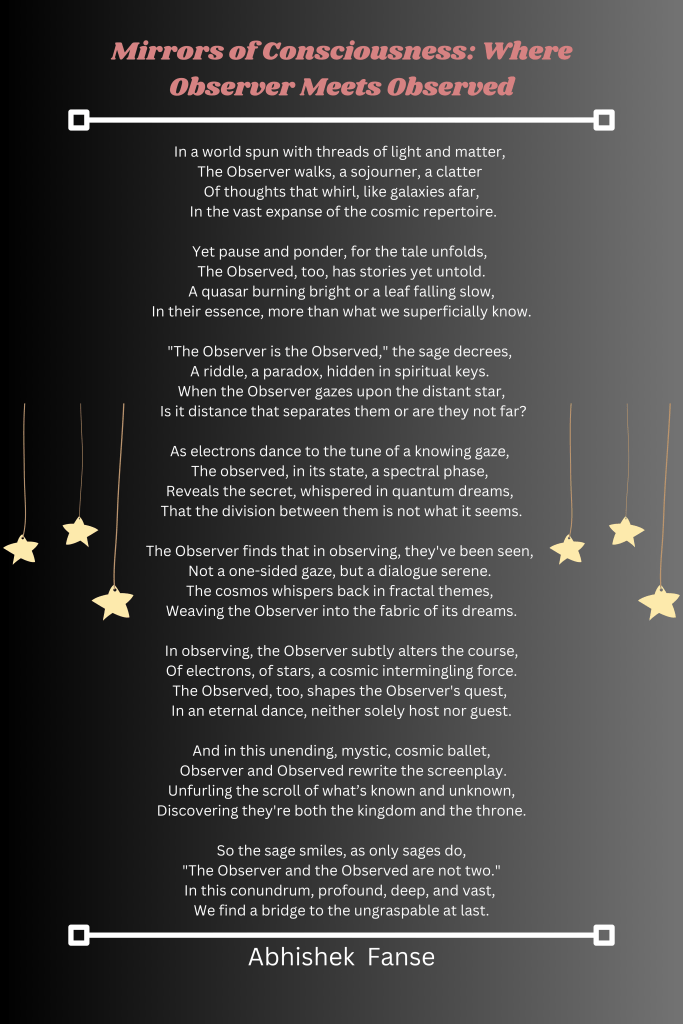
The universe, in its vastness and complexity, encompasses everything that exists, both seen and unseen. It is a tapestry of countless forms, energies, and phenomena. The senses, which include sight, hearing, taste, smell, and touch, allow us to engage with the universe and gather information about its various aspects. Through the senses, we perceive the colors, shapes, sounds, tastes, and textures that make up our experience of the world.
However, the senses themselves are limited in their scope. They can only perceive a fraction of the vastness of the universe. For example, we are unable to see the entire electromagnetic spectrum, hear sounds beyond a certain frequency range, or perceive microscopic or macroscopic phenomena without the aid of technology. Therefore, our sensory perception is inherently incomplete and filtered through the limitations of our biological apparatus.
In addition to the senses, the mind plays a crucial role in our experience of the universe. The mind is a complex web of thoughts, emotions, memories, and beliefs. It is constantly processing information, creating interpretations, and generating subjective experiences. The mind categorizes and conceptualizes the sensory input, giving rise to our perception of the world. However, the mind itself is shaped by conditioning, beliefs, and past experiences. It is influenced by cultural, social, and personal factors that shape our understanding of reality. Therefore, the mind can often distort our perception, leading to subjective interpretations and biases. It can create a veil of concepts, judgments, and expectations that colors our experience of the universe.
In this context, the attributes of the Self, such as pure consciousness, are beyond the realm of sensory perception and mental constructs. Pure consciousness is considered to be formless, timeless, and transcendent. It is the underlying essence of our being, the source from which all experiences and phenomena arise. It is the unchanging presence that witnesses the play of the senses and the mind.
While the senses and the mind are instrumental in our experience of the universe, they are not capable of directly perceiving or expressing the attributes of pure consciousness. The senses can only detect the physical aspects of reality, while the mind can only interpret and conceptualize based on its conditioning and limitations. Pure consciousness, on the other hand, is free from such limitations and is beyond the dualistic nature of sensory perception and conceptualization.
To truly understand the attributes of the Self, one must go beyond the sensory-mind apparatus and directly experience pure consciousness. This requires a shift in awareness, a turning inward towards the source of consciousness itself. Practices such as meditation, mindfulness, and self-inquiry are tools that can facilitate this shift, allowing us to transcend the limitations of the senses and the mind and connect with the formless essence within.
Through these practices, we can enter a state of deep presence and stillness, where the incessant chatter of the mind subsides and we become aware of the underlying field of consciousness. In this state, we can experience the beauty and expansiveness of formless awareness, which is not bound by time, space, or any particular form. It is a state of pure being, where the limitations of duality dissolve, and we connect with the universal essence that underlies all existence.
This direct experience of pure consciousness can bring about a profound transformation in our perception of the universe. We come to realize that the universe is not separate from us, but rather an expression of the same underlying consciousness. The beauty of formless awareness is universal because it transcends the limitations of any particular form or attribute.
As we deepen our connection with pure consciousness, we begin to recognize that the attributes of the Self are not limited to our individual experience. They are inherent qualities that exist within the fabric of the universe itself. The formless essence that we touch through our practice is the same essence that permeates every particle, every living being, and every aspect of creation.
In this expanded awareness, we realize that the beauty of formless awareness is not confined to our subjective experience alone. It is the very essence of existence that manifests in myriad forms and expressions. Just as a single drop of water is inseparable from the vast ocean, each form within the universe is interconnected and imbued with the universal consciousness.
This realization brings a profound shift in our perception of the world. We begin to see the interconnectedness and interdependence of all things. The divisions and boundaries that once seemed so solid start to dissolve, and we recognize the underlying unity that binds us all together. It is through this lens of unity that we can truly appreciate the beauty of formless awareness.
The beauty of formless awareness lies in its ability to transcend the limitations of duality and separation. It is a state of being that is free from judgment, comparison, and the need to categorize. In the realm of formless awareness, there is no distinction between good and bad, right and wrong, beautiful and ugly. Everything simply is as it is, in its purest expression.
When we perceive the world from the vantage point of formless awareness, we can witness the inherent beauty that exists in every moment, in every form, and in every experience. We are no longer confined by the limited judgments and preferences of the mind. Instead, we embrace the totality of existence with a sense of awe, wonder, and reverence.
The beauty of formless awareness also lies in its timeless nature. It transcends the constructs of time and space, allowing us to touch the eternal dimension of being. In the present moment, where formless awareness resides, we find a profound sense of peace, stillness, and expansiveness. It is a state beyond the limitations of past and future, where we can fully immerse ourselves in the richness of the present.
To access the beauty of formless awareness, it is essential to cultivate a sense of presence and mindful awareness in our daily lives. We can engage in practices such as meditation, contemplation, and self-reflection to quiet the mind and open ourselves to the realm of formless awareness. By letting go of our attachments to form and embracing the formless essence within, we can experience the beauty that transcends the transient and ephemeral nature of the world.
 Abhishek Fanse