The Mirrored Self: Reflections of the Experiencer and Experienced
Experience, by its very nature, is inherently subjective. It is the culmination of one’s perceptions, interpretations, emotions, and cognitive processes. Every individual, with their unique personal history, values, beliefs, and physiological makeup, encounters the world in a way that is uniquely their own. For instance, two people might stand before a work of art—one sees profound beauty and feels deep emotion, while the other simply sees colors on canvas. Both are valid experiences, but they differ drastically based on the individual’s subjective lens.
Yet, the objective reality of the world persists. The artwork, the physical colors, and brushstrokes remain constant. It’s this duality of the objective and subjective that creates the richness of human experience. We all share the same objective world, but our subjective interpretations of it vary widely, leading to an immense diversity of human thought, emotion, and expression.
Despite the deeply personal nature of experience, there exists within us a contrary desire to communicate and validate our experiences with others. This need can be attributed to our inherently social nature. As social beings, we have an innate drive to connect, to be understood, and to find commonality with others.
However, the act of communication is fraught with challenges. Language, while powerful, often falls short of capturing the full depth and nuance of our experiences. Words are mere approximations, often failing to convey the entirety of what we feel or perceive. When faced with the ineffability of certain experiences, humans may resort to crafting stories, metaphors, or beliefs to encapsulate and convey the essence of their experiences to others. While these may not represent the experience in its entirety, they offer a bridge, a means to connect with others and share a glimpse of our internal world.
Consider an example of observing a tree. The act of seeing is immediate and direct, but the moment we try to articulate the experience, we find ourselves grappling with memory, association, and linguistic constraints. If the tree is of a kind we’ve never seen before, we still try to relate it to what we know, drawing parallels and making distinctions. This process, while it can enrich our understanding, can also distance us from the immediacy of the experience itself.
This leads us to the profound realization that perhaps the “experiencer” is indeed the “experienced.” Every thought, sensation, or emotion we have is not just a passive observation but an active engagement with our internal and external realities. The very act of experiencing reshapes our understanding, influencing future experiences in a continuously evolving cycle. One could argue that the realm of art, music, poetry, and other forms of non-verbal expression arises from this very challenge. When words fail, a painting, a melody, or a dance can capture and convey those intangible feelings and thoughts. They provide a medium that transcends linguistic barriers, offering glimpses into those profound depths of human experience. It’s no surprise that many people, when moved by a piece of art or music, often exclaim, “That’s exactly how I feel!” even if they couldn’t previously articulate that feeling.
Every individual, in their quest to understand and make sense of their experiences, inevitably draws from the collective knowledge and wisdom of humanity. Philosophies, religious teachings, scientific discoveries, and cultural narratives all play a role in shaping how one interprets and understands their experiences. They provide frameworks and lenses through which experiences are viewed, digested, and integrated.
This interplay between the individual and the collective further emphasizes the inherent tension between subjectivity and objectivity. While personal experiences are deeply subjective, the frameworks we use to understand them often have objective, shared components. A sunset viewed by an individual might evoke a personal memory or emotion, but the scientific understanding of why sunsets appear as they do, or the cultural or poetic interpretations of sunsets, come from collective human knowledge. Moreover, as individuals continue to share and communicate their experiences, they contribute to the collective understanding, which in turn shapes future individual and collective experiences. It’s a dynamic, reciprocal relationship, highlighting the interconnectedness of humanity.
The inherent elusiveness of pure experience, the ever-present gap between what is felt and what can be communicated, reminds us of the limitations of our human condition. Yet, it also highlights the beauty and depth of our existence. In our attempts to bridge this gap, we engage in some of the most profound human endeavors: art, literature, philosophy, and spirituality. Through these mediums, we continuously strive to touch the intangible, to grasp the ungraspable, and to share the very essence of what it means to be human.
Experience, in its fullest form, requires presence. To truly experience is to be fully in the moment, unburdened by the past and undistracted by the future. It’s here, in the pure and unfiltered present, that the experiencer and the experienced merge. This idea echoes in various spiritual traditions which posit that in moments of true presence, the duality of observer and observed collapses. Such moments, where one feels at one with the world, are often described as transcendent or mystical. They hint at a deeper interconnectedness, a web of existence that binds all things.
Yet, despite these profound moments, the human condition is also characterized by a fundamental sense of separateness. It’s this very separateness that gives rise to the desire to communicate, to reach out, to bridge the gap between self and other. We yearn to share, to be understood, and to understand. This yearning, however, is fraught with challenges. As earlier mentioned, the depth and richness of personal experience often evade linguistic encapsulation. But it’s not just about the inadequacy of language; it’s also about the limitations of perception.
Going into depths, In day-to-day life, we’re accustomed to distinguishing ourselves from our environment. We say “I am looking at the tree,” naturally separating the ‘I’ (experiencer) from the ‘tree’ (experienced). However, if we deconstruct this process, things become more intriguing. When you observe a tree, light reflected from its leaves and bark enters your eyes, gets processed by your brain, and forms an image. Here, the ‘tree’ you perceive isn’t the physical entity outside; it’s a manifestation within your consciousness. The tree, as you know it, exists within you, blurring the lines between the observer and the observed. Now, extend this idea to all experiences. Sounds you hear, emotions you feel, even thoughts that arise — all these are not ‘external’ or ‘separate’ events, but transformations within your field of consciousness. You never truly experience the world directly; you experience your consciousness’s interpretation of the world. This realization is profound: it suggests that what we consider ‘external’ is intricately woven into our ‘internal’ realms of experience. The division between us and the universe isn’t as sharp as it might seem.
Many spiritual traditions suggest that this feeling of separateness is a kind of illusion, often termed ‘maya’ in Hinduism. Beneath this illusion, it is proposed that there’s a deeper, unified reality where all distinctions merge. The Zen Buddhist concept of ‘interbeing’ beautifully encapsulates this: nothing exists independently; everything inter-is with everything else. So, in this interconnected dance of existence, to say “I am experiencing the tree” might be more aptly expressed as “The universe, in the form of ‘me’, is experiencing the universe in the form of ‘tree’.”
Exploring this further, we confront the nature of the ‘self’. If the experiencer and the experienced are one, what does this mean for our sense of identity? Who is the ‘I’ that experiences? These questions lie at the heart of self-inquiry in traditions like Advaita Vedanta, where meditative introspection is used to peel back layers of identity, seeking the true Self or ‘Atman’ beneath.

When one begins to deeply contemplate these ideas, the boundaries of self start to dissolve. This can lead to transformative experiences, often described as feelings of oneness or unity with all of existence. Such experiences are marked by a dissolution of the ego, a fading of the habitual sense of separateness. Individuals who have undergone such experiences often describe them as the most profound and meaningful of their lives, reshaping their understanding of themselves and the universe. However, embodying this perspective consistently in daily life is challenging. We’re evolutionarily wired to perceive separateness, as it’s useful for survival. But periodic glimpses into the interconnectedness of all things can offer solace, meaning, and a sense of belonging in a vast universe. They remind us that even amidst the diversity and multiplicity of existence, at the deepest levels, perhaps the experiencer truly is the experienced.
If we consider consciousness to be all-encompassing, then everything we experience is a manifestation within this field of awareness. This perspective aligns with the concept of non-duality, where there’s no division between the self and the rest of existence. In this view, consciousness isn’t something we have; it’s what we are. Our individual sense of self, our thoughts, emotions, and the world we perceive are all arising within and made of this same foundational consciousness.
When we say “I am experiencing this,” who is this ‘I’? Psychologically, it refers to the ego—a mental construct that represents our individual identity. The ego is essential for our survival and functioning, but it also gives us a sense of separateness. From birth, we’re conditioned by society, family, and culture, creating layers of beliefs, desires, and fears that shape this ego. We start identifying with our thoughts, our bodies, our roles, and possessions, forgetting our intrinsic connection with the wider universe. The ego, being a construct, is fragile. It seeks validation and fears annihilation. This is why even after a profound experience, there’s an urge to share or validate it. The ego wants assurance that its interpretation of the experience is ‘real’ or ‘valid’. In moments of deep meditation or spiritual insight, the boundaries of the ego can dissolve, giving a person a glimpse of a reality beyond the constructed self—a state where the experiencer and the experienced merge.
Our understanding of reality is based on our sensory perceptions and cognitive interpretations. But our senses have limits. There’s a vast spectrum of light we can’t see, sounds we can’t hear, and dimensions of reality we might be oblivious to. Quantum mechanics, for instance, has shown that at fundamental levels, particles don’t have definite states until observed, challenging our classical views of reality. Could it be that reality, as we perceive it, is just a sliver of what’s truly out there? And if our very observation shapes reality (as quantum mechanics suggests), then the distinction between the observer and the observed becomes even more blurred. The act of experiencing might be intrinsically linked to the shaping of reality itself. Finally, the experience, consciousness, and reality challenges our conventional beliefs and invites us question, to meditate, introspect and to realize that our fundamental nature might be far more interconnected and expansive than our day-to-day experiences suggest. The dance between the experiencer and the experienced isn’t just a philosophical or spiritual inquiry; it’s a journey into the very heart of existence!!
Choice “Paralysis“
A choice implies that there is an alternative, and with every alternative comes the weight of consequences, perceived or real.
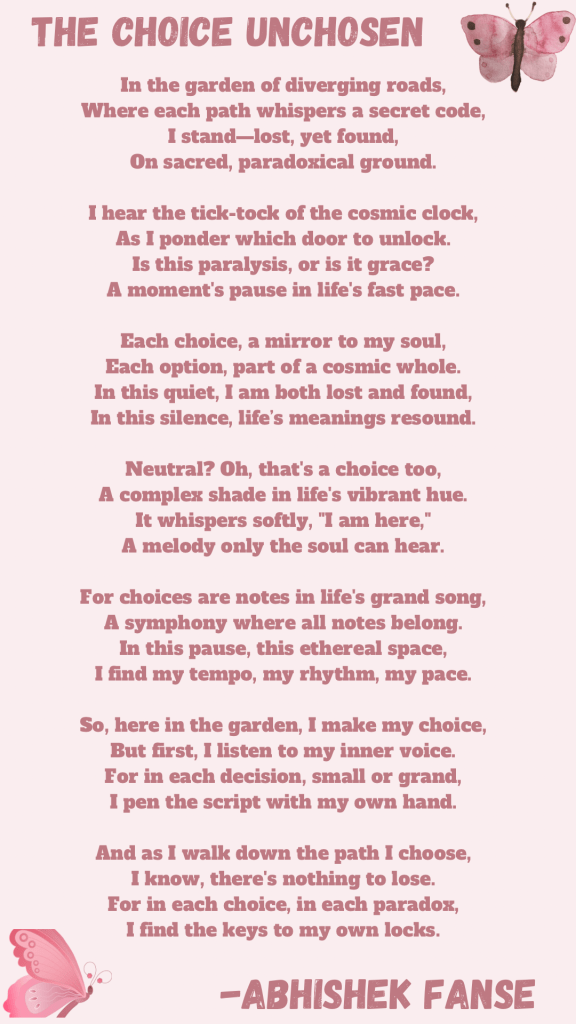
You speak of a ‘neutral’ stand, but let’s investigate what that really means. In reality, the idea of a neutral stance is a contradiction in terms. The very act of choosing neutrality is in itself a choice, made in opposition to other possible choices. So, the notion of being ‘neutral’ is inherently paradoxical because it cannot exist without the conditions that make it a choice to begin with.
For example, When you agree to a certain dosage of medication, you exercise control by making an informed decision. However, you also surrender control to the effects of that dosage, which may not be entirely predictable. This brings emotional complexity into play: the comfort of taking action (choosing the dosage) juxtaposed against the uncertainty of outcome. When we agree to disagree, we are on the contrary acknowledging that a middle ground is unreachable, yet we’re finding a sort of middle ground in that very acknowledgment. The challenge lies in our psychological need for validation and agreement, which often feels at odds with the more rational understanding that it’s perfectly okay for different viewpoints to coexist. We often fail to agree to disagree because our conditionings, our egos, don’t allow us to let go without a ‘win’ or a ‘loss.’
Every choice, by definition, is a rejection of its alternative. Therefore, choices are always relative, biased, and limited by the options that exist. In that sense, a choice cannot be independent because it is defined by the conditions that make it a choice. The idea of a ‘choice’ presupposes the existence of an alternative, of a comparison. In a context where there is only one thing that exists independently, the notion of ‘choice’ would be meaningless because there would be nothing to choose from. Therefore, it wouldn’t be a choice; it would simply be a state of being. The paradox exists because we try to define and understand choice within the limited framework of language and duality. However, once you recognize that the very nature of choice is paradoxical and conditional, and you embrace that paradox rather than trying to resolve it, you arrive at a sort of meta-clarity. This does not mean you’ve resolved the paradox; it simply means you’ve stepped outside of it. You’ve transcended the limitations that come with the dualistic thinking of ‘this or that,’ ‘yes or no,’ ‘neutral or biased.’
Choices are never made in emotional vacuums. They are laden with expectations, fears, and desires that stem from our past experiences, conditionings, and inherent personality traits. Even the seemingly most “logical” choice is often deeply influenced by emotions we may not even be fully aware of. The emotional charge of expectations is often the heaviest. When we make a choice, it is often governed by what we expect the outcome will bring us—pleasure, validation, success, or the avoidance of pain and conflict. The emotion here is one of anticipation, coupled with anxiety about whether our expectations will be met.
Then there’s desire, an emotion that often masquerades as need. The choices we make based on desire are emotionally charged with hopes for fulfillment, achievement, or recognition. But desire is a double-edged sword: while it motivates us, it also sets us up for disappointment if things don’t go as planned.
Even when we think we are making a “neutral” choice, what we are often trying to do is distance ourselves emotionally from the implications of the decision. We might say it’s “purely logical,” but the underlying emotion is often one of self-preservation—we wish to remain unscathed by the emotional weight that comes with making a more obviously partial choice.

One reason choices are emotionally charged is that they give us the illusion of control. Making a decision allows us to feel like we have some say over our fate. However, this control is always somewhat illusory. Life’s unpredictability ensures that our choices, no matter how well-considered, often have unexpected outcomes. The realization that our control is limited can bring up a host of emotions like helplessness or existential dread. Every choice we make, big or small, adds a brick to the edifice of our self-identity. We look for validation through our choices; when they lead to desired outcomes, it reinforces our sense of self-worth. When they don’t, it challenges our self-image and can lead to emotions like self-doubt, shame, or regret.
Our choices also affect how we are viewed by others, adding another layer of emotional complexity. Sometimes we make choices that conform to societal norms or expectations to avoid judgment or gain approval. The emotions at play here are often related to a fear of rejection or a need for social cohesion. At other times, we may make choices that go against the grain, driven by a desire for individuality or authenticity. This can lead to a complicated cocktail of pride, liberation, but also potential loneliness.
When it comes to seemingly paradoxical choices—like choosing wisdom over a loved one or maintaining a “neutral” stance—the emotional texture becomes even more intricate. For instance, choosing wisdom over a loved one might be a defense mechanism to protect oneself from future emotional pain, yet it can also lead to immediate emotional pain due to the distancing from the loved one. Here, both foresight and dread, love and rationality, are locked in an emotional tussle.
In cases where we choose to be “neutral,” what we are really doing is choosing not to engage emotionally in a way that makes us vulnerable. We might convince ourselves that we’re staying above the fray, but deep down, the need to protect ourselves emotionally is dictating that ‘neutral’ choice. The emotion behind neutrality is often a fear of emotional engagement, wrapped up in a protective layer of rationality. Ultimately, emotional maturity plays a large role in how we navigate the sea of choices and their associated feelings. Being aware of our emotional drivers allows us to make more ‘informed’ choices, even if that information is coming from within ourselves. This kind of self-awareness can temper the more reactive emotions like fear and desire and allow room for more nuanced feelings like contentment, acceptance, and genuine love to inform our decisions.
Choice is often seen as liberating, an act of free will that puts us in the driver’s seat of our destiny. However, with every choice we make, we also close off other possibilities, limiting ourselves in certain ways. The emotional paradox here is the simultaneous existence of freedom and constraint within the same action. We may feel exuberant for choosing a particular path, but there can be a latent sadness or anxiety about the paths left unexplored.
While choices often feel monumental in the moment, their impact can wane over time, sometimes even reversing in significance. What seemed like a terrible choice in the past may later appear wise, or vice versa. This fluidity can generate complex emotions, such as regret for past choices or anxiety about the unpredictability of future choices and their unforeseeable emotional implications.
Ultimately, where every action presents us with a choice and counter choices, we sometimes find ourselves paralyzed, suspended in a moment of indecision. Yet, this paralysis isn’t a dead end; it’s a pause, a sacred space that invites us to reflect, to feel, and to become keenly aware of our humanity.
What if we reframe this so-called “choice paralysis” not as a dilemma but as a moment of pause in the great narrative of our lives? It becomes not a prison, but a platform; not a quagmire, but a quest. In this paused state, we are philosophers, artists, and explorers of the inner cosmos. We grapple not just with options but with identities, not merely with pros and cons but with hopes and fears, love and loss.
In this pause, we are not frozen; we are fervently alive. We are composing in our minds the symphony of our future, writing the next act of our life’s drama, sculpting the clay of our becoming.
And when the pause lifts—as it always does—we make a choice, yes, but we also do something more profound: we embrace our capacity to choose, even when the choices are hard, even when the path is foggy. For it’s in the wrestling with choices that we come to know who we truly are.
So, the next time you find yourself in the clutches of choice paralysis, remember: you are standing at the confluence of many rivers, each leading to a different ocean but all part of the same Earth. And it’s okay to stand there for a while, to feel the currents, to listen to their distinct murmurs, before stepping into the stream that will carry you to your next adventure.
And so, we are forever navigating, forever choosing. Not in search of resolution, but in pursuit of growth. In the end, it’s not about making the perfect choice, but about making our choices perfect us.
Can actions be detached?
The origin of action can be traced back to the very fabric of life itself. Every living entity, whether it’s a single-celled organism or a complex human being, is in a continuous state of action. Even in states of seeming inactivity, there are countless actions taking place within our bodies – cells dividing, heart beating, neurons firing. These actions are not born out of attachment, but rather out of the inherent nature of life and its ceaseless dynamism.
In human beings, actions become more complex. Many of our actions stem from cognitive processes, decision-making, emotions, motivations, desires, and fears. Some of these might be influenced by past experiences or expectations of future outcomes. While it’s true that past experiences can inform our actions, it doesn’t necessarily mean that every action is an outcome of attachment to past results.
Let’s take the example of learning to ride a bike. The initial attempts are informed by the desire to learn, and perhaps the fear of falling. Each attempt, whether successful or not, provides a learning experience which informs future attempts. Over time, as we master the skill, the act of riding a bike becomes almost second nature. It’s no longer driven by the initial desire or fear, but instead becomes an integrated action that we can perform almost effortlessly. In this scenario, the action of riding the bike is not an outcome of attachment, but a manifestation of learned skills and understanding.
Now, let’s consider the concept of detached action as explained in the Bhagavad Gita. Detachment in this context does not mean indifference or lack of care, but rather a state of being where one is not excessively attached to the fruits of their actions. When we perform an action with an attached mindset, we are often excessively focused on the outcome. This focus on the future can rob the action of its full potential, as our mind is not fully present in the action itself.
Detached action, on the other hand, allows us to be fully present in the act of doing. This presence can liberate the action from the constraints of past experiences or future expectations, allowing it to unfold with its full potential. A detached action is one that is performed with a sense of duty, with full attention, and without excessive attachment to the outcome. This doesn’t mean that we don’t care about the result. Instead, it means that we perform the action to the best of our ability, accepting whatever result comes as a consequence.
An important aspect to consider here is the interconnectedness of life. Our actions do not exist in a vacuum; they are part of an interconnected web of actions, reactions, and interactions. Understanding this can help us realise that while we have control over our own actions, the results are influenced by countless other factors, many of which are beyond our control. This realisation can foster a sense of humility, acceptance, and detachment, which can free us from the psychological burden of excessively identifying with the outcomes of our actions.
Moving further into the philosophy of actions, let’s delve into the concept of ‘free will’ and ‘determinism’. These two philosophical positions often clash when we try to understand the nature of our actions.
Free will posits that we, as conscious beings, have the power to make choices and act independently of any external constraints. It suggests that our actions originate from our conscious decisions and, thus, we bear full responsibility for them.
Determinism, on the other hand, suggests that every event, including human actions, is determined by previously existing causes. It argues that all our actions are the result of some cause, whether it is our genetic predisposition, upbringing, social environment, or other factors.
Both of these positions hold some truth. While we may feel that we have the freedom to choose our actions, we cannot deny that our choices are influenced by our past experiences, genetic predisposition, and external circumstances. So, our actions are both free and determined, depending on the perspective we adopt.
When we examine our actions closely, we find that they are not purely the result of our conscious decisions. Our subconscious mind, conditioned by past experiences and deep-seated beliefs, plays a significant role in our decision-making process. So, while we might believe that we are acting freely, many of our actions are habitual reactions conditioned by our past.
Understanding this can liberate us from the illusion of absolute control and the burden of excessive self-blame or self-congratulation. It can also foster a sense of compassion for ourselves and others, as we recognise that our actions are often the result of deep-seated conditioning and external circumstances, rather than purely intentional choices.
The key lies in the practice of mindfulness and self-awareness. By becoming more aware of our thoughts, feelings, and motivations, we can start to understand the forces that drive our actions. We can recognise our habitual patterns and start to make more conscious choices.
In the Bhagavad Gita, Krishna advises Arjuna to act without attachment to the fruits of action. This does not mean acting without care or intention. Rather, it means acting with full attention and commitment, without getting caught up in the anxiety about the outcome. This attitude allows us to act with greater freedom and effectiveness, as we are not burdened by excessive worry about the future or regrets about the past.
When we act, we set into motion a series of events, and the consequences of those actions ripple out into the world. The impact of our actions is not confined to ourselves; it influences those around us, our environment, and ultimately the world at large. This chain of cause and effect is constantly in motion and is dictated by the nature and intent of the action.
Duality arises from the perceived differentiation between good and bad, positive and negative, joy and pain, and so forth. This perceived differentiation often causes conflict and suffering because we instinctively cling to what we perceive as good and resist what we perceive as bad. We are pleased when our actions yield positive outcomes and disappointed when they do not.
However, the Bhagavad Gita teaches us that the dichotomy of good and bad is a construct of our mind and that every action simply is. This is a difficult concept to understand because it runs counter to our instinctual desire to classify and judge things based on our subjective perspective.
In reality, an action is neither good nor bad; it is our attachment to the outcome that labels it so. When we act without attachment to the outcome, we act in the fullest expression of our being, free from the constraints of expectation or fear of failure. This state of detachment does not mean that we do not care about the outcome, but rather that we understand we cannot control every aspect of it.
Instead, our focus shifts to the process, the action itself. By doing so, we become more present, more mindful, and more engaged in our actions. We start to see our actions not as a means to an end but as an end in themselves.
Therefore, to navigate the duality of actions and their effects, we must cultivate awareness and detachment. By observing our thoughts, emotions, and actions without judgment or expectation, we can experience life as it is, without the filter of duality.
In the grand scheme of life, our actions are but tiny ripples in a vast ocean. They may cause waves, they may create turbulence, but eventually, they will settle, leaving the water calm and clear once more. It is in this state of calmness, free from the duality of actions and their effects, that we find true freedom and peace.
Divinity – an escape to fear ?
As we delve into the concept of divinity, we encounter a landscape of varying interpretations and perceptions, shaped by the human quest for understanding and meaning. Divinity refers to the state of things that are believed to come from a supernatural power or deity, such as a god, or spirit beings, and are therefore regarded as sacred and holy. Such things are regarded as divine due to their transcendental origins or because their attributes or qualities are superior or supreme relative to things of the earthly world.
But why, one might ask, is divinity interpreted differently by different individuals and cultures? And how can something considered divine and universal also be understood subjectively?
While it may seem paradoxical, the reason lies in the intersection of the human cognitive apparatus with the profound mystery that the concept of divinity embodies. Even though divinity may represent universal principles or realities, the ways in which we understand, relate to, and express these principles are inherently influenced by our cultural, psychological, and experiential contexts.
Cultural factors play a significant role in shaping our views of the divine. Different religions and spiritual traditions have unique ways of conceptualizing and relating to divinity, reflecting their historical, cultural, and philosophical contexts. For instance, monotheistic religions like Christianity, Islam, and Judaism conceive of divinity as a single, all-powerful God, while polytheistic traditions like Hinduism and ancient Greek religion portray divinity in the form of many gods and goddesses, each representing different aspects of reality.
Psychological factors also contribute to the subjective experience of divinity. Our personal beliefs, emotions, experiences, and cognitive processes shape our understanding and experience of the divine. Some people might experience divinity as a personal relationship with a divine being, while others might perceive it as a transcendent state of consciousness or a profound sense of connection with all of life.
As for why divinity appears to wear ‘multiple masks,’ this is again a reflection of the diversity and complexity of human understanding and experience. Just as a multifaceted diamond reflects light in various ways, the concept of divinity can manifest in countless forms, reflecting the myriad ways in which human beings perceive and relate to the mystery of existence.
One might wonder: if the laws of nature are universal, why is our understanding of divinity so diverse? This discrepancy can be understood by considering the difference between objective and subjective realms of knowledge.
The laws of nature belong to the realm of objective knowledge. They can be studied, tested, and validated using the scientific method, which is designed to minimize the influence of individual bias and subjective perception. This is why scientific knowledge, including our understanding of the laws of nature, is largely consistent across different cultures and societies.
On the other hand, our understanding of divinity belongs primarily to the realm of subjective knowledge. It’s rooted in personal experience, cultural context, and introspective understanding, all of which are inherently subjective. While subjective knowledge can be deeply meaningful and transformative, it is also diverse and multi-dimensional, reflecting the complexity of human perception and experience.
Despite this diversity, there may be universal principles or realities underlying our various perceptions of the divine. These might include principles like the interconnectedness of all life, the transformative power of love and compassion, or the existence of a reality that transcends our ordinary perception.
However, just as a map is not the territory it represents, our concepts and images of the divine are not the divine itself. They are human-made representations, shaped by our cognitive capacities and cultural contexts. The divine itself, whatever it may be, likely transcends our human capacities for understanding and conceptualization.
To further elaborate, let’s consider an analogy. Picture a group of people standing around a magnificent sculpture placed in the center of a room, each person looking at the sculpture from a different angle. While they’re all observing the same object, the perspective they have of the sculpture is unique to their standpoint. Some will notice features that are invisible to others, while some aspects remain hidden to everyone. In essence, they are all viewing the same objective reality, yet their individual subjective experiences differ.
This analogy provides some insight into how people perceive divinity. Even though there may exist an objective divine reality (the sculpture), the way people perceive and experience it (their view of the sculpture) is dependent on their individual perspectives. These perspectives are shaped by a variety of factors including personal experiences, cultural backgrounds, religious beliefs, and individual psychological make-up.
In other words, the “masks” of divinity that different cultures, religions, and individuals see are representations tailored to their unique viewpoints and contexts. This diversity in divine interpretation does not necessarily imply that divinity itself is subjective or inconsistent, but rather that our understanding and experiences of it are.
Moving forward, it’s important to differentiate between the objectivity of the laws of nature and the subjectivity of our experience and understanding of divinity. The laws of nature operate independently of human perception or consciousness; they govern the physical world whether or not anyone is aware of them. Scientists strive to discover and understand these laws through a methodical, systematic process that aims to be as objective and unbiased as possible.
In contrast, our relationship with divinity is deeply personal and subjective. It depends largely on individual consciousness, belief systems, and experiences. Unlike the laws of nature, our experiences of the divine cannot be measured or empirically verified. They lie beyond the domain of scientific investigation and are instead in the realm of personal and spiritual exploration.
This doesn’t mean that our experiences of the divine are less “real” or valuable than scientific knowledge, just that they operate within a different sphere of human experience and understanding. Both realms – the objective and the subjective, the scientific and the spiritual – are crucial aspects of our quest for knowledge and meaning.
Many of the world’s religious and spiritual traditions point towards the possibility of experiencing divinity directly, beyond conceptual understanding. This direct experience, sometimes described as “mystical” or “transcendent,” is often said to transcend ordinary categories of thought and perception, providing a profound sense of unity, sacredness, or ultimate reality.
However, the path to such experiences is highly individual and cannot be standardized or prescribed. It often involves practices like meditation, contemplation, devotion, ethical living, or service to others, aimed at cultivating qualities like mindfulness, compassion, humility, and openness to the divine.
Ultimately, our understanding and experience of divinity are part of the rich tapestry of human existence, reflecting our deepest yearnings, questions, and potentials. They invite us to explore the mysteries of life, to cultivate virtues and wisdom, and to connect with something greater than ourselves. Despite the diversity of divine interpretations, they all point towards a reality that transcends the limitations of our ordinary perception, inviting us on a journey of discovery, transformation, and awakening.
There was no one there to tell me that I couldn’t.
Share a story about someone who had a positive impact on your life.
In the bustling city of Mumbai lived a girl named Riya. She came from a modest background, with her father working as a security guard and her mother a housekeeper. From a young age, Riya had a fascination for books. She loved the adventures they held within their pages and the places they took her to, all from the safety of her humble home.
Riya’s family, though supportive, could not afford many luxuries. Books were considered one such luxury. Her parents would often remind her, “Books are expensive, Riya, we should be spending on necessities, not luxuries.” Yet, the fire of her passion for reading was undeterred.
One day, on her way back from school, she noticed an old man struggling with his load of books. With a heart full of kindness, Riya rushed to help him. The old man turned out to be the owner of a small, second-hand bookstore. To thank her, he offered Riya a book of her choice. That day, she returned home with a gleaming smile and a copy of ‘The Secret Garden’.
Following this, Riya began to visit the bookstore regularly, helping the old man with his daily chores. In return, she was allowed to read the books. She spent hours engrossed in the world of words, losing herself in the tales of courage, love, and adventure.
One day, the old man noticed Riya reading a book on programming. He was surprised and asked her why she was interested in such a complex subject. Riya replied, “I want to become a software engineer, but everyone tells me it’s a dream too big for a girl like me.” The old man just smiled and said, “Dear child, there’s no one here to tell you that you can’t.”
Emboldened by the old man’s words, Riya threw herself into learning programming languages from the books available in the bookstore. She began to create small applications, using the old, discarded computer in the bookstore.
Word soon spread about the talented young coder. A local NGO, aiming to promote education among underprivileged children, heard about Riya. They offered her a scholarship to pursue her studies in computer science. Riya’s dream was finally becoming a reality.
Riya’s story illustrates how powerful self-belief can be. Despite her humble background and the societal norms that attempted to limit her ambitions, she dared to dream big. She didn’t let her circumstances define her future. Instead, she used every opportunity to inch closer to her dream, reminding herself, “There was no one there to tell me that I couldn’t.”
The moral of this story echoes the spirit of- Believe in yourself, Utilise the resources available to you, and don’t let others’ perceptions limit your potential. You are the creator of your own destiny!!
 Abhishek Fanse