Needs – Fulfilment or imaginary?
At its core, ‘need’ represents a perceived lack within our lives. Whether it’s a need for something material like food or shelter, or something psychological such as love or acceptance, every need suggests that something essential is missing. Desire, according to Buddhist philosophy, leads to suffering because it perpetuates a state of lacking and grasping. When needs arise, they disturb our peace by suggesting that our current state is insufficient.
When a need is fulfilled, it confirms its existence as something genuine. For example, the need for nourishment is affirmed as real when eating relieves the pangs of hunger. Here, the need aligns with a fundamental requirement for survival. Conversely, if a need fades away without being fulfilled, one might argue it was never a true need but rather a transient desire. This observation is particularly relevant in the context of emotional or psychological needs, where distinguishing between deep-seated necessities and superficial wants becomes complex.

The paradox lies in the dual nature of needs as both real and illusory. On one hand, certain needs are indisputably real, as their fulfillment directly pertains to survival and well-being. On the other, many needs, when scrutinized, reveal themselves as constructs of the mind, shaped by societal, cultural, and personal expectations and conditioning. Stoic philosophy, for instance, teaches the value of distinguishing between what we can control and what we cannot, urging a detachment from external desires and an acceptance of what is. This detachment is not about suppression of need but rather a profound understanding of the ephemerality of external conditions.
Existentially, needs can be viewed as anchors that give meaning to our lives. Yet, this meaning is often predicated on the continual pursuit of fulfillment, which can lead to an endless cycle of desire and disappointment. Spiritually, transcending needs can be seen as a path to enlightenment, where one achieves a state of contentment and unity with all existence, free from the dualities of lack and fulfillment. Exploring the concept of need across both living and non-living entities broadens our understanding of the fundamental nature of existence. In living beings, needs are typically biologically or psychologically driven, manifesting as impulses towards survival, reproduction, and social bonding. In contrast, the ‘needs’ of non-living entities—such as the need for maintenance or preservation—are attributed by human perspectives, often reflecting our own values or necessities imposed upon objects or systems.

When a need vanishes without fulfillment, it raises profound questions about its existence. Was it a real need, or merely a temporary desire? This question aligns with the philosophical inquiry into the nature of being and non-being. In metaphysical terms, the disappearance of a need without fulfillment suggests that it may have been a contingent, not a necessary state. Contingent needs are dependent on specific conditions and perceptions, which can change over time and context, leading to the dissolution of the perceived need. The journey towards fulfilling a need is often fraught with turmoil and dissatisfaction. This chaos, particularly evident in the human experience, stems from the tension between current states of lack and the anticipated states of fulfillment. Psychologically, this turmoil can be seen in the frustration, anxiety, and even despair that arise in the pursuit of unmet needs. The existential tension here is the human confrontation with limitation and imperfection.
Philosophically, the condition of being ‘in need’ can be seen as a fundamental aspect of the human condition. Existential philosophers have long grappled with the notion of lack as a core component of existence. Jean-Paul Sartre, for instance, discussed how human consciousness is defined by a lack—being “for-itself” implies a constant striving towards an elusive “in-itself,” a state of being that remains perpetually out of reach, creating a perpetual state of desire and resultant existential void.
From another perspective, the chaos and discomfort experienced in the face of unmet needs can also be transformative. This aligns with the concept of “creative destruction” in economic theory, where old structures must be destroyed to make way for new, potentially more adaptive arrangements. Psychologically, enduring the discomfort of unfulfilled needs can lead to personal growth, resilience, and a deeper understanding of oneself and one’s true priorities. In spiritual traditions, particularly those influenced by non-dualistic philosophies, the ultimate aim is often described as transcending need altogether. This transcendence is not about achieving a state where no physical or psychological needs exist, but rather reaching a state of consciousness where one is no longer enslaved by those needs. This state is characterized by a profound inner peace and contentment, where external conditions no longer dictate one’s inner state. Thus, the existence of need, its fulfillment, or its vanishing without impact each carry significant implications. These phenomena invite us to reflect on the ephemeral and often illusory nature of needs. They challenge us to consider whether true fulfillment comes from satisfying every need or from cultivating a state of being that is free from the tyranny of need.

As we delve further into the dynamics of need and its fulfillment, it becomes crucial to distinguish between short-term satisfaction and long-term fulfillment. Immediate resolution of needs often brings temporary relief, but the underlying drivers—whether emotional, psychological, or spiritual—may still persist. This introduces a cyclical pattern where fulfilled needs may resurface or evolve into new desires, suggesting that the root of need is not merely in the external lack but in a deeper, internal void. Existentially, the concept of need pushes individuals to confront their freedom and responsibility. Jean-Paul Sartre’s idea of existential freedom suggests that while we are free to pursue our needs, we are also responsible for the choices we make in response to these needs. This freedom is double-edged; it empowers but also burdens us with the responsibility of discernment and decision-making, highlighting the existential challenge of navigating needs without clear, predefined paths. The pursuit of fulfilling all needs can create an illusion that perpetual satisfaction is attainable. This illusion can lead to constant striving and dissatisfaction, as each fulfilled need often gives rise to new desires. Philosophically, this reflects the Buddhist teaching on the nature of desire and suffering. Recognizing this cycle can lead to a profound existential and spiritual inquiry: Is there an end to need, or is the human condition inherently defined by endless desire?
In spiritual traditions, particularly those advocating non-attachment and detachment, the ultimate freedom is described as a state of needlessness. This does not imply a lack of engagement with the world but rather an engagement that is free from the compulsion of needs. Achieving such a state is often described as enlightenment, where one exists in complete harmony with the universe, undisturbed by individual desires and aversions. One of the central paradoxes in the realm of need is the tension between dependence and independence. On one hand, fulfilling basic needs often requires interdependence—relying on others and the environment, which seemingly contradicts the ideal of self-sufficiency. On the other hand, the more we fulfill certain needs, the more autonomous we may become, capable of pursuing higher, more abstract needs such as self-actualization. Yet, this pursuit can lead back to new dependencies, such as the need for validation or intellectual stimulation, illustrating a cyclical return to interdependence.
Needs emerge from a sense of lack or emptiness, driving us to seek fulfillment to feel complete. Paradoxically, this quest for completion through fulfilling needs can deepen the sense of emptiness, as each fulfillment often reveals new voids. This reflects the Buddhist notion that desire (and its fulfillment) inherently leads to suffering due to the impermanent nature of all conditioned phenomena. Thus, the very act of seeking wholeness through external fulfillment paradoxically perpetuates emptiness. Another paradox lies in the relationship between desire and liberation. In many spiritual traditions, liberation is attained through the cessation of desire. However, the initial movement towards liberation itself arises from a desire—the desire to be free from suffering. This presents a fundamental paradox: one must harness desire to ultimately transcend all desires. The path to liberation, therefore, involves navigating through desires in a way that gradually diminishes their power over one’s state of being. The pursuit of self-improvement is often driven by the recognition of one’s needs and deficiencies. This pursuit, intended to overcome limitations, paradoxically reaffirms those limitations by constantly highlighting areas of lack. The more one engages in self-improvement, the more one might become aware of further imperfections, potentially leading to a never-ending cycle of self-enhancement and the persistent sense of being ‘not enough.’
The ultimate understanding is that distinctions between need and fulfillment are illusory—both are manifestations of the same underlying reality, perceived differently due to mental conditioning and dualistic thinking. Here, the paradox is that need and its resolution are not truly separate; they are two sides of the same coin. Recognizing this non-duality can lead to a profound shift in how one experiences need and fulfillment, seeing them not as opposing forces but as interconnected aspects of life’s unfolding.
Mystique of Manifestation: Sculpting Reality
To understand manifestation, we must journey back to ancient philosophies and spiritual teachings. In Eastern philosophies, particularly within Hinduism and Buddhism, the concept of ‘Sankalpa’ or intention is paramount. It suggests that focused intention with a clear vision and a pure heart, has the power to shape one’s reality. This aligns closely with the Buddhist teaching of ‘Pratītyasamutpāda’ or dependent origination, which posits that all phenomena arise in interdependence and not in isolation. In Western thought, traces of manifestation can be found in the works of philosophers like Aristotle, who emphasized the power of potentiality and actuality – the transformation of what ‘could be’ into what ‘is’. This idea was further nuanced in the Hermetic traditions, particularly in the principle of ‘As above, so below’, suggesting a mirror-like relationship between the macrocosm (the universe) and the microcosm (the individual). In psychology, manifestation finds resonance with the theory of self-fulfilling prophecy and the placebo effect. The former, proposed by sociologist Robert K. Merton, argues that believing in a certain outcome can indeed cause it to occur, primarily through the lens of expectation influencing behavior. The placebo effect, a well-documented phenomenon in medical science, further illustrates how belief can result in tangible changes in the physical body.

Is manifestation empirical or imaginary? The answer is nuanced. While certain aspects, like the placebo effect, have empirical evidence, other elements tread into the subjective and personal realms of belief and faith, which evade empirical scrutiny.
When individuals set an intention, their subconscious mind begins aligning thoughts and actions towards the desired outcome. This alignment can often result in heightened awareness of opportunities and a greater propensity to take actions that lead towards the goal. Manifestation often emphasizes the importance of ‘feeling’ the reality of the desired outcome. This emotional resonance might act as a catalyst for more profound engagement with one’s goals, thereby increasing the likelihood of their realization. Manifestation is not a magic wand. The constraints of physical reality, combined with personal limitations (skills, resources, timing), play a significant role. Moreover, a misunderstanding of manifestation as merely ‘wishing’ without corresponding action leads to its ineffectiveness. The universe is not entirely predictable. Random events and external factors beyond one’s control can influence outcomes, irrespective of one’s intentions or actions.
Manifestation often works more effectively at the level of basic needs because these needs are more deeply connected to our survival instincts and thus, may be more intensely focused upon. Desires, especially those that are more whimsical or less aligned with our core values and needs, might not hold the same power in our psyche, leading to lesser focus and energy directed towards them.
Psychologically, when we set an intention to manifest something, it often creates a state of cognitive dissonance – a psychological tension between our current reality and our desired state. Leon Festinger’s theory suggests that we are intrinsically motivated to reduce this dissonance. This motivation can lead to a change in attitude or behavior, aligning more closely with the desired outcome. When we are focused on manifesting a particular outcome, we tend to notice and give importance to events and information that support our beliefs or desires. This selective attention can sometimes make the process of manifestation seem more effective than it might objectively be. A common misconception is that manifestation is solely about attracting what you desire through thought. This overlooks the necessity of action and the multifaceted nature of human experiences where external factors and chance also play significant roles. While the idea of manifesting one’s destiny is empowering, it can oversimplify the complexities of life’s challenges. Issues like systemic inequality, health problems, and other factors often cannot be resolved merely through positive thinking or intention setting.
The subconscious mind is a powerful aspect of our psyche, operating below the level of conscious awareness. It plays a critical role in manifestation. Our deep-seated beliefs, often formed in childhood and shaped by our experiences, reside here. These beliefs can either propel us towards our goals or hold us back. The process of manifestation often involves reprogramming the subconscious to align with our conscious desires. Visualization, a key technique in manifestation practices, leverages the brain’s neuroplasticity. By repeatedly visualizing a desired outcome, we can potentially rewire our brain to be more attuned to opportunities and actions that can make the visualization a reality. This practice can create mental and emotional readiness, aligning our internal state with our external actions. The power of manifestation comes with responsibility. It raises questions about ethics and intentions. For instance, manifesting at the expense of others or for purely selfish gains goes against many spiritual teachings’ emphasis on compassion and interconnectedness.
Carl Jung’s concept of the Shadow Self is pivotal in understanding manifestation. The Shadow encompasses the parts of ourselves we reject or ignore. When these aspects are unacknowledged, they can sabotage our manifesting efforts. For instance, if someone desires success but subconsciously harbors a fear of failure or unworthiness, these shadow elements can hinder manifestation. The nature of desire itself is complex. Desires are not always straightforward or conscious. They can be influenced by societal expectations, past traumas, or unmet childhood needs. Understanding and untangling these desires is crucial in manifestation, as conflicting or unconscious desires can lead to mixed results or unfulfilled outcomes.
Many spiritual traditions, such as Buddhism, advocate for non-attachment to outcomes. This presents a paradox in manifestation: How does one intensely desire and visualize an outcome while simultaneously practicing detachment from it? Balancing intense desire with a state of inner peace and acceptance is a nuanced aspect of manifestation. At the heart of this complexity is the human psyche itself, an intricate and layered entity. The conscious mind, where intentions and desires are actively formed, is just the tip of the iceberg. Beneath this lies the vast expanse of the subconscious, a realm filled with deeply ingrained beliefs, past experiences, and emotional patterns. Often, these subconscious elements are not in complete harmony with our conscious desires. This discord can subtly undermine our efforts at manifestation, creating an internal resistance that might not be immediately apparent. This inner landscape is often a repository of contradictory desires, fears, and conditioning from past experiences. For instance, a person might consciously desire success but subconsciously fear it due to past experiences of failure or a deep-seated belief that they are unworthy of success. These subconscious elements create a complex inner dialogue, often leading to a manifestation process that is less straightforward and more convoluted than initially assumed.
A central paradox in the art of manifestation is the balance between control and surrender. On one hand, manifestation requires a clear vision and proactive effort towards achieving our goals. On the other hand, there is a need for surrender – an acceptance of the unknown and an acknowledgment that not everything is within our control.
This balance is not a static state but a dynamic equilibrium, constantly shifting as we navigate through life. It involves recognizing our co-creative role in the universe while also understanding that the universe has its own wisdom and timing. In many spiritual traditions, this surrender is not seen as a weakness but as a strength – a deep trust in the larger cosmic order.

Manifestation is also intimately tied to the concepts of timing and synchronicity. The universe operates on its own rhythms and cycles, which do not always align with our personal timelines. Sometimes, what we wish for does not manifest not because the intention is flawed, but because the timing is not right. Synchronicity, a term coined by Carl Jung, refers to meaningful coincidences that seem to defy conventional explanations. In the context of manifestation, synchronicity can be seen as the universe’s way of aligning our intentions with the right opportunities and connections. These synchronicities are often markers that we are in harmony with the larger flow of life, guiding us towards our goals in ways that our rational minds may not immediately comprehend.
If we’re not tired of reading, let’s delve deeper into it to understand the finer nuances of “Manifesting in the Now”!
When we manifest in the now, our focus is not on a future goal but on the quality and richness of our present experience. This form of manifestation is about aligning with the current moment, fully engaging with it, and allowing it to unfold naturally. It’s a state of being deeply rooted in the present, where every action and thought is an expression of our intention to be fully alive and aware in the here and now. In this state, the power of manifestation is not directed toward changing or obtaining something in the future, but in transforming the present moment. It’s about bringing a quality of awareness, gratitude, and intentionality to whatever we are experiencing. This approach often involves a heightened sense of awareness and mindfulness, where each action and thought is infused with a conscious presence.
Manifesting in the now aligns closely with the concept of non-attachment found in various spiritual traditions. Non-attachment doesn’t mean not caring about outcomes; rather, it’s about not being controlled by the desire for specific outcomes. This approach allows for a more fluid interaction with life, where one is open to the myriad possibilities that each moment presents, free from the constraints of rigid expectations. The ‘now’ is often viewed as the only true reality. Past and future are seen as constructs of the mind, illusions that distract from the full experience of life. In this context, manifesting in the now becomes a practice of deep spiritual significance. It’s about aligning with the eternal present, where all of life’s potentialities exist in a state of pure possibility.
Here Time is realised as an illusion, a linear construct that confines the boundless nature of consciousness. By focusing on manifesting in the now, one steps out of the confines of chronological time and into a more fluid, timeless state of being. This state is often described as experiencing the eternal ‘now’, where every moment holds infinite potential and is complete in itself. The concept of desire is paradoxical. While desires are seen as natural, there’s an emphasis on non-attachment to them. Manifesting in the now, therefore, involves a balance between honoring one’s desires and simultaneously releasing attachment to their outcomes. It’s about fully engaging with life as it is, without being ensnared by the relentless pursuit of specific goals.
Intention is more than just a goal or a desire. It’s a powerful force that shapes the energy and direction of our lives. By focusing on the present, intentions are set not for future outcomes but for the quality and experience of the present moment. Manifesting in the now is seen as a tool for the transformation of consciousness. It shifts the focus from external achievements to internal growth and understanding, fostering a deeper connection with the self and the universe. This practice aligns with the belief that the universe operates in a state of perfect harmony and balance. By focusing on the now, one aligns with this cosmic rhythm, experiencing life as a seamless flow rather than a series of disjointed events.
Let’s touch little bit on the illusion of separation as well – the false belief that we are distinct and isolated from the rest of existence. This illusion is perpetuated by our adherence to linear time. In the practice of manifesting in the now, this illusion begins to fade. The present moment is understood not as a fleeting point between past and future, but as the eternal ‘now’ – a timeless space where all of existence converges.
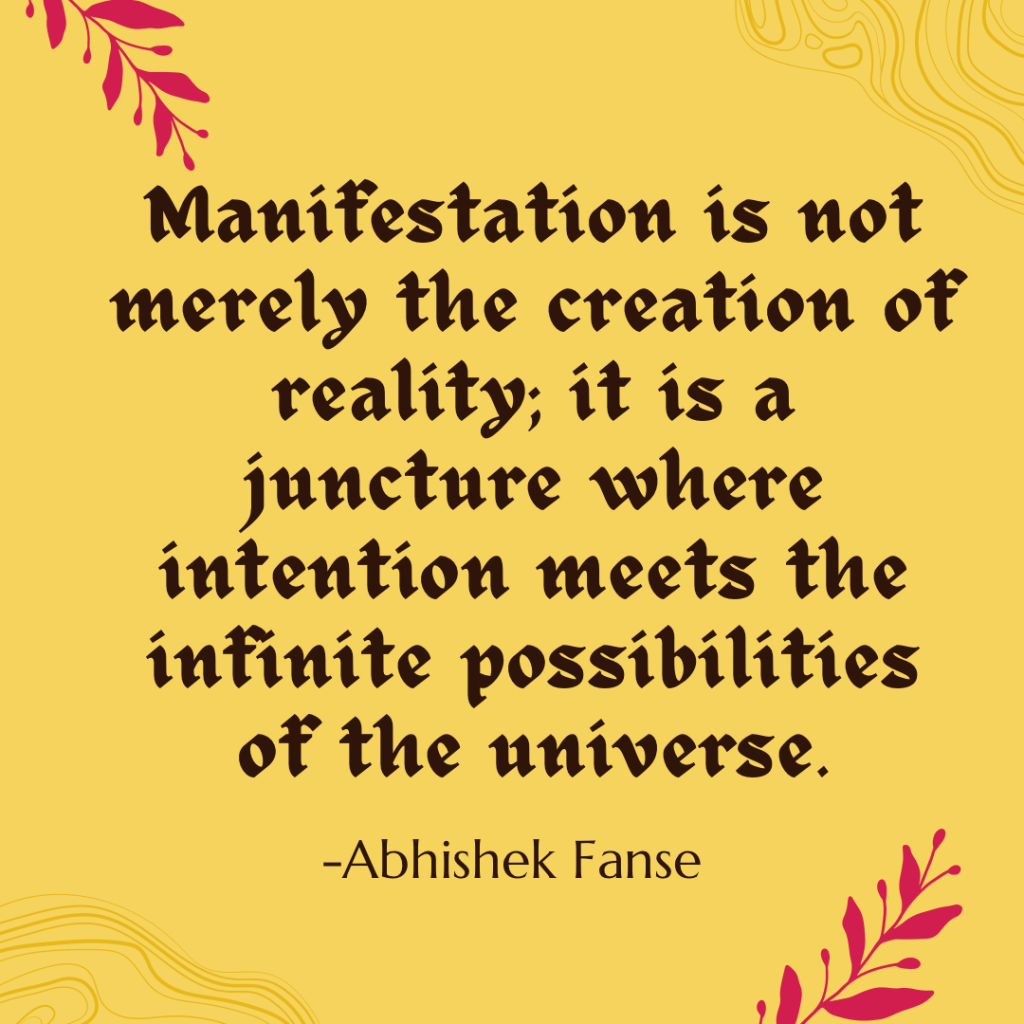
Consciousness is not static but fluid and ever-changing. It’s like a river flowing through the landscape of reality, constantly reshaped by its interactions with the external world and internal states. Manifesting in the now becomes an act of navigating this fluidity, understanding the transient nature of thoughts and emotions, and aligning with the deeper currents of consciousness.
The deepest aspect of manifesting in the now is self-realization – the understanding of one’s true nature beyond the ego and individual identity. In this state, manifestation is not about bringing desires into reality but realizing that one’s essential nature is already whole and complete. In this space, manifestation is experienced as an alignment with the cosmic dance of creation, where the distinction between the manifestor and the manifested blurs with the ultimate realisation “Manifestor is manifested”.
Whispers of the Quiet Quest!!
Silent seeker’s quest
In the realm of the silent seeker’s stride,
Where bridges burn, and shadows hide,
A journey deep, through time’s vast tide,
To realms within, where truths reside.
The witness stands, on shores of mind,
Observing life, to ties unbind.
Yet comes a time, the seeker finds,
To transcend watch, and life entwined.
For what’s an end, but a new dawn?
A realization, a reborn fawn.
Not a destination, but a stretch yawning wide,
A shift of soul, where truths reside.
Observer, witness, names do vary,
Yet their essence, one mustn’t miscarry.
A silent gaze, detached, unweary,
In the dance of life, a step so necessary.
The ego’s song, a siren’s call,
Binds the soul, in a webbed thrall.
But in awakened states, its grip does fall,
As vastness reigns, over the minuscule and small.
Time, a river, flowing swift and sure,
Past’s lessons, future’s lure.
Yet in the present, lies the cure,
To manifest dreams, pure and pure.
Intention sets the compass’ needle,
Visualization paints the dream’s easel.
Emotion fuels, action’s sequel,
And gratitude wraps, life’s upheaval.
In the dance of duality, the rhythm is profound,
Yet beyond the beats, a silence is found.
For in the heart of existence, where truths are unbound,
Lies the song of the soul, an eternal sound.

Love – can it be more or less??
Love is a deeply profound and complex human emotion, often defying straightforward explanations and definitions. At its core, love can be viewed as an unconditional acceptance and appreciation of oneself or another, involving care, empathy, and a desire for the loved one’s well-being. This exploration will delve into why we sometimes feel the need for more or less love, why we keep expectations in love, and why love can sometimes result in hurt.
The expression of love involves a diverse array of feelings, behaviors, and beliefs, which are influenced by a myriad of psychological, social, cultural, and biological factors. From the perspective of evolutionary psychology, love can be seen as a survival mechanism, promoting bonding and mutual aid, which are crucial for the survival of our species.
On a psychological level, love involves the interplay of multiple elements including attachment, intimacy, commitment, passion, and care. It’s often in the dynamics of these elements that we start to perceive love as being ‘more’ or ‘less’. The need for ‘more’ love could be linked to an increased desire for emotional intimacy, assurance, or care, while the feeling of ‘too much’ love might be related to an overwhelming sense of vulnerability or loss of autonomy.
Cultural and societal norms also play a role in shaping our perceptions of love. Cultures around the world have different understandings and expectations of love, which influence how individuals perceive, express, and experience love.
The expectation in love is a widely experienced phenomenon and is closely tied to the human propensity for prediction and desire for stability. As human beings, we have an innate tendency to form expectations based on our past experiences and societal norms. These expectations can serve as a guide, helping us navigate our relationships and giving us a sense of control and predictability.
However, expectations can sometimes lead to disappointment and hurt when they are not met. This can happen when our expectations are unrealistic or when they are not aligned with the other person’s capabilities or intentions. It’s important to note that unmet expectations don’t necessarily imply a lack of love, but rather a discrepancy between our desires and reality.
The concept of love being always 100% and none when there’s less, is a philosophical interpretation that holds love as a complete, all-encompassing emotion. When we truly love, we love wholly and unconditionally. This kind of love does not fluctuate but remains constant, irrespective of circumstances. This is the ideal form of love, the one we aspire to, where love is pure, unconditional, and complete.
Yet, in our human experience, we often find ourselves in a different reality, one where love is not always perceived as complete or constant. In these instances, love can sometimes lead to hurt. This is because love involves vulnerability. To love is to open ourselves up to another, to let them affect us in a deeply personal way. This openness can sometimes lead to pain, especially if the love is not reciprocated, if there’s a betrayal, or if the loved one is lost.
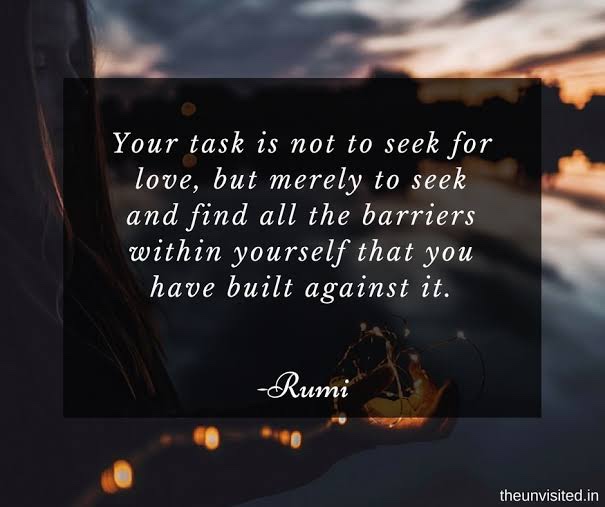
Moreover, it’s crucial to distinguish between love as a pure, selfless emotion, and our human interpretations and reactions to this emotion. While love in its purest form is unconditional and constant, our perceptions and experiences of love are influenced by our individual personalities, past experiences, emotional needs, and mental health.
So, when we say we want ‘more’ love, what we often mean is that we want more demonstrations of love – more time, more affection, more understanding, more validation. Similarly, when we feel hurt in love, it’s often not love itself that hurts us, but the actions (or lack thereof) that stem from it, or rather, our interpretation of these actions.
It’s important to acknowledge that while love is a universal emotion, our understanding and experience of love are deeply personal and unique. It is through our interactions with others that we learn about love, and through introspection, we deepen our understanding of it.
As we continue our exploration of love, let’s delve into the concept of ‘contagious’ love. The contagious nature of love is deeply rooted in our evolutionary history and neurobiology. As social beings, our survival and well-being are dependent on our ability to form and maintain relationships with others. Love, being a powerful emotional bond, helps us create these social ties and foster cooperation.
On a neurological level, the contagiousness of love can be explained by the presence of mirror neurons in our brain. These are a type of brain cell that responds equally when we perform an action or when we witness someone else perform the same action. When we see a loved one expressing love, our mirror neurons fire, causing us to mimic their emotional state internally. This neural ‘mirroring’ can result in us experiencing a similar feeling of love, making it seem as if love is ‘contagious’.
The shared experience of love enhances empathy, strengthens social bonds, and promotes communal harmony. It allows us to understand and share the feelings of others, contributing to our ability to empathize and connect on a deeper level. Moreover, when we see love being expressed, it often inspires us to express our own love more freely, spreading the emotion in a ripple effect.
However, as we navigate through the realms of love, we often come face-to-face with the reality of emotional pain. Why do we get hurt in love? It’s important to remember that love in its truest, most unadulterated form doesn’t cause pain. It is the conditions, expectations, and attachments that we often associate with love that lead to suffering.
We are often hurt when our expectations in love are not met. This could be because we expect certain behaviors from our loved ones, or we assume that our expression of love should be reciprocated in a certain way. When reality does not align with these expectations, it can result in feelings of disappointment, rejection, and hurt.
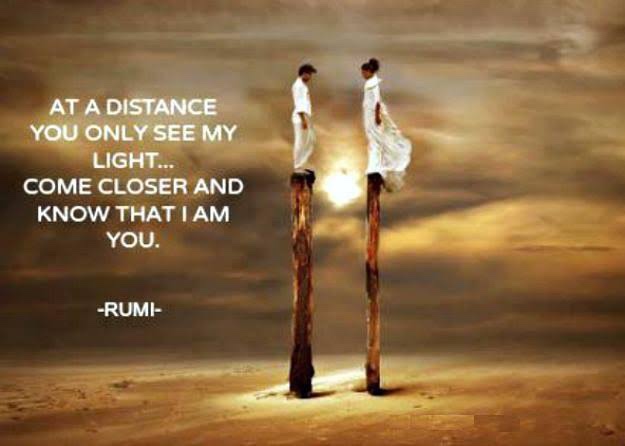
Furthermore, love inherently involves vulnerability. When we love, we open up, we share our innermost selves, our hopes, fears, dreams, and insecurities. This emotional openness leaves us susceptible to pain and hurt. If our vulnerability is not handled with care, or if our trust is broken, it can lead to deep emotional wounds.
Yet, it’s essential to note that the potential for pain should not deter us from embracing love. Love, even with its potential for hurt, brings a depth of emotion and a richness of experience that is unparalleled. The joy, connection, and growth that love can bring far outweigh the risks associated with it.
In addition, the pain that sometimes accompanies love can serve as a catalyst for personal growth and self-understanding. It can help us understand our emotional needs and patterns better, encourage us to develop healthier relationship skills, and foster emotional resilience.

In the grand tapestry of life, love weaves its own unique thread. It adds color, texture, and depth, making our human experience all the more vibrant and meaningful. Love, in its fullness, is not just an emotion; it is an experience, a journey. It is a journey of joy and pain, of connection and loss, of self-discovery and growth.
Understanding love in its entirety requires embracing its complexities, its highs and lows, its joys and pains. It involves recognizing that love is not merely about fulfilling our needs or desires, but about growth, understanding, and deep connection. It’s about seeing and accepting ourselves and others in our wholeness, with all our strengths and weaknesses, hopes and fears, perfections and imperfections.
And while love can sometimes lead to pain, it also holds the promise of healing. Love has the capacity to heal wounds, bridge divides, and transform our lives in profound ways. So, despite its complexities and challenges, we continue to seek love, to give love, to be in love. For in the end, love is not just an emotion; it is a fundamental part of our humanity, a testament to our capacity for empathy, connection, and kindness. It is a force that binds us, nurtures us, and propels us towards growth and fulfillment.
 Abhishek Fanse