
Patanjali Yoga Sutra: Abhyāsa-vairāgyābhyāṁ tan-nirodhaḥ
Sutra-12: अभ्यासवैराग्याभ्यां तन्निरोधः।
(Translation: Abhyāsa-vairāgyābhyāṁ tan-nirodhaḥ)
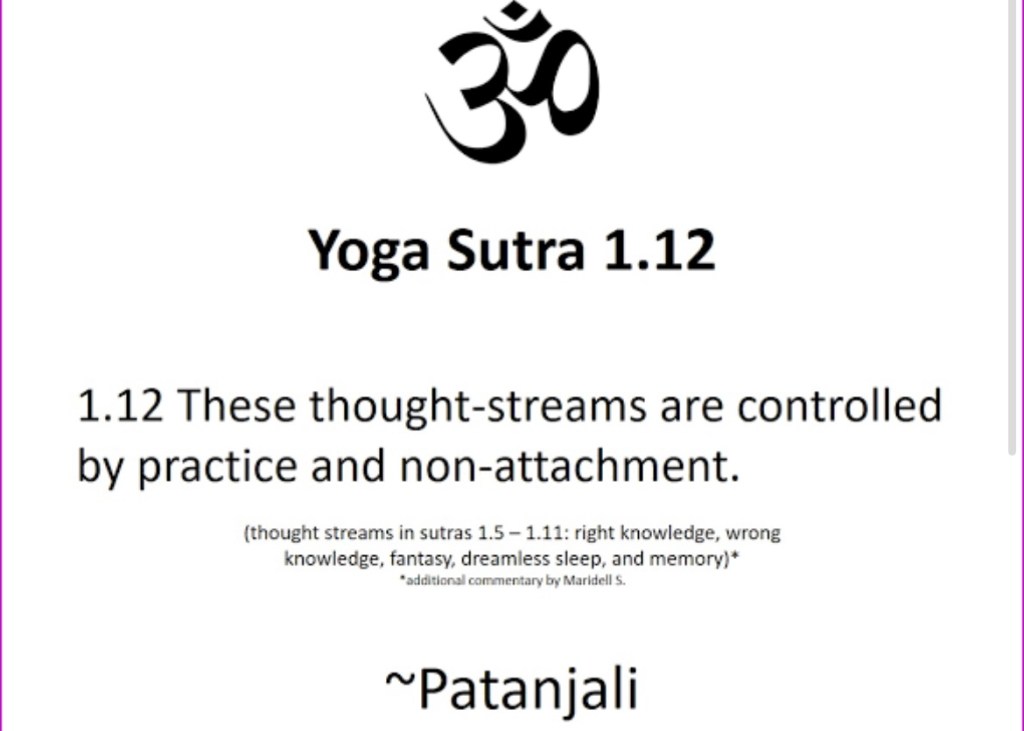
This translates to: “The cessation of all mental modifications can be achieved by practice and non-attachment.”
1. Abhyasa (Practice)
The first part of Sutra-12 mentions “Abhyasa” which directly translates to practice. The context in which it is used here refers to the practice of controlling and focusing the mind. It signifies persistent effort in a disciplined and dedicated manner. Just as physical skills, such as playing a musical instrument, require regular and consistent practice to master, so too does the calming and focusing of the mind.
By this, Patanjali suggests that to master our thoughts and control our mind, we must commit to persistent practice, to gently direct our attention back whenever it wanders. Over time, this practice can lead to deeper concentration, greater mindfulness, and, ultimately, a state of meditation.
2. Vairagya (Non-Attachment)
The second part of the sutra talks about “Vairagya” or non-attachment. Vairagya doesn’t denote a physical abandonment of worldly possessions or relationships, but it refers to an inner state of freedom from desires and attachments. It is the ability to be in the world, fully engaged, yet not bound by it.
It requires an understanding of the transient nature of all things, a recognition that clinging to the impermanent will invariably lead to suffering. By practicing Vairagya, we learn to enjoy the world around us without becoming entangled in it, to be at peace regardless of circumstances, and to maintain equanimity in all situations.
The Interplay of Abhyasa and Vairagya
Patanjali proposes that the mind’s modification and the attainment of inner tranquillity require both Abhyasa and Vairagya to work in conjunction. While Abhyasa provides the mind with the discipline it requires to maintain focus and concentration, Vairagya allows the mind to let go of distracting desires and attachments. When these two are practiced in tandem, they help one to quiet the mind and lead to a state of stillness and equanimity.
Patanjali’s Yoga Sutra-12 can be a potent guide to living a fulfilled life. In our daily existence, it encourages us to embrace a disciplined practice of mental focusing – be it through meditation, prayer, or mindfulness. Simultaneously, it advocates for a detached interaction with worldly matters, teaching us not to be swayed by success or failure, and to find peace amidst chaos.
It is a challenging yet liberating practice that can lead to increased mental clarity, reduced stress, and ultimately, a deeper understanding of oneself and the world.
Applying the Sutra in Your Yoga Practice
The teaching of this sutra can be reflected upon during asana (physical postures), pranayama (breathing exercises), and dhyana (meditation) practices. Here are some ways to do this:
- Asana Practice: While practicing yoga poses, make it a regular habit (Abhyasa) to observe your body’s alignment, breath, sensations, and thoughts. This will help in training your mind to focus and be present. Simultaneously, cultivate Vairagya by not becoming attached to any specific outcome, such as perfecting a pose. Instead, appreciate the journey of progressing in each posture.
- Pranayama Practice: Regular practice of pranayama techniques can enhance concentration and control of the mind. While practicing, cultivate Vairagya by accepting where you are in your practice, not striving for more breaths or deeper inhalations and exhalations. Accept the flow of your breath as it is.
- Meditation Practice: Meditation is the most direct form of practice (Abhyasa) for achieving the mind’s control. When you meditate, practice Vairagya by not attaching to or judging any thoughts or feelings that arise. Observe them and let them pass like clouds in the sky.
Patanjali Yoga Sutra: yatra yogashchittavrittinirodhah
यत्र योगश्चित्तवृत्तिनिरोधः॥११॥
Transliteration: yatra yogashchittavrittinirodhah
Translation: “The restraint of the modifications of the mind-stuff is Yoga.”
In the eleventh sutra of Patanjali’s Yoga Sutras, we are presented with a profound insight into the essence of Yoga. The sutra encapsulates the fundamental practice of restraining the fluctuations of the mind, which is at the core of the yogic path.
To understand the depth of this sutra, we must explore the meaning of each component. The word “yatra” refers to a state or condition, indicating a specific realm or dimension. “Yoga” is the state of union or connection, often understood as the union of the individual self with the universal consciousness. “Chittavrittinirodhah” refers to the restraint or cessation of the modifications of the mind-stuff.

The mind, with its ever-changing thoughts, emotions, and desires, can be likened to a turbulent ocean. It is constantly in motion, easily swayed by external circumstances and internal fluctuations. This constant agitation of the mind creates a veil that obstructs our true nature and hinders our ability to experience the deeper realms of consciousness.
The practice of Yoga is not merely about physical postures or breathing exercises. It is about gaining mastery over the mind and transcending its limitations. The eleventh sutra emphasizes the importance of restraining the modifications of the mind-stuff to attain a state of clarity and stillness.
When the mind is free from the incessant fluctuations of thoughts and desires, it becomes like a calm and serene lake, reflecting the truth of our being. In this state of stillness, we can directly experience the boundless nature of consciousness and the interconnectedness of all things.
The practice of restraining the mind requires discipline, awareness, and self-inquiry. It involves observing the patterns of the mind, noticing the arising thoughts and emotions without getting entangled in them, and gradually quieting the mental chatter. Through regular practice, we cultivate a space of inner silence where true understanding and insight can arise.
It is important to note that the restraint of the modifications of the mind does not imply suppression or denial of thoughts and emotions. Rather, it is a process of witnessing them with non-judgmental awareness, allowing them to naturally arise and subside without being carried away by their transient nature.
As we delve deeper into this practice, we begin to recognize the intrinsic connection between the mind and our perception of reality. The mind, with its constant fluctuations, shapes our perception and colors our experience of the world. By restraining the modifications of the mind, we gain the ability to see things as they truly are, free from the distortions created by our conditioned patterns of thinking.
In this state of pure awareness, the limitations of the individual self dissolve, and we enter into a state of union with the larger tapestry of existence. We realize our interconnectedness with all beings and the underlying unity that permeates the universe. This realization brings profound peace, harmony, and a sense of oneness.
The eleventh sutra serves as a reminder of the transformative power of Yoga. By restraining the modifications of the mind-stuff, we unlock the door to higher states of consciousness, expanding our perception and deepening our connection to the divine. It is an invitation to go beyond the surface-level fluctuations of the mind and discover the vastness of our true nature.
Incorporating the practice of restraining the mind into our daily lives, both on and off the mat, allows us to cultivate a state of inner stillness where clarity and wisdom can naturally arise. It is a journey of self-discovery, where we learn to observe our thoughts and emotions without judgment, and cultivate a sense of detachment from the constant stream of mental activity.
As we delve deeper into the practice, we may encounter challenges and resistance. The mind, accustomed to its habitual patterns, may rebel against the discipline of restraint. It may tempt us with distractions, enticing us to indulge in the endless stream of thoughts and desires. But it is through perseverance and dedication that we can gradually loosen the grip of the mind’s fluctuations and find moments of genuine stillness.
In the state of mind-stuff restraint, we discover the freedom to choose our responses rather than being driven by unconscious reactions. We become aware of the choices available to us in every moment and can act from a place of clarity and authenticity. This cultivates a sense of empowerment and enables us to navigate life’s challenges with grace and equanimity.
The practice of restraining the modifications of the mind also has a profound impact on our relationships. As we become more attuned to the present moment, we develop a deeper sense of empathy and understanding towards others. We listen attentively, without the burden of preconceived judgments or projections. This fosters authentic connections and enhances our capacity for compassionate communication.
It is important to acknowledge that the process of restraining the mind’s fluctuations is not a quick fix or a one-time achievement. It is an ongoing practice that requires patience, self-compassion, and gentle persistence. We may experience moments of progress followed by periods of regression, but with each step, we deepen our understanding and strengthen our capacity to abide in a state of stillness. May the practice of restraining the mind’s modifications lead us to a state of profound peace, liberation, and the unshakable recognition of our interconnectedness with all of existence.
 Abhishek Fanse