Dissecting Risk: Risk Reevaluated
To understand risk, one must first examine its intertwined relationship with fear and uncertainty. Fear, in many respects, is a primal instinct, a protective mechanism that has evolved over millennia to ensure our survival. When faced with uncertainty, fear is our brain’s way of signaling possible danger. This fear then transmutes into the perception of risk. If we dissect the concept further, risk is not merely the chance of a negative outcome; it is the variability of all possible outcomes, both positive and negative.
Historically, our ancestors perceived risk in terms of immediate threats to survival. A rustling in the bushes could be a predator; consuming an unknown fruit could be poisonous. The decision to confront or flee from such situations was binary and rooted in the immediate need for survival. Over time, as societies became more complex and the nature of threats more multifaceted, our understanding of risk evolved. It began encompassing not just immediate physical threats but also social, emotional, and existential ones. The risk of rejection, the risk of failure, the risk of lost opportunities – these became the new “predators” lurking in the modern-day bushes. When we probe deeper into the origin of risk, we see that it arises from our innate desire to predict, control, and secure our futures. As sentient beings, we’re acutely aware of the passage of time and the transient nature of life. This awareness engenders a need to anticipate and influence future outcomes. When the outcome of an action or decision is uncertain, the mind perceives a risk.
However, it’s essential to note that risk, in itself, is neutral. It’s our emotional and cognitive responses to it that assign value – labeling it as ‘good’ or ‘bad’. For instance, an entrepreneur might view starting a business in a saturated market as a worthy risk, driven by the thrill of competition and the lure of potential success. Conversely, someone more security-oriented might see the same situation as fraught with unnecessary peril. If one doesn’t fear loss, failure, or the unknown, does risk even exist for them? At a philosophical level, without fear, the concept of risk is indeed defanged. However, even in the absence of fear, the uncertainty of outcomes remains. The fearless individual might not perceive this uncertainty as threatening, but it exists nonetheless. In this context, risk transforms from an emotionally charged concept into a mere statistical or probabilistic one.
Our personal experiences significantly color our perception of risk. Someone who has experienced the turbulent waters of bankruptcy might view financial risks differently than someone who has always experienced financial stability. Similarly, someone who has been burnt in love might perceive emotional risks in relationships more acutely than someone who hasn’t. Our past becomes the lens through which we evaluate future uncertainties. Beyond these factors, there’s also the intriguing interplay between risk and reward. Often, the potential rewards are what entices individuals to take risks in the first place. The entrepreneur might be motivated by the potential success, recognition, and financial gain, while the mountaineer is driven by the allure of conquering a challenging peak and the accompanying sense of accomplishment. This dynamic relationship often acts as the fulcrum on which decisions are balanced, with individuals constantly gauging whether the potential rewards justify the inherent risks.
Our linear experience of time – past, present, and future – makes us unique in the animal kingdom. We’re not just reactive to the present but are perpetually planning, anticipating, and sometimes dreading the future. Risk becomes a manifestation of this temporal consciousness. It embodies our anxieties about the future, our memories of the past, and our actions in the present.
Risk also touches upon the core tenets of freedom and responsibility. The very act of making a choice, knowing that the outcomes are uncertain, underlines the essence of human freedom. Each choice, enveloped in risk, becomes an assertion of our existence. Jean-Paul Sartre, a prominent existential philosopher, believed that we are “condemned to be free.” This freedom carries the weight of responsibility. Every risk we take, every decision we make, anchors us more deeply into the world, creating ripples that affect not only our own lives but also those around us. In this context, risk becomes an embodiment of our existential freedom and the accompanying burdens of our choices.
Risk also invites us to confront the inherent unpredictability and chaos of the universe. Despite our best efforts, life remains fundamentally uncertain. This reality poses profound questions about determinism and free will. If everything is preordained, is there truly any ‘risk’? Yet, the very experience of uncertainty, the palpable tension before a decision’s outcome, seems to argue for the existence of free will, or at least the perception of it. This brings us to the concept of ‘absurdity’, as introduced by Albert Camus. For Camus, life is inherently absurd because humans constantly seek meaning in an indifferent universe. Risk, in many ways, mirrors this absurdity. We seek to calculate, manage, and control risks, attempting to impose order on the inherent chaos of existence. Yet, no matter how meticulous our calculations, the unpredictable can and often does occur.

The human mind is a complex apparatus that thrives on patterns, structures, and predictions. It’s this very nature of our mind that gives birth to the notion of “risk.” Risk, in essence, can be seen as a cognitive construct – a product of our mind’s incessant need to anticipate the future based on past experiences, knowledge, and the limited information at our disposal. Risk as we perceive it, might indeed be an illusion.
Imagine for a moment a world without memory and without the capability to anticipate the future. In such a world, every moment would be lived in its pure immediacy, with no concept of potential loss or gain in future endeavors. In this hypothetical scenario, the concept of “risk” would be non-existent.

Consider the stock market: A trader might perceive a significant risk in buying a particular stock. This perception is rooted in market analysis, past performance of the stock, global economic indicators, and a myriad of other variables. But strip all that away, and the “risk” is essentially a story, a narrative constructed from myriad data points and emotions like fear and greed.
Similarly, the fear of rejection or judgment in social situations, often seen as a social risk, is built upon personal experiences, societal norms, and cultural expectations. But at its core, it’s a self-created narrative – a story we tell ourselves about potential outcomes and their implications for our self-worth. Does this mean risk is entirely subjective? In many ways, yes. While there are objective measurements of risk in certain fields (like insurance or finance), the emotional and psychological experience of risk is deeply subjective.
Yet, this subjectivity doesn’t render the concept of risk meaningless. Even if risk is a construct, it holds tangible power over our actions, decisions, and emotions. The very fact that we can feel fear, anxiety, excitement, or anticipation when faced with uncertainty testifies to the real-world impact of this illusion.
Can a decision be good or bad?
The concept of decision making and the parameters that define its goodness or badness are both fascinating and complex. When we take a decision, we hope for a certain outcome, and the real-world result of our decision is judged in relation to this expectation. Decisions are inherently linked with the consequences they bring, and we often label them as ‘good’ or ‘bad’ based on whether the outcome was favorable or unfavorable. But should this be the only measure of a decision’s quality?
Every decision, regardless of its scale or impact, is taken within a context. Factors such as personal beliefs, values, emotions, knowledge, past experiences, as well as our estimation of future events, all feed into the decision-making process. This intricate mixture of elements makes decision-making a highly individualized and subjective process.
Given this complexity, is it then possible or even fair to categorize decisions as definitively good or bad? And what are the parameters we should use to judge them?
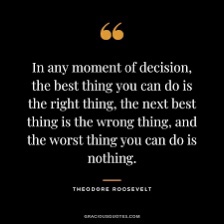
One viewpoint suggests that a good decision is one that is well-informed, well-considered, and aligned with one’s core values and goals. From this perspective, the goodness of a decision lies not in the outcome it produces, but rather in the process by which it was made. An individual may take a decision based on the best information available, taking into account all possible scenarios and aligning the decision with their values. If the outcome is unfavorable, does that make the decision bad? Arguably, no.
However, another viewpoint posits that decisions are inherently tied to their outcomes. If a decision leads to a positive outcome, it was a good decision. If the outcome is negative, the decision was bad. This perspective is very results-oriented, focusing on the end rather than the means. But it fails to consider that outcomes are often influenced by variables outside our control and cannot be predicted with certainty at the time of decision-making.
Considering both these viewpoints, it becomes clear that the notion of good and bad in decision-making is not absolute. It’s subjective and contextual, relying on both the decision-making process (the means) and the resulting outcome (the end).
Let’s consider an example to illustrate this: Imagine a person deciding to invest their savings in a seemingly promising startup. They do their due diligence, researching the market, the product, the team, and even consulting experts. They make a well-informed and well-considered decision to invest. But despite all their thoroughness, the startup fails after a few years, and they lose their investment. Was their decision bad?

If we judge solely based on the outcome, we might say yes. But if we look at the decision-making process, we could argue that they made a good decision given the information they had at the time. This example highlights the complexity and subjectivity involved in labeling decisions as good or bad.
The question of accountability further adds to this complexity. When we hold someone accountable for a decision, we are implying that they had control over the decision-making process and its outcome. This notion of control, however, is not always reflective of reality. As we’ve noted, decisions are influenced by numerous factors, many of which are beyond our control.
That being said, there is an aspect of decision-making where accountability does play a crucial role. When individuals make decisions, they should be held accountable for ensuring that the decision-making process is as thoughtful, ethical, and informed as possible. This means they should strive to gather all relevant information, consider all possible options, and align their decisions with their values and responsibilities.
While we cannot control all factors affecting the outcome of our decisions, we can strive to make informed, deliberate choices that reflect our values and understandings. And in the end, it’s through the experience of decision-making, both its successes and failures, that we learn and grow.
The notion of decision-making as it intersects with personal development and growth forms a vital part of this discussion. Each decision we make, whether deemed as good or bad, influences our lives, shaping us into who we become. It’s essential to understand that every decision, regardless of its outcome, provides us an opportunity for growth and learning.
Every decision, even the ones with unfavorable outcomes, provide lessons that can be harnessed to make better-informed decisions in the future. This idea ties into the concept of ‘failing forward,’ where we view failures not as dead-ends but as stepping stones to success. If we are open to learning from our missteps, we can transform even ‘bad’ decisions into useful experiences that make us wiser and more resilient.
Now, let’s explore the concept of regret, which often intertwines with our reflections on past decisions. Regret can stem from believing we made a ‘bad’ decision, which led to an unfavorable outcome. While it’s natural to experience regret, dwelling on past decisions can trap us in a cycle of guilt and self-blame. A healthier approach would be to acknowledge the decision and its consequences, extract lessons from the experience, and then use these insights to inform future decisions.
A further consideration in decision-making involves understanding the distinction between controllable and uncontrollable outcomes. This concept, often termed as ‘circle of influence’ and ‘circle of concern’ by management gurus like Stephen Covey, can be very helpful in reducing the stress around decision-making. We can focus our energies on the areas we can control or influence, rather than on areas beyond our reach. This shift in focus can help us make more empowered decisions and develop a more constructive perspective on the outcomes of those decisions.
Let’s expand this understanding with another example: A mountain climber prepares to scale a peak. She trains rigorously, equips herself with the right gear, studies weather patterns, and plans her route meticulously. Despite all these careful preparations, she could be forced to abandon her climb due to unexpected weather changes. Was her decision to climb wrong? By focusing on the process, we could argue that her decision was sound, based on her preparation and knowledge at the time.
We can also apply these principles in everyday decisions, such as choosing a career, deciding on a diet, or even selecting a movie to watch. By focusing on the decision-making process and by being open to learning from each decision’s outcomes, we enhance our ability to make better decisions in the future.
So, is there relevance to good and bad in decision-making? Yes, but it is a complex, multi-faceted relevance that cannot be boiled down to a simple binary. It includes considering our values, the information we have at hand, the potential consequences, and the context in which the decision is being made. It’s also about understanding that decision-making is a skill that can be honed over time, and every decision, whether it leads to success or failure, contributes to that learning and growth.
 Abhishek Fanse