Choice “Paralysis“
A choice implies that there is an alternative, and with every alternative comes the weight of consequences, perceived or real.
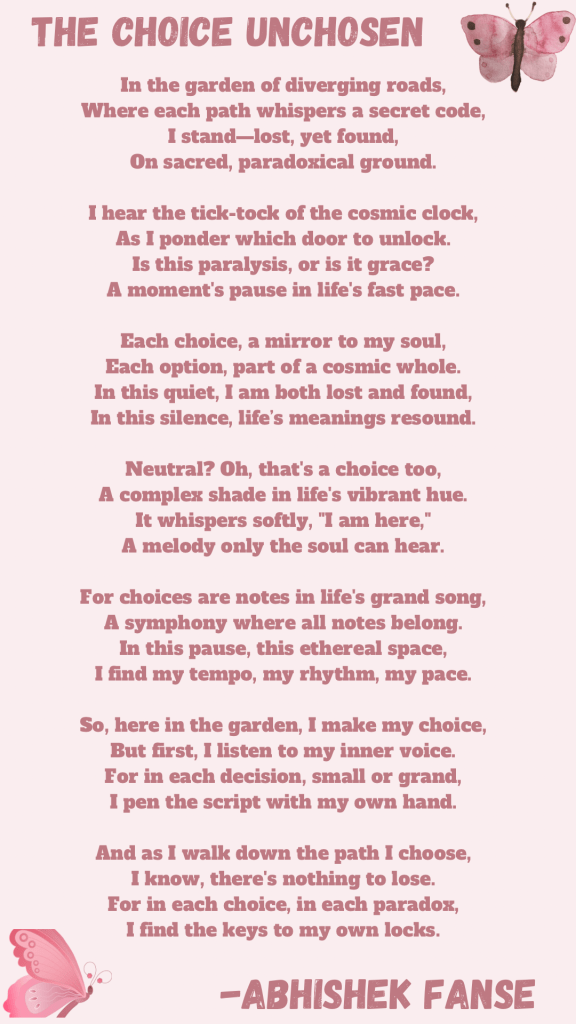
You speak of a ‘neutral’ stand, but let’s investigate what that really means. In reality, the idea of a neutral stance is a contradiction in terms. The very act of choosing neutrality is in itself a choice, made in opposition to other possible choices. So, the notion of being ‘neutral’ is inherently paradoxical because it cannot exist without the conditions that make it a choice to begin with.
For example, When you agree to a certain dosage of medication, you exercise control by making an informed decision. However, you also surrender control to the effects of that dosage, which may not be entirely predictable. This brings emotional complexity into play: the comfort of taking action (choosing the dosage) juxtaposed against the uncertainty of outcome. When we agree to disagree, we are on the contrary acknowledging that a middle ground is unreachable, yet we’re finding a sort of middle ground in that very acknowledgment. The challenge lies in our psychological need for validation and agreement, which often feels at odds with the more rational understanding that it’s perfectly okay for different viewpoints to coexist. We often fail to agree to disagree because our conditionings, our egos, don’t allow us to let go without a ‘win’ or a ‘loss.’
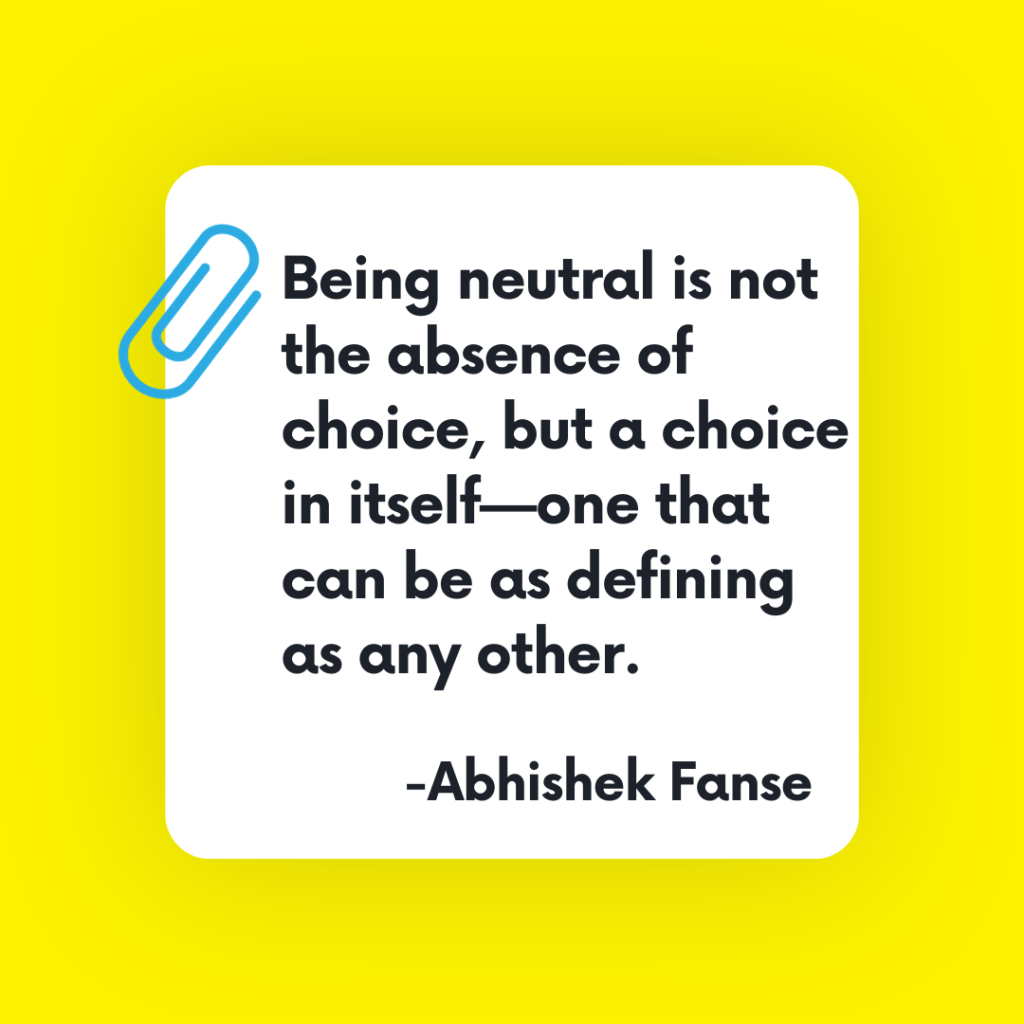
Every choice, by definition, is a rejection of its alternative. Therefore, choices are always relative, biased, and limited by the options that exist. In that sense, a choice cannot be independent because it is defined by the conditions that make it a choice. The idea of a ‘choice’ presupposes the existence of an alternative, of a comparison. In a context where there is only one thing that exists independently, the notion of ‘choice’ would be meaningless because there would be nothing to choose from. Therefore, it wouldn’t be a choice; it would simply be a state of being. The paradox exists because we try to define and understand choice within the limited framework of language and duality. However, once you recognize that the very nature of choice is paradoxical and conditional, and you embrace that paradox rather than trying to resolve it, you arrive at a sort of meta-clarity. This does not mean you’ve resolved the paradox; it simply means you’ve stepped outside of it. You’ve transcended the limitations that come with the dualistic thinking of ‘this or that,’ ‘yes or no,’ ‘neutral or biased.’
Choices are never made in emotional vacuums. They are laden with expectations, fears, and desires that stem from our past experiences, conditionings, and inherent personality traits. Even the seemingly most “logical” choice is often deeply influenced by emotions we may not even be fully aware of. The emotional charge of expectations is often the heaviest. When we make a choice, it is often governed by what we expect the outcome will bring us—pleasure, validation, success, or the avoidance of pain and conflict. The emotion here is one of anticipation, coupled with anxiety about whether our expectations will be met.
Then there’s desire, an emotion that often masquerades as need. The choices we make based on desire are emotionally charged with hopes for fulfillment, achievement, or recognition. But desire is a double-edged sword: while it motivates us, it also sets us up for disappointment if things don’t go as planned.
Even when we think we are making a “neutral” choice, what we are often trying to do is distance ourselves emotionally from the implications of the decision. We might say it’s “purely logical,” but the underlying emotion is often one of self-preservation—we wish to remain unscathed by the emotional weight that comes with making a more obviously partial choice.

One reason choices are emotionally charged is that they give us the illusion of control. Making a decision allows us to feel like we have some say over our fate. However, this control is always somewhat illusory. Life’s unpredictability ensures that our choices, no matter how well-considered, often have unexpected outcomes. The realization that our control is limited can bring up a host of emotions like helplessness or existential dread. Every choice we make, big or small, adds a brick to the edifice of our self-identity. We look for validation through our choices; when they lead to desired outcomes, it reinforces our sense of self-worth. When they don’t, it challenges our self-image and can lead to emotions like self-doubt, shame, or regret.
Our choices also affect how we are viewed by others, adding another layer of emotional complexity. Sometimes we make choices that conform to societal norms or expectations to avoid judgment or gain approval. The emotions at play here are often related to a fear of rejection or a need for social cohesion. At other times, we may make choices that go against the grain, driven by a desire for individuality or authenticity. This can lead to a complicated cocktail of pride, liberation, but also potential loneliness.
When it comes to seemingly paradoxical choices—like choosing wisdom over a loved one or maintaining a “neutral” stance—the emotional texture becomes even more intricate. For instance, choosing wisdom over a loved one might be a defense mechanism to protect oneself from future emotional pain, yet it can also lead to immediate emotional pain due to the distancing from the loved one. Here, both foresight and dread, love and rationality, are locked in an emotional tussle.
In cases where we choose to be “neutral,” what we are really doing is choosing not to engage emotionally in a way that makes us vulnerable. We might convince ourselves that we’re staying above the fray, but deep down, the need to protect ourselves emotionally is dictating that ‘neutral’ choice. The emotion behind neutrality is often a fear of emotional engagement, wrapped up in a protective layer of rationality. Ultimately, emotional maturity plays a large role in how we navigate the sea of choices and their associated feelings. Being aware of our emotional drivers allows us to make more ‘informed’ choices, even if that information is coming from within ourselves. This kind of self-awareness can temper the more reactive emotions like fear and desire and allow room for more nuanced feelings like contentment, acceptance, and genuine love to inform our decisions.
Choice is often seen as liberating, an act of free will that puts us in the driver’s seat of our destiny. However, with every choice we make, we also close off other possibilities, limiting ourselves in certain ways. The emotional paradox here is the simultaneous existence of freedom and constraint within the same action. We may feel exuberant for choosing a particular path, but there can be a latent sadness or anxiety about the paths left unexplored.
While choices often feel monumental in the moment, their impact can wane over time, sometimes even reversing in significance. What seemed like a terrible choice in the past may later appear wise, or vice versa. This fluidity can generate complex emotions, such as regret for past choices or anxiety about the unpredictability of future choices and their unforeseeable emotional implications.
Ultimately, where every action presents us with a choice and counter choices, we sometimes find ourselves paralyzed, suspended in a moment of indecision. Yet, this paralysis isn’t a dead end; it’s a pause, a sacred space that invites us to reflect, to feel, and to become keenly aware of our humanity.
What if we reframe this so-called “choice paralysis” not as a dilemma but as a moment of pause in the great narrative of our lives? It becomes not a prison, but a platform; not a quagmire, but a quest. In this paused state, we are philosophers, artists, and explorers of the inner cosmos. We grapple not just with options but with identities, not merely with pros and cons but with hopes and fears, love and loss.
In this pause, we are not frozen; we are fervently alive. We are composing in our minds the symphony of our future, writing the next act of our life’s drama, sculpting the clay of our becoming.
And when the pause lifts—as it always does—we make a choice, yes, but we also do something more profound: we embrace our capacity to choose, even when the choices are hard, even when the path is foggy. For it’s in the wrestling with choices that we come to know who we truly are.
So, the next time you find yourself in the clutches of choice paralysis, remember: you are standing at the confluence of many rivers, each leading to a different ocean but all part of the same Earth. And it’s okay to stand there for a while, to feel the currents, to listen to their distinct murmurs, before stepping into the stream that will carry you to your next adventure.
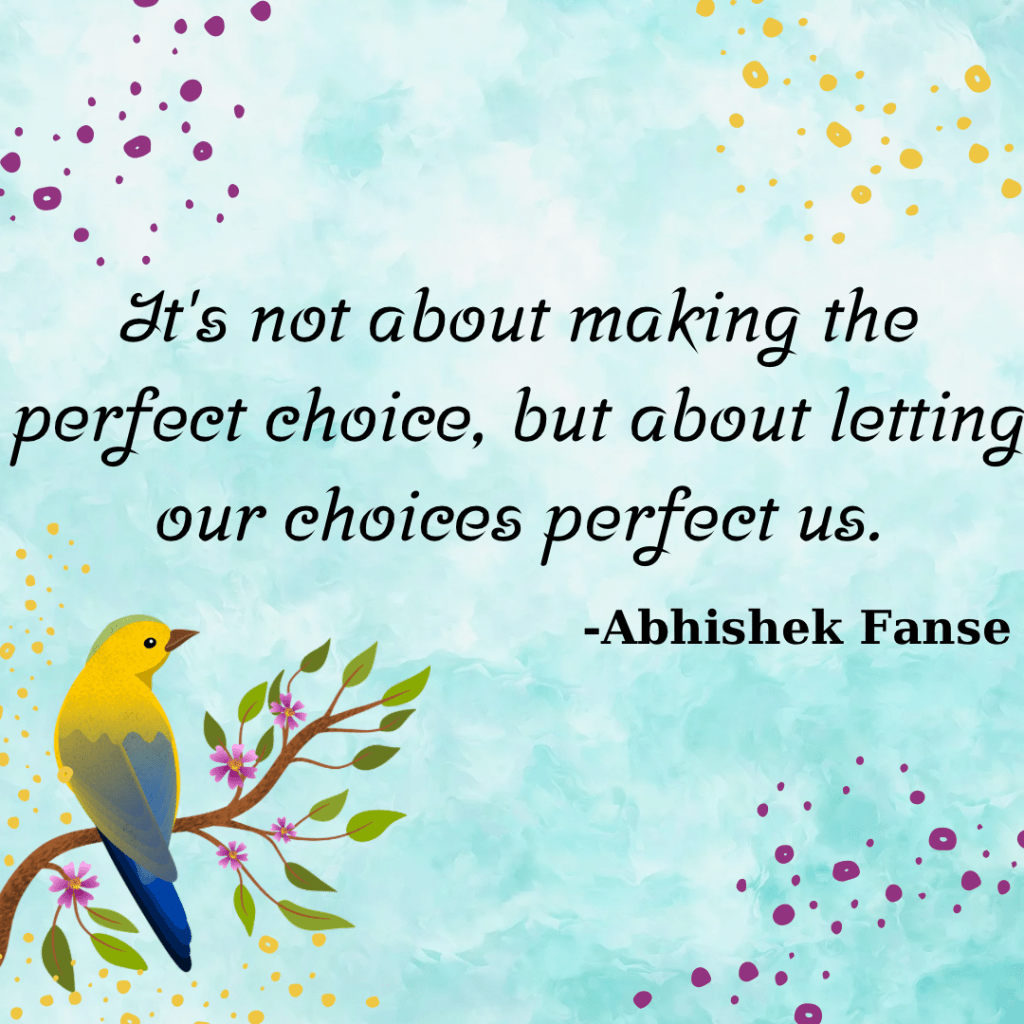
And so, we are forever navigating, forever choosing. Not in search of resolution, but in pursuit of growth. In the end, it’s not about making the perfect choice, but about making our choices perfect us.
Faith – reality in unseen ?
The concept of faith is one of the most profound yet elusive aspects of human life. Rooted in the intangible and often transcending the bounds of logical reasoning, faith is a powerful force that shapes our worldviews, influences our actions, and gives meaning to our existence. In its most fundamental form, faith is a complete trust or confidence in something or someone. However, the nature and implications of faith are much more nuanced and multifaceted.
Faith operates in various dimensions of our lives, not just in religious or spiritual contexts. We exhibit faith when we trust our loved ones, when we believe in the promise of a better future, when we have confidence in our abilities despite past failures, and even when we participate in social or economic systems. Faith, therefore, is deeply ingrained in our daily lives, influencing our decisions and perceptions, often without us consciously realizing it.
When it comes to faith in things unseen or events yet to happen, the dynamics become even more complex. This kind of faith typically involves a degree of uncertainty and mystery. It requires a leap beyond the confines of empirical evidence and tangible proof. But why do we, as rational beings, place faith in the unseen or the unknown?
Part of the answer lies in our inherent desire for meaning, purpose, and connection. As conscious beings, we yearn to understand the world around us, to make sense of our experiences, and to feel connected to something greater than ourselves. This quest for understanding and connection often leads us into the realm of the unseen, the unproven, the mysterious. It’s in this realm that faith becomes an essential tool.
Moreover, our experiences shape our faith. Experiences of love, compassion, resilience, and transformation can reinforce our faith in positive values, in humanity, or in a higher power. On the other hand, experiences of pain, loss, or injustice might challenge or even shatter our faith. Nevertheless, it’s often in the midst of adversity that faith evolves and deepens, as we grapple with questions of meaning, purpose, and hope.

The role of faith in our lives can be multifarious. For some, faith in a divine entity brings comfort and guidance. It instills hope during trials and tribulations, fosters a sense of community and belonging, and provides a moral framework for life. For others, faith in human potential and progress fuels the pursuit of knowledge, justice, and innovation.
Does faith have anything to do with what has happened and what’s going to happen? Indeed, faith is often interwoven with our perceptions of the past, present, and future. Past experiences can shape our faith, as we learn from our triumphs and failures, joys and sorrows. Our faith, in turn, influences how we navigate the present and envision the future. It can give us the courage to face challenges, the patience to endure hardships, and the inspiration to dream and create.
At the same time, faith is not about predicting the future with certainty. Rather, it’s about embracing uncertainty with hope and resilience. It’s about daring to dream, to strive, and to love, even when the outcomes are unknown. It’s about trusting in the potential for growth, transformation, and transcendence, regardless of our current circumstances or past experiences.
Is faith real? The reality of faith might not be tangible or measurable, but its impact on human life is undeniable. Across cultures and throughout history, faith has inspired art and literature, fueled social movements, shaped civilizations, and transformed individual lives. Its reality is manifested in the courage of those who dare to dream and create, in the resilience of those who endure suffering with hope, and in the love and compassion that transcend boundaries of race, religion, and ideology.
It’s worth noting, however, that faith is not about passive acceptance or blind allegiance. True faith involves questioning, seeking, and growing. It’s a dynamic, evolving journey rather than a fixed destination. It requires humility to acknowledge the unknown, courage to question and explore, and wisdom to discern truth from illusion. While the nature of faith is complex and elusive, its essence can be encapsulated in the timeless words of Martin Luther King Jr.: “Faith is taking the first step even when you don’t see the whole staircase.”

To deepen our exploration of faith, let’s consider it from various perspectives: philosophical, psychological, sociological, and spiritual.
From a philosophical perspective, faith brings up interesting questions about knowledge and belief. Philosophers have long pondered how we can justify our beliefs or knowledge claims, particularly when they concern the unseen or the unproven. Can faith be considered a form of knowledge? Does it require justification or evidence? Different philosophical traditions offer diverse answers. For instance, the school of pragmatism posits that beliefs (and by extension, faith) can be justified if they yield positive outcomes or experiences.
From a psychological perspective, faith can be viewed as a cognitive and emotional mechanism that helps us navigate uncertainty and complexity. For instance, when we face a difficult decision or an unpredictable situation, faith can provide a sense of direction and confidence. Psychological research has shown that faith (both religious and secular) can contribute to mental well-being, resilience, and prosocial behavior. For instance, faith in one’s abilities (also known as self-efficacy) is a key factor in motivation and achievement.
From a sociological perspective, faith plays a crucial role in social cohesion and collective action. Shared beliefs and values can foster a sense of community and cooperation, enabling societies to function and evolve. For example, faith in democratic values underpins democratic institutions and practices. Moreover, faith can inspire social change. The civil rights movement in the United States, led by figures like Martin Luther King Jr., is a powerful example of faith-driven social activism.
From a spiritual perspective, faith is often associated with the relationship between the human soul and the divine or the transcendent. Faith can manifest as trust in divine providence, commitment to spiritual practices, or aspiration for spiritual growth. For instance, in the Bhagavad Gita, a sacred text of Hinduism, Lord Krishna advises Arjuna to perform his duty with faith and without attachment to the results – a principle known as Karma Yoga.
Let’s consider a few examples that illuminate the multifaceted nature of faith. Imagine a student who is preparing for a challenging exam. Her faith in her abilities motivates her to study diligently. She also has faith in the fairness of the educational system and the value of her chosen field of study. This faith sustains her through the stress and uncertainty of the exam period.
Consider also the example of a social activist. He has faith in the possibility of a more just and sustainable world. This faith fuels his advocacy and activism, despite the challenges and setbacks he might face. He also has faith in the power of collective action and the potential for social change.
Finally, contemplate the faith of a spiritual seeker. She has faith in a higher power and a deeper reality beyond the material world. This faith guides her spiritual practices and informs her life choices. Even in the face of doubt or despair, her faith provides a source of strength and solace.
Let’s consider some more aspects of faith: faith as an act of surrender, faith and reason, faith and doubt, and faith as a dynamic process.
- Faith as an Act of Surrender: In many spiritual traditions, faith is often depicted as a surrender, a relinquishing of the illusion of control. When we face life’s uncertainties, we often try to manipulate outcomes according to our desires. However, faith involves trusting the flow of life, even when it does not conform to our expectations. It’s like floating on the surface of a vast ocean, trusting in its currents to guide us, rather than struggling against them. This concept of surrender is not about inaction or defeat, but about embracing life’s unpredictability and recognizing our limited perspective.
- Faith and Reason: Faith and reason are often viewed as conflicting forces, particularly in the discourse between science and religion. However, they can also be seen as complementary aspects of our human quest for understanding. Reason involves the critical examination of evidence and the logical analysis of ideas. It is indispensable in our pursuit of empirical knowledge and practical wisdom. Faith, on the other hand, steps in where reason reaches its limits. It enables us to navigate the mysteries of existence, to live with uncertainty, and to aspire for ideals that transcend empirical evidence.
- Faith and Doubt: Doubt is often seen as the antithesis of faith, but it can also be an integral part of the journey of faith. Doubt prompts us to question our beliefs, to seek deeper understanding, and to remain open to new insights. A faith that has never been challenged by doubt may be unexamined or dogmatic. As philosopher Paul Tillich put it, “Doubt is not the opposite of faith; it is one element of faith.”
- Faith as a Dynamic Process: Faith is not a static state but a dynamic process. It evolves as we encounter new experiences, insights, and challenges. Faith is not about clinging to fixed beliefs, but about cultivating a receptive and resilient spirit. It involves not only trusting in something beyond ourselves but also believing in our capacity to learn, grow, and adapt.
To illustrate these aspects, let’s revisit our previous examples. The student preparing for an exam may experience moments of self-doubt and anxiety. However, she can choose to see these challenges as opportunities for growth rather than threats to her faith in her abilities. By acknowledging her doubts, she can deepen her understanding of herself and her aspirations. By surrendering to the process, she can relieve her anxiety and focus on her effort rather than the outcome.
The social activist might face skepticism or opposition, testing his faith in his cause. But rather than deterring him, these challenges can strengthen his commitment and clarify his vision. His faith is not a blind belief but a conscious choice, informed by his understanding of social issues and his conviction in the power of change.
The spiritual seeker may grapple with profound questions about the divine and the nature of existence. Her faith does not prevent her from questioning or exploring different perspectives. Instead, it serves as a compass in her spiritual quest, guiding her through the vast and often confusing landscape of spiritual wisdom.
These examples underscore the richness and complexity of faith. Rather than a monolithic entity, faith is a kaleidoscope of perspectives, experiences, and choices. It is a multifaceted gem, whose beauty and depth are revealed in the light of our personal and collective journeys.
 Abhishek Fanse