
Understanding Confidence: Beyond the Binary of “more” or “less“
It’s a term thrown around often, in self-help books, motivational speeches, and even casual conversations. But what exactly is confidence? Is it an intangible force that some people possess while others lack, or is it an inherent aspect of every individual that remains unaffected by external circumstances? Let’s dive deep into this paradoxical phenomenon.

If one looks closely, the term has been constructed based on societal norms and standards. It is believed that certain behaviors, decisions, or characteristics project a sense of certainty, while others indicate a lack of the same. Over time, these beliefs have formed the structure we identify as confidence. However, considering the vast spectrum of human emotions and the varied circumstances everyone faces, is it valid to classify them under the binary of confidence and its lack?
For instance, a deer running from a predator is often acting out of fear. However, the very act of running, the determination to escape, indicates a level of confidence in its ability to survive. Similarly, when a person is fearful, that fear doesn’t necessarily negate their confidence. The act of acknowledging fear and responding to it can be viewed as an act performed with complete confidence in that particular emotion.
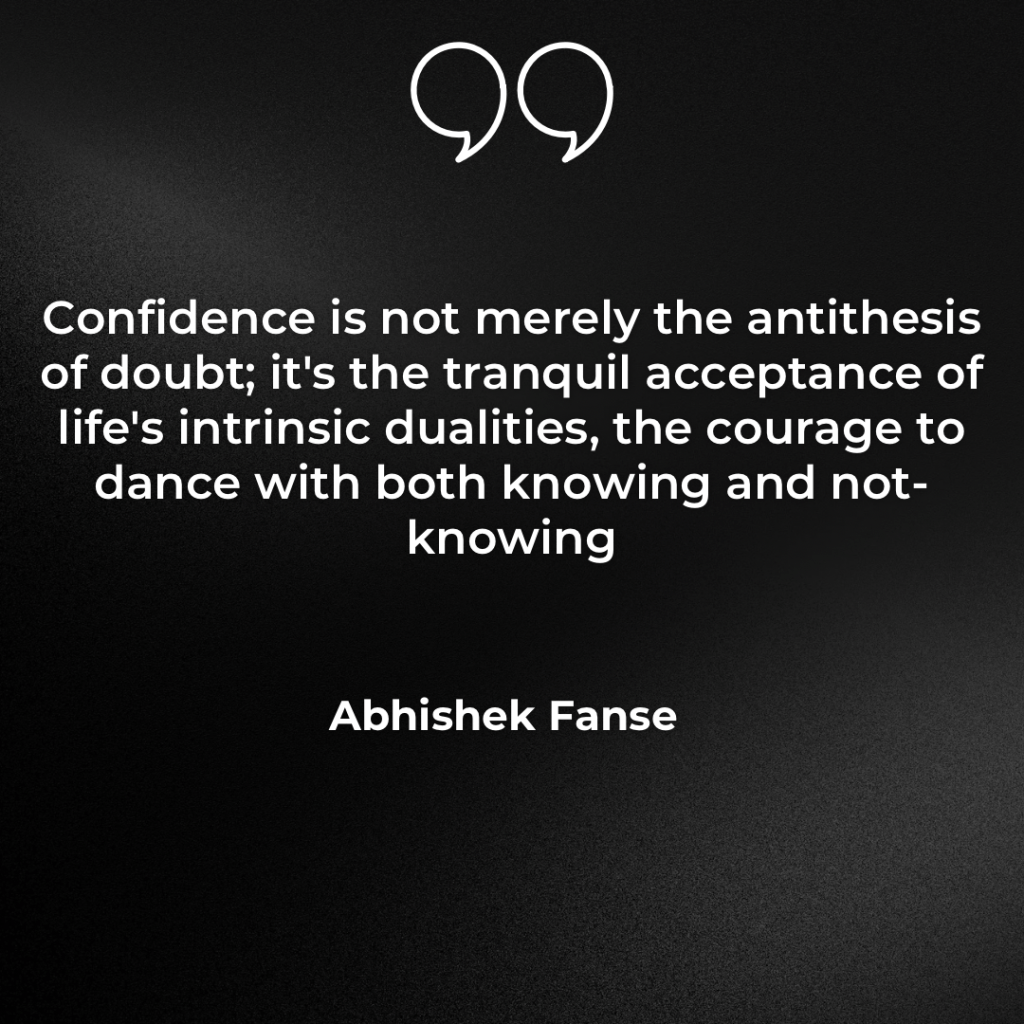
While it’s argued that confidence is unaffected by external situations, one can’t deny the impact of external validation on perceived self-worth. A student praised continuously may seem more confident than one who’s always criticized. But this brings forth another question: Is the confidence of the praised student genuine, or is it a facade built upon external validation? The underlying belief here is that true confidence remains unaffected by external factors. It is an internal compass, guiding one through life’s challenges. The student who seems less confident due to criticism might very well have an inherent belief in their abilities but chooses not to display it openly.
The intricate relationship between fear and confidence is captivating. While at first glance, they might seem opposing, a deeper introspection suggests they coexist harmoniously. As mentioned before, acknowledging fear can be an act of confidence in itself. Embracing one’s vulnerabilities, doubts, and fears can be seen as the highest form of confidence because it stems from self-awareness.
If we view confidence as neither a trait one can gain nor lose but as a constant presence, it reshapes our understanding. In this perspective, every act, regardless of its nature, is executed with full confidence. A person displaying apprehension is confidently apprehensive. A person in doubt is confidently doubtful. Modern society often categorizes confidence in degrees – more or less, high or low. This categorization restricts our understanding. When we say someone is “more confident,” we’re comparing their current state to a previous one or juxtaposing them against someone else. However, by acknowledging that every act is executed with complete alignment to a particular emotion or state of being, the need for comparison dissipates.
Confidence, in its true essence, is not about loud declarations or silent sufferings. It’s about recognizing and accepting the inherent completeness in every emotion, decision, and action. It’s about understanding that every response to a situation, be it with enthusiasm, fear, doubt, or joy, is done with utmost confidence in that response. If confidence is inherent, it would imply that any action performed in a state of fear, joy, or doubt is done with a level of assurance. In a crisis, for example, a hesitant decision to call for help is executed with as much confidence as a swift decision to solve the problem. This inherent nature of confidence, therefore, suggests that the concept is not binary but rather a spectrum, or perhaps beyond a spectrum—a state of consistent existence.
When we look at external circumstances affecting confidence, it becomes apparent that this so-called “influence” is transient. If confidence is genuinely inherent, then external factors may create an illusion of change but cannot alter its core. That said, constant external validation can create a clouded perception of self-worth, often mistaken for genuine self-confidence. The distinction between inherent confidence and externally-induced confidence is crucial for holistic understanding. If confidence is a constant presence, the degrees of “more” or “less” cease to have real meaning. It suggests that everyone, at any point in time, is fully committed to their actions or reactions, be it hesitancy or decisiveness. In such a framework, everyone is performing at their own level of 100% confidence tailored to the specific situation or emotion they are dealing with. Therefore, to say that one is ‘lacking’ in confidence is to misunderstand its inherent nature.

If every act is performed in complete alignment with the emotion or thought process governing it, it removes the need for comparison or valuation, which are tools the ego uses to identify itself. The notion of someone being “more confident” than someone else arises from a place of duality, from distinguishing the self from the ‘other.’ When one’s existence is in complete harmony with the intrinsic nature of confidence, these comparisons become irrelevant.

 Abhishek Fanse
I appreciate deeply your words and thoughts. Your descriptive language is refreshing and rings True as I read it. Thank you for your voice and sharing.
LikeLiked by 1 person
Thank you very much for the appreciation and taking out time to read the article James!! ☺️🙏🏻
LikeLiked by 1 person