Choice “Paralysis“
A choice implies that there is an alternative, and with every alternative comes the weight of consequences, perceived or real.
You speak of a ‘neutral’ stand, but let’s investigate what that really means. In reality, the idea of a neutral stance is a contradiction in terms. The very act of choosing neutrality is in itself a choice, made in opposition to other possible choices. So, the notion of being ‘neutral’ is inherently paradoxical because it cannot exist without the conditions that make it a choice to begin with.
For example, When you agree to a certain dosage of medication, you exercise control by making an informed decision. However, you also surrender control to the effects of that dosage, which may not be entirely predictable. This brings emotional complexity into play: the comfort of taking action (choosing the dosage) juxtaposed against the uncertainty of outcome. When we agree to disagree, we are on the contrary acknowledging that a middle ground is unreachable, yet we’re finding a sort of middle ground in that very acknowledgment. The challenge lies in our psychological need for validation and agreement, which often feels at odds with the more rational understanding that it’s perfectly okay for different viewpoints to coexist. We often fail to agree to disagree because our conditionings, our egos, don’t allow us to let go without a ‘win’ or a ‘loss.’
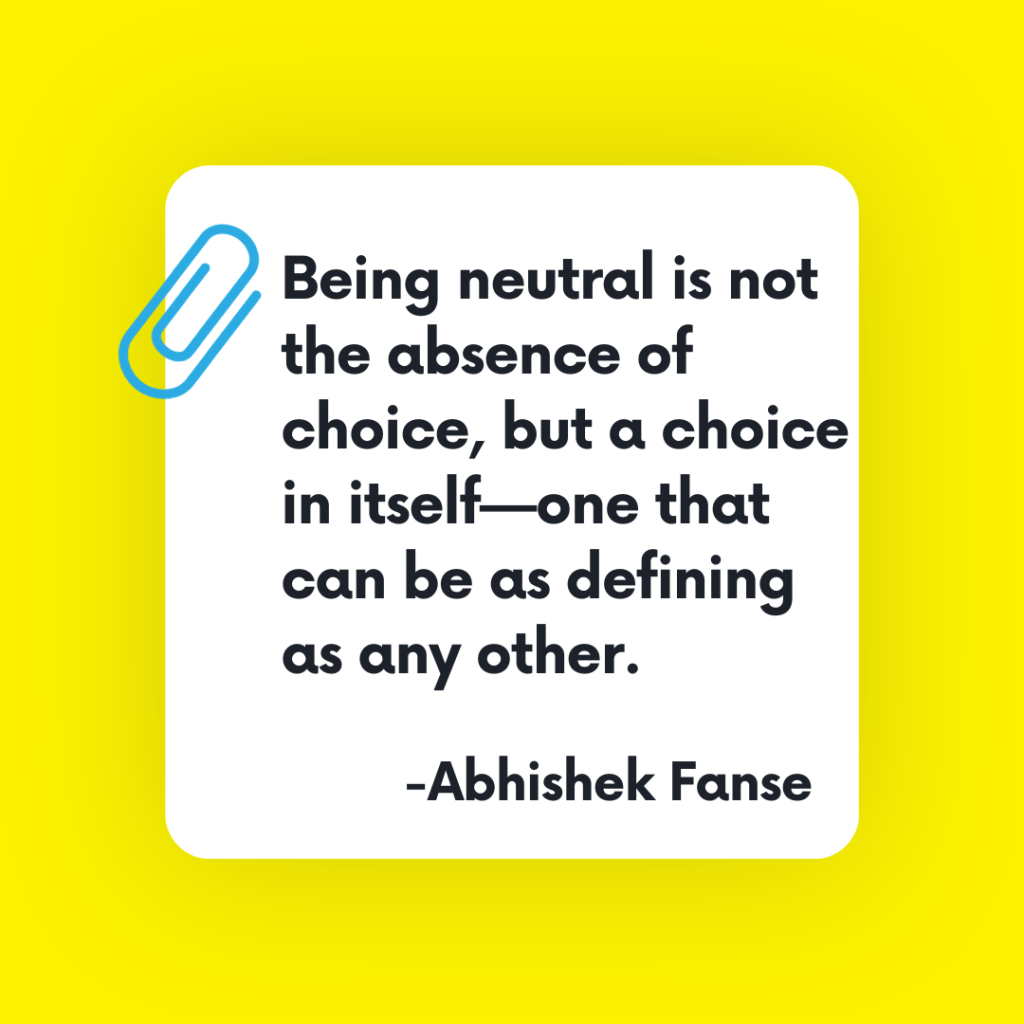
Every choice, by definition, is a rejection of its alternative. Therefore, choices are always relative, biased, and limited by the options that exist. In that sense, a choice cannot be independent because it is defined by the conditions that make it a choice. The idea of a ‘choice’ presupposes the existence of an alternative, of a comparison. In a context where there is only one thing that exists independently, the notion of ‘choice’ would be meaningless because there would be nothing to choose from. Therefore, it wouldn’t be a choice; it would simply be a state of being. The paradox exists because we try to define and understand choice within the limited framework of language and duality. However, once you recognize that the very nature of choice is paradoxical and conditional, and you embrace that paradox rather than trying to resolve it, you arrive at a sort of meta-clarity. This does not mean you’ve resolved the paradox; it simply means you’ve stepped outside of it. You’ve transcended the limitations that come with the dualistic thinking of ‘this or that,’ ‘yes or no,’ ‘neutral or biased.’
Choices are never made in emotional vacuums. They are laden with expectations, fears, and desires that stem from our past experiences, conditionings, and inherent personality traits. Even the seemingly most “logical” choice is often deeply influenced by emotions we may not even be fully aware of. The emotional charge of expectations is often the heaviest. When we make a choice, it is often governed by what we expect the outcome will bring us—pleasure, validation, success, or the avoidance of pain and conflict. The emotion here is one of anticipation, coupled with anxiety about whether our expectations will be met.
Then there’s desire, an emotion that often masquerades as need. The choices we make based on desire are emotionally charged with hopes for fulfillment, achievement, or recognition. But desire is a double-edged sword: while it motivates us, it also sets us up for disappointment if things don’t go as planned.
Even when we think we are making a “neutral” choice, what we are often trying to do is distance ourselves emotionally from the implications of the decision. We might say it’s “purely logical,” but the underlying emotion is often one of self-preservation—we wish to remain unscathed by the emotional weight that comes with making a more obviously partial choice.

One reason choices are emotionally charged is that they give us the illusion of control. Making a decision allows us to feel like we have some say over our fate. However, this control is always somewhat illusory. Life’s unpredictability ensures that our choices, no matter how well-considered, often have unexpected outcomes. The realization that our control is limited can bring up a host of emotions like helplessness or existential dread. Every choice we make, big or small, adds a brick to the edifice of our self-identity. We look for validation through our choices; when they lead to desired outcomes, it reinforces our sense of self-worth. When they don’t, it challenges our self-image and can lead to emotions like self-doubt, shame, or regret.
Our choices also affect how we are viewed by others, adding another layer of emotional complexity. Sometimes we make choices that conform to societal norms or expectations to avoid judgment or gain approval. The emotions at play here are often related to a fear of rejection or a need for social cohesion. At other times, we may make choices that go against the grain, driven by a desire for individuality or authenticity. This can lead to a complicated cocktail of pride, liberation, but also potential loneliness.
When it comes to seemingly paradoxical choices—like choosing wisdom over a loved one or maintaining a “neutral” stance—the emotional texture becomes even more intricate. For instance, choosing wisdom over a loved one might be a defense mechanism to protect oneself from future emotional pain, yet it can also lead to immediate emotional pain due to the distancing from the loved one. Here, both foresight and dread, love and rationality, are locked in an emotional tussle.
In cases where we choose to be “neutral,” what we are really doing is choosing not to engage emotionally in a way that makes us vulnerable. We might convince ourselves that we’re staying above the fray, but deep down, the need to protect ourselves emotionally is dictating that ‘neutral’ choice. The emotion behind neutrality is often a fear of emotional engagement, wrapped up in a protective layer of rationality. Ultimately, emotional maturity plays a large role in how we navigate the sea of choices and their associated feelings. Being aware of our emotional drivers allows us to make more ‘informed’ choices, even if that information is coming from within ourselves. This kind of self-awareness can temper the more reactive emotions like fear and desire and allow room for more nuanced feelings like contentment, acceptance, and genuine love to inform our decisions.
Choice is often seen as liberating, an act of free will that puts us in the driver’s seat of our destiny. However, with every choice we make, we also close off other possibilities, limiting ourselves in certain ways. The emotional paradox here is the simultaneous existence of freedom and constraint within the same action. We may feel exuberant for choosing a particular path, but there can be a latent sadness or anxiety about the paths left unexplored.
While choices often feel monumental in the moment, their impact can wane over time, sometimes even reversing in significance. What seemed like a terrible choice in the past may later appear wise, or vice versa. This fluidity can generate complex emotions, such as regret for past choices or anxiety about the unpredictability of future choices and their unforeseeable emotional implications.
Ultimately, where every action presents us with a choice and counter choices, we sometimes find ourselves paralyzed, suspended in a moment of indecision. Yet, this paralysis isn’t a dead end; it’s a pause, a sacred space that invites us to reflect, to feel, and to become keenly aware of our humanity.
What if we reframe this so-called “choice paralysis” not as a dilemma but as a moment of pause in the great narrative of our lives? It becomes not a prison, but a platform; not a quagmire, but a quest. In this paused state, we are philosophers, artists, and explorers of the inner cosmos. We grapple not just with options but with identities, not merely with pros and cons but with hopes and fears, love and loss.
In this pause, we are not frozen; we are fervently alive. We are composing in our minds the symphony of our future, writing the next act of our life’s drama, sculpting the clay of our becoming.
And when the pause lifts—as it always does—we make a choice, yes, but we also do something more profound: we embrace our capacity to choose, even when the choices are hard, even when the path is foggy. For it’s in the wrestling with choices that we come to know who we truly are.
So, the next time you find yourself in the clutches of choice paralysis, remember: you are standing at the confluence of many rivers, each leading to a different ocean but all part of the same Earth. And it’s okay to stand there for a while, to feel the currents, to listen to their distinct murmurs, before stepping into the stream that will carry you to your next adventure.
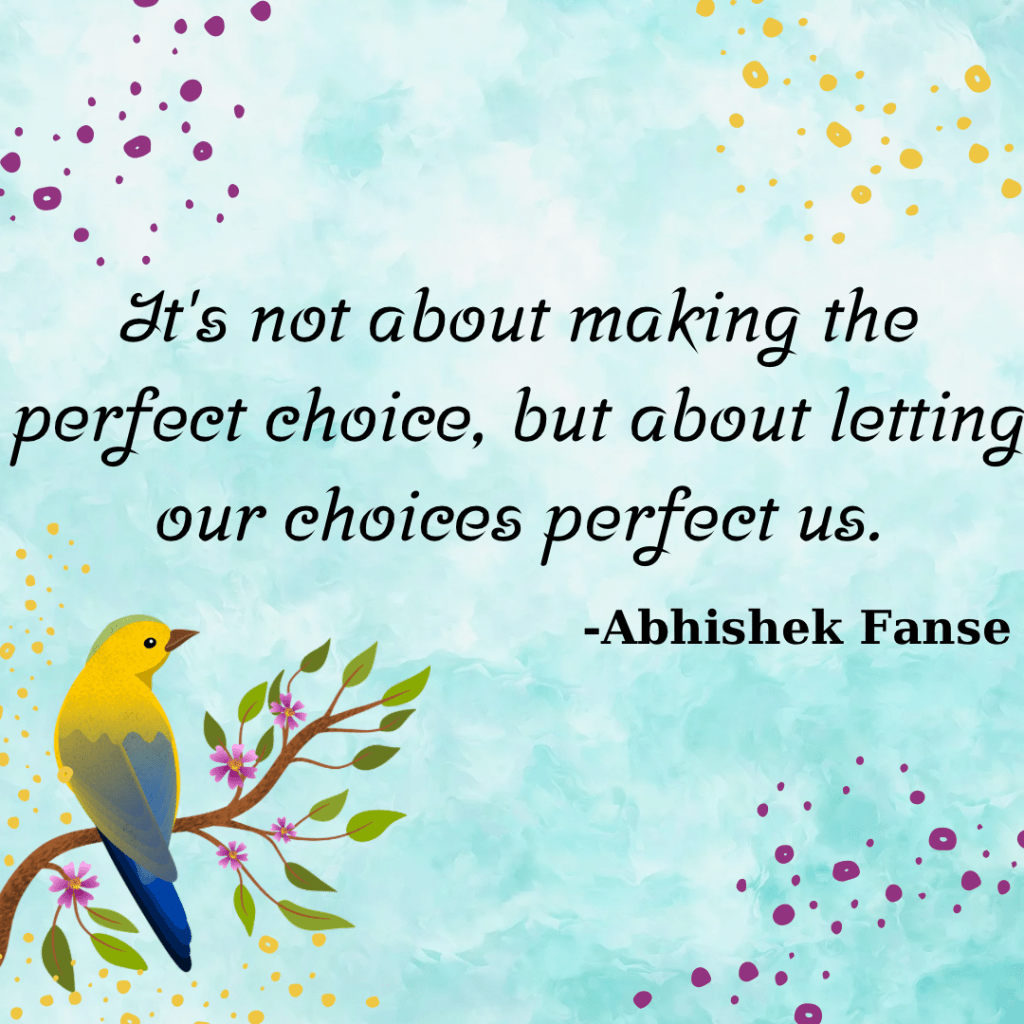
And so, we are forever navigating, forever choosing. Not in search of resolution, but in pursuit of growth. In the end, it’s not about making the perfect choice, but about making our choices perfect us.

 Abhishek Fanse
👍💐
LikeLiked by 1 person
Thank you for reading! 🙏🏻
LikeLiked by 1 person
Rather difficult to understand…..
But this thinking is ‘hatke’…
Keep it up Mr. Abhishek..
LikeLiked by 1 person
Thank you very much for reading it though sir! 🙏🏻
LikeLiked by 1 person
Agree, being neutral is not ‘choice paralysis’. Neutrality is also a proactive choice.
It’s important to note that being neutral does not necessarily mean being indifferent or passive. Neutrality is a conscious choice to remain uninvolved in the conflict’s substantive issues while still actively promoting peaceful resolution, fairness, and understanding. In some cases, neutrality can be a valuable stance, especially when attempting to mediate or facilitate a resolution between conflicting parties.
You have here a well written post. Loved reading it.
LikeLiked by 1 person
I’m glad you enjoyed reading the article!
It’s particularly heartening to hear that you recognize the complexity of choices, including the choice to remain neutral. Thank you for adding such depth to this conversation.
🙏🏻🙏🏻
Regards
Abhishek
LikeLiked by 1 person
Lovely pieces and Insightful….. very truthful a thing taken for granted these days
LikeLiked by 1 person
Thank you very much! 🙏🏻
LikeLike
Beautiful post actually all the time we can’t choose the right but we should be aware to choose perfect.👌
LikeLiked by 1 person
Thank you very much Priti for adding a perspective! 🙏🏻
Regards
Abhishek
LikeLiked by 1 person
☺️please read my book if possible, ” The Touch Of Breeze” by Pritilata Nandi🙏
LikeLike
A nicely articulated piece, Abhishek. I agree that desire is a double-edged sword, and coming to choices we make, neutrality is one. Sometimes sitting on the fence gives better choice to make later. Doing or speaking nothing is also a choice. And choices vary from person to person in the same circumstances. As such, in certain cases, agree to disagree is the best choice. I love the thought process that you put in for writing such a thought provoking piece. Thanks and regards 🙏💐
LikeLiked by 1 person
Thank you very much!! ☺️☺️
LikeLiked by 1 person
Beautiful 😍
LikeLiked by 1 person
Thank you 🙏🏻
LikeLiked by 1 person
You welcome 🤗
LikeLiked by 1 person