Mystique of Manifestation: Sculpting Reality
To understand manifestation, we must journey back to ancient philosophies and spiritual teachings. In Eastern philosophies, particularly within Hinduism and Buddhism, the concept of ‘Sankalpa’ or intention is paramount. It suggests that focused intention with a clear vision and a pure heart, has the power to shape one’s reality. This aligns closely with the Buddhist teaching of ‘Pratītyasamutpāda’ or dependent origination, which posits that all phenomena arise in interdependence and not in isolation. In Western thought, traces of manifestation can be found in the works of philosophers like Aristotle, who emphasized the power of potentiality and actuality – the transformation of what ‘could be’ into what ‘is’. This idea was further nuanced in the Hermetic traditions, particularly in the principle of ‘As above, so below’, suggesting a mirror-like relationship between the macrocosm (the universe) and the microcosm (the individual). In psychology, manifestation finds resonance with the theory of self-fulfilling prophecy and the placebo effect. The former, proposed by sociologist Robert K. Merton, argues that believing in a certain outcome can indeed cause it to occur, primarily through the lens of expectation influencing behavior. The placebo effect, a well-documented phenomenon in medical science, further illustrates how belief can result in tangible changes in the physical body.

Is manifestation empirical or imaginary? The answer is nuanced. While certain aspects, like the placebo effect, have empirical evidence, other elements tread into the subjective and personal realms of belief and faith, which evade empirical scrutiny.
When individuals set an intention, their subconscious mind begins aligning thoughts and actions towards the desired outcome. This alignment can often result in heightened awareness of opportunities and a greater propensity to take actions that lead towards the goal. Manifestation often emphasizes the importance of ‘feeling’ the reality of the desired outcome. This emotional resonance might act as a catalyst for more profound engagement with one’s goals, thereby increasing the likelihood of their realization. Manifestation is not a magic wand. The constraints of physical reality, combined with personal limitations (skills, resources, timing), play a significant role. Moreover, a misunderstanding of manifestation as merely ‘wishing’ without corresponding action leads to its ineffectiveness. The universe is not entirely predictable. Random events and external factors beyond one’s control can influence outcomes, irrespective of one’s intentions or actions.
Manifestation often works more effectively at the level of basic needs because these needs are more deeply connected to our survival instincts and thus, may be more intensely focused upon. Desires, especially those that are more whimsical or less aligned with our core values and needs, might not hold the same power in our psyche, leading to lesser focus and energy directed towards them.
Psychologically, when we set an intention to manifest something, it often creates a state of cognitive dissonance – a psychological tension between our current reality and our desired state. Leon Festinger’s theory suggests that we are intrinsically motivated to reduce this dissonance. This motivation can lead to a change in attitude or behavior, aligning more closely with the desired outcome. When we are focused on manifesting a particular outcome, we tend to notice and give importance to events and information that support our beliefs or desires. This selective attention can sometimes make the process of manifestation seem more effective than it might objectively be. A common misconception is that manifestation is solely about attracting what you desire through thought. This overlooks the necessity of action and the multifaceted nature of human experiences where external factors and chance also play significant roles. While the idea of manifesting one’s destiny is empowering, it can oversimplify the complexities of life’s challenges. Issues like systemic inequality, health problems, and other factors often cannot be resolved merely through positive thinking or intention setting.
The subconscious mind is a powerful aspect of our psyche, operating below the level of conscious awareness. It plays a critical role in manifestation. Our deep-seated beliefs, often formed in childhood and shaped by our experiences, reside here. These beliefs can either propel us towards our goals or hold us back. The process of manifestation often involves reprogramming the subconscious to align with our conscious desires. Visualization, a key technique in manifestation practices, leverages the brain’s neuroplasticity. By repeatedly visualizing a desired outcome, we can potentially rewire our brain to be more attuned to opportunities and actions that can make the visualization a reality. This practice can create mental and emotional readiness, aligning our internal state with our external actions. The power of manifestation comes with responsibility. It raises questions about ethics and intentions. For instance, manifesting at the expense of others or for purely selfish gains goes against many spiritual teachings’ emphasis on compassion and interconnectedness.
Carl Jung’s concept of the Shadow Self is pivotal in understanding manifestation. The Shadow encompasses the parts of ourselves we reject or ignore. When these aspects are unacknowledged, they can sabotage our manifesting efforts. For instance, if someone desires success but subconsciously harbors a fear of failure or unworthiness, these shadow elements can hinder manifestation. The nature of desire itself is complex. Desires are not always straightforward or conscious. They can be influenced by societal expectations, past traumas, or unmet childhood needs. Understanding and untangling these desires is crucial in manifestation, as conflicting or unconscious desires can lead to mixed results or unfulfilled outcomes.
Many spiritual traditions, such as Buddhism, advocate for non-attachment to outcomes. This presents a paradox in manifestation: How does one intensely desire and visualize an outcome while simultaneously practicing detachment from it? Balancing intense desire with a state of inner peace and acceptance is a nuanced aspect of manifestation. At the heart of this complexity is the human psyche itself, an intricate and layered entity. The conscious mind, where intentions and desires are actively formed, is just the tip of the iceberg. Beneath this lies the vast expanse of the subconscious, a realm filled with deeply ingrained beliefs, past experiences, and emotional patterns. Often, these subconscious elements are not in complete harmony with our conscious desires. This discord can subtly undermine our efforts at manifestation, creating an internal resistance that might not be immediately apparent. This inner landscape is often a repository of contradictory desires, fears, and conditioning from past experiences. For instance, a person might consciously desire success but subconsciously fear it due to past experiences of failure or a deep-seated belief that they are unworthy of success. These subconscious elements create a complex inner dialogue, often leading to a manifestation process that is less straightforward and more convoluted than initially assumed.
A central paradox in the art of manifestation is the balance between control and surrender. On one hand, manifestation requires a clear vision and proactive effort towards achieving our goals. On the other hand, there is a need for surrender – an acceptance of the unknown and an acknowledgment that not everything is within our control.
This balance is not a static state but a dynamic equilibrium, constantly shifting as we navigate through life. It involves recognizing our co-creative role in the universe while also understanding that the universe has its own wisdom and timing. In many spiritual traditions, this surrender is not seen as a weakness but as a strength – a deep trust in the larger cosmic order.

Manifestation is also intimately tied to the concepts of timing and synchronicity. The universe operates on its own rhythms and cycles, which do not always align with our personal timelines. Sometimes, what we wish for does not manifest not because the intention is flawed, but because the timing is not right. Synchronicity, a term coined by Carl Jung, refers to meaningful coincidences that seem to defy conventional explanations. In the context of manifestation, synchronicity can be seen as the universe’s way of aligning our intentions with the right opportunities and connections. These synchronicities are often markers that we are in harmony with the larger flow of life, guiding us towards our goals in ways that our rational minds may not immediately comprehend.
If we’re not tired of reading, let’s delve deeper into it to understand the finer nuances of “Manifesting in the Now”!
When we manifest in the now, our focus is not on a future goal but on the quality and richness of our present experience. This form of manifestation is about aligning with the current moment, fully engaging with it, and allowing it to unfold naturally. It’s a state of being deeply rooted in the present, where every action and thought is an expression of our intention to be fully alive and aware in the here and now. In this state, the power of manifestation is not directed toward changing or obtaining something in the future, but in transforming the present moment. It’s about bringing a quality of awareness, gratitude, and intentionality to whatever we are experiencing. This approach often involves a heightened sense of awareness and mindfulness, where each action and thought is infused with a conscious presence.
Manifesting in the now aligns closely with the concept of non-attachment found in various spiritual traditions. Non-attachment doesn’t mean not caring about outcomes; rather, it’s about not being controlled by the desire for specific outcomes. This approach allows for a more fluid interaction with life, where one is open to the myriad possibilities that each moment presents, free from the constraints of rigid expectations. The ‘now’ is often viewed as the only true reality. Past and future are seen as constructs of the mind, illusions that distract from the full experience of life. In this context, manifesting in the now becomes a practice of deep spiritual significance. It’s about aligning with the eternal present, where all of life’s potentialities exist in a state of pure possibility.
Here Time is realised as an illusion, a linear construct that confines the boundless nature of consciousness. By focusing on manifesting in the now, one steps out of the confines of chronological time and into a more fluid, timeless state of being. This state is often described as experiencing the eternal ‘now’, where every moment holds infinite potential and is complete in itself. The concept of desire is paradoxical. While desires are seen as natural, there’s an emphasis on non-attachment to them. Manifesting in the now, therefore, involves a balance between honoring one’s desires and simultaneously releasing attachment to their outcomes. It’s about fully engaging with life as it is, without being ensnared by the relentless pursuit of specific goals.
Intention is more than just a goal or a desire. It’s a powerful force that shapes the energy and direction of our lives. By focusing on the present, intentions are set not for future outcomes but for the quality and experience of the present moment. Manifesting in the now is seen as a tool for the transformation of consciousness. It shifts the focus from external achievements to internal growth and understanding, fostering a deeper connection with the self and the universe. This practice aligns with the belief that the universe operates in a state of perfect harmony and balance. By focusing on the now, one aligns with this cosmic rhythm, experiencing life as a seamless flow rather than a series of disjointed events.
Let’s touch little bit on the illusion of separation as well – the false belief that we are distinct and isolated from the rest of existence. This illusion is perpetuated by our adherence to linear time. In the practice of manifesting in the now, this illusion begins to fade. The present moment is understood not as a fleeting point between past and future, but as the eternal ‘now’ – a timeless space where all of existence converges.
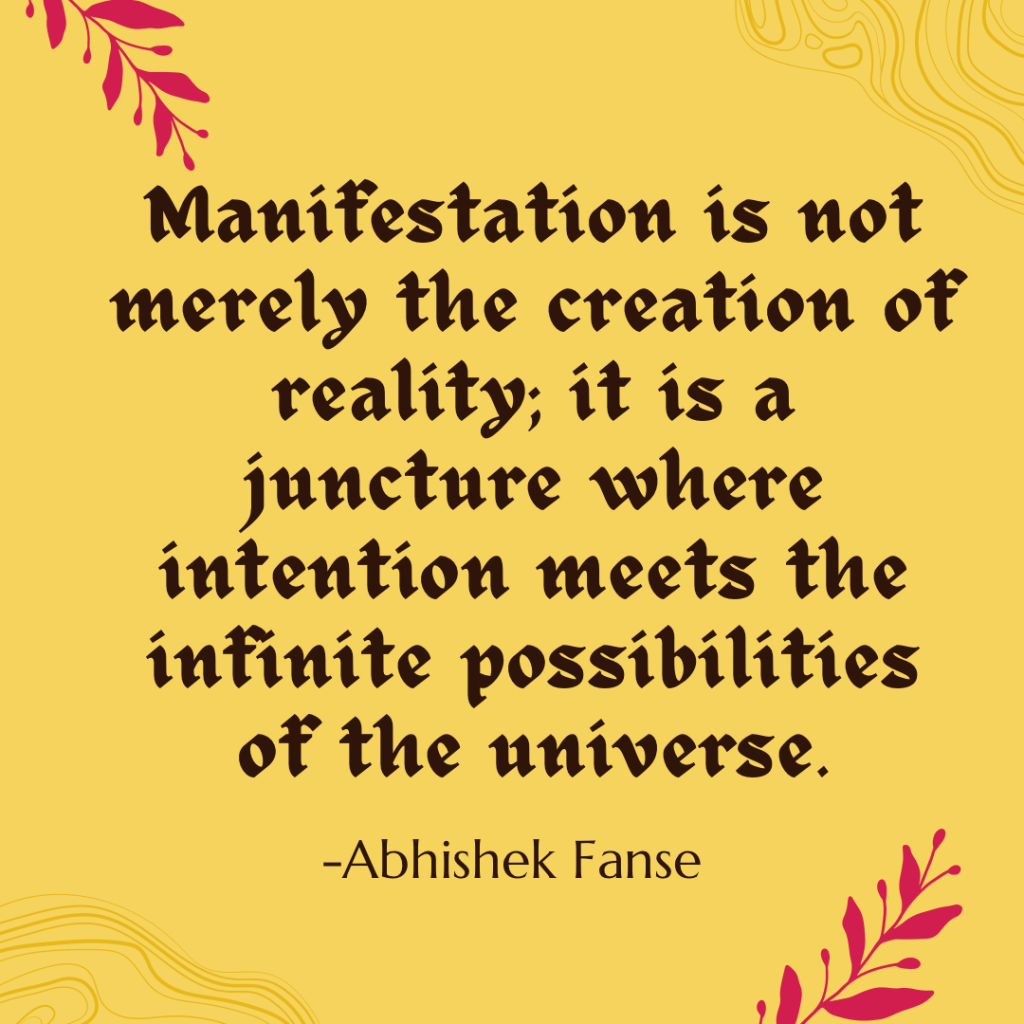
Consciousness is not static but fluid and ever-changing. It’s like a river flowing through the landscape of reality, constantly reshaped by its interactions with the external world and internal states. Manifesting in the now becomes an act of navigating this fluidity, understanding the transient nature of thoughts and emotions, and aligning with the deeper currents of consciousness.
The deepest aspect of manifesting in the now is self-realization – the understanding of one’s true nature beyond the ego and individual identity. In this state, manifestation is not about bringing desires into reality but realizing that one’s essential nature is already whole and complete. In this space, manifestation is experienced as an alignment with the cosmic dance of creation, where the distinction between the manifestor and the manifested blurs with the ultimate realisation “Manifestor is manifested”.

 Abhishek Fanse
Your article is profound 🙏🏻🙏🏻. It is a meta analysis of manifestation. Thanks for sharing a wonderful piece of writing.
LikeLiked by 2 people
Thank you very much Dr. for reading it!! 🙏🏻🙏🏻😊🥰
LikeLiked by 1 person
Always my pleasure to read your articles 💖
LikeLiked by 1 person
This is quite knowledgeable and well researched and understood. A valuable piece! 💛
LikeLiked by 2 people
Thank you very much!! 🥰🥰☺️
LikeLiked by 1 person
I didn’t realize that the comment got posted. It was showing some error when I was trying to comment on a couole of posts of yours. Good that it did.
The topics that you have chosen to write are quite unique and you have penned very well.
LikeLiked by 1 person
Thanks a ton for reading it!! ⭐️
Regards
Abhishek
LikeLiked by 1 person
Really interesting post.
LikeLiked by 1 person
Thank you very much Pooja! 😊🙏🏻💫
LikeLiked by 1 person
My pleasure! 😊
LikeLiked by 1 person
As always, it’s also a well researched article that talks of placebo effect, basic needs, shadow self etc to explain a unique topic of manifestation. Finally you have also talked of self realisation. It reminds me of Maslow theory that says that self actualisation is the ultimate. Thank you, Abhishek for this beautiful piece interspersed with your lovely quotes!
LikeLiked by 2 people
Thank you very much KK for adding perspective from Maslow’s theory!! ☺️☺️⭐️
LikeLike
Amen🙏❤ Great Post
LikeLiked by 1 person
Thank you very much! ☺️🥰💫
LikeLike
There’s so much yin vs. yang so to speak in your perspective of manifestation. I see it then as a matter of balance between the two.
LikeLiked by 3 people
😊
LikeLike
love the idea of “sculpting reality” ! Linda x
LikeLiked by 2 people
Thank you for the read!
LikeLiked by 1 person
Super welcome – thank you for the write! 🥰
LikeLiked by 1 person